.webp)

Is Your Bryant AC Covered? How to Verify Before Calling for Repair
Is your system blowing warm air, leaving you wondering about decoding your Bryant Air Conditioner warranty before booking a repair? When a sudden cooling failure strikes in the middle of our peak July heat, the first question our technicians at Countryside Heating and Cooling Solutions hear from Maple Plain homeowners is whether the breakdown is covered by the manufacturer. It is a common misconception that having a unit "under warranty" means you will face absolutely zero out-of-pocket expenses when our team arrives at your door. The reality of HVAC warranties is far more nuanced, dividing the responsibility between the manufacturer's hardware and the local dealer's labor.
Understanding exactly what coverage you have empowers you to make informed financial decisions when your equipment fails to keep up with the summer load. Verifying your status in advance removes the guesswork from the diagnostic visit. Once you know exactly where you stand with your Bryant Air Conditioner coverage, it is much easier to confidently schedule HVAC service to get your air conditioning systems back online and restoring your home's comfort.
Step 1: Locating the Serial and Model Numbers on Your Bryant Unit
Every official warranty lookup requires exact identification of your equipment. You cannot simply use the brand name or the year you bought the house to verify coverage. You need the specific alphanumeric codes assigned to your exact condenser at the factory.
Where to Find the Manufacturer's Data Plate
To find this information, you will need to walk outside to your exterior condenser unit. Follow these steps to locate the necessary details:
1. Locate the service panel: Look at the exterior cabinet of your outdoor AC unit. The data plate is usually located on the back or side of the unit, near where the refrigerant lines and electrical conduit enter the cabinet.
2. Identify the data sticker: Look for a silver, black, or white rectangular sticker with a barcode. This is the manufacturer's data plate, and it contains all the technical specifications for your specific unit.
3. Record the Model Number: This number usually begins with a letter (often "C" or "B" for condenser) and tells the technician the exact size, tonnage, and series of your equipment.
4. Record the Serial Number: This is a unique string of numbers and letters. The serial number acts as the unit's fingerprint, telling the manufacturer exactly when it came off the assembly line and when it was registered.
Why Both Numbers Are Essential
It is important to understand that this data plate format applies across various Bryant HVAC products, from entry-level air conditioners to variable-speed heat pumps. The model number dictates which replacement parts are compatible with your system, while the serial number is the key that unlocks your specific registration file in the manufacturer's database. If the sticker is faded from years of sun exposure, you can also check the original installation invoice or the owner's manual packet left by the installation team, which usually contains a duplicate sticker.
Step 2: Navigating the Bryant Warranty Lookup Process
Once you have your model and serial numbers written down, you can perform a quick online check to see the exact status of your coverage. This process is entirely public and takes only a few minutes to complete.
Using the Official Manufacturer Portal
Navigate to the official Bryant website and locate the warranty registration and lookup page. You will be prompted to enter the serial number and model number exactly as they appear on the data plate. Some portals may also ask for the original installation date or your zip code to help narrow down the search, though the serial number is the primary identifier.
Tips for accurate entry: Ensure you do not confuse the letter "O" with the number "0" or the letter "I" with the number "1." A single typo will result in an "unregistered" error message, causing unnecessary panic.
Interpreting Your Warranty Status Results
After submitting your information, the system will generate a status report. Here is what the typical results mean:
• Active (Registered): This means the unit was properly registered within the required timeframe after installation. You likely have the full 10-year parts coverage available.
• Active (Base): This indicates the unit is active, but it was never officially registered by the homeowner or the builder. In this case, the coverage defaults to the standard 5-year parts term.
• Expired: The equipment has aged past its coverage window, meaning all replacement parts and labor will be entirely out-of-pocket.
If your system shows as active, take a screenshot or print the confirmation page. Having this document ready for our technicians streamlines the administrative process and ensures the repair moves forward without delay.
Understanding the 10-Year vs. 5-Year Standard Parts Coverage
One of the most confusing aspects of HVAC coverage is the variable timeline. The length of your protection depends entirely on actions taken during the first few months after the equipment was installed.
The 90-Day Registration Window Explained
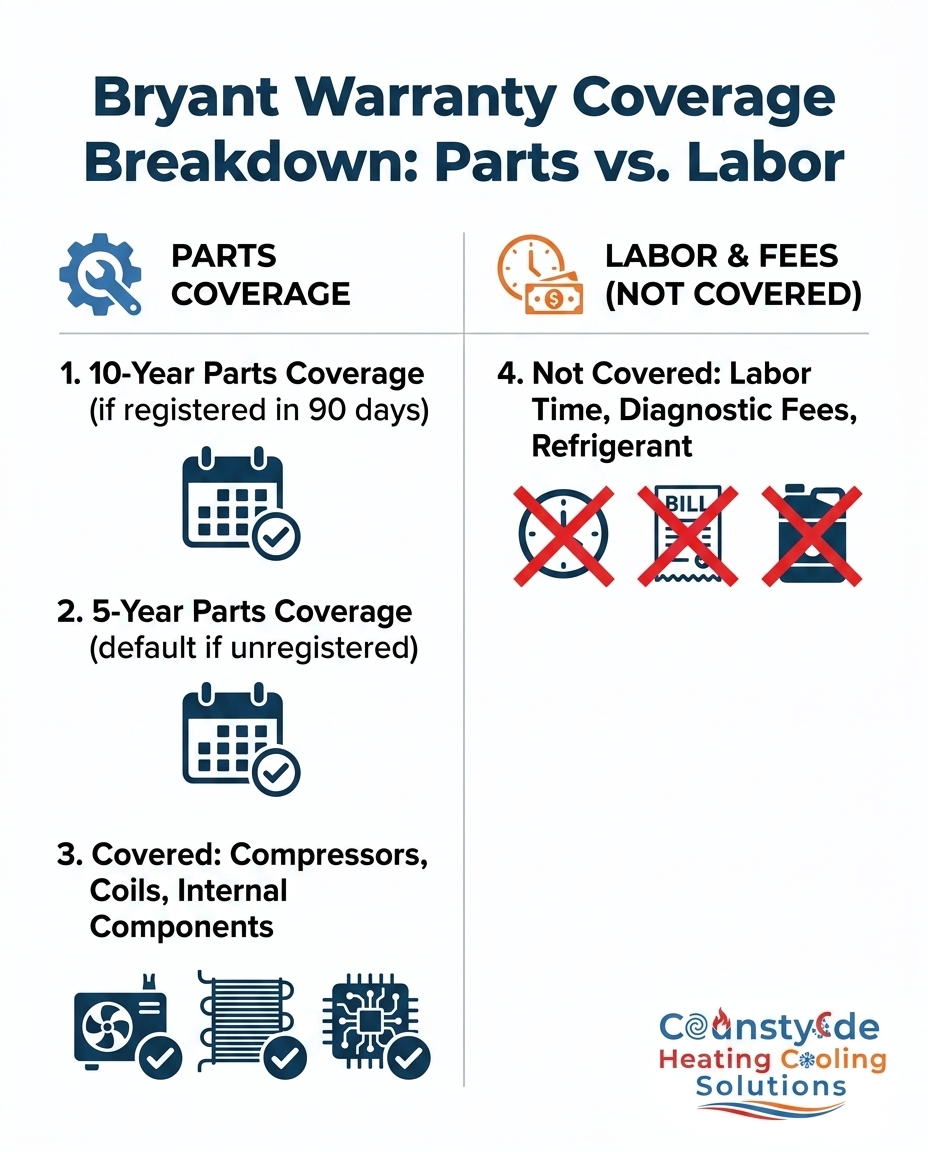
Standard registered warranties cover internal parts for 10 years. However, there is a critical rule that catches many homeowners off guard: the unit must be registered with the manufacturer within 90 days of the installation date. If this deadline is missed, the manufacturer automatically defaults the term to a 5-year base warranty. This policy applies strictly across the industry.
Many homeowners assume the installation company automatically registers the equipment for them. While premium dealers often handle this paperwork as a courtesy, the ultimate responsibility falls on the homeowner. If you are exploring HVAC frequently asked questions regarding your system's longevity, our team strongly recommends verifying this registration date as your first step.
Core Components Typically Covered
If your Bryant Air Conditioner is within its active term, the warranty protects you against factory defects and premature hardware failure. The major components covered under a standard parts warranty generally include:
• The Compressor: The heart of the air conditioner, responsible for pumping refrigerant. This is typically the most expensive part of the system.
• The Condenser Coil: The outdoor tubing where heat is released into the outside air.
• The Evaporator Coil: The indoor component (usually sitting above your furnace) that absorbs heat from your home's air.
• Internal Motors: Condenser fan motors and blower motors that circulate air and exhaust heat.
• Electrical Components: Capacitors, contactors, and internal control boards that manage the system's operation.
Understanding what is covered is only half the battle. The next step is understanding the expenses that the manufacturer explicitly excludes.
Parts vs. Labor: What You Will Pay Out-of-Pocket
In our years of restoring summer comfort across Maple Plain, the most persistent myth our team encounters is that a warranty repair is entirely free. In reality, manufacturer warranties are designed to replace defective hardware, not to cover the local service provider's time and expertise.
Defining the "Parts Warranty" Limit
During peak July heat and high humidity, AC units endure maximum strain. Fast warranty verification is essential to restore cooling capacity without delay when breakdowns happen in Maple Plain MN. When our technician arrives to diagnose a failed system, the manufacturer covers the cost of the physical replacement part, but the homeowner is responsible for everything else.
The Real Cost of Diagnostic Testing and Refrigerant
Standard manufacturer warranties explicitly exclude labor time, diagnostic fees, and consumable materials like refrigerant. While an expensive compressor might be provided by the factory at no cost, the hours required to safely recover the old refrigerant, remove the broken compressor, braze in the new one, vacuum the lines, and recharge the system are the homeowner's responsibility.
• Physical Replacement Parts (Compressor, Coils, Motors) — Covered by Standard Warranty?: Yes (if active) — Who Pays?: Manufacturer
• Diagnostic Service Fee — Covered by Standard Warranty?: No — Who Pays?: Homeowner
• Technician Labor Hours — Covered by Standard Warranty?: No — Who Pays?: Homeowner
• Refrigerant (Puron/R-410A) — Covered by Standard Warranty?: No — Who Pays?: Homeowner
• Shipping/Freight for Special Parts — Covered by Standard Warranty?: No (usually) — Who Pays?: Homeowner
Emphasizing this distinction is vital. During the hottest weeks of the summer, knowing these out-of-pocket costs upfront prevents stressful surprises when the final invoice is presented. You are paying for the specialized tools, the hazardous material handling, and the technical expertise required to install the free part correctly.
How Unauthorized Repairs Can Void Your Coverage
Your warranty is a legal agreement between you and the manufacturer, and it comes with strict conditions. Hiring uncertified technicians or attempting DIY repairs is the fastest way to instantly void an active Bryant warranty.
The Risks of Using Unverified Technicians
Manufacturers require that all diagnostics, maintenance, and repairs be performed by licensed professionals. If an uncertified handyman bypasses a safety switch, installs an off-brand aftermarket capacitor, or improperly charges the refrigerant lines, the manufacturer reserves the right to deny future claims. Manufacturer standards must be strictly followed during parts replacement to ensure the new component does not fail due to improper installation.
The Dealer's Role in Processing Your Claim
This is where your choice of contractor matters immensely. As a Bryant Factory Authorized Dealer and Circle of Champions Award Winner, our team at Countryside Heating and Cooling Solutions brings verified, elite expertise to navigating your warranty and ensuring repairs meet strict manufacturer standards.
Authorized dealers have direct access to the manufacturer's parts distribution network. We know exactly how to file the claim on the backend, process the defective part return, and secure the replacement hardware without forcing the homeowner to act as a middleman. Working with an authorized expert ensures the repair is documented correctly, protecting the remaining years of your coverage.
Recent Homebuyers: Checking for a Transferred Warranty
A pattern we see often occurs when a family purchases a home with an existing, relatively new HVAC system. Many buyers assume that because the air conditioner is only three years old, they are automatically protected by the original 10-year warranty.
The Time-Sensitive Transfer Process
Manufacturer warranties do not automatically transfer to new homeowners upon the sale of a house. The original warranty is tied to the original purchaser. To keep the 10-year coverage intact, the warranty must be formally transferred to the new homeowner's name. This process typically requires submitting specific transfer paperwork and a nominal processing fee within a strict timeframe—usually 90 days from the closing date of the home sale.
What Happens If You Miss the Window?
If the new homeowner fails to complete the transfer within the required window, the coverage automatically reverts to the base 5-year warranty, calculated from the original date of installation. If you recently moved in, your first step should be checking the data plate and verifying the previous owner's registration status. If you are within the window, reviewing resources on transferring a Bryant HVAC warranty can save you from substantial out-of-pocket parts expenses down the road.
Frequently Asked Questions About Bryant Warranty Repairs
How do I do a Bryant HVAC warranty lookup?
You can verify your coverage by locating the model and serial numbers on your outdoor unit's data plate and entering them into the official Bryant warranty portal to check active status. The portal will tell you immediately if your system is registered, operating under a base warranty, or completely expired. Having this information ready before you call a technician speeds up the repair process.
What is not covered by a Bryant AC warranty?
Standard coverage excludes labor costs, diagnostic fees, and consumable materials like refrigerant. It also excludes damage resulting from a lack of annual maintenance, improper installation, or external factors like power surges and storm damage. The warranty is strictly designed to cover manufacturer defects in the physical hardware.
Why do I have to pay for labor if my AC parts are under warranty?
Manufacturer warranties are designed to replace defective hardware, not to fund local service operations. The time, expertise, and specialized tools required by a local technician to safely diagnose the issue, remove the broken component, and install the new part are separate service costs. You are paying for the professional execution of the repair.
Does a Bryant warranty cover refrigerant?
No, refrigerant (such as Puron or R-410A) is considered a consumable material and is never covered by standard manufacturer warranties. If a covered evaporator coil springs a leak, the factory will provide the replacement coil at no cost, but the new refrigerant required to refill the system is an out-of-pocket expense for the homeowner.
What voids a Bryant air conditioner warranty?
Failing to register the unit within 90 days can reduce your term from 10 to 5 years, while using unauthorized aftermarket parts, failing to perform annual maintenance, or hiring uncertified technicians can completely void coverage. Manufacturers require proof that the system was maintained by licensed professionals according to factory specifications.
Restore Your Cooling Safely With an Authorized Expert
Knowing your exact warranty status removes the anxiety and guesswork from AC repairs. By taking a few minutes to locate your serial number and verify your coverage, you can approach the diagnostic process with clear financial expectations. Remember that choosing an authorized dealer protects your remaining coverage and ensures the repair is done to factory standards. If your system is struggling through the Maple Plain MN heat, do not wait for a total breakdown. Verify your status today and schedule your diagnostic visit with our team to get your system back online, ensuring your home remains cool, comfortable, and fully protected.
