.webp)

The Myth of the Quick Fix for Aging Air Conditioners
Swapping a single broken part on an aging cooling unit doesn't guarantee another decade of reliable comfort. In our years of restoring comfort across Maple Plain, our team at Countryside Heating & Cooling Solutions has found that weighing Freon leaks vs. bad compressors: deciding when an older AC is worth fixing requires looking at the big picture. A common myth among homeowners we talk to is that patching a leak or replacing a major component will instantly restore an older system to its original factory condition. In reality, when you are facing a catastrophic breakdown during July peak summer heat, a quick fix is often just a temporary band-aid on a much larger problem.
If you need immediate help evaluating your air conditioning systems, the most reliable next step is to schedule AC repair or replacement with a certified professional. Making the right choice between a major repair and a full system replacement requires an objective, value-based framework rather than just looking at the immediate quote. By stepping back and evaluating the overall health of your equipment with our experienced technicians, you can make a pressure-free decision that ensures long-term comfort and peace of mind for your home.
Diagnosing the Damage: Freon Leaks vs. Compressor Failure
When a 10+ year old R-410a system suddenly stops cooling your home, the culprit our technicians most frequently uncover is one of two major catastrophic failures: a significant loss of refrigerant or a dying compressor. Understanding the technical differences between these two issues is the first step in determining your best path forward.
Recognizing a Refrigerant Leak
Air conditioning systems do not "consume" refrigerant like a car consumes gas. The refrigerant runs in a closed loop, meaning that if your system is low, there is a physical hole or compromised seal somewhere in the lines. Symptoms of a significant refrigerant loss we regularly see include:
• Ice buildup on the evaporator coils: Low refrigerant causes the coil temperature to drop below freezing, turning ambient humidity into a block of ice.
• Blowing warm air: Without enough refrigerant to absorb heat from inside your home, the vents will push out lukewarm or room-temperature air.
• Excessively long cooling cycles: The system will run continuously as it struggles to reach the temperature set on your thermostat.
Spotting a Failing Compressor
The compressor is the heart of your cooling system, responsible for pumping the refrigerant through the lines. When it begins to fail, the signs are usually loud and disruptive. You might notice hard starting, where the unit struggles, stutters, or dims the house lights when kicking on. Loud grinding, screeching, or clanking noises are also common, along with a system that repeatedly trips your electrical breaker.
The Impact of the Minnesota Climate
Regional weather patterns play a massive role in system wear and tear. In our experience maintaining local HVAC units, long, freezing Minnesota winters cause AC systems to sit completely dormant for six months or more. During this extended downtime, the rubber seals and gaskets inside your unit can dry out, shrink, and become brittle. When the system is finally fired up for the summer, these compromised seals are suddenly pressurized, drastically increasing the risk of refrigerant leaks. Because diagnosing the exact location of a leak or testing the electrical draw of a compressor requires specialized gauges and high-voltage expertise, accurate diagnosis always requires professional tools and licensing.
The R-410a Phase-Out: What It Means for Older Systems
Even if our technicians can locate the leak or source a replacement compressor, the type of refrigerant your system uses plays a massive role in its long-term viability. For anyone operating a 10+ year old R-410a system, we always warn our customers that the regulatory landscape has fundamentally shifted.
Understanding the EPA AIM Act
The Environmental Protection Agency's American Innovation and Manufacturing (AIM) Act mandates a staggering 85% phase-down in the production and consumption of hydrofluorocarbons (HFCs), which includes the industry-standard R-410a refrigerant. This is not a future proposal; the phase-down is actively happening right now. As production quotas shrink each year, the availability of virgin R-410a is dropping rapidly, heavily impacting its long-term viability for residential repairs.
The Risks of Obsolete Technology
Because of this phase-out, patching a leak and recharging a 10+ year old R-410a system is increasingly viewed as a temporary band-aid rather than a permanent solution. If your aging system develops another leak next summer, or if the compressor fails shortly after a major refrigerant recharge, you will find yourself paying for repairs on a platform that the industry is actively leaving behind.
• Scarcity of supplies: As R-410a becomes harder to source, maintaining older systems becomes far more difficult.
• Incompatible upgrades: You cannot simply put a modern, eco-friendly refrigerant into an older R-410a system; the operating pressures and oils are completely incompatible.
• Sunk investments: Pouring significant resources into obsolete technology carries inherent risks, as the foundational components of your system are already past their prime.
Why Compressors Fail Under Peak Summer Stress
Air conditioning units rarely break down on mild, breezy days. They fail when they are pushed to their absolute mechanical limits. According to data from the Department of Energy, and supported by what we see in the field, central AC units typically last 15 to 20 years, but major component wear accelerates significantly after year 10.
The Strain of Peak Heat
Maple Plain's short but intensely hot and humid July requires peak cooling performance from your equipment. During these heatwaves, our emergency dispatch team sees firsthand how an aging compressor has to work overtime, running for hours on end to combat the high outdoor temperatures and indoor humidity. This intense, continuous operation generates massive amounts of internal heat. If the compressor is already suffering from worn bearings or degraded electrical windings, the stress of July peak summer heat is often the final straw that causes it to lock up completely.
The Danger of Cascading Failures
Major AC components do not operate in isolation. An undetected refrigerant leak, for example, forces the compressor to work much harder to achieve the same amount of cooling. Because the compressor relies on the cool refrigerant returning from the house to keep its own motor from overheating, low refrigerant levels can cause the compressor to literally cook itself to death. What starts as a simple leak cascades into a total system failure.
The urgency of these sudden breakdowns cannot be overstated. One local homeowner recently experienced this firsthand when their air conditioning unit went out unexpectedly. Because urgent AC failures require immediate attention, our technicians were dispatched to provide service on the same day, getting the system repaired quickly and efficiently. If you find yourself in a similar situation, it is critical to schedule AC repair or replacement promptly before a minor issue cascades into a total breakdown.
The Repair vs. Replace Decision Matrix
When facing a major repair on a 10+ year old R-410a system, it helps to remove the emotion from the equation. Using a non-financial, value-based framework allows you to evaluate your options side-by-side based on the long-term health of the equipment.
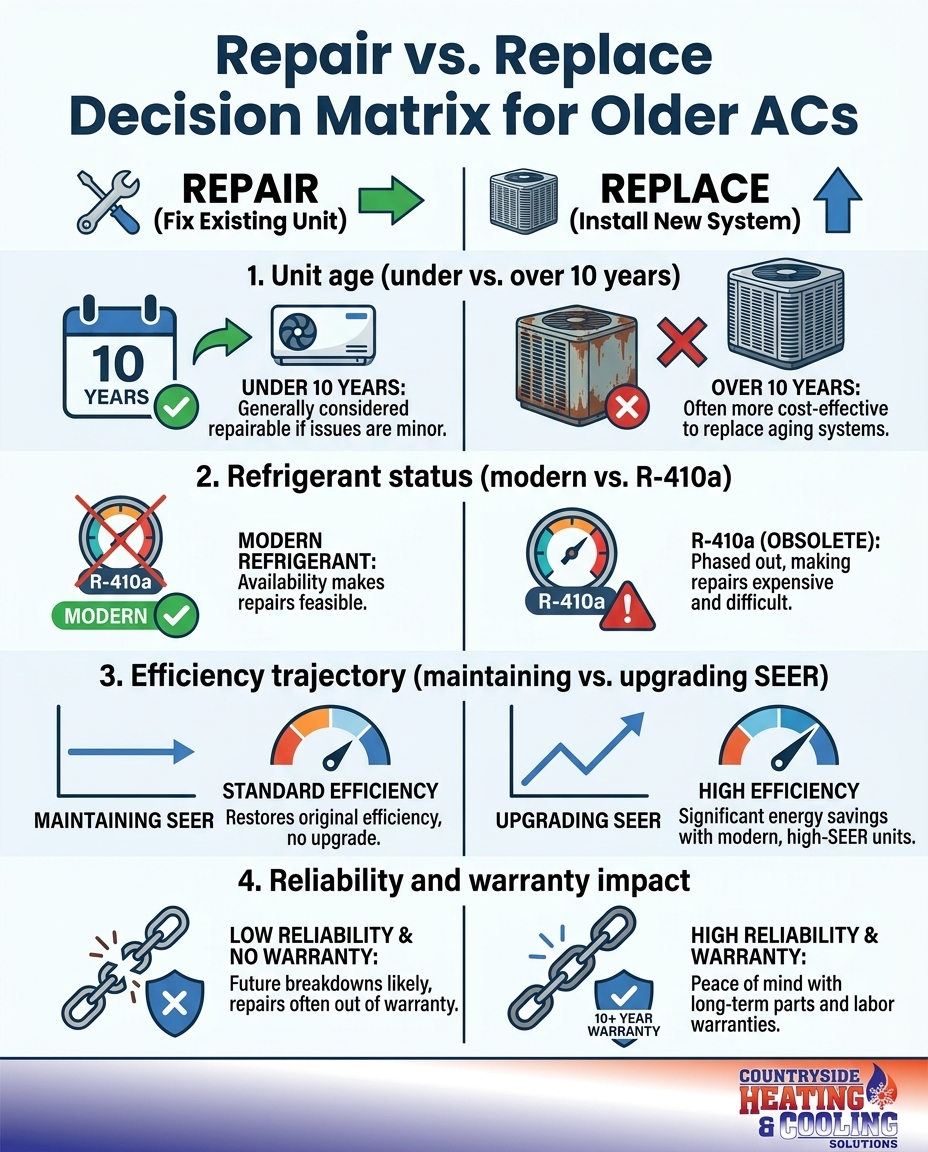
We use the matrix below to help our customers evaluate the four critical factors you should consider when deciding whether to fix your current unit or compare new air conditioners for a full replacement.
• Unit Age — Leaning Toward Repair: Under 10 years old with a solid maintenance history. — Leaning Toward Replacement: Over 10 years old, experiencing accelerated component wear.
• Refrigerant Type — Leaning Toward Repair: System uses modern, widely available refrigerants. — Leaning Toward Replacement: System relies on obsolete R-410a, facing severe phase-down limits.
• Energy Efficiency — Leaning Toward Repair: System still meets its original SEER rating and cools evenly. — Leaning Toward Replacement: System struggles to cool, resulting in constantly running equipment.
• Reliability & Warranty — Leaning Toward Repair: Unit is still covered by an active manufacturer warranty. — Leaning Toward Replacement: Warranty has expired; patching the system offers no guarantees.
By weighing these four factors—age, refrigerant status, efficiency, and reliability—you can make an informed choice that prioritizes your family's long-term comfort over a quick, temporary fix.
Evaluating the Hidden Costs of Repeated Breakdowns
Focusing entirely on the immediate mechanical fix often blinds homeowners to the hidden, ongoing burdens of nursing an aging system through another severe season. As air conditioners age past the decade mark, we consistently notice a natural loss of cooling capacity and efficiency. The coils become less effective at transferring heat, the blower motor loses a step, and the compressor draws more electricity to do the same amount of work.
The Toll of Lost Efficiency
This degradation means your system has to run for significantly longer periods to combat July peak summer heat. Longer run times not only put more wear and tear on the already fragile components, but they also compromise your indoor comfort. You may notice hot and cold spots throughout the house, or a sticky, humid feeling indoors because the system is no longer dehumidifying the air effectively.
Managing the Replacement Process
Enduring multiple service calls during heatwaves is incredibly frustrating. The anxiety of wondering if your AC will turn on every time the thermostat clicks is a hidden cost that takes a toll on your peace of mind. Fortunately, upgrading to a modern system often opens the door to generic energy rebates, federal tax credits, or utility incentive programs that apply to qualifying high-efficiency replacements (always consult your utility provider or a tax professional for current program details).
While the thought of replacing a major appliance can feel daunting, it doesn't have to be. For instance, one local homeowner recently faced a situation where their AC system needed replacement, and the process initially felt overwhelming. Our experienced technicians stepped in, explained every detail, walked through the installation process, and followed up afterward. The new equipment was installed smoothly, leaving the customer fully satisfied. If you are tired of repeated breakdowns, exploring the best AC replacement options can permanently eliminate the stress of an unreliable system.
Getting Honest Guidance for Your Cooling System
Navigating the complex decision between repairing a compressor, patching a leak, or replacing a 10+ year old R-410a system requires a trusted partner. Countryside Heating & Cooling Solutions has built an award-winning reputation by providing honest, pressure-free advice to homeowners facing these exact dilemmas. We believe that an educated homeowner is our best customer, which is why our team focuses on objective evaluations rather than high-pressure sales tactics.
A thorough assessment from our experts goes far beyond just looking at the broken part. Our technicians evaluate the overall health of your ductwork, measure airflow, inspect electrical components, and assess the system's age and refrigerant status. This comprehensive approach ensures you have all the facts needed to make the best long-term decision for your home. If a system replacement proves to be the most viable route, there are flexible HVAC financing options available to make necessary efficiency upgrades manageable and stress-free.
Frequently Asked Questions About Major AC Repairs
Is it worth replacing a compressor on a 10 year old AC?
In our professional experience, it is generally not recommended to replace a compressor on a system this old due to accelerated wear on other components and the ongoing phase-out of R-410a. A 10-year-old unit has already exceeded the most reliable years of its lifespan. Investing in a major repair often leads to a cycle of repeated breakdowns, whereas a new unit provides modern efficiency and a fresh manufacturer warranty.
How do I know if my home AC compressor is bad or just needs freon?
A bad compressor often involves hard starting, loud grinding noises, or repeatedly tripped electrical breakers, while low Freon usually presents as ice on the indoor coils and warm air blowing from the vents. Both issues can cause the system to stop cooling effectively. Because these symptoms can overlap and involve high voltage or regulated chemicals, our professional diagnosis is always required to pinpoint the exact failure.
What happens when R-410a is phased out?
As the EPA mandates the phase-down of R-410a, supplies of this once-standard refrigerant become increasingly scarce. This scarcity makes future repairs on older systems that rely on it highly impractical and difficult to maintain. Eventually, servicing an R-410a system will become obsolete as the industry fully transitions to more environmentally friendly alternatives.
Can a refrigerant leak cause my AC compressor to fail?
Yes, running an air conditioner with low refrigerant forces the compressor to work much harder and run significantly hotter. The compressor relies on the returning refrigerant to cool its internal motor. Without that cooling effect, the motor overheats, which we frequently see leading to premature and permanent catastrophic failure.
How long should a central air conditioner compressor last?
Most central air conditioner compressors are engineered to last between 12 to 15 years under normal operating conditions. However, severe weather, intense summer heatwaves, and a lack of routine maintenance can significantly shorten this lifespan. Regular tune-ups from our certified team are the best way to ensure the compressor reaches its maximum intended operational life.
Secure Your Comfort for the Rest of the Summer
Deciding between a major repair and a full system replacement doesn't have to be a guessing game. By using a clear, value-based framework that accounts for system age, refrigerant obsolescence, and future reliability, you can make a confident choice. Do not wait for a total catastrophic breakdown in the middle of July peak summer heat to figure out your next steps. If your aging AC is struggling to keep up, schedule an expert evaluation with our team today to secure your home's comfort, efficiency, and peace of mind for the seasons ahead.
Freon Leaks vs. Bad Compressors: Deciding When an Older AC is Worth Fixing
When you are weighing Freon leaks vs. bad compressors: deciding when an older AC is worth fixing ultimately comes down to securing reliable, long-term comfort rather than just patching a symptom. Let Countryside Heating & Cooling Solutions help you find the right path forward.
