.webp)

Why Minnesota Homeowners Can't Afford to Skip HVAC Service
How often should you service your HVAC in Minnesota is one of the most important questions you can ask as a homeowner in the Minneapolis-Saint Paul area. Minnesota's climate is demanding — heating seasons stretch six to seven months, winters regularly push temperatures to -16°F in the Twin Cities, and summers bring enough heat and humidity to push your cooling system hard. Your HVAC system carries a heavy load all year long, and without a consistent service schedule, that load leads to breakdowns, higher energy bills, and a shorter system life.
Here is a quick answer to get you started:
• Air conditioner (cooling) — Recommended Service Frequency: Once per year (minimum) — Best Time to Schedule: Early spring (April-May)
• Furnace (heating) — Recommended Service Frequency: Once per year (minimum) — Best Time to Schedule: Late summer or early fall (August-September)
• Heat pump — Recommended Service Frequency: Twice per year — Best Time to Schedule: Spring and fall
• Older systems (10+ years) — Recommended Service Frequency: Every 6 months — Best Time to Schedule: Spring and fall
• Homes with pets, allergies, or heavy use — Recommended Service Frequency: Add a mid-season check — Best Time to Schedule: As needed
The short version: Most Minnesota homes need at least two professional tune-ups per year — one in the spring before cooling season and one in the fall before heating season. If your system is older, you have pets, or someone in your home has allergies, you may need more frequent visits.
The rest of this guide from Countryside Heating and Cooling Solutions walks you through exactly what that schedule looks like, why it matters for Minnesota's specific climate, and what happens when maintenance gets skipped.
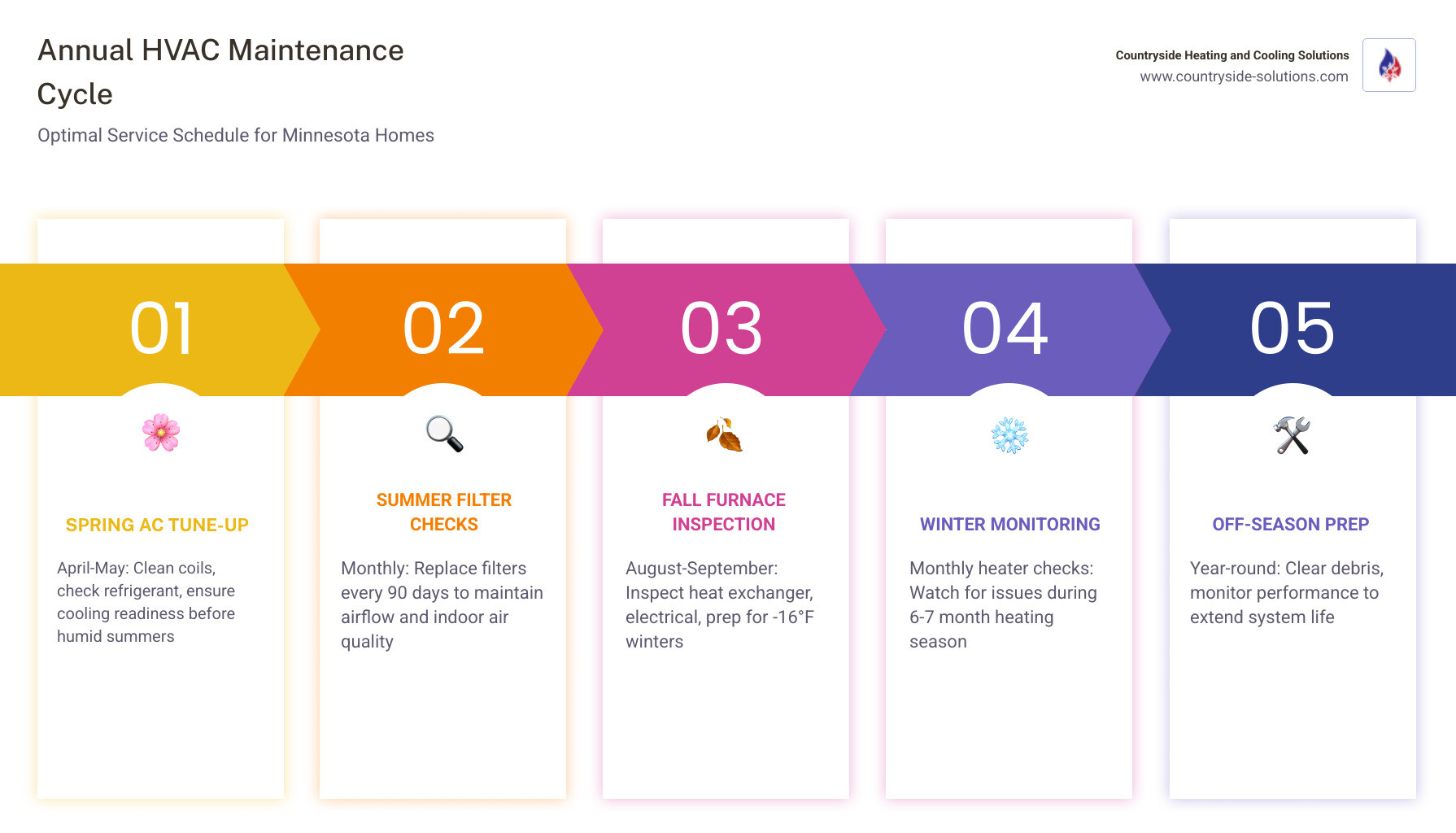
How Often Should You Service Your HVAC in Minnesota?
When we talk about how often should you service your HVAC in Minnesota, the general rule of thumb is twice a year. Because our state experiences such extreme seasonal shifts, your heating and cooling systems aren't just luxuries; they are essential for safety and survival.
A standard HVAC system in a place like Wayzata or Minnetonka should last about 15 to 20 years, but that lifespan is entirely dependent on how well it’s cared for. We recommend a semi-annual schedule: one visit in the spring specifically for your air conditioner and one visit in the fall specifically for your furnace or heating unit. This ensures that each system is ready to handle the upcoming peak demand.
By following this cadence, you ensure peak performance when the first "Polar Vortex" or July humidity spike hits. To stay ahead of these transitions, it is vital to Schedule Professional HVAC Maintenance before you actually need to turn the system on for the season.
Factors Influencing How Often Should You Service Your HVAC in Minnesota
While twice a year is the baseline, every home in the Twin Cities metro area is unique. Several factors might mean you need to see our technicians more often:
• System Age: Older systems (those over 10 years old) naturally experience more wear and tear. Components like capacitors, fan motors, and heat exchangers become more prone to failure. For these units, a check-up every six months is a non-negotiable requirement to prevent a mid-winter breakdown.
• Household Pets: If you have furry family members in Buffalo or Chanhassen, your HVAC system is working harder. Pet hair and dander clog filters and coat internal components much faster than in pet-free homes.
• Allergies and Respiratory Issues: For families dealing with asthma or severe allergies, indoor air quality is paramount. More frequent servicing allows us to ensure your filtration and purification systems are operating at 100% efficiency.
• Usage Patterns: If your home is large or if you keep your thermostat at a very high or low setting compared to the outdoor temperature, your system runs longer cycles. This heavy usage accelerates the need for lubrication and cleaning.
Reviewing Proper Heating Maintenance Tips can help you understand how these variables impact your specific equipment.
Why Timing Matters for How Often Should You Service Your HVAC in Minnesota
In Minnesota, timing is everything. If you wait until the first 90-degree day in June to realize your AC isn't cooling, you'll likely face long wait times as every other homeowner in the metro area is making the same call.
We suggest scheduling your AC service in early spring (April or May). This allows our NATE-certified technicians to address any issues left over from the previous summer and ensures the unit is clean and charged before the heat arrives. Following 6 Best Summer Maintenance Tips for Your Air Conditioner can keep your home comfortable through the hottest months.
Similarly, furnace maintenance should happen in August or September. You do not want to discover a cracked heat exchanger or a faulty igniter when the temperature drops below freezing. For our neighbors in the Lake Minnetonka area, an AC Tune-Up Mound MN in the spring is the best way to ensure a worry-free summer.
The Critical Importance of Seasonal Tune-Ups in the North
Minnesota homeowners face challenges that homeowners in milder climates simply don't understand. Our design temperatures — the temperature that HVAC systems are engineered to handle — can reach -16°F. This means your furnace isn't just "running"; it's sprinting for months at a time.
Furthermore, the long periods of inactivity (dormancy) can be just as damaging as heavy use. When an air conditioner sits idle from October to May, parts can stiffen, belts can dry out, and electrical connections can corrode. Professional maintenance catches these "dormancy issues" before they turn into "failure issues."
If you use a heat pump, which handles both heating and cooling, the stakes are even higher. These systems require a specialized touch to ensure the defrost cycle and refrigerant levels are calibrated for our sub-zero winters. You can learn more in our Heat Pump Maintenance Wayzata MN Guide.
Essential Tasks for Heating and Cooling Systems
A professional tune-up is much more than a "quick look." It is a comprehensive technical inspection. Here is a comparison of what we focus on during our seasonal visits:
• Clean evaporator and condenser coils — Fall Heating Maintenance Tasks: Inspect heat exchanger for cracks/corrosion
• Check and replenish refrigerant levels — Fall Heating Maintenance Tasks: Test and calibrate combustion controls
• Test electrical capacitors and contactors — Fall Heating Maintenance Tasks: Clean and adjust burner assembly
• Flush condensate drain lines — Fall Heating Maintenance Tasks: Inspect flue venting and PVC pipes
• Inspect outdoor unit for debris/damage — Fall Heating Maintenance Tasks: Test carbon monoxide detectors
• Verify airflow (350–400 CFM per ton) — Fall Heating Maintenance Tasks: Lubricate blower motor bearings
Whether you are wondering How Do You Maintain a Bryant Air Conditioner? or trying to understand What Maintenance Needs to Be Done on a Gas Furnace?, the goal is the same: safety, efficiency, and reliability.
Key Benefits of Consistent HVAC Maintenance
Investing in regular service pays for itself in several ways. First and foremost is energy efficiency. Routine maintenance can reduce your energy use by 10% to 15%. When your system is clean and well-lubricated, it doesn't have to work as hard to move air or change temperatures. Conversely, a dirty coil alone can increase your energy bills by 20%.
There are many The Benefits of Servicing Your Air Conditioning Systematically, including:
1. Lower Utility Bills: An efficient system draws less power and burns less fuel.
2. Extended Lifespan: Regular care is the answer to the question, How Do You Extend Your HVAC Life?. It prevents the "cascading failure" where one small worn part causes a major component to break.
3. Warranty Protection: Most manufacturers require documented annual maintenance to keep your warranty valid. If a major part fails and you can't prove the system was serviced, you might be stuck paying for the entire repair.
4. Emergency Prevention: The cost of a tune-up is significantly less than an emergency repair call, which can be quite high depending on the part needed.
5. Improved Air Quality: Cleaning the internal components prevents dust, mold, and allergens from being blown through your vents.
There are many Top Reasons to Service Your Air Conditioner Regularly, but peace of mind during a Minnesota blizzard is perhaps the most valuable one.
Professional vs. DIY: What Homeowners Need to Know
We often get asked what a homeowner can do versus what requires a professional. We encourage homeowners to take an active role in their system’s health. Basic tasks like AC Maintenance Tips to Increase the Performance of Your Unit often include:
• Filter Changes: This is the single most important DIY task.
• Debris Removal: Keep the area around your outdoor condenser clear of grass clippings, leaves, and snow.
• Vent Clearance: Ensure that furniture or rugs aren't blocking your supply or return registers.
However, professional service is required for the technical aspects of the system. Our NATE-certified technicians use specialized diagnostic tools to measure refrigerant pressure, test electrical draw, and perform combustion analysis. These are tasks that involve high-voltage electricity and flammable gases — they are not safe for DIY.
Furthermore, Essential AC Maintenance Plans for Optimal Performance provide a level of thoroughness that ensures your system meets the ACCA Standard 4 for residential maintenance. When Choosing the Best HVAC Service Provider for Your Needs, look for local expertise and a commitment to safety.
Frequently Asked Questions about Minnesota HVAC Service
Does annual maintenance affect my system warranty?
Yes, absolutely. Almost every major HVAC manufacturer (such as Bryant, Carrier, or Trane) includes a clause in their warranty stating that the equipment must be maintained annually by a qualified technician. If you skip these services and a part like a compressor or heat exchanger fails, the manufacturer may deny your claim. Keeping a documented service history is the only way to protect your investment. If you aren't sure about the timing, ask yourself: How Often Should the Heater Be Inspected? The answer is always at least once a year.
How often should I change my air filters in Minnesota?
In Minnesota, we recommend a 90-day baseline for standard 1-inch filters. However, during our active heating season (October through March), you should check your filter monthly. If you use high-efficiency MERV 11–13 filters, they may last up to 6 months, but homes with pets or smokers will need more frequent changes. For a deep dive into furnace care, see our Furnace Maintenance Wayzata MN Complete Guide.
What are the risks of skipping a tune-up?
The risks range from annoying to life-threatening. A skipped furnace tune-up could mean a cracked heat exchanger goes unnoticed, leading to carbon monoxide leaks. Carbon monoxide detectors are required in Minnesota dwellings under state law for this very reason. Other risks include "frozen" AC coils, which happen when airflow is restricted by dirt, and premature system failure. Our Heating Tune-Up Wayzata MN Complete Guide and Furnace Maintenance Saint Bonifacius MN resources highlight why these checks are vital for safety.
Conclusion
Maintaining your home’s comfort in the Twin Cities shouldn't be a guessing game. By understanding how often should you service your HVAC in Minnesota, you can take control of your home's energy efficiency and system reliability. Whether you are in Eden Prairie, Maple Grove, or Wayzata, your HVAC system is the heart of your home.
At Countryside Heating and Cooling Solutions, we are proud to serve our neighbors with NATE-certified expertise and a commitment to excellence. We even offer guaranteed next-business-day service to ensure you are never left in the cold (or the heat) for long.
Don't wait for a breakdown to give your system the attention it deserves. Explore our Service Plans today to find a maintenance schedule that fits your home and keeps your family comfortable all year long.
