

The Dilemma of Unpredictable Fall Temperatures
Your thermostat reads an uncomfortable 76 degrees inside, but the outdoor thermometer is plummeting quickly—this is exactly when you need local service expertise and area tips to navigate the seasonal transition without damaging your equipment. Mid-fall weather is notoriously confusing for homeowners trying to maintain indoor comfort. You might experience a bright, sunny afternoon that heats up your living room, followed by a sharp drop in temperature the moment the sun dips below the horizon. This sudden shift creates a frustrating tension: your house feels too warm, but the air outside is rapidly getting too cold to safely operate your cooling equipment.
For comprehensive guidance on protecting your equipment year-round, exploring your air conditioning system is the best place to start.
The freeze-thaw volatility of Minnesota autumns makes this transition particularly tricky. A warm afternoon in Maple Plain MN and surrounding Hennepin County can quickly drop below safe cooling thresholds by evening. Because homes retain daytime heat through their insulation and building materials—a concept known as thermal mass—your indoor air often stays stubbornly warm even as frost begins to form on your lawn. It is incredibly tempting to switch the cooling back on just to clear out that stale, trapped heat before bed.
However, residential cooling equipment is not designed for extreme day-to-night fluctuations or cold-weather operation. The outdoor condenser relies on a specific range of ambient heat to function properly. When you force the unit to run in chilly conditions, you introduce severe mechanical stress that can lead to catastrophic failure. Knowing the exact temperature cutoff is not just a matter of efficiency; it is a strict boundary required for system safety. Ignoring this limit during the unpredictable weeks of mid-fall puts your entire investment at risk.
The 60-Degree Rule: Why Running AC in the Cold is Risky
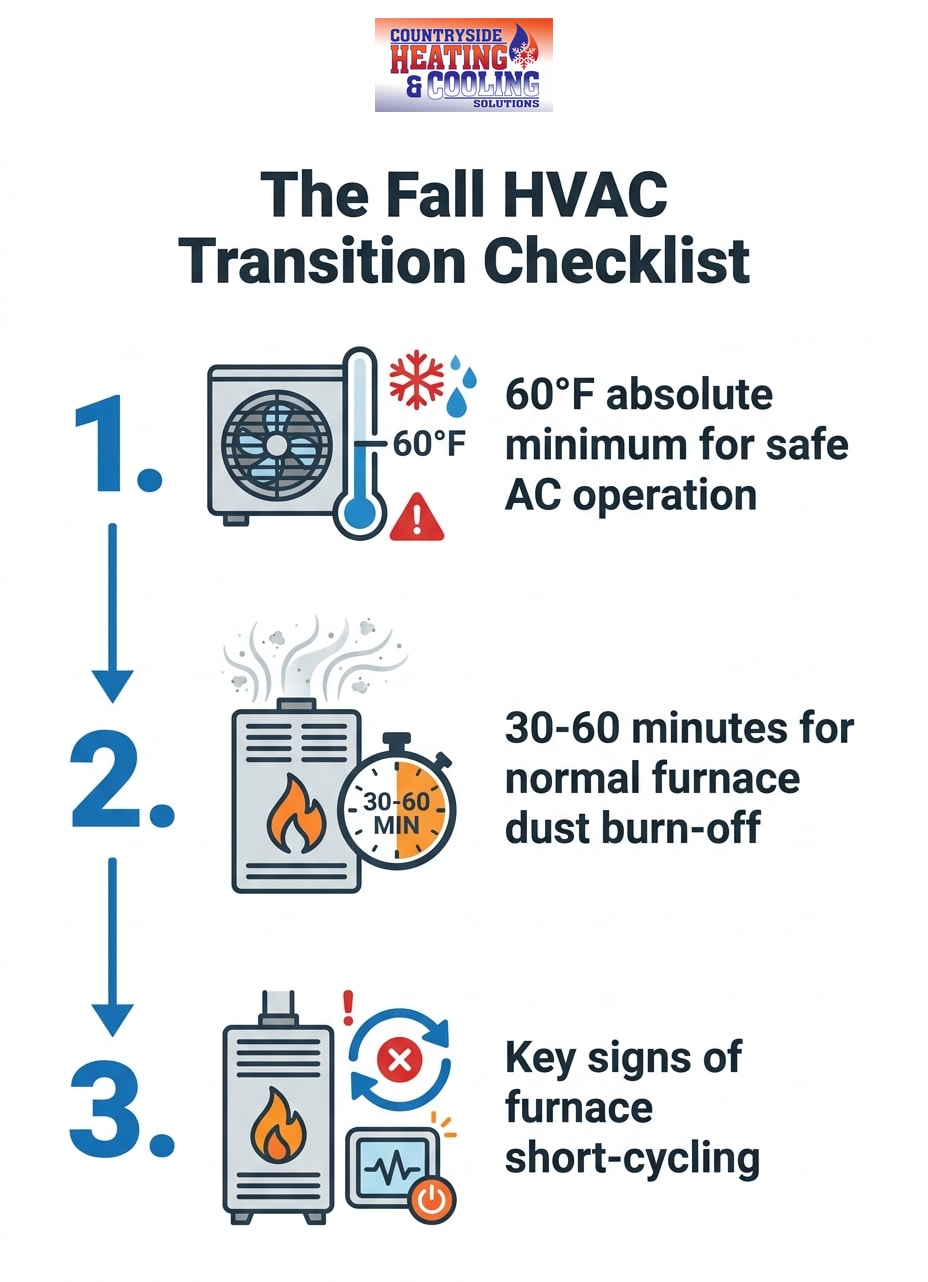
The short answer is: 60 degrees Fahrenheit is the absolute lowest safe temperature for operating your central cooling. If the outdoor temperature has dropped below this mark, you must turn the thermostat off, regardless of how warm the inside of your house feels. Operating your system below this threshold introduces immediate mechanical hazards that can destroy your compressor and lead to an expensive mid-season replacement.
Many homeowners assume that their modern thermostat or the unit's internal ambient temperature sensors will automatically prevent the system from running if it is too cold outside. Unfortunately, this is a dangerous misconception. Most standard residential units do not have built-in low-ambient lockouts. If your indoor thermostat calls for cooling, the outdoor unit will attempt to run, completely blind to the freezing conditions surrounding it. To fully understand the danger of running your AC below 60 degrees, you have to look at the physics of how the equipment moves heat.
How Cold Weather Affects Compressor Lubricants
Your outdoor compressor acts as the heart of the system, pumping refrigerant through the lines to absorb and release heat. To keep its internal moving parts moving smoothly, the compressor relies on a specific type of specialized oil. This lubricant is formulated to flow freely in warm summer weather.
When the temperature drops below 60 degrees—especially as we approach the October first-freeze—this oil behaves very differently. The cold air causes the lubricant to thicken and become sluggish, much like pouring cold syrup out of a jar.
• Poor lubrication: The thick oil cannot properly coat the internal bearings and pistons.
• Increased friction: Metal grinds against metal, causing rapid wear and tear.
• Compressor failure: The excess friction generates internal heat and mechanical strain, eventually causing the compressor motor to lock up entirely.
Replacing a burned-out compressor is often nearly as expensive as replacing the entire outdoor unit. Running the system in the cold directly invites this level of damage.
The Danger of Frozen Coils
Beyond the compressor, cold-weather operation severely impacts your indoor evaporator coil. Air conditioners work by absorbing heat from your indoor air and transferring it outside. When the outdoor air is already cold, the system's internal pressure drops. This pressure drop causes the indoor coil to become far colder than its normal operating range.
The quick fix: If you suspect your coil is freezing, turn the system off immediately and switch the fan to "ON" to help thaw it.
As normal indoor humidity passes over this super-chilled coil, the condensation does not just drip away into the drain pan—it freezes instantly. Within a matter of hours, a solid block of ice can encase the entire coil. This ice blocks airflow completely, forcing the blower motor to work twice as hard while delivering zero cooling to your rooms. Furthermore, when that massive block of ice eventually melts, it often overwhelms the drain pan, causing water damage to your ceilings, floors, or furnace components sitting directly below the coil.
Making the Switch: From Cooling to Heating in Mid-Fall
Once the outdoor temperatures consistently dip below the 60-degree mark, it is time to officially retire your cooling for the season. Bridging the gap between stopping the AC and starting the furnace requires a methodical approach. Leveraging Countryside Heating & Cooling Solutions' local expertise, we highly recommend a safety-first guide for transitioning your system smoothly. Rushing the process can cause electrical stress or leave you shivering if the furnace fails to ignite.
If you need assistance ensuring your system is ready for the long winter, exploring professional furnace and heating services can provide peace of mind before the deep freeze sets in.
Follow these steps to safely make the seasonal switch in Maple Plain MN and surrounding Hennepin County:
1. Power down the cooling correctly: Switch your thermostat from "COOL" to "OFF." Do not simply lower the temperature setting; actively disengage the cooling mode to prevent the system from accidentally kicking on during a brief afternoon warm spell.
2. Give the system a resting period: Allow the equipment to sit idle in the "OFF" position for at least a few hours. This resting phase gives the internal refrigerant pressures time to equalize and prevents the thermostat from sending conflicting electrical signals to the control board.
3. Check and replace the air filter: A summer's worth of dust, pollen, and pet dander is likely trapped in your current filter. Starting the furnace with a clogged filter restricts airflow, which can cause the heat exchanger to overheat and shut down prematurely. Install a fresh, clean filter before turning on the heat.
4. Clear the area around the furnace: Over the summer, it is common for boxes, holiday decorations, or cleaning supplies to migrate close to the indoor unit. Ensure there is at least a three-foot clearance around the furnace to allow for safe combustion air intake and to prevent fire hazards.
5. Initiate the first heating cycle: Switch the thermostat to "HEAT" and raise the temperature a few degrees above the current room temperature. Listen closely as the system cycles on. You should hear the inducer motor start, followed by the click of the igniter, the whoosh of the burners, and finally, the steady hum of the blower fan.
Diagnosing That First-Run Furnace Smell
One of the most common sources of panic during the October first-freeze is the distinct burning smell that fills the house immediately after the furnace kicks on. After sitting completely dormant for months, your heating system has a few quirks as it wakes up. Understanding what is harmless and what is hazardous is essential for your safety.
Most of the time, that initial odor is simply the smell of settling dust. Throughout the spring and summer, microscopic particles of household dust, pet dander, and skin cells float through the air and settle directly onto the cold metal of your furnace's heat exchanger. When the burners ignite for the very first time in autumn, those metal plates get incredibly hot very quickly, incinerating the accumulated debris. This creates a distinct "burning dust" smell that gets pushed through your ductwork and into every room.
Normal Dust Burn-Off vs. Warning Signs
The normal dust burn-off should dissipate entirely within 30 to 60 minutes of continuous operation. You can help clear the air by opening a few windows to ensure proper ventilation during this initial startup. However, not all smells are harmless. If the odor lingers for hours or smells like something other than dusty lint, you need to take immediate action.
• Toasted or burning dust — Likely Cause: Normal debris burn-off on the heat exchanger. — Required Action: Wait 30-60 minutes. Open windows for ventilation.
• Melting plastic or rubber — Likely Cause: A foreign object in the ductwork or a failing electrical component. — Required Action: Turn off the furnace immediately. Call for service.
• Sharp electrical or ozone scent — Likely Cause: An overheating blower motor or a short-circuiting control board. — Required Action: Shut off power at the breaker. Request an emergency inspection.
• Rotten eggs or sulfur — Likely Cause: A natural gas leak near the burner assembly or gas valve. — Required Action: Evacuate the home immediately and call your gas utility provider.
Never ignore a persistent, unnatural odor. If your home smells like melting wire casing or sulfur, shut the system down at the thermostat and the breaker, and wait for a professional evaluation.
Recognizing Furnace Short-Cycling vs. Normal Operation
Here's the thing: A weird smell isn't the only issue that can pop up during early-season heating. Another major red flag is a mechanical behavior known as short-cycling. While a normal heating cycle runs consistently until your home reaches the target temperature, a short-cycling furnace starts up, runs for just a minute or two, and abruptly shuts down before the house is actually warm. It will then wait a few minutes and repeat this rapid, start-and-stop loop endlessly.
Short-cycling is a protective mechanism. The furnace's internal safety sensors are detecting a problem and shutting down the burners to prevent a fire or severe mechanical failure. In Maple Plain MN and surrounding Hennepin County, where winter demands reliable, continuous heat, ignoring a short-cycling system is a guaranteed path to a mid-winter breakdown.
Common causes of rapid short-cycling include:
• Dirty flame sensors: The flame sensor is a tiny metal rod that confirms the gas burners have actually ignited. If it is coated in summer grime or light soot, it cannot detect the flame. The system assumes raw gas is pouring into the chamber without burning and immediately shuts the gas valve as a safety precaution.
• Restricted airflow: If your air filter is heavily clogged, or if too many supply vents are closed around the house, the heat exchanger cannot shed its heat fast enough. The high-limit switch detects that the furnace is dangerously overheating and cuts the power to cool it down.
• Blocked exhaust flues: Birds, rodents, or fallen autumn leaves can block the PVC exhaust pipes outside your home. If the furnace cannot safely vent toxic combustion gases, pressure switches will prevent the system from running.
Ignoring short-cycling drastically inflates your utility bills because the system uses the most energy during startup. Worse, the constant stopping and starting puts immense wear on the igniter and blower motor, leading to premature system failure. Because diagnosing and repairing internal combustion components involves natural gas and high voltage, you should never attempt to clean a flame sensor or test a limit switch yourself. This work strictly requires a licensed professional. If your system is caught in a rapid loop, schedule an HVAC inspection immediately to resolve the root cause.
Frequently Asked Questions About Fall System Transitions
Navigating the shift from cooling to heating always brings up a few uncertainties. For more details, check out our common HVAC questions, or review these quick answers to the most common early-season concerns.
Is it ok to run ac when it's 60 degrees outside?
No, 60 degrees Fahrenheit is the lowest safe limit for central air conditioning. Operating the system at or below this temperature causes the internal compressor oil to thicken, leading to poor lubrication and severe metal-on-metal friction. It also significantly increases the risk of the indoor evaporator coil freezing solid, which blocks airflow and can cause water damage when the ice melts.
What happens if you run AC in cold weather?
Running your AC in cold weather drops the refrigerant pressure too low, causing condensation on the indoor coil to freeze into a block of ice. Simultaneously, the outdoor compressor struggles to pump thickened, cold oil. This combination forces the motors to overwork, drastically reducing the lifespan of the equipment and often resulting in a locked-up compressor that requires a costly replacement.
Why does my furnace smell when I turn it on in the fall?
The burning smell is caused by the sudden incineration of dust, pet dander, and airborne particles that settled on the heat exchanger while the furnace was turned off over the summer. When the burners ignite for the very first time in the fall, the metal gets extremely hot and burns off this debris. This is a normal process and the scent should completely fade away shortly after startup.
Can I run my AC to dehumidify if it's 50 degrees outside?
You should never run a standard central AC unit when it is 50 degrees outside, even if the indoor air feels humid. The outdoor unit is not designed to operate in that ambient temperature, and doing so will freeze the coils and damage the compressor. If high humidity is an issue during cold weather, you should use a dedicated whole-home or portable dehumidifier instead.
How long should the burning smell last the first time I turn on my heat?
The normal "burning dust" smell should dissipate within 30 to 60 minutes of continuous furnace operation. You can open a few windows to help ventilate the home while the system clears the summer buildup. If the smell lasts longer than an hour, or if it smells like melting plastic, electrical ozone, or sulfur, turn the system off immediately and call a licensed technician.
Prepare Your System for the Winter Ahead
Successfully navigating the October first-freeze requires more than just flipping a switch on the wall. By respecting the 60-degree minimum for your cooling equipment and monitoring your furnace closely during its initial startup, you protect your system from unnecessary wear and tear. Always pay attention to how your system sounds and smells during this critical transition period.
If you notice persistent odors, rapid short-cycling, or if your system simply struggles to keep up with the dropping temperatures, do not wait for the harsh winter to arrive. Proactive professional inspections give you the peace of mind that your home will stay safe and warm, no matter what the weather does next. Schedule your comprehensive pre-winter tune-up today to ensure your equipment is fully prepared for the freezing months ahead.
