.webp)

The Mid-Summer Shock: When a Simple AC Swap Isn't Possible
Your air conditioner is blowing warm air, the house is sweltering in the peak July summer heat, and you just want a quick fix so your family can sleep comfortably again. You naturally assume our team will pull out the broken unit, drop a new one onto the exact same concrete pad, and have your home cooled down by dinner. But navigating AC replacements in Big Lake's older lakefront properties often comes with a frustrating surprise we see all too often: the new equipment physically will not fit where the old one sat.
If you are facing this exact roadblock, exploring your options for modern air conditioning systems with Countryside Heating & Cooling Solutions is the first step toward restoring your home's comfort.
Experiencing a total cooling failure during the hottest part of the year is stressful enough without unexpected installation hurdles. Many homeowners do not realize that the physical dimensions of cooling equipment have changed drastically over the last two decades. When our technicians arrive to measure your existing setup, we often discover that a modern unit will overhang the old pad, block a narrow walkway, or sit dangerously close to a property line.
Common spatial hurdles include:
• Undersized concrete pads: A pad poured in 2005 is rarely wide enough to support a 2026 condenser safely.
• Blocked access routes: Larger units can obstruct side-yard paths used for moving lawnmowers or accessing the lake.
• Proximity to structures: New units placed too close to the siding restrict airflow and reduce system lifespan.
Understanding these spatial constraints early is the best way to prevent extended delays. When you know what to expect, you can work with our team to find a viable location for the new equipment before the heat inside your home becomes unbearable.
Why Modern High-Efficiency Condensers Are Physically Larger
It is incredibly common to look at a quote for a new air conditioner from our team and wonder why the proposed unit looks like a giant compared to your old one. In our experience, the answer comes down to changing federal regulations and the physics of heat transfer. Over the last 15 to 20 years, the Department of Energy (DOE) has significantly updated efficiency standards for residential cooling.
To meet these strict requirements and achieve higher SEER2 (Seasonal Energy Efficiency Ratio) ratings, manufacturers had to redesign the equipment. Air conditioners cool your home by absorbing heat from the inside and releasing it outside. To release heat more efficiently while using less electricity, the system requires a much larger surface area for its condenser coils.
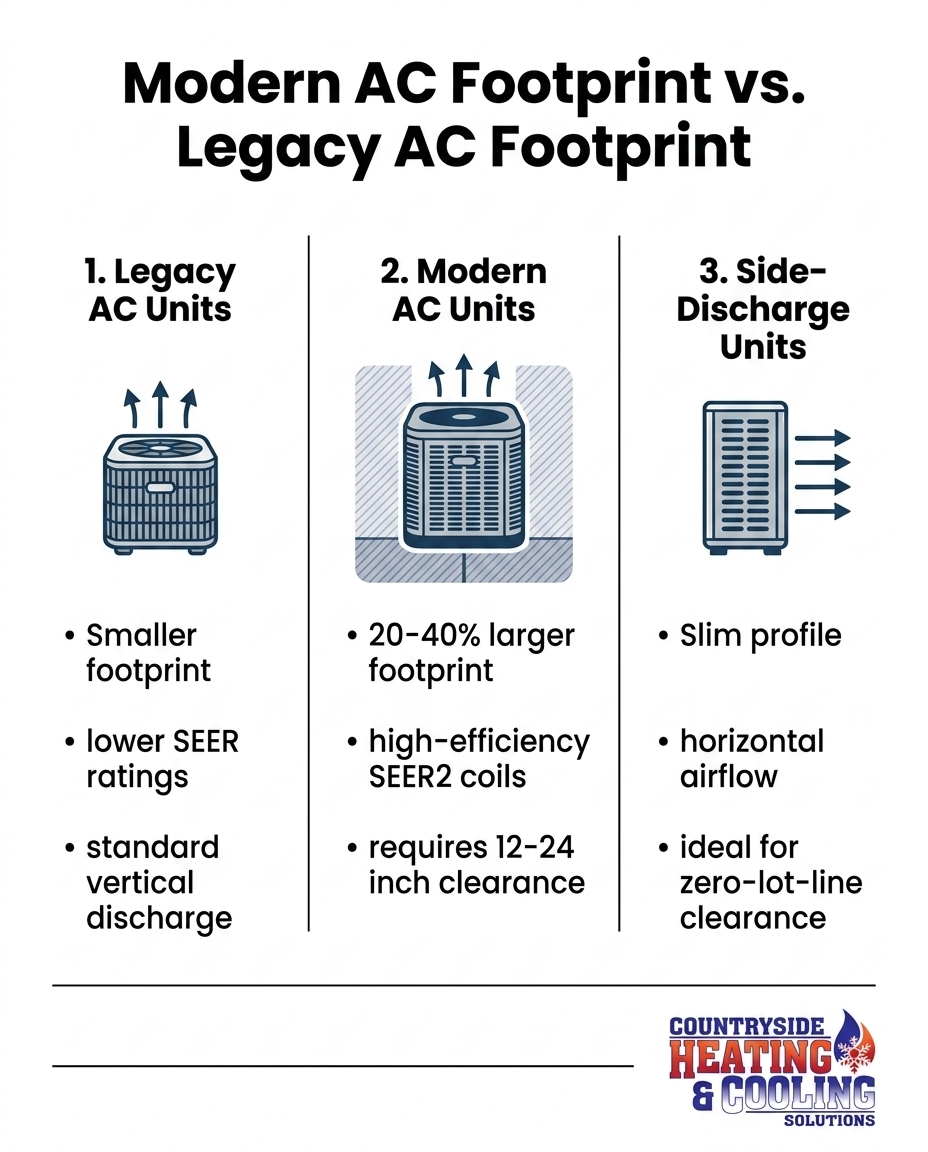
When comparing modern high-efficiency, larger-footprint condensers vs. older low-SEER units, the difference is visually striking. This increased coil size translates directly to a bulkier, taller, and wider physical footprint. The days of the small, cube-shaped air conditioner tucked invisibly behind a bush are largely over for standard central air systems.
Because of this footprint disparity, the original installation location on your property may no longer be viable or compliant with safety standards. Before the hottest days arrive, it pays to schedule an AC replacement consultation to measure your existing space and evaluate your options.
• Physical Footprint — Older Low-SEER Legacy Units: Compact, often 24x24 inches or smaller — Modern High-Efficiency SEER2 Units: Bulky, often 36x36 inches or larger
• Coil Surface Area — Older Low-SEER Legacy Units: Minimal, requiring more electricity to run — Modern High-Efficiency SEER2 Units: Maximized, allowing for lower energy use
• Airflow Clearance — Older Low-SEER Legacy Units: Often squeezed tightly against the home — Modern High-Efficiency SEER2 Units: Strictly requires 12 to 24 inches on all sides
Navigating Property Setbacks and Narrow Lakefront Lots
The increased size of modern equipment creates a unique headache for homeowners living in Big Lake older lakefront cabins. At Countryside Heating & Cooling Solutions, we see firsthand that lakefront properties are frequently situated on long, narrow lots that prioritize water frontage over side-yard space. When it is time to upgrade your mechanical equipment, you are immediately forced to deal with local zoning regulations and property setbacks.
A setback is a local zoning rule that dictates exactly how close a permanent structure or piece of mechanical equipment can be placed to your property line. Many older cabins were built decades before modern setback requirements existed. Your original air conditioner might be sitting just a few inches from your neighbor's fence line, completely grandfathered in under old rules.
However, when you replace that equipment, the grandfather clause typically expires. The new installation must comply with current local codes. If the modern unit is significantly wider, placing it in the same spot might cross the legal setback line, resulting in failed inspections or mandatory relocation orders from the city.
Furthermore, standard manufacturer guidelines require 12 to 24 inches of clearance around the entire condenser for proper airflow and routine servicing. Placing a larger modern unit in a narrow side yard can easily block pathways, making it impossible to move a lawnmower to the backyard or safely navigate the side of the house. Navigating these overlapping rules requires careful measurement and a deep understanding of local compliance standards before any equipment is ordered.
The Humidity Factor: Why Downsizing Equipment is a Mistake
Faced with strict property lines and massive modern equipment, it can be incredibly tempting to ask our technicians for a smaller capacity unit just to make it fit the existing concrete pad. If a 3-ton unit is too wide for the side yard, why not just install a smaller 2-ton unit that fits perfectly?
Our team strongly advises against this critical mistake, as it will severely impact your comfort, especially during the peak July summer heat. Minnesota's humid summers require robust cooling and dehumidification, which is especially critical for lakefront properties in Big Lake that face higher ambient moisture coming off the water. Your air conditioner does two distinct jobs: it lowers the temperature (sensible cooling) and it removes moisture from the air (latent cooling).
An undersized AC unit lacks the power to handle the heat load of your home. As a result, it will run continuously, struggling to reach the temperature set on your thermostat. This constant operation drives up your monthly energy costs dramatically while failing to properly cool the living space. Worse, because the unit is overwhelmed, it cannot effectively pull the heavy lakefront humidity out of the indoor air, leaving your home feeling clammy, sticky, and uncomfortable.
Proper dehumidification requires adequate system capacity and appropriate run cycles. The system needs to run long enough to move air over the cold coils to extract condensation, but it also needs the physical cooling power to keep up with the afternoon sun. Balancing physical size constraints with the necessary cooling load of your home is not a guessing game; it requires professional load calculations by our team to ensure you get the exact right capacity, regardless of the tight lot lines.
Spatial Workarounds for Tight Clearances
When comparing modern high-efficiency, larger-footprint condensers vs. older low-SEER units, it might seem like there is no viable way to upgrade without violating property lines. Fortunately, our HVAC experts have implemented specific technological and logistical solutions for properties with severe space limitations.
One of the most effective solutions is relocating the AC pad entirely. If the narrow side yard is no longer viable, the condenser can often be moved to a different side of the house or tucked neatly into the backyard. While this solves the setback violation, it does require upgrading electrical runs and extending refrigerant lines to connect the new location to your indoor furnace or air handler.
If relocating the traditional central unit is not feasible, alternative cooling technologies can eliminate the need for large central condensers entirely. Exploring ductless mini-split options allows you to mount a much smaller outdoor compressor on an exterior wall or tucked into a tight corner, bypassing the massive footprint of standard central air.
The Advantages of Side-Discharge Units
For homeowners who want to maintain a traditional central air system but simply do not have the width in their side yard, side-discharge air conditioners (often called slimline units) are a game-changer. These units are engineered specifically to solve zero-lot-line challenges.
• Horizontal airflow: Instead of pulling air through the sides and blowing it straight up like a traditional cube condenser, slimline units pull air from the back and blow it horizontally out the front.
• Reduced clearance needs: Because they blow air outward rather than upward, they require significantly less overhead and side clearance, allowing them to be tucked under overhangs or placed closer to walls.
• High efficiency in a small package: Despite their compact, suitcase-like profile, these units maintain exceptional SEER2 efficiency ratings, providing powerful cooling without the massive footprint.
Retrofitting Older Homes Without Compromising Integrity
Updating the mechanical systems in Big Lake older lakefront cabins requires a delicate touch. These homes often feature unique architectural details, limited crawl spaces, and older building materials that require careful handling during an installation.
The process begins long before the old unit is removed. Older properties frequently feature outdated electrical panels that must be evaluated to ensure they can safely handle the power draw of a modern, high-efficiency system. If a system is being relocated to satisfy setback rules, routing new refrigerant lines or modifying the existing ductwork requires a strategic approach to preserve the home's aesthetic and structural integrity.
Our professional installers prioritize minimal disruption. For example, our team at Countryside Heating & Cooling Solutions tackled an installation project last summer that required new venting. We made a specific, extra effort to route the system carefully, successfully completing the job with minimal disruption and avoiding unnecessary drywall cutting. This level of care is essential when working in older cabins where patching and matching vintage woodwork or plaster is exceptionally difficult.
A thorough pre-installation assessment ensures all these logistical hurdles are mapped out in advance. Reviewing an air conditioning installation checklist with our technicians guarantees that electrical needs, property lines, and structural quirks are addressed before the heavy lifting begins. We bring specialized local expertise in retrofitting older Minnesota homes and navigating tight lot lines without compromising system efficiency.
Pre-Planning Your Cooling Upgrade to Avoid Delays
The worst time to discover that a new air conditioner will not fit your property is during a total system failure in the middle of a heatwave. Waiting until your equipment completely dies limits your options, increases your stress, and leaves your family sweltering while you scramble to figure out zoning rules and equipment sizes.
Proactive sizing and logistical planning ensure the right equipment is ordered, delivered, and ready to install exactly when you need it. When you plan ahead, you have the luxury of exploring slimline units, discussing pad relocation, and verifying local setback requirements without the pressure of a 90-degree indoor temperature during the peak July summer heat.
Our professional technicians are here to help homeowners understand the entire process, from selecting the right equipment to the final installation and post-installation follow-up. For example, one of our customers last summer found the prospect of replacing their aging equipment completely overwhelming. By working with our team, who took the time to explain the entire process step-by-step, the installation was completed smoothly, leaving them with a working system and all their questions answered.
Working with a team that is deeply familiar with regional architecture and specific local HVAC service areas ensures that your new system will comply with all local codes, fit your property perfectly, and keep your home comfortable for years to come.
Frequently Asked Questions
Why is my new AC unit so much bigger than my old one?
Modern air conditioners are physically larger because they require more surface area on their condenser coils to meet strict federal energy efficiency standards. A larger coil allows the system to transfer heat more effectively, which lowers your energy consumption and helps the unit achieve a higher SEER2 rating.
What are the clearance requirements for an air conditioner?
Most manufacturers require a minimum of 12 to 24 inches of unobstructed clearance around the sides of the outdoor unit, and up to 60 inches of clearance above it. This spacing ensures the system can pull in enough air to cool the compressor and allows technicians enough room to perform routine maintenance safely.
Can I put my AC unit anywhere in my yard?
While you have flexibility, you cannot place an AC unit just anywhere. The location must comply with local zoning setbacks regarding property lines, it must meet manufacturer clearance guidelines for airflow, and it must be practically connected to your home's electrical panel and indoor ductwork via refrigerant lines.
What is a side-discharge air conditioner?
A side-discharge air conditioner, often called a slimline unit, is a compact cooling system that blows exhaust air horizontally out the front rather than vertically out the top. These units have a narrow, suitcase-like profile, making them perfect for tight zero-lot-line properties or narrow side yards where traditional bulky units will not fit.
How close to the property line can an AC be placed in Big Lake?
Setback requirements dictate how close mechanical equipment can sit to a property line, and these rules vary depending on your specific zoning district and lot type. Because older lakefront properties often have unique or grandfathered boundaries, it is crucial to verify current municipal codes before installing a new system.
What happens if a new AC unit violates local setback rules?
If a newly installed air conditioner violates local setback regulations, you may fail your municipal building inspection. In many cases, the local government can require you to physically relocate the equipment to a compliant area of your yard at your own expense, which involves pouring a new pad and extending electrical and refrigerant lines.
Moving Forward with Confidence
Dealing with tight lot lines and bulky modern equipment doesn't have to be a stressful ordeal. With a clear explanation of why new units are bigger and a solid understanding of alternative options like side-discharge systems, you can upgrade your home's comfort confidently. Trusting our professional team at Countryside Heating & Cooling Solutions to navigate these spatial challenges ensures your older lakefront property stays perfectly cool all summer long.
