.webp)

Balancing Indoor Comfort When Fall Weather Arrives
Have you ever found yourself pacing the hallway at 9 p.m., debating whether to turn on the thermostat because the house feels like an oven, even though the air outside is brisk? If you are wondering what is the lowest outside temp to run ac, you are facing a common, frustrating seasonal challenge. During the transition between summer and winter, daytime heat often gets trapped indoors, leaving your bedrooms stuffy and uncomfortable right when it is time to sleep.
However, turning on your central cooling system when the outdoor temperature has dropped can cause severe, permanent damage to your equipment. Air conditioners are engineered to remove heat from your home and release it outside, a process that relies heavily on specific outdoor ambient temperatures. Operating your system outside of its intended design parameters forces it to work against the laws of thermodynamics. For homeowners looking to maintain a comfortable environment without risking catastrophic equipment failure, understanding these limits is crucial. Partnering with professionals for your air conditioning services is the ultimate way to ensure your system operates safely year-round.
The 60-Degree Rule: What Is the Lowest Outside Temp to Run AC?
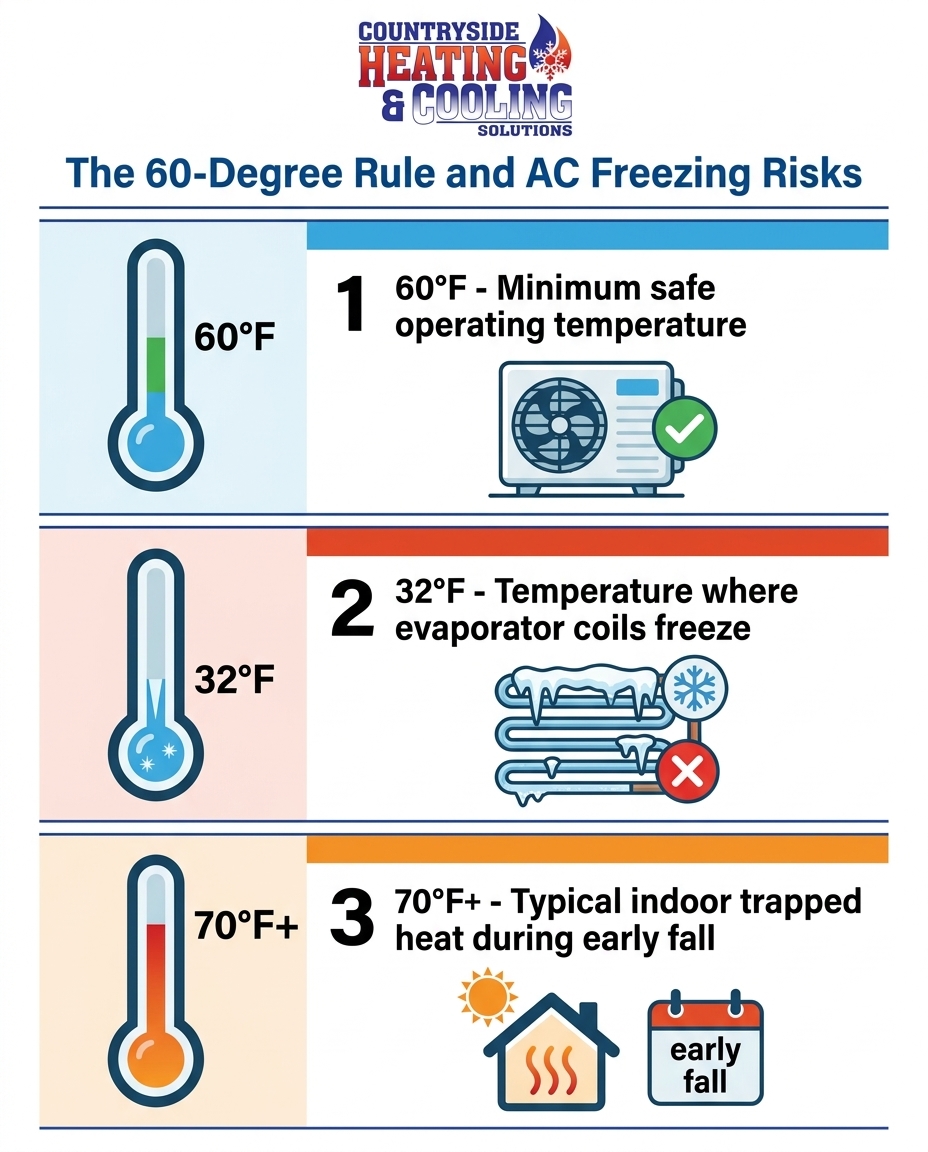
The absolute lowest outside temperature you should run your air conditioner is 60 degrees Fahrenheit. Standard residential air conditioning systems are engineered specifically to operate in warmer ambient conditions, relying on the heat of the outdoor air to facilitate the proper pressure levels inside the refrigerant lines.
While 60 degrees Fahrenheit is the widely accepted absolute floor for safe operation, many conservative manufacturer guidelines actually recommend keeping the system powered off if the outdoor temperature is below 65 degrees. When you operate a central air conditioner below this critical threshold, you alter the physical state and pressure of the chemical refrigerant flowing through the system. This disruption prevents the system from absorbing and releasing heat correctly, which inevitably leads to frozen components and total system failure.
To help you gauge when it is safe to rely on mechanical cooling, here is a breakdown of how outdoor temperatures impact your system:
• Above 70°F — System Status: Normal Operation — Recommended Action: Run your AC normally to maintain your desired indoor comfort.
• 60°F to 69°F — System Status: Caution Zone — Recommended Action: Limit AC use. Monitor the outdoor temperature carefully as the sun goes down.
• Below 60°F — System Status: Danger Zone — Recommended Action: Turn the AC off completely. Use alternative ventilation methods to cool the home.
By strictly adhering to the 60-degree rule, you protect your system's most expensive components from unnecessary stress and avoid the costly repairs associated with cold-weather operation.
The September Dilemma: Managing Trapped Indoor Heat
The temptation to run the air conditioner in cool weather usually peaks during the September early fall transition. In areas like Maple Plain MN, this time of year is characterized by highly variable, unpredictable weather patterns. You might experience bright, sunny afternoons where the temperature climbs past 70 degrees, followed by rapid evening drops where the night air plummets into the 40s or 50s.
During those sunny afternoons, your home experiences significant solar heat gain. The sun beats down on your roof, streams through your windows, and warms the physical structure of your house. Modern homes are built with excellent insulation and tight seals to maximize energy efficiency. While this is fantastic for keeping winter cold out, it acts as a double-edged sword during the fall transition. That thick insulation traps the afternoon heat inside your living spaces long after the sun goes down.
This creates a frustrating dilemma for homeowners. By 8 p.m., the outdoor air might be a crisp 55 degrees, but your indoor thermostat still reads a stuffy 76 degrees. The natural instinct is to turn on the air conditioner to cool the bedrooms for a comfortable night of sleep. However, because the outdoor temperature has already dropped below the safe operating threshold, running the system puts the internal mechanics at immediate risk. You are forced to choose between sleeping in a warm room and risking the integrity of your HVAC system.
The Physics Behind Frozen Evaporator Coils
To understand why the 60-degree rule is so critical, it helps to understand the mechanical physics of how your air conditioner moves heat. Your system does not actually "create" cold air; it absorbs heat from inside your house and pumps it outside using a chemical refrigerant. This process is highly dependent on specific temperature and pressure balances. If you want to dive even deeper into the specific risks, you can read more about the danger of running your AC when nights drop below 60 degrees.
How Refrigerant Reacts to Cold Ambient Air
Refrigerant relies on a precise pressure-temperature relationship to function. The outdoor unit (the condenser) needs warm outdoor air passing over its coils to maintain the high pressure required to keep the refrigerant moving efficiently. When the outdoor air drops below 60 degrees Fahrenheit, it disrupts this heat transfer process. The ambient air is too cold, causing the refrigerant pressure inside the outdoor unit to drop significantly.
Because the system is a closed loop, a pressure drop outside causes a corresponding pressure drop inside. The indoor unit (the evaporator coil) relies on this pressure to keep the refrigerant at the correct temperature to absorb heat. When the pressure plummets, the temperature of the indoor evaporator coil falls rapidly, often dropping well below 32 degrees Fahrenheit.
The Chain Reaction of Ice Buildup
Under normal operating conditions, your indoor coil extracts humidity from your home's air. This moisture forms condensation on the metal coils and safely drips away into a drain pan. However, when the coil temperature drops below freezing due to cold outdoor weather, that condensation instantly turns into solid ice.
This creates a rapid chain reaction. A small layer of ice acts as an insulator, preventing the coil from absorbing any more heat from your indoor air. This makes the coil even colder, causing more moisture to freeze. Within a matter of hours, the ice rapidly spreads down the refrigerant lines, completely encasing the indoor unit. Furthermore, the cold temperatures cause the specialized lubricant inside the outdoor compressor to thicken, increasing mechanical friction. In severe cases, liquid refrigerant can flow backward into the compressor—a phenomenon known as "liquid slugging"—which can destroy the compressor valves entirely. Never attempt to thaw a frozen coil yourself using heat guns, hair dryers, or sharp tools; this requires a licensed professional to prevent permanent damage to the delicate fins and lines.
Identifying a Frozen AC System During the Fall Transition
If you have already run your air conditioner on a chilly evening, you might be wondering if your system has suffered damage. Catching a frozen coil early can mean the difference between a simple service call and a catastrophic compressor replacement. Because the ice builds up inside the enclosed ductwork and air handler, you often have to rely on secondary symptoms to diagnose the problem.
Watch for these primary signs of a frozen AC system:
• Drastically reduced airflow: Place your hand over the supply vents. If the air feels like a weak trickle rather than a strong breeze, ice is likely blocking the passage of air through the indoor coil.
• Warm air blowing indoors: Because the ice acts as a barrier, the refrigerant can no longer absorb heat. The system will continue to blow air, but it will feel room-temperature or warm.
• Unusual noises: Listen closely to the indoor air handler. A hissing or bubbling sound can indicate pressure issues, while a straining motor sound means the blower is fighting against an ice blockage.
• Visible ice on refrigerant lines: Check the copper pipes running from your indoor unit to the outdoor unit. If you see white frost or solid ice forming on the insulated lines, your system is frozen.
• Water pooling around the furnace: As the ice eventually begins to melt, it overwhelms the drip pan, causing water to pool around the base of your indoor unit.
If you notice any of these symptoms, immediately turn your thermostat's cooling mode to "OFF" and switch the fan setting to "ON." This stops the refrigeration cycle while forcing warm indoor air over the coil to begin the slow melting process. One local homeowner reached out during the fall transition when their AC went out completely after running on a chilly night. Needing same-day service to assess the damage, they called for help. A technician arrived promptly, provided fast, accurate diagnostics, and repaired the system, getting their home comfort back on track. Fast, professional intervention is the only way to safely evaluate the system for permanent damage.
Safe Alternatives to Mechanical Cooling on Chilly Nights
When the September early fall transition traps 75-degree heat inside your home but the outdoor air is a crisp 55 degrees, you need safe ways to cool your living space without engaging the AC compressor. Fortunately, you can leverage that cool outdoor air to your advantage using natural and mechanical ventilation strategies.
Follow these safe alternatives to cool a stuffy house:
1. Create a strategic cross-breeze: Do not just open one window. Open a window on the lower level of the windward side of your home (the side the wind is blowing against), and open another window on the upper level of the leeward side. This creates a pressure differential that actively pulls cool air in and pushes hot, stale air out.
2. Run the HVAC blower fan independently: Go to your thermostat and switch the system from "Cool" to "Off," then switch the Fan setting from "Auto" to "On." This engages the indoor blower motor without turning on the outdoor compressor. It continuously circulates the air throughout your home, evening out hot and cold spots while providing a gentle, cooling breeze from the vents.
3. Utilize window or whole-house fans: Strategically place box fans in your windows. Point fans on the cooler side of the house inward to pull cool air inside, and point fans on the warmer side of the house outward to exhaust trapped heat. If you have a whole-house fan installed in your attic, running it for just 15 minutes after the sun goes down can completely refresh the air in your home.
4. Manage daytime solar heat gain: Prevention is the best strategy. Keep your blinds, shades, and curtains tightly closed on the south and west-facing windows during peak afternoon sunlight. By preventing the heat from entering your home during the day, you will not have to fight to remove it at night.
Protecting Your Equipment with Professional Oversight
Systems that are repeatedly stressed by improper temperature operation often suffer from hidden wear and tear. Even if your air conditioner did not completely freeze into a block of ice, running it below 60 degrees Fahrenheit forces the compressor to work against thickened oil and improper pressures, significantly shortening its lifespan.
This is why proactive, routine AC maintenance is so critical. A system that is slightly low on refrigerant or suffering from a dirty air filter is already operating at a disadvantage. When you combine those existing issues with the unpredictable temperature swings of the fall transition, a frozen coil becomes almost inevitable. A well-maintained system is far more resilient and better equipped to handle the shifting demands of the season.
When dealing with the extreme day-to-night temperature swings in Maple Plain MN, relying on local experts provides peace of mind. Countryside Heating & Cooling Solutions backs their work with a strong Satisfaction Guarantee, ensuring that you receive honest, accurate advice tailored to the specific climate challenges of the region. Professional oversight ensures that your equipment is protected, efficient, and ready to perform when you actually need it.
Comprehensive FAQ: Operating Temperatures and System Safety
Understanding the exact limits of your HVAC equipment can save you from unexpected breakdowns. Here are direct answers to the most common questions homeowners ask about running their air conditioners in cooler weather. For more detailed troubleshooting, you can also review our complete HVAC FAQ.
Is it ok to run AC when it's 60 degrees outside?
60 degrees is the absolute minimum safe temperature for running standard residential air conditioning. While it is technically permissible, running it exactly at 60 degrees carries risks if the ambient temperature drops any further while the system is actively cycling. It is generally safer to rely on natural ventilation once the outdoor air reaches this threshold.
Can I run my AC if it's 55 degrees outside?
No, running the AC at 55 degrees will likely cause the evaporator coils to freeze. At this temperature, the refrigerant pressure drops significantly, forcing the system to operate well outside its designed mechanical parameters. You should turn the system off and open windows to cool the home instead.
What happens if you run AC in cold weather?
When you run an AC in cold weather, the refrigerant pressures drop rapidly, causing the indoor coil temperature to fall below freezing. The normal condensation on the coils turns into solid ice, blocking airflow. Additionally, the compressor oil thickens, leading to severe mechanical friction and potential total system failure.
At what temperature does an AC freeze up?
The freezing process typically begins when outside temperatures dip below 60 degrees Fahrenheit. This drop in outdoor heat causes the actual indoor coil temperature to drop below 32 degrees. Once the coil hits the freezing mark, the moisture in your home's air instantly turns into ice upon contact.
Is there a minimum outside temperature for an air conditioner in winter?
Standard air conditioners should never be run in the winter under any circumstances. Only specialized commercial systems or heat pumps equipped with specific low-ambient kits can safely operate in winter temperatures. Running a standard residential AC in the winter will result in immediate, catastrophic damage to the compressor.
Can running the AC in the cold ruin the compressor?
Yes, liquid refrigerant can return to the compressor—a destructive process known as liquid slugging—causing catastrophic internal damage. Because liquids cannot be compressed, the compressor valves will shatter trying to process it. Compressor replacement is one of the most extensive and expensive HVAC repairs a homeowner can face.
Ensure Your HVAC System is Ready for the Changing Seasons
Navigating the late summer and September early fall transition does not have to put your expensive cooling equipment at risk. By adhering to the 60-degree rule and utilizing safe, alternative ventilation methods, you can keep your home comfortable without stressing your compressor or freezing your coils. If you suspect your system was run during a cold night and want to ensure it hasn't suffered hidden damage, now is the perfect time to schedule HVAC service. Proactive professional care guarantees your equipment transitions safely from the cooling season into the heavy demands of winter heating.
