.webp)

Why Your Vents Are Blowing Warm When You Need Cooling the Most
Our team at Countryside Heating & Cooling Solutions knows that before the first freeze hits and while late summer is still pushing temperatures to their peak, finding out is your AC blowing warm air? The difference between a dirty coil and low refrigerant is the very first thing you need to understand. You expect your home to be a cool refuge, but right now, your system is running constantly while the air coming out of your vents feels lukewarm at best. You walk over to check your settings, only to find the thermostat holding at 76°F despite being set to 70°F. The blower motor is humming, the outdoor unit is buzzing, but the house simply refuses to cool down.
This specific symptom—a system that pushes air but fails to drop the indoor temperature—is one of the most frustrating things we see homeowners experience during the hottest weeks of the year. The immediate dilemma is figuring out whether you are dealing with a simple airflow restriction that requires basic maintenance, or a complex mechanical failure that demands specialized repair.
The good news is that you do not have to guess. While these two issues share identical outward symptoms, our professional diagnostics can pinpoint the exact cause of the malfunction. If your system is struggling right now, the best first step is to schedule an AC diagnostic so an expert can evaluate the equipment before a minor issue turns into a major breakdown.
The Late-Summer Tipping Point: Cumulative Wear and Tear
Our technicians consistently see a spike in these exact service calls around August. It is no coincidence that cooling systems tend to exhibit these specific problems at the tail end of the season. By the time late summer arrives, your air conditioner has been working overtime for months. This extended run time creates a perfect storm for cumulative wear and tear to finally show its consequences.
The Burden of Summer Debris
Months of continuous operation lead to a heavy buildup of summer dust, airborne pollen, and household debris inside the system. Even if you changed your filter in May, the sheer volume of air moving through your ductwork by August means your indoor coil has likely accumulated a layer of grime. A pattern we see often is that this slow buildup does not cause immediate failure; instead, it gradually suffocates the system until it reaches a tipping point where cooling performance drops off a cliff.
The Slow Drain of a Microscopic Leak
Hidden mechanical wear follows a similar timeline. Slow, microscopic refrigerant leaks that may have started as tiny pinholes in the spring often take months to deplete the system's charge. Throughout June and July, the air conditioner might run a little longer than usual to compensate for the slight loss of pressure. By late summer, however, the refrigerant level drops below the minimum threshold required to cool the air, resulting in a sudden, noticeable shift from cold breezes to warm drafts.
Because both severe dust accumulation and slow refrigerant leaks reach their breaking point after months of heavy use, late summer is the prime time for these two very different problems to manifest with the exact same warm-air symptom.
The Science of Warm Vents: How Heat Transfer Fails
To understand why your vents are blowing warm air, you have to look at how your cooling equipment actually operates. Air conditioners do not "create" cold air out of nothing. Instead, they act as heat transfer machines, pulling thermal energy out of your home and releasing it outside. When you need comprehensive air conditioning services, our technicians are primarily looking at how well this heat transfer cycle is functioning.
The Problem: A Drop in Coil Temperature
The heat transfer process relies on the evaporator coil inside your home. Warm indoor air blows across the cold copper tubes, and the liquid refrigerant inside absorbs the heat. For this to work, the pressure and temperature inside the coil must remain perfectly balanced. Both a dirty coil and low refrigerant disrupt this delicate balance by causing an abnormal drop in system pressure.
The Cause: Condensation and Freezing
When the pressure drops too low—either because dirt is blocking the warm air from reaching the coil, or because there simply is not enough refrigerant in the lines—the temperature of the coil plummets below freezing. As warm household air hits this unnaturally cold metal, the natural humidity in the air condenses onto the copper. Because the coil is below freezing, that condensation instantly turns to frost.
The Solution: Restoring the Heat Transfer Cycle
Within a matter of hours, that frost builds into a solid block of ice, completely encasing the evaporator coil. Once the coil freezes, it acts as an impenetrable barrier. The heat transfer process completely halts. The blower motor continues to push air through your ductwork, but because the air can no longer touch the cold refrigerant lines, it blows straight past the block of ice and out of your vents as warm air.
Airflow Restriction: Recognizing a Dirty Evaporator Coil
When dirt and debris are the root cause of your warm air, we almost always trace the issue back to a severe airflow restriction. The evaporator coil needs a constant supply of warm air to function properly. When a physical barrier of grime blankets the indoor coil, that warm air never reaches the cold refrigerant inside the copper tubes.
Common Culprits of Restricted Airflow
• Neglected air filters: A filter that is packed with dust forces the blower motor to work harder and allows microscopic particles to bypass the media and stick directly to the wet coil.
• Pet dander and hair: Homes with multiple pets often see faster coil buildup, as fine dander slips past standard filters and mats against the delicate aluminum fins.
• Household dust: Everyday activities kick up dust that eventually settles inside the air handler, creating an insulating blanket over the heat-transfer surfaces.
The Impact of Local Humidity
In our years serving the Maple Plain MN area, we've seen firsthand how high summer humidity dramatically increases the moisture load on evaporator coils. As your system attempts to dehumidify the indoor air, gallons of water condense on the indoor unit. In a dry climate, a moderately dirty coil might just run inefficiently. However, with our local humidity levels, a dirty coil causes that heavy condensation to freeze over much faster, turning a minor airflow restriction into a solid block of ice in record time.
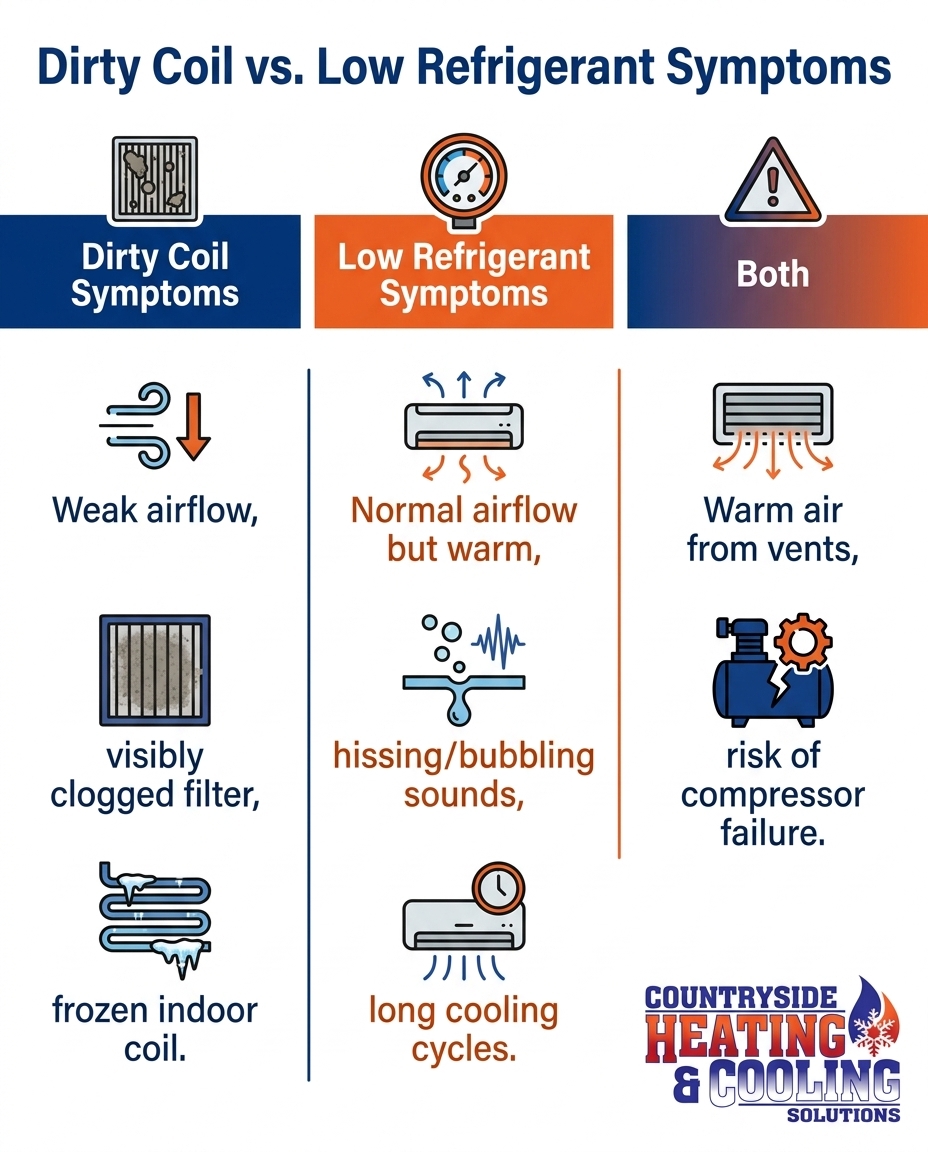
Visible symptoms of a dirty coil usually include a severely clogged air filter, noticeably weak airflow coming from the supply registers, and water pooling around the indoor unit as the ice eventually begins to melt. Keeping up with routine AC maintenance in Maple Plain is the most effective way to prevent this exact airflow restriction. In fact, a long-time customer who relies on our routine seasonal upkeep recently noted that consistent maintenance completely eliminates these sudden mid-season freeze-ups, keeping their system running reliably year after year.
Mechanical Failure: Spotting a True Refrigerant Leak
If your airflow is strong but the air is still warm, our team often finds a mechanical failure rather than a dirty coil. One of the most common misconceptions our technicians encounter about cooling systems is that they slowly "use up" or consume refrigerant over time. This is entirely false. Air conditioners operate on a closed-loop system.
The Closed-Loop Reality
Your system should have the exact same amount of refrigerant on its last day of operation as it did on the day it was installed. It never needs to be "topped off" unless there is a physical hole, crack, or leak in the copper lines or coils. If your system is low on refrigerant, it means there is a breach in the closed loop that must be located and repaired.
Signs Your System is Losing Pressure
• Hissing or bubbling noises: A noticeable hissing sound near the outdoor compressor or along the indoor refrigerant lines often indicates a pressurized leak actively venting gas.
• Abnormally long cooling cycles: As refrigerant levels drop, the system loses its cooling capacity. It will run for hours on end trying to meet the thermostat setting before eventually blowing warm air.
• Ice on the outdoor line: You may notice frost creeping along the thick, insulated copper pipe running from your house to the outdoor condenser unit.
We always remind our customers that handling these chemicals is not a do-it-yourself project. Federal EPA regulations require licensed professionals to handle, recover, and repair leaks due to the environmental impact of the gases involved. If you spot signs your AC has a refrigerant leak, the only safe option is to bring in a certified technician.
Side-by-Side Comparison: Dirty Coil vs. Low Refrigerant
Because these two problems share the primary symptom of warm air blowing from the vents, diagnosing the root cause requires looking at secondary clues. We recommend using this side-by-side comparison to help differentiate between an airflow restriction and a mechanical failure before our technician arrives.
• Airflow Strength — Dirty Evaporator Coil: Noticeably weak; barely pushing through vents — Low Refrigerant (Leak): Normal strength, but the air feels warm or lukewarm
• Unusual Sounds — Dirty Evaporator Coil: Straining blower motor struggling against a blockage — Low Refrigerant (Leak): Hissing or bubbling noises near the unit or copper lines
• Air Filter Condition — Dirty Evaporator Coil: Visibly clogged, gray, or packed with heavy dust — Low Refrigerant (Leak): Often perfectly clean or recently changed
• Root Cause — Dirty Evaporator Coil: Lack of routine maintenance and neglected filters — Low Refrigerant (Leak): Physical damage, vibration wear, or metal corrosion
The Hidden Danger of Running a Struggling AC
When the house is uncomfortably warm, the natural instinct is to leave the thermostat set low and hope the system eventually catches up. However, continuing to run the air conditioner when it is blowing warm air forces the compressor—the most expensive component in the entire system—to work overtime without proper cooling.
The Threat of Overheating
The compressor relies on returning refrigerant to stay cool. As cold gas flows back from the indoor unit to the outdoor unit, it absorbs excess heat from the compressor motor. If the indoor coil is frozen solid due to dirt, or if there is a severe lack of refrigerant due to a leak, that cooling effect disappears. The compressor continues to pump relentlessly, generating massive amounts of heat with nothing to cool it down.
The Loss of Vital Lubrication
Oil travels with the refrigerant. Inside the closed-loop system, a specialized lubricant mixes with the refrigerant to keep the compressor's moving parts properly oiled. When refrigerant levels drop, oil return drops with it. Running the system in this state strips the compressor of its necessary lubrication, causing metal components to grind against one another.
We've seen this situation quickly escalate from a simple coil cleaning or a basic leak repair into a catastrophic compressor failure. A burned-out compressor often means replacing the entire outdoor unit. If you notice your vents blowing warm air, the safest action you can take is to turn the system completely off at the thermostat and review frequently asked HVAC questions or call for professional help.
Why Accurate Diagnostics Matter More Than a Quick Fix
When you are staring at a thermostat holding at 76°F despite being set to 70°F, you want a fast solution. However, speed should never come at the expense of accuracy. Simply "topping off" the system with refrigerant without finding the underlying leak is a temporary, unethical fix that guarantees the problem will return in a matter of weeks or months.
Getting the Right Fix the First Time
A professional diagnostic process involves far more than just checking the air temperature. Technicians must check the total static pressure to verify airflow, measure superheat and subcooling to gauge the exact refrigerant charge, and use sensitive electronic leak detectors to find microscopic holes in the copper lines.
At Countryside Heating & Cooling Solutions, our team's rigorous diagnostic process ensures that we pinpoint the exact root cause of the failure. During a recent summer inspection, one of our technicians meticulously walked a homeowner through their system's exact condition, explaining every measurement and reporting on the equipment's status so the homeowner understood exactly what was needed. This level of transparency prevents you from paying for expensive refrigerant charges when a comprehensive coil cleaning was all that was actually required to restore your comfort.
Frequently Asked Questions
How do I know if my AC is low on Freon or just dirty?
The easiest way to tell the difference is by checking the strength of the airflow coming from your vents. If the airflow is incredibly weak and barely pushing out of the register, you likely have a dirty filter or a clogged evaporator coil blocking the air. If the airflow feels completely normal and strong, but the temperature of the air is warm, you are more likely dealing with a refrigerant leak.
Can a dirty coil cause warm air?
Yes, a dirty evaporator coil is one of the most common causes of warm air blowing from the vents. When a thick layer of dust and debris covers the coil, it acts as an insulating blanket, preventing the warm indoor air from touching the cold copper tubes. This stops the heat transfer process, causing the coil to freeze over and forcing the system to blow warm air.
What does a frozen AC coil look like?
A frozen evaporator coil literally looks like a solid block of white ice or heavy frost encasing the metal fins inside your indoor air handler. You might also notice frost creeping along the thick, insulated copper pipe that connects the indoor unit to the outdoor condenser. As the ice begins to melt, you will typically see excessive water pooling around the base of the indoor unit.
Why is my AC running but not cooling?
When an air conditioner runs constantly without lowering the indoor temperature, it means the heat transfer cycle has been interrupted. This is usually caused by restricted airflow from a severely clogged filter, a frozen evaporator coil, or a drop in refrigerant pressure due to a leak. The system's motors are still operating, but the mechanical ability to remove heat has failed.
Should I turn off my AC if it's blowing warm air?
You should immediately turn off your air conditioner at the thermostat if you notice it blowing warm air. Allowing the system to continue running forces the compressor to work without proper cooling or lubrication. Shutting the system down prevents permanent, catastrophic damage to the compressor while you wait for a technician to diagnose the problem.
Clear, observable symptoms are the key to understanding your home's cooling challenges. By recognizing the difference between a simple airflow restriction and a mechanical leak, you gain the confidence to know exactly when to call our team and secure the right fix for your system.
