.webp)

The Late-Summer AC Breakdown: Identifying the Source of the Noise
August is closing in, and after months of battling the heat, your outdoor condenser unit has suddenly stopped blowing cold air. Before you panic, understanding the symptoms of a failing AC contactor vs. a bad capacitor can help you figure out exactly what is going wrong. At Countryside Heating & Cooling Solutions, our team typically sees a surge of these specific electrical failures right as families are prepping for the back-to-school transition. Recognizing the difference between auditory buzzing vs. clicking from the outdoor unit is the first step toward getting your home comfortable again.
Need immediate help with your air conditioning systems? Reach out to our team to schedule HVAC service today.
The Reality of End-of-Season Wear
When our technicians arrive at a Maple Plain home to inspect a malfunctioning air conditioner, homeowners usually report a wall of hot air and an unsettling noise coming from the metal cabinet. By late summer, your cooling equipment has been running almost non-stop. In our experience, this heavy usage leads to predictable August end-of-season cooling wear, particularly on the electrical components that work the hardest to start and stop your system.
Most homeowners don't realize that the vast majority of late-summer breakdowns we repair trace back to just two small electrical parts: the contactor and the capacitor. Both of these components live inside the outdoor condensing unit, and both are essential for communicating with your thermostat and powering the compressor.
Why Sound and Sight Are Your Best Tools
If your system is failing, it will usually tell you through distinct sounds and visual cues. A failing contactor behaves very differently from a blown capacitor. However, as we tell all our customers, it is critical to state right up front: your diagnosis must remain purely observational. Gathering symptoms from a safe distance helps you report the problem accurately without putting yourself at risk of electrical shock. By simply listening for specific noises and looking for obvious visual damage through the fan grate, you can gather all the information a professional technician needs to bring the right parts to your home.
What Does an AC Contactor Do, and How Do You Know It's Failing?
To understand why your system is struggling, you first need to understand how it receives power. The AC contactor acts as the primary heavy-duty switch for your outdoor unit. When your indoor thermostat detects that the house is too warm, it sends a low-voltage signal outside. This signal energizes a magnetic coil inside the contactor, which pulls a set of metal contacts together. When those metal plates touch, high-voltage electricity flows into the compressor and the condenser fan, starting the cooling cycle.
The Impact of Continuous Cycling
With the intense Minnesota summer heat and humidity, condenser units are forced to cycle on and off continuously throughout the day. Our service team routinely notices that every single time that contactor closes, a small electrical arc occurs between the metal plates. Over time, this constant arcing causes accelerated thermal wear. The metal surfaces become pitted, scarred, and coated in black carbon buildup. Eventually, the connection becomes so poor that the electricity cannot flow properly.
Visual and Auditory Red Flags
When a contactor begins to fail, the symptoms are usually very distinct. Here is what you should look and listen for from a safe distance:
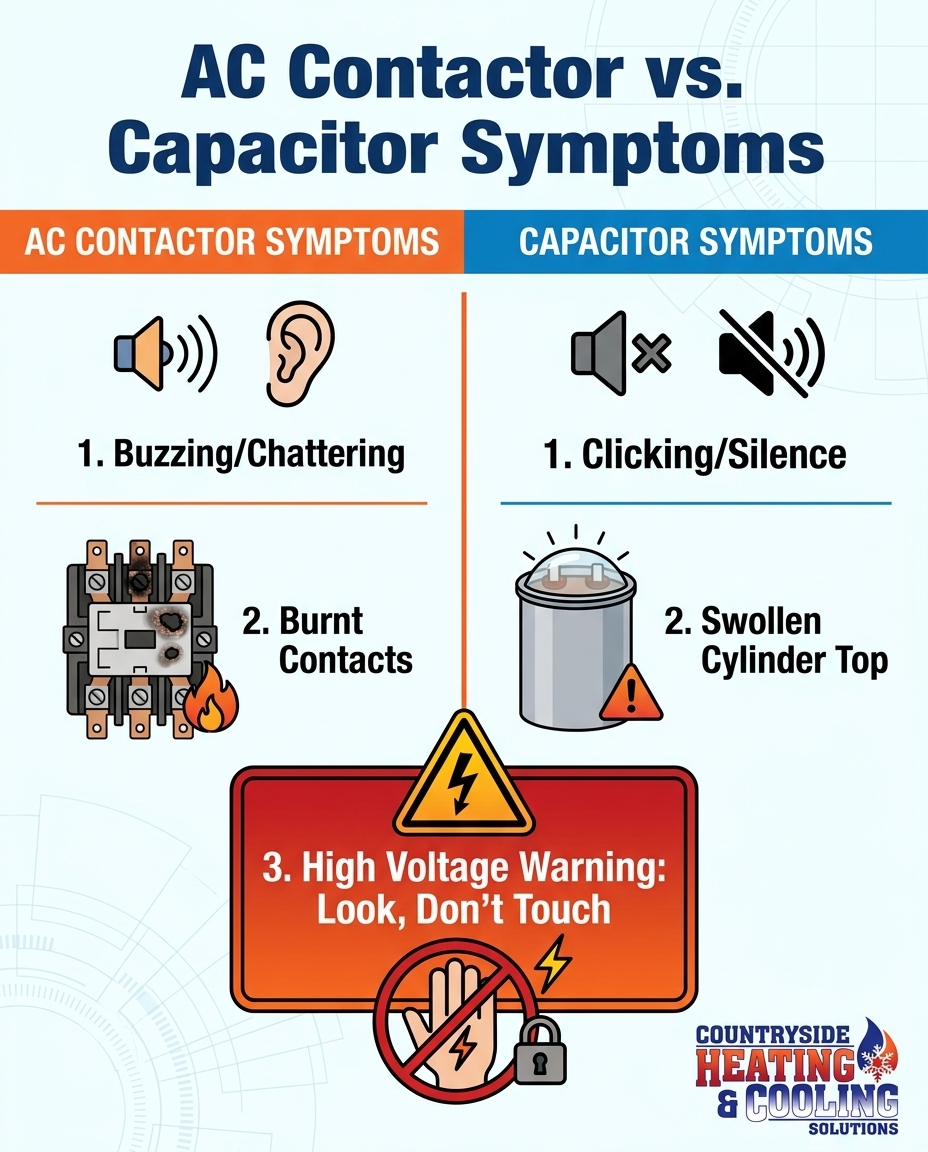
• Loud chattering or buzzing: If the magnetic coil weakens or the metal plates become uneven from pitting, the contactor will struggle to hold a solid connection. This results in a rapid mechanical chattering or a loud AC making buzzing sound that you can hear clearly from several feet away.
• Visibly burnt components: If you look through the side panels of the condenser unit (without removing them), you might see black, scorched marks around the electrical panel, or visible melting on the plastic housing of the contactor itself.
• Intermittent cooling: Because the switch is failing to make a solid connection, your AC might turn on sometimes, but fail to start at other times, leaving your house warm despite the thermostat calling for cooling.
Accurate observation makes a massive difference in repair times. A pattern we see often is when homeowners catch these signs early. Just last August, one local Maple Plain family reached out when their AC unit stopped working unexpectedly right before the back-to-school rush. Because they were able to clearly describe the buzzing sound and the intermittent fan operation, our technician arrived on the same day with the correct diagnostic tools and replacement parts. The AC was repaired quickly and accurately, restoring comfort before the house grew completely stifling.
Recognizing the Signs of a Blown AC Capacitor
While the contactor is the switch that allows electricity to flow, the capacitor is the component that actually gives your motors the strength to start moving. Think of an AC capacitor as a powerful, temporary battery. Air conditioning compressors and heavy fan motors require a massive jolt of energy to start spinning—much more energy than your home's standard electrical wiring can provide all at once. The capacitor stores up electrical energy and releases it in a powerful burst to jump-start the motors.
How Capacitors Fail Under Pressure
Capacitors are incredibly sensitive to heat. In our years of replacing these components, we've seen firsthand how the extreme late-summer temperatures affect them. They are filled with a specialized dielectric fluid that helps regulate their internal temperature while they store electricity. During the hottest weeks of the year, the ambient outdoor temperature combined with the heat generated by the running compressor can cause this fluid to boil. When the fluid boils, it turns into a gas, creating immense pressure inside the capacitor's metal cylinder.
The Telltale Symptoms of Capacitor Failure
When a capacitor blows or loses its ability to hold a charge, the symptoms are entirely different from a failing contactor. If you are standing near the unit, you will likely notice the following:
• Rapid clicking or total silence: Instead of a loud mechanical buzz, a bad capacitor often results in a faint, rapid clicking sound. This is the sound of the system trying to engage, but failing because the motors aren't receiving their jump-start. In many cases, the unit will remain completely silent even though the indoor blower is running.
• A swollen or bulging cylinder: To prevent a dangerous explosion when the internal fluid boils, capacitors are designed with a scored top that expands upward. If you look through the fan grate and see a silver cylinder that looks like a swollen soda can with a bulging, domed top, the capacitor has failed.
• The fan won't spin, but the unit hums: A classic sign of a dead capacitor is an outdoor unit that emits a low, struggling hum while the top fan blade remains perfectly still. The compressor is trying to pull power, but without the capacitor's boost, the motors remain locked in place.
Side-by-Side Comparison: Contactor vs. Capacitor Symptoms
When you are sweating in the midday heat, you need answers quickly. Distinguishing between these two common failures comes down to paying close attention to the specific auditory buzzing vs. clicking from the outdoor unit, as well as the visual state of the components.
Here is a direct comparison to help you organize your observations before you call for professional service:
• Auditory Signs — Failing AC Contactor: Loud mechanical chattering, harsh buzzing, or a rattling sound as the switch struggles to stay closed. — Blown AC Capacitor: Faint, rapid clicking, a low struggling hum from the compressor, or complete silence outside.
• Visual Cues — Failing AC Contactor: Blackened, pitted metal contacts, scorched plastic housing, or visible carbon buildup. — Blown AC Capacitor: A silver cylinder with a swollen, domed, or bulging top (looks like a distorted tin can).
• Fan Behavior — Failing AC Contactor: The fan may run intermittently, or not at all if the high-voltage connection fails completely. — Blown AC Capacitor: The fan often refuses to spin at all, even while the rest of the unit hums and tries to start.
• Primary Cause — Failing AC Contactor: Electrical arcing over time, thermal degradation, or physical debris blocking the metal plates. — Blown AC Capacitor: Overheating dielectric fluid expanding due to severe late-summer temperatures and heavy usage.
The Critical Importance of Observational-Only Diagnosis
While it is incredibly helpful for you to observe and report these symptoms, it is absolutely vital that you stop there. Air conditioning condensers are high-voltage appliances that demand strict respect for safety protocols. HVAC industry standard safety manuals and OSHA guidelines are explicitly clear regarding the dangers of high-voltage equipment.
The Hidden Dangers of High-Voltage Components
The most dangerous misconception we encounter in the field is that turning off the breaker makes the outdoor unit entirely safe to handle. This is fundamentally untrue when dealing with air conditioning systems. AC capacitors are designed to store massive amounts of electrical energy. They can hold a lethal high-voltage electrical charge for days or even weeks after the main power to the unit has been disconnected.
If you attempt to touch the terminals, test the system with a household multimeter, or manually jump-start a stuck fan blade with a stick, you risk severe electrical shock, catastrophic damage to the system, or worse. The internal components, including a burnt AC compressor relay or a swollen capacitor, must only be handled by technicians trained to safely discharge the stored energy.
The "Look, Don't Touch" Rule
All symptom gathering must be done visually and auditorily from a safe distance. Do not unscrew the metal side panels. Do not reach through the fan grate. Stand a few feet back, listen closely to the sounds the unit is making when the thermostat calls for air, and look through the vents with a flashlight to see if you spot a bulging cylinder or blackened plastic. That observational data is more than enough to help a professional take over safely.
Why Your Symptom Description Matters for Dispatch
When an air conditioner breaks down in the middle of August, our dispatch team experiences a massive surge in emergency calls. During peak breakdown season, there is often a communication gap between frustrated homeowners and dispatchers. Most calls start and end with, "My AC is blowing warm air." While true, that broad statement doesn't give the technician any clues about what parts they might need before they drive to your property.
Translating Symptoms into Solutions
Providing accurate, descriptive vocabulary changes the entire trajectory of your service call. When you tell a dispatcher, "I can see a swollen capacitor through the fan grate," or "The outdoor unit is making a loud, chattering buzz but the fan won't spin," you are giving them actionable intelligence. This level of detail allows the dispatcher to pull the correct part profiles for your specific system.
Faster Fixes Through Better Communication
Accurate reporting directly prevents frustrating return trips. If a technician arrives knowing they are likely dealing with a bad contactor, they ensure their truck is stocked with the right voltage and amperage switches for your model before they ever leave the shop. Our team at Countryside Heating & Cooling Solutions leverages these accurate homeowner descriptions to dispatch technicians with the exact right parts on the first trip, minimizing your downtime. By acting as the eyes and ears on the ground, you help ensure that your AC maintenance in Maple Plain or emergency repair is handled swiftly, efficiently, and correctly the very first time.
Frequently Asked Questions
What does a bad AC capacitor sound like?
A bad AC capacitor typically produces a faint, rapid clicking sound, or a low, struggling hum coming from the compressor. Because the capacitor can no longer provide the electrical jump-start the motors need, the unit will try to pull power, fail, and often fall completely silent while the indoor blower continues to run.
How do you tell if the AC contactor is failing?
You can tell an AC contactor is failing by listening for a loud mechanical chattering or harsh buzzing noise from the outdoor unit. Visually, if you look through the side panels, you may see blackened, pitted metal contacts or melted plastic housing caused by electrical arcing over time.
Why is my outside AC unit buzzing but not turning on?
If your outside AC unit is buzzing but not turning on, it usually means the contactor is receiving the signal from the thermostat but failing to close the high-voltage circuit. The magnetic coil inside the contactor is struggling to hold the metal plates together, creating a vibration that you hear as a loud buzz.
Will a bad contactor cause the fan not to run?
Yes, a bad contactor will absolutely cause the outdoor fan not to run. Because the contactor acts as the main gateway for high-voltage electricity entering the condenser, a failed connection means neither the compressor nor the fan motor will receive the power they need to operate.
Can a bad capacitor ruin a contactor?
A bad capacitor can indirectly contribute to contactor wear by forcing the system to pull higher amperage as the motors struggle to start. This excess electrical strain can increase the heat and arcing at the contactor plates, accelerating pitting and carbon buildup, eventually leading to premature failure of the switch.
Is it safe to visually inspect my AC unit's electrical components?
It is only safe to visually inspect your AC unit's electrical components from a distance, without removing any access panels. You should never touch the internal components, as parts like capacitors store lethal high-voltage charges even when the system's power is completely shut off.
Ready to Restore Your Cooling? Let the Experts Handle the Electrical Work
Understanding the symptoms of a failing AC contactor vs. a bad capacitor empowers you to communicate effectively without risking your safety. When you can provide a clear, safe, non-DIY breakdown of what your system sounds and looks like, you give our technicians the exact vocabulary needed to arrive prepared. Don't let late-summer breakdowns compromise your comfort—reach out to our team to schedule HVAC service and let our licensed professionals restore your cooling safely and efficiently.
