

Safeguarding Your HVAC System as Late Fall Temperatures Drop
Before the late November first freeze officially takes hold, many homeowners face a confusing period of fluctuating weather. When navigating the transition between cooling and heating, relying on local service expertise and area tips is the best way to protect your home. A sudden, unseasonably warm afternoon might tempt you to turn the air conditioner back on for a few hours. However, operating your cooling equipment during this critical transition window carries significant mechanical risks that most homeowners do not realize until it is too late.
If you want to protect your equipment and ensure your home is ready for the winter ahead, it is time to properly retire your cooling unit and focus on heating reliability. You can learn more about protecting your system through our air conditioning services, or if you are ready to prepare for the cold, schedule HVAC service today.
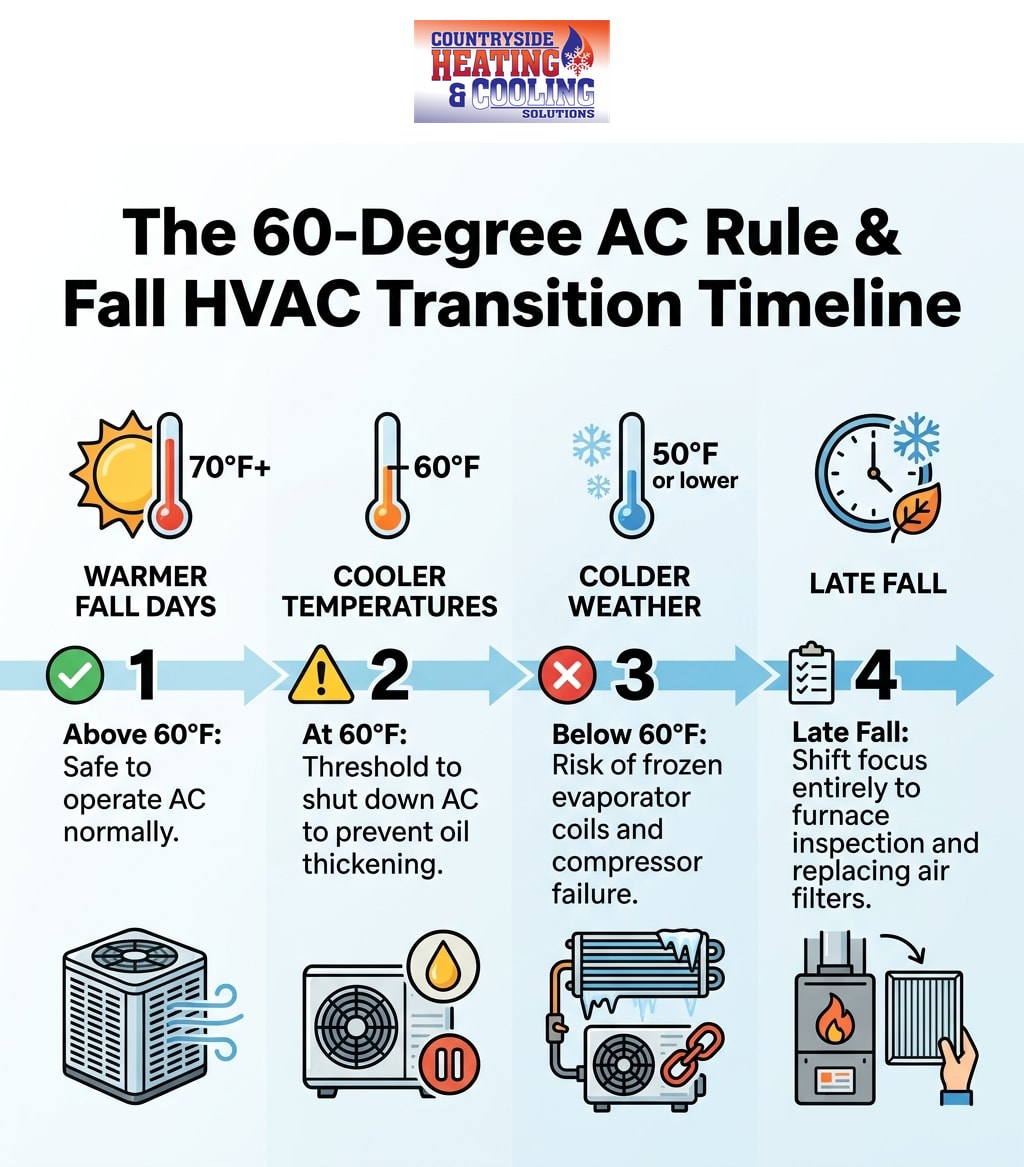
The lowest outside temperature to safely run your AC is 60 degrees Fahrenheit. Operating your air conditioner below this threshold can cause the compressor oil to thicken and the evaporator coils to freeze, leading to severe system damage. Capturing this featured snippet of advice is crucial because it highlights a strict mechanical limit, not just a casual recommendation.
The core problem arises when homeowners test or run their air conditioners during brief warm anomalies right before a severe temperature plunge. These short bursts of cooling might feel comfortable in the moment, but the ambient outdoor air is often much colder than the system was designed to handle. When you operate an air conditioner in chilly weather, you are forcing the internal components to work against their own physical properties. Instead of risking a catastrophic compressor failure, the smarter decision is to properly retire the AC unit for the season and shift your complete attention to furnace reliability before the harsh winter weather arrives.
The 60-Degree Threshold: Mechanical Risks of Cold Weather AC Use
Air conditioners are engineered to remove heat from your home and release it into the hot outdoor air. When the outdoor air is already cold, the entire thermodynamic process is thrown out of balance. Operating below 60 degrees Fahrenheit introduces severe mechanical stress to the system, particularly affecting the compressor and the evaporator coils. These damages often go completely unnoticed until the next cooling season, leaving homeowners in Maple Plain and surrounding Hennepin County with a broken AC on the first hot day of summer—a frustrating scenario our repair crews respond to all too often.
To fully grasp the danger of running AC below 60 degrees, it helps to understand exactly what happens inside the metal cabinet sitting outside your home.
Why Compressor Oil Thickens
Your air conditioner's compressor acts as the heart of the system, pumping refrigerant through the lines to facilitate heat transfer. Just like a car engine, this compressor relies on specific lubricants to keep its moving parts moving smoothly. Modern air conditioners typically use synthetic lubricants, such as POE (polyolester) or PVE (polyvinyl ether) oils.
These oils are formulated to flow freely at high summer temperatures. However, when the ambient temperature drops below 60 degrees, the viscosity of these lubricants changes dramatically. The oil thickens, turning sluggish and heavy. When the compressor attempts to run with thickened oil, the internal bearings and pistons do not receive adequate lubrication. This lack of lubrication leads to metal-on-metal friction, severe mechanical wear, and eventually, a total compressor failure. Replacing a seized compressor is one of the most extensive and complex repairs our Countryside Heating & Cooling Solutions technicians handle.
The Danger of Frozen Evaporator Coils
Beyond lubrication issues, cold weather fundamentally alters the internal pressure of your air conditioning system. Air conditioners rely on a precise balance of temperature and pressure to convert refrigerant from a liquid to a gas and back again. When the outdoor temperature is low, the system's internal pressure drops significantly.
This pressure drop causes the indoor evaporator coil to become far colder than it should be. As warm, humid indoor air blows across this super-cooled coil, the natural condensation that forms does not just drip into the drain pan—it freezes directly onto the metal fins.
• Reduced airflow: A layer of ice blocks the narrow spaces between the coil fins, suffocating the system.
• Cascading stress: The blower motor has to work twice as hard to push air through the ice blockage, leading to motor overheating.
• Liquid slugging: If the refrigerant cannot absorb heat due to the ice barrier, it may return to the compressor as a liquid rather than a gas. Compressors can only pump gas; liquid refrigerant will instantly destroy the compressor valves.
• Above 70°F (Optimal) — Compressor Oil Status: Flows freely, fully lubricating — System Pressure: Normal operating range — Risk of Damage: Very Low
• 60°F to 69°F (Caution) — Compressor Oil Status: Slightly viscous, acceptable — System Pressure: Lower end of normal — Risk of Damage: Low to Moderate
• Below 60°F (Danger) — Compressor Oil Status: Thickened, poor lubrication — System Pressure: Dangerously low — Risk of Damage: High (Seizure/Freezing)
Why the Upper Midwest Climate Demands Strict HVAC Protocols
The transition months in the Upper Midwest are notoriously unpredictable. Homeowners in Maple Plain and surrounding Hennepin County know all too well that a sunny, mild afternoon does not guarantee a mild evening. Extreme temperature swings are common, and these rapid shifts are exactly why strict adherence to HVAC operating protocols is necessary.
A day that peaks at an unseasonably warm 65 degrees can easily plummet to below freezing by nightfall. If you turn your air conditioner on during that brief afternoon window and forget to shut it down as the sun sets, the system will continue to cycle on as the outdoor temperatures drop into the danger zone. The rapid cooling of the ambient air catches many homeowners off guard, resulting in the exact mechanical stress and oil thickening described earlier.
This is where Countryside Heating & Cooling Solutions' deep understanding of Minnesota's unpredictable transition seasons makes a critical difference. After years of serving our local community, our team has learned that late-season AC use is simply not worth the risk. Instead of trying to squeeze one last day of cooling out of the system, the smartest approach is to acknowledge the climate reality. Once the trend shifts toward consistent evening chills, it is time to cut the power to the AC at the thermostat (and the breaker, if desired) and pivot entirely to preparing the home's heating infrastructure.
Shifting Gears: Preparing Your Heating System for the Winter Workload
One of the biggest issues with improper AC shutdown is that it distracts from vital early-season furnace preparation. When homeowners are still focused on cooling their homes in late October, they often neglect to test their heating systems until the late November first freeze is already knocking at the door. Waiting until the absolute last minute places immense stress on aging residential heating systems during the first major cold stretch.
When a furnace sits dormant for months, dust settles on the burners, flame sensors, and blower motors. Firing the system up for the first time requires it to push past this idle period. If there are underlying issues from the previous winter, they will immediately surface when the system is demanded to run continuously during a cold snap.
Our technicians see this pattern frequently. Just recently during cooler October weather, our team was called out to a local homeowner who turned on their furnace only to find it completely unresponsive. Because they addressed the issue early in the transition season, our technician was able to quickly diagnose the problem and get the heat back on successfully before the severe winter weather arrived. This proactive approach is exactly what separates a minor inconvenience from a mid-winter emergency.
Ensuring your equipment is fully operational requires shifting your mindset early. By retiring the AC properly, you free up the time and attention needed to evaluate your heating systems. This means turning the furnace on for a test run on a mild day, listening for unusual noises, and monitoring how effectively it reaches the set temperature on the thermostat.
Identifying Furnace Short-Cycling During Early Cold Snaps
As you transition to heating, one of the most common and damaging issues you might encounter is furnace short-cycling. Short-cycling occurs when the heating system turns on, runs for a very brief period, and then shuts off prematurely before adequately heating the home. It then turns back on a few minutes later, repeating this rapid, inefficient loop.
The first severe temperature drops leading up to the late November first freeze often expose these underlying inefficiencies or airflow restrictions. When the furnace is forced to run longer cycles to combat the cold, safety mechanisms within the unit become highly sensitive to overheating.
It is important to differentiate between normal operational adjustments and true mechanical distress. When you first turn on the furnace, you might smell a faint burning odor—this is usually just dust burning off the heat exchanger and should dissipate quickly. You might also hear the metal ductwork expanding and contracting. These are normal signs of a system "waking up." However, short-cycling is a clear indicator of mechanical distress.
Common causes of short-cycling include:
• Severely clogged air filters: A dirty filter restricts airflow, causing the heat exchanger to rapidly overheat. The system's high-limit switch will trip, shutting the furnace down for safety.
• Dirty flame sensors: If the sensor cannot detect the burner flame due to soot or oxidation, it will shut the gas valve off within seconds to prevent a gas leak.
• Blocked exhaust vents: Snow, ice, or debris in the flue pipe can cause exhaust gases to back up, triggering safety switches that halt the heating cycle.
• Thermostat placement issues: If the thermostat is located near a heat source or in direct sunlight, it will falsely register that the house is warm and shut the system down prematurely.
Ignoring a short-cycling furnace causes severe long-term wear and tear. The constant starting and stopping places immense strain on the blower motor, the igniter, and the gas valve, significantly shortening the lifespan of the entire unit.
Professional Diagnostics vs. Safe Homeowner Checks
When you encounter poor heating performance or short-cycling, determining your next steps is crucial. Homeowners in Maple Plain and surrounding Hennepin County need clear parameters on what constitutes safe DIY maintenance versus when it is absolutely necessary to call a professional. Intervening in complex mechanical issues without the proper licensing can lead to dangerous gas leaks, electrical hazards, or voided warranties.
Safe Homeowner Checks:
• Checking thermostat settings: Ensure the thermostat is set to "Heat" and that the fan is set to "Auto." Replace the batteries if the screen is blank or flashing.
• Replacing dirty air filters: This is the single most important task a homeowner can perform. A fresh, clean filter resolves a massive percentage of early-season airflow and short-cycling issues.
• Ensuring vents are open: Walk through the home and verify that all supply and return registers are fully open and unblocked by furniture, rugs, or curtains.
• Clearing the area around the furnace: Remove boxes, storage bins, and any combustible materials from the immediate vicinity of the indoor unit.
When to Call a Professional:
If you have checked the filter and the thermostat, but the system is still struggling, it is time to call an expert. Unusual grinding or squealing noises, persistent short-cycling, electrical tripping at the breaker panel, or any internal mechanical failures require a licensed technician.
The value of prompt, professional intervention cannot be overstated. In another recent instance, a local family returned home from a fall vacation to find their furnace completely broken. Because they reached out to our team immediately rather than attempting dangerous DIY repairs, our Countryside Heating & Cooling Solutions crew came out quickly, provided expert service, and fixed the furnace at a great value, restoring safety to the home just as temperatures dropped.
If your aging furnace is requiring frequent professional diagnostics, it may be time to consider alternative or supplementary heating solutions. Exploring modern heat pump options—which may qualify for general federal tax credits or utility incentive programs—can provide incredibly efficient heating during the milder transition weeks, reducing the overall burden on your primary furnace when the deep freeze finally arrives.
Frequently Asked Questions About Fall HVAC Transitions
Can I run my AC if it's 55 degrees outside?
No, operating your air conditioner when it is 55 degrees outside is highly discouraged. Running the system below the 60-degree threshold risks freezing the evaporator coils and severely damaging the compressor. At 55 degrees, the ambient air is cool enough that you can simply open windows to ventilate and cool the home without risking thousands of dollars in mechanical damage to your HVAC equipment.
What happens if you run AC in cold weather?
When you run an AC in cold weather, the system loses internal refrigerant pressure, and vital compressor lubricants thicken. This thickened oil fails to protect the moving parts inside the compressor, leading to severe metal-on-metal wear. Additionally, the drop in pressure causes condensation to freeze solid on the indoor coils, blocking airflow and potentially causing liquid refrigerant to flow backward into the compressor, which destroys the unit.
At what temperature should you turn off your AC for the winter?
Once outdoor temperatures consistently drop below 60 degrees Fahrenheit, the AC should be shut off for the season. To prevent accidental operation during a random warm afternoon, it is best to turn the system off completely at the thermostat. By the time the late November first freeze is approaching, your cooling system should be fully retired so you can focus entirely on heating.
How do I test my AC in the winter?
You cannot safely test a standard central air conditioner in the winter. Attempting to turn the system on in freezing temperatures will almost certainly cause immediate mechanical damage. If you need to test the system after a winter repair, you must wait for a day when ambient outdoor temperatures rise above 60 degrees and have remained there for at least 24 hours to allow the compressor oil to warm up and thin out.
Should I cover my outdoor AC unit during the fall?
A breathable top cover can be useful to keep falling autumn leaves, twigs, and debris out of the fan grille. However, you should never fully wrap the entire outdoor unit in a tight, non-breathable tarp. Fully wrapping the cabinet traps ground moisture inside, which accelerates rust and corrosion, and creates an inviting, sheltered environment for rodents seeking refuge from the cold.
Secure Your Comfort Ahead of the Harshest Winter Months
Proper seasonal preparation is the key to maintaining a comfortable, safe home in Maple Plain and surrounding Hennepin County. Adhering to the 60-degree rule and safely retiring your air conditioner protects your cooling investment from unnecessary mechanical wear. More importantly, it allows you to shift your focus to proactive furnace diagnostics, ensuring your heating equipment is ready to handle the heavy workload ahead.
Do not wait for a mid-winter breakdown to find out your furnace is struggling. By establishing clear, safe parameters on what you can check yourself and when to call a professional, you can ensure your home is fully prepared before the harsh Minnesota winter sets in. Take action today to secure your comfort and schedule HVAC service with local experts who understand the demands of our unique climate.
