.webp)

Navigating the Late Summer Shift to an Empty House
Late August is just around the corner, bringing a sudden shift to your household routine. The season of constant summer occupancy is ending, and soon, the house will sit empty for eight hours a day. As morning schedules tighten and kids head back to the classroom, adjusting your thermostat schedule for the back-to-school empty house becomes a top priority for maintaining comfort and controlling energy use.
To keep your home comfortable without overworking your air conditioning, it is often best to schedule HVAC service to ensure your system is ready for the seasonal transition.
At Countryside Heating & Cooling Solutions, a common pattern our technicians see during the late August back-to-school season across Maple Plain is homeowners turning their cooling systems completely off as they walk out the door. The logic seems sound: why cool a house when nobody is home? However, this approach often leads to unintended consequences. By mid-afternoon, the house has absorbed hours of radiant heat from the sun. When the family returns at 3:00 PM and flips the system back on, the air conditioner faces an overwhelming workload.
The primary goal during this transition is balancing energy efficiency with afternoon comfort. Your cooling equipment is designed to maintain a stable environment, not to perform daily miracles by dropping the indoor temperature by ten degrees in a matter of minutes. When you force a system to recover from an extreme temperature spike, you place immense strain on the compressor and blower motor. Finding the right daytime temperature setting ensures that your house remains reasonably conditioned while still saving energy during the hours it sits unoccupied.
The Late August Humidity Trap: Why Turning the AC Off Costs More
When the house is completely empty, it is tempting to follow generic energy-saving guidelines. The Department of Energy often recommends a 7-to-10-degree setback for an eight-hour workday. While this advice works well in dry, arid climates, our team at Countryside Heating & Cooling Solutions understands how to balance Minnesota's unpredictable late summer weather with energy efficiency, unlike generic national advice. In a region like Maple Plain MN, a deep setback creates a frustrating and inefficient recovery scenario due to the heavy afternoon humidity.
The problem: Turning the system off allows the indoor environment to become stagnant. Without the air conditioner cycling on, moisture from the outside air slowly infiltrates the home through micro-leaks around windows, doors, and the attic.
The cause: By mid-afternoon, the indoor air is not just warm; it is heavily saturated with moisture. When the system finally turns back on, it faces a massive wall of humidity.
The solution: Allowing the system to run periodically throughout the day prevents this moisture buildup, making the eventual temperature recovery much faster and less taxing on your equipment.
Sensible Heat vs. Latent Heat in an Empty Home
To understand why a stagnant house feels so uncomfortable, you have to look at the two types of heat your air conditioner manages daily.
• Sensible Heat — Definition: The actual temperature you can feel and measure with a standard thermometer. — Impact on an Empty House: Rises steadily throughout the day as sunlight hits the roof and windows. Easy for the AC to lower quickly.
• Latent Heat — Definition: The thermal energy hidden within the moisture (humidity) in the air. — Impact on an Empty House: Accumulates silently. The AC must spend significant energy removing this moisture before the air actually feels cool.
Removing latent heat takes significantly longer and requires far more energy than simply dropping the sensible temperature. This is known as "recovery strain." If your system has to run continuously at 3:00 PM just to wring the excess water out of the air, it uses more electricity than it would have if it had simply cycled on a few times during the day. Keeping the humidity in check is the secret to an efficient late summer cooling strategy.
The 3 to 4 Degree Rule: Finding the Optimal Daytime Setback
Rather than shutting the system down completely, the most effective strategy for an empty house is a moderate adjustment. Utilizing a 3 to 4 degree maximum setback provides the perfect balance between reducing energy consumption and maintaining a manageable indoor climate.
Here is how to implement this rule effectively:
1. Determine your baseline comfort setting: Identify the temperature your family prefers when relaxing at home in the evening. For many households, this is around 72 degrees.
2. Apply the moderate setback: Add three or four degrees to your baseline setting for the hours the house is empty. If your evening setting is 72 degrees, program your daytime away schedule to 75 or 76 degrees.
3. Allow for short cycles: At this slightly elevated temperature, your air conditioner will still turn on occasionally during the hottest parts of the day. These brief cycles are crucial—they pull air across the cold evaporator coil, extracting humidity and keeping the indoor air from feeling swampy.
4. Protect your equipment: A 3 to 4 degree maximum setback prevents the compressor from overheating. When a system only has to drop the temperature by three degrees at the end of the day, it can accomplish the task in a single, normal cooling cycle rather than running non-stop for two hours.
By keeping the temperature drift narrow, you ensure that the walls, furniture, and flooring do not absorb excessive heat. When the structural elements of your home remain relatively cool, the ambient air temperature is much easier to manage.
Timing the Afternoon Recovery for the 3:00 PM Arrival
Setting the right temperature is only half the battle; timing the system's recovery is just as important. Recovery time is the duration it takes for your HVAC system to cool the house back down from the daytime setback to your preferred comfort setting. If you wait until you walk through the door to lower the thermostat, you will be waiting a long time for relief.
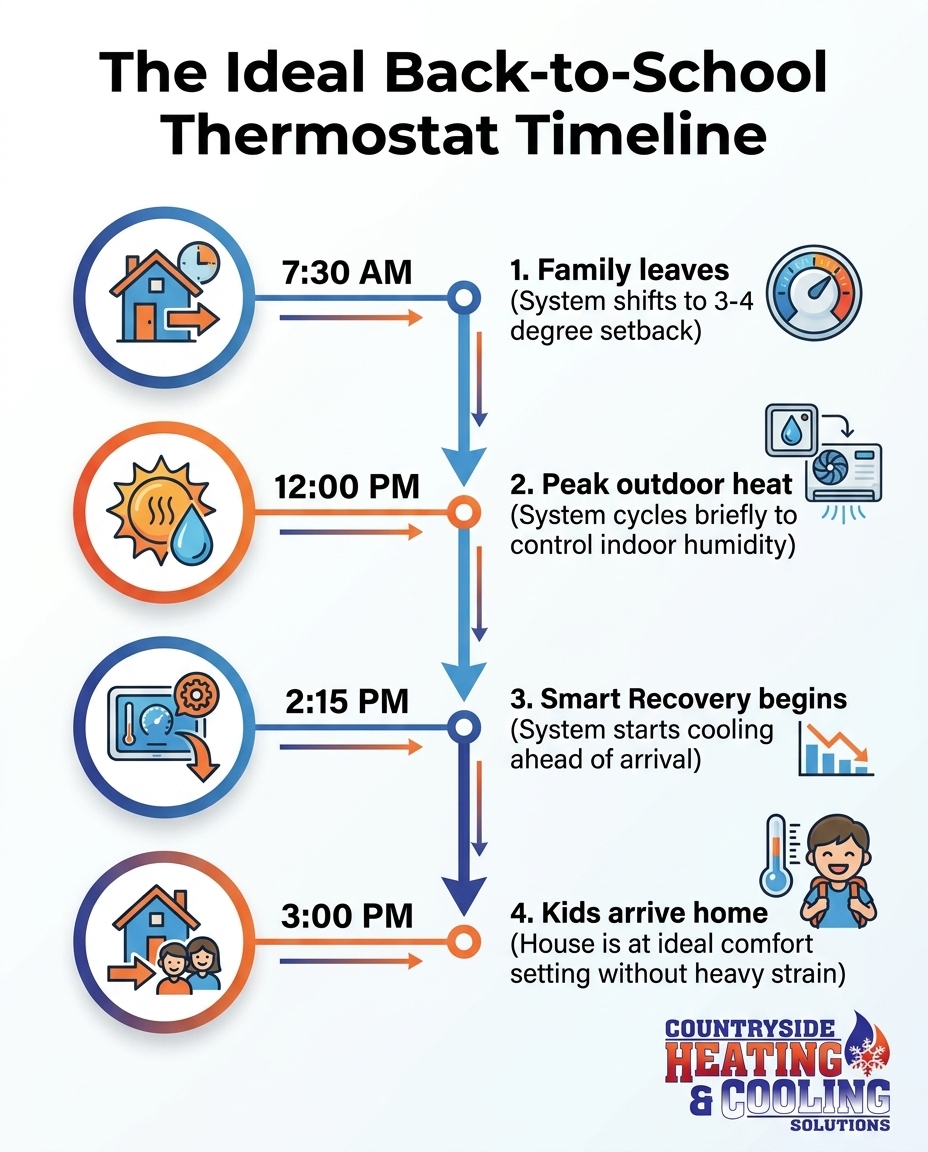
A well-planned timeline ensures the house is ready the moment the late August back-to-school day ends:
• 7:30 AM (Departure): The system shifts into the away schedule, allowing the temperature to rise slowly to the maximum setback limit.
• 12:00 PM to 2:00 PM (Peak Heat): The system cycles briefly to maintain the setback temperature, actively managing indoor humidity while the sun is at its strongest.
• 2:15 PM (Pre-Cooling Begins): The thermostat initiates the recovery period, starting the cooling process 30 to 60 minutes before the first person arrives home.
• 3:00 PM (Arrival): The house reaches the target comfort setting right as the front door opens, avoiding the need for anyone to manually crank the thermostat down to 65 degrees in frustration.
Leveraging Smart Thermostat Features
Modern Wi-Fi thermostats take the guesswork out of recovery timing. Features like "Smart Recovery" or "Adaptive Intelligent Recovery" allow the device to learn exactly how long your specific home takes to cool down. Instead of programming the system to start cooling at 2:00 PM, you simply tell the thermostat you want it to be 72 degrees by 3:00 PM. The thermostat calculates the necessary start time based on the current indoor temperature and outdoor weather conditions.
For these intelligent features to function correctly, the device requires a stable internet connection. If your system is failing to follow the schedule or missing its target temperatures, you may need to reset a glitchy Bryant Wi-Fi thermostat to restore its communication with the HVAC equipment.
Managing Brisk Mornings and Warm Afternoons in the Midwest
The late summer weather pattern in Maple Plain MN presents a unique challenge for indoor climate control. Early mornings often feature crisp, cool air that feels like early fall, while the afternoons quickly rebound into hot, sticky conditions demanding heavy cooling. This dynamic swing requires a thoughtful approach to daily household management.
The open window dilemma: When you wake up to 62-degree weather outside, opening the windows to flush the house with fresh air seems like a great idea. However, that cool morning air often carries a high dew point. By opening the windows, you introduce a massive amount of latent heat (humidity) into the home. When you close up the house and leave for the day, that moisture gets trapped inside. Later, your air conditioner has to work twice as hard to remove the humidity you let in during breakfast.
Just recently, a local Maple Plain homeowner reached out to us for a late-summer check-up because they wanted to ensure everything was running efficiently through these exact temperature swings. Our Countryside technician, Nick Brose, checked their entire system thoroughly and explained exactly what our team does to keep equipment optimized for unpredictable afternoon heat.
Instead of relying on open windows, consider utilizing your thermostat's continuous fan setting (turning the fan from "Auto" to "On"). This circulates air continuously through your filter, preventing stagnant pockets of warm air from forming in upstairs bedrooms while keeping temperatures even throughout the home.
If seasonal allergies or lingering humidity are constant battles during this time of year, transitioning to whole-home indoor air quality solutions can dramatically improve how your home feels. Dedicated whole-home dehumidifiers and advanced media filters work alongside your HVAC system to purify the air and remove excess moisture without requiring the AC compressor to run non-stop.
Using Routine Maintenance to Smooth the Seasonal Transition
A thermostat schedule is only as effective as the equipment executing it. If your air conditioner is struggling with restricted airflow or dirty components, even a modest 3 to 4 degree maximum setback will cause the system to labor during the afternoon recovery period.
As fall approaches, routine maintenance bridges the gap between the heavy cooling season and the upcoming heating season. A proactive approach ensures your system can handle the daily back-to-school schedule efficiently.
• Filter Replacement: A clogged filter forces the blower motor to work harder, extending the time it takes to cool the house down at 3:00 PM. Check and replace filters monthly during peak usage seasons.
• Evaporator Coil Cleaning: The indoor coil is responsible for extracting both sensible and latent heat. If it is coated in a layer of summer dust, its ability to remove humidity drops significantly, leading to longer recovery times.
• Outdoor Condenser Clearance: Ensure the outdoor unit is free of late-summer yard debris, tall grass, and cottonwood seeds so it can exhaust heat effectively.
• Heating System Prep: The transition window is the ideal time to prep the furnace before the first real cold snap hits. Waiting until the house is freezing to discover a heating issue leads to uncomfortable nights.
Another long-term customer relying on Countryside Heating & Cooling Solutions for various HVAC services over the years specifically requests our team members, Adam and Tony, who consistently provide knowledgeable, prompt, and courteous service to keep their equipment running smoothly season after season. Taking a proactive stance prevents sudden breakdowns. Homeowners who enroll in routine maintenance service plans benefit from scheduled check-ups that keep both the furnace and the AC running at peak efficiency year-round, ensuring that your carefully planned thermostat schedules actually translate into energy savings.
Frequently Asked Questions About Empty House Thermostat Settings
Should I turn my AC off when I go to work or school?
No, turning your AC completely off is generally a bad idea in humid climates. When the system is off, indoor humidity rises rapidly, and the internal temperature of your home's structure increases. When you finally turn the system back on, it has to work incredibly hard to remove that accumulated moisture and heat, which often uses more energy than simply letting it run occasionally during the day.
What is the best thermostat schedule for an empty house?
The best schedule utilizes a moderate setback of three to four degrees above your normal comfort setting. Program the thermostat to raise the temperature when the last person leaves in the morning. Then, schedule the recovery period to begin about 30 to 60 minutes before the first person arrives home, ensuring the house is comfortable right when you walk in.
Is it cheaper to leave the AC on all day or turn it off?
It is usually more cost-effective to leave the AC on with a moderate temperature setback rather than turning it completely off. A massive temperature swing forces the compressor to run continuously at maximum capacity during the hottest part of the afternoon to recover. Maintaining a slightly warmer, steady temperature prevents this extreme energy spike.
How long does it take an AC to cool a house down by 4 degrees?
Under normal conditions, a properly sized and well-maintained air conditioner takes about 45 to 60 minutes to cool a home down by four degrees. However, this timeframe can increase significantly if the indoor humidity is very high, if the air filter is dirty, or if the outdoor temperatures are exceptionally extreme.
How does indoor humidity affect my thermostat settings?
High indoor humidity makes the air feel warmer and stickier than the actual temperature on the thermostat. If your home is humid, you might feel the need to lower the thermostat setting further just to feel comfortable. By keeping the AC running on a moderate setback during the day, you control the humidity, allowing you to feel perfectly comfortable at a slightly higher, more energy-efficient temperature.
Locking in Comfort and Efficiency for the School Year
In our years of serving the Maple Plain community, we've found that transitioning into the back-to-school season doesn't have to mean sacrificing afternoon comfort for the sake of energy efficiency. The key is avoiding extreme temperature swings. By relying on a 3 to 4 degree maximum setback, you prevent heavy strain on your air conditioning equipment while still reducing your daily energy usage. Remember that managing humidity is just as important as managing temperature; a house that feels sticky will never feel truly cool, regardless of what the thermostat reads.
If you notice that your system is struggling to recover in the afternoon, running constantly without providing relief, or failing to keep up with your programmed schedule, it is time to consult with a local expert. Do not wait for a complete breakdown to get your system checked. Take a proactive step today and schedule HVAC service to ensure your home remains an oasis of comfort all school year long.
