.webp)

The 30-Year Countdown: Why Your AC Struggles This Late Summer
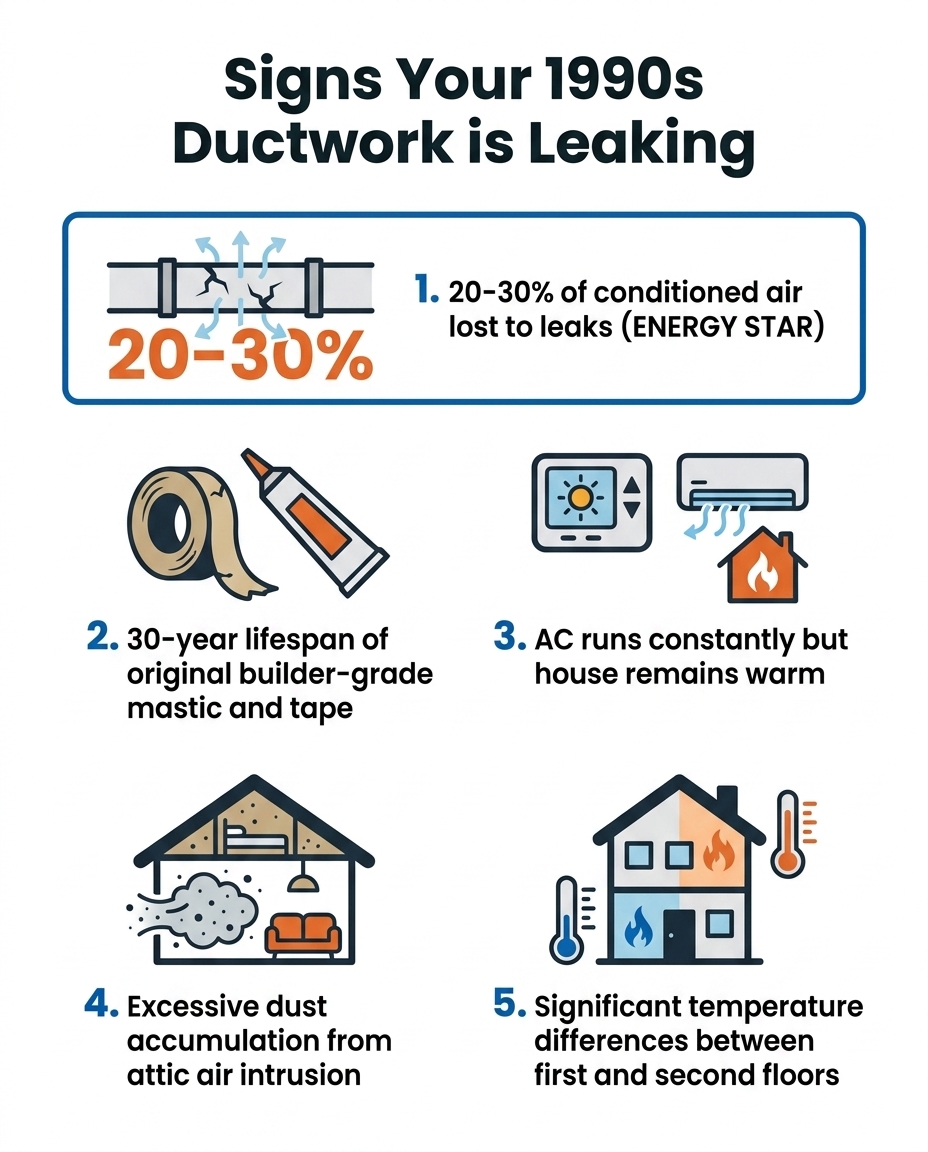
According to ENERGY STAR data, nearly 20 to 30 percent of the conditioned air moving through a typical home's duct system is lost to leaks—a staggering statistic that perfectly captures the hidden cost of leaky ductwork in 1990s Twin Cities subdivisions. It is a frustrating scenario our technicians at Countryside Heating & Cooling Solutions see all the time during the intense heat of late-summer August: your thermostat is set to a comfortable temperature, the outdoor compressor has been humming for hours, yet the living room still feels sticky and warm. When this happens, the immediate assumption is usually that the cooling equipment is failing and needs to be replaced.
However, in our experience, the real culprit is often entirely hidden from view. If your home was built roughly three decades ago, the original materials used to seal your ventilation system have likely reached the end of their functional lifespan. The cold air you are paying to generate is simply escaping into your attic or between your walls before it ever reaches your living spaces. This massive loss of conditioned air forces your equipment to work overtime, driving up your energy usage while leaving you uncomfortable.
Addressing this issue is about much more than just temperature control. When supply ducts push cold air out into unconditioned spaces, return ducts often pull stagnant, dusty air back into the system. This means your system efficiency and your indoor air quality are deeply intertwined issues. By understanding the 30-year countdown of your home's original construction materials, you can make an informed decision between needlessly replacing an overworked cooling unit or letting our team finally fix the underlying structural leaks.
The Building Boom Legacy: Inside 1990s Twin Cities Subdivisions
The 1990s brought a massive wave of suburban housing development across the region. Neighborhoods expanded rapidly, and builders worked quickly to meet the soaring demand for new homes. While we frequently admire the excellent floor plans and sturdy framing of homes from this era, the standard HVAC installation practices of the time left behind a hidden vulnerability that our team sees surfacing exactly three decades later.
During the 1990s, homes were built well before the adoption of modern, stringent blower door and duct leakage testing requirements. Today's building codes require rigorous pressure testing to ensure a home's envelope and ventilation network are airtight. Back then, however, ductwork was often sealed with basic cloth-backed duct tape or early formulations of mastic sealant. Over a 30-year timeline, we have watched these builder-grade materials undergo a slow but inevitable degradation process.
Common 1990s ductwork realities our team encounters include:
• Dried out sealants: Original mastic hardens, turns brittle, and eventually cracks away from sheet metal joints.
• Failing adhesives: Standard duct tape loses its sticky backing when exposed to decades of ambient heat, causing it to peel off entirely.
• Unconditioned routing: Builders frequently routed long runs of sheet metal through unconditioned spaces like attics, crawlspaces, and exterior soffits to save interior space.
• Disconnected joints: Without modern mechanical fasteners, sections of pipe can slowly vibrate apart over thousands of operational cycles.
Because these metal networks were often tucked away out of sight, this degradation happens completely unnoticed by most homeowners. The original sealants have now reached their failure point, leaving gaping holes and disconnected seams right when your system needs to perform at its peak.
How Extreme Temperature Swings Destroy Original Duct Seals
The failure of these 30-year-old seals is not just a matter of time; it is a matter of physics. We see firsthand how the Twin Cities extreme temperature swings—featuring brutal, freezing winters and hot, humid summers—create an aggressive environment that relentlessly attacks ductwork located in unconditioned spaces. Metal ducting is highly susceptible to thermal expansion and contraction, meaning it physically grows and shrinks as temperatures change.
Consider the environment our technicians navigate inside a typical unconditioned attic in Twin Cities suburban subdivisions. During a freezing January night, the ambient temperature in the attic can easily drop below zero. When your heating systems kick on, they blast 120-degree air through freezing cold metal pipes. The sudden introduction of intense heat causes the sheet metal to rapidly expand. The brittle, aging mastic and tape on the joints are forced to stretch, often cracking under the strain.
The exact opposite happens a few months later. During a humid July afternoon, the radiant heat from the sun can push attic temperatures to a sweltering 130 degrees. When the cooling cycle begins, 55-degree air rushes through the blistering hot metal, causing rapid contraction. This extreme, constant flexing happens multiple times a day, every single day, for thirty years.
The mechanical toll of thermal dynamics we regularly repair:
• Joint separation: The constant swelling and shrinking physically pulls metal seams apart.
• Adhesive failure: Extreme attic heat bakes the moisture out of tapes and sealants, turning them to dust.
• Condensation rust: Humid summer air hitting cold metal ducts can create condensation, leading to localized rust that weakens the structural integrity of the joints.
Modern installations use flexible, rubberized sealants and mechanical fasteners designed to move with the metal. The rigid sealants of the 1990s simply cannot survive three decades of this relentless expansion and contraction cycle.
Diagnosing Duct Leaks vs. Failing Air Conditioning Units
Because the symptoms of massive air loss closely mimic the symptoms of a dying compressor, many homeowners misdiagnose the problem. During the sweltering heat of late-summer August, it is easy to assume your unit is simply too old or broken to keep up. However, learning to spot the distinct signs of duct failure can save you from replacing equipment prematurely.
When cold air dumps directly into a hot attic through a broken seam, your air conditioning is forced to run continuously because the thermostat inside the house never reaches its set point. At the same time, leaky return ducts—the pipes responsible for pulling air back to the furnace filter—can suck dirty, unconditioned attic air directly into the system. Our team recently helped a local Maple Plain homeowner who noticed their system struggling. When we inspected it, we found their furnace and internal ductwork were extremely dirty. After a professional cleaning and inspection that provided clear before-and-after documentation, the internal components looked brand new, highlighting just how much attic debris and dust we see bypass failing seals and circulate through a home.
Key symptoms of compromised ductwork we look for:
• Excessive indoor dust: If you have to dust your furniture constantly, your return ducts are likely pulling in attic insulation fibers and dirt.
• Unexplainable hot spots: Certain rooms that never seem to cool down, regardless of how long the system runs.
• Whistling or hissing noises: Audible air pressure escaping from walls or floors near the vents.
• Non-stop operation: The outdoor unit runs for hours without effectively dropping the indoor temperature.
The Two-Story Cooling Challenge
In our experience, second-story bedrooms consistently suffer the most when attic ductwork fails. Pushing dense, heavy cold air up to a second floor requires strong, consistent static pressure within the ventilation network. When a seal breaks in the attic, that internal pressure plummets immediately. The system simply loses the physical force required to push the remaining cool air to the furthest points of the house, leaving the upper bedrooms stagnant and uncomfortably warm while the main floor stays perfectly chilled.
Paying to Cool the Attic: The True Cost of Compromised Ductwork
Ignoring deteriorating ventilation systems carries a steep hidden cost that compounds month after month. Every time your system kicks on, a significant portion of your utility bill goes toward air conditioning an unoccupied attic or crawlspace. In a typical 1990s build, this inefficiency forces the equipment to work significantly harder than it was designed to, leading to a cascade of expensive side effects.
The most immediate impact is accelerated wear and tear on your HVAC equipment. Compressors, blower motors, and electrical capacitors all have finite lifespans based on operational hours. When massive leaks force the system to run non-stop to compensate for lost air, these components degrade much faster, leading to premature breakdowns and unexpected repair bills. Furthermore, the hidden cost of poor indoor air quality takes a toll on your home environment, as fiberglass insulation particles, dust mites, and allergens are actively pulled into your living space.
We regularly meet homeowners who mistakenly believe they need to buy a larger, more powerful unit to solve their comfort issues. In reality, addressing the ductwork can often resolve these problems completely, restoring the necessary pressure to push air upstairs and explaining why your upstairs is always hotter. Sealing the system allows your existing equipment to perform exactly as the manufacturer intended.
• Airflow Delivery — Leaky 1990s Ductwork: Loses 20-30% of conditioned air into the attic. — Professionally Sealed Ductwork: Delivers 100% of conditioned air to living spaces.
• Equipment Lifespan — Leaky 1990s Ductwork: Shortened due to non-stop operation and overworking. — Professionally Sealed Ductwork: Maximized through normal, efficient cycling.
• Indoor Air Quality — Leaky 1990s Ductwork: Poor; pulls attic dust and insulation into the home. — Professionally Sealed Ductwork: Clean; circulates only filtered, indoor air.
• Second-Story Comfort — Leaky 1990s Ductwork: Stagnant, warm, and lacking air pressure. — Professionally Sealed Ductwork: Consistent, cool, and balanced with the main floor.
Modern Blower Door Tests vs. 1990s Building Codes
Understanding the gap between historical building practices and modern efficiency standards is crucial for diagnosing these hidden flaws. Today, new construction must pass strict energy codes, but homes built thirty years ago operate under an entirely different set of rules. This is where our professional diagnostics bridge the gap between old infrastructure and modern performance.
Our team utilizes a professional blower door test as the industry standard for measuring a home's envelope and duct leakage. During this test, a powerful, calibrated fan is temporarily sealed into an exterior doorway. The fan pulls air out of the house, depressurizing the interior. This forces outside air to rush back inside through every unsealed crack, gap, and broken duct joint. Using specialized pressure gauges and thermal imaging cameras, our technicians can pinpoint the exact locations where the 1990s seals have failed.
The modern diagnostic process our team follows typically involves:
1. Depressurization: Calibrating the home's internal pressure to expose hidden leaks.
2. Thermal scanning: Using infrared technology to visually identify cold or hot air escaping behind drywall.
3. Airflow measurement: Calculating the exact percentage of air loss across the entire system.
4. Targeted sealing: Applying modern, flexible aeroseal or advanced mastic to permanently fix the identified weak points.
Having era-specific knowledge is vital when diagnosing historical building flaws. Our experts at Countryside Heating & Cooling Solutions bring deep local expertise in diagnosing the specific construction trends and architectural quirks of Maple Plain and Twin Cities 90s suburban builds. Knowing exactly how these specific subdivisions were framed and where builders typically routed sheet metal allows us to provide faster, more accurate diagnostics without unnecessary invasive searching.
Frequently Asked Questions About Duct Sealing in Older Homes
Why is my AC running constantly but my house is warm?
When your AC runs non-stop without cooling the house, it usually indicates a severe loss of conditioned air. If your home has massive leaks in the ventilation system, the cold air is dumping into the attic or walls before it reaches your thermostat. Because the thermostat never registers the target temperature, it continually signals the compressor to keep running, wasting massive amounts of energy.
How long do duct seals last in older homes?
Original builder-grade mastic and cloth-backed tape used in the 1990s generally have a functional lifespan of about 30 years. Continual exposure to extreme temperature swings in unconditioned spaces causes these materials to dry out, turn brittle, and crack. If your home was built three decades ago, we typically find that your original seals are currently failing or have already failed.
How do I know if my ductwork is leaking?
The most common signs include excessive dust accumulation, unexplainable hot spots in certain rooms, and a noticeable lack of airflow coming from the vents. You might also notice your utility bills climbing higher than normal despite regular equipment maintenance. Our technicians can perform a professional blower door test to definitively measure the exact percentage of air your system is losing.
Does sealing ductwork actually save money and energy?
Yes, sealing your ventilation system is one of the most effective ways to reduce household energy consumption. By preventing 20 to 30 percent of your conditioned air from escaping into the attic, your HVAC equipment cycles off much faster. This reduces your monthly utility bills and prevents premature mechanical breakdowns caused by an overworked system. Additionally, generic utility incentive programs or federal tax credits may apply to qualifying energy-efficiency upgrades, so it is always worth checking with your utility provider or a tax professional.
Can leaky ductwork cause excessive dust in a two-story home?
Absolutely. When return ducts—the pipes that pull air back to the furnace—develop cracks in an attic or crawlspace, they act like a vacuum cleaner. They pull dirt, insulation fibers, and allergens directly from those dirty spaces and blow them through the supply vents into your living areas, requiring you to dust your second-story rooms constantly.
Stop Cooling Your Attic and Reclaim Your Home's Comfort
As the back-to-school transition begins and late-summer August heatwaves push your cooling equipment to its absolute limit, it is important to recognize that an overworked AC is often a symptom, not the root disease. In 30-year-old homes, we find the true problem usually lies hidden in the attic, where deteriorating 1990s seals are slowly leaking your comfort and your energy dollars away.
You do not have to accept uneven cooling, excessive dust, or sky-high utility bills as a normal part of living in an older subdivision. A professional assessment can map out exactly where your system is losing efficiency and provide era-appropriate solutions to permanently seal those gaps. If you are ready to stop wasting energy and finally restore balance to your home, schedule HVAC service today to have your original ductwork evaluated by our local experts at Countryside Heating & Cooling Solutions.
