.webp)

How a New HVAC System Increases Home Value: What Minneapolis-Saint Paul Homeowners Need to Know
How a new HVAC system increases home value is one of the most practical questions you can ask before listing your home — or before deciding whether a big repair bill is worth it. The short answer: yes, it does, and in ways that go beyond just a higher asking price.
Here's a quick breakdown of what the research shows:
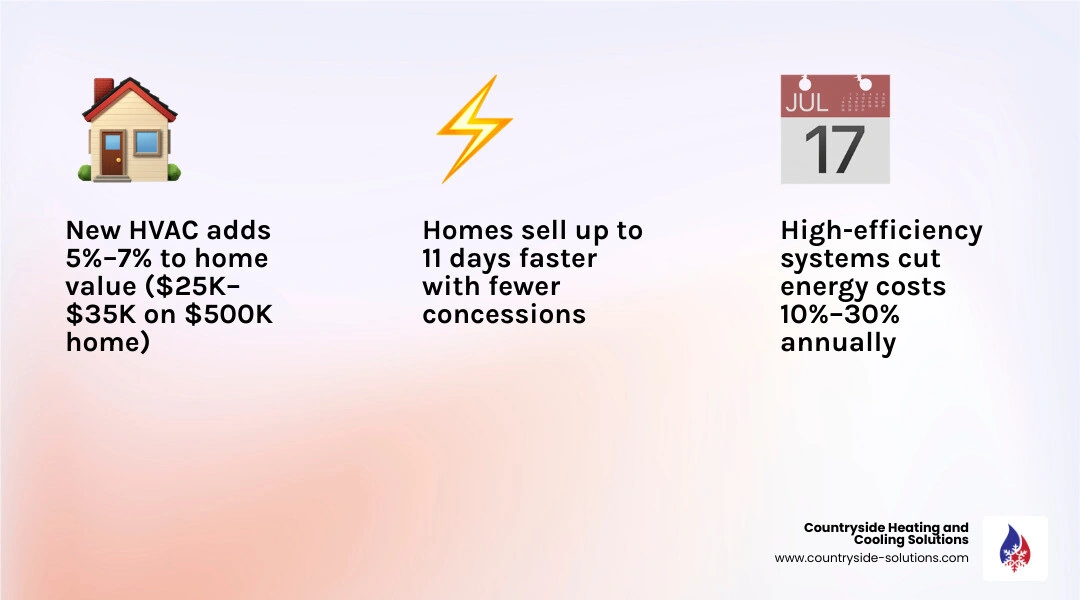
• Resale value boost: A new HVAC system typically adds 5%–7% to a home's value — that's $25,000–$35,000 on a $500,000 home
• Faster sales: Homes with new HVAC systems can sell up to 11 days faster with fewer buyer concessions
• Buyer confidence: A new system signals that the home has been well maintained, which leads to responsible upkeep
• Appraisal strength: Appraisers factor in system age and condition — a new unit avoids red flags that can delay or derail a sale
• Energy savings: High-efficiency systems can cut heating and cooling costs by 10%–30% annually, a real draw for budget-conscious buyers
• ROI: Comprehensive HVAC upgrades can recover approximately 71% of project costs at resale, with some estimates putting ROI between 30%–70%
For homeowners in the Minneapolis-Saint Paul area, this matters even more. Minnesota's brutal winters and humid summers mean buyers are paying close attention to heating and cooling systems. A failing or outdated HVAC isn't just an inconvenience — it's a negotiating chip that works against you.
In this guide, we'll walk through exactly how a new system adds value, which upgrades deliver the best return, and when replacement makes financial sense before you sell.
How a New HVAC System Increases Home Value and Marketability
When you think of home renovations that "wow" buyers, your mind probably goes straight to granite countertops or a finished basement. While those are great, they are aesthetic. An HVAC system is functional. In the real estate world, we often call this "invisible value."

A new system acts as a massive boost to your home's marketability. Think about it from the buyer's perspective: when they walk through a home in Eden Prairie or Minnetonka, they are mentally adding up future costs. If they see a furnace from the 1990s, they see a "to-do" list item that could cost them thousands the moment they move in.
By investing in HVAC Services before you list, you flip that script. Instead of a liability, the heating and cooling system becomes a selling point. This leads to:
• Appraisal Boost: While appraisers don't always give a dollar-for-dollar increase, a new, high-efficiency system prevents "condition" deductions. It signals to the appraiser that the home’s mechanical systems are in top-tier shape.
• Market Speed: Data suggests homes with updated HVAC systems sell up to 11 days faster. In a competitive market like Maple Grove or Chanhassen, being the "move-in ready" house is a huge advantage.
• Negotiation Leverage: A common tactic for buyers is to use an old HVAC system to ask for thousands in repair credits during the inspection phase. A new system removes this leverage entirely.
• Inspection Readiness: Nothing kills a deal faster than a home inspector finding a cracked heat exchanger or a refrigerant leak. A new system ensures a clean bill of health for your home’s "lungs."
Factors That Influence How a New HVAC System Increases Home Value
Not all upgrades are created equal. Several variables determine exactly how much equity you'll build with your new installation.
• Climate Demands: In the Twin Cities, HVAC isn't a luxury; it's a survival tool. Because our climate sees both 95-degree humidity and -20-degree wind chills, the value added by a reliable system is much higher here than in more temperate states.
• System Type: Modern buyers are looking for versatility. Systems that offer both heating and cooling—like high-efficiency heat pumps—often see a higher return.
• SEER2 Ratings: Efficiency is the name of the game in 2026. Systems with high SEER2 (Seasonal Energy Efficiency Ratio) ratings are more attractive because they promise lower monthly bills. You can learn more about these metrics in our guide on HVAC System Energy Efficiency.
• Smart Technology: Integrating a smart thermostat or a "smart-home ready" HVAC interface adds modern appeal. Buyers love the idea of controlling their home's temperature from their phone while commuting home to Wayzata or Edina.
Impact on Home Appraisals and Buyer Negotiations
An appraiser’s job is to determine the fair market value of your home compared to others nearby. If your neighbor’s house sold for a premium and had a brand-new furnace while yours has one that is 20 years old, the appraiser will likely adjust your home’s value downward.
To maximize your appraisal, we recommend keeping a "Home Maintenance Binder." This should include:
1. Installation Date: Proof that the system is new.
2. Maintenance Records: Documentation showing you’ve had Quality HVAC Services performed regularly.
3. Warranty Information: Many modern warranties are transferable to the new owner, which is a massive "peace of mind" bonus for buyers.
Strategic Upgrades for Maximum Return
If you are replacing your system specifically to increase home value, you need to choose the right technology. Here is how the most common options compare:
• Heat Pumps — Typical Home Value Boost: $1,260 – $2,280 — Best For: Eco-conscious buyers & all-in-one comfort
• Central Air — Typical Home Value Boost: $1,170 – $2,370 — Best For: Standard market expectation in MN
• Ductless Mini-Splits — Typical Home Value Boost: $600 – $4,350 (per zone) — Best For: Older homes or additions without ducts
• Geothermal — Typical Home Value Boost: $1,300 – $7,300 — Best For: High-end luxury properties
For many homeowners in areas like Orono or Excelsior, a heat pump is becoming the gold standard. Before you dive in, check out these Things to Know Before Heat Pump Installation to see if it fits your property’s needs.
How a New HVAC System Increases Home Value Through Energy Savings
In April 2026, energy costs are a top-of-mind concern for everyone. A new system doesn't just add value through its hardware; it adds value through the money it doesn't spend.
By choosing ENERGY STAR-certified equipment, you are telling potential buyers that their monthly overhead will be lower. Modern systems can cut energy use by up to 40% compared to units from just 15 years ago. This reduction in the home's carbon footprint is a major selling point for the growing demographic of eco-conscious buyers. We offer specialized Energy Efficiency Services in Maple Plain, MN to help you identify the most "green" options for your specific floor plan.
Regional Importance in the Minneapolis-Saint Paul Metro
Living in the Land of 10,000 Lakes means dealing with 10,000 different weather patterns. A new HVAC system in our region needs to handle:
• Extreme Winters: A furnace that can't keep up with a January "Polar Vortex" is a deal-breaker.
• High Humidity: Our summers are notoriously sticky. A new AC unit with superior dehumidification makes a home feel much more high-end.
• Indoor Air Quality: With homes sealed tight for six months of the year, features like HRVs (Heat Recovery Ventilators) or advanced filtration are highly valued.
Additionally, don't forget to look into Minnesota Energy Rebates for HVAC Upgrades. These can significantly offset your initial investment, making the "pay for itself" math even more attractive.
When to Replace Your System Before Selling
Timing is everything. You don't always need to replace a working system, but there are "red flag" scenarios where a replacement is almost mandatory if you want top dollar for your home.
• System Age: If your furnace or AC is over 15 years old, most buyers will view it as "on its deathbed." Replacing it pre-emptively allows you to market the home as having a "brand-new HVAC," which sounds much better than "working but old."
• R-22 Phase-Out: If your older AC unit still uses R-22 (Freon), it is becoming nearly impossible and incredibly expensive to service. Savvy buyers and inspectors know this. If you're wondering, "Do You Need a New AC Unit?", check the refrigerant type first.
• Frequent Repairs: If you’ve had to call for service more than twice in the last two years, it’s time. Buyers will ask for repair histories, and a long list of fixes can be scary.
Signs Your Current HVAC is Hurting Your Sale
Even if the system "works," it might be driving away buyers during the open house. Watch out for these subtle value-killers:
• Uneven Temperatures: If the upstairs is a sauna while the downstairs is an icebox, buyers will worry about ductwork issues or an undersized unit.
• High Utility Bills: If you provide utility history (which many buyers request), high bills suggest an inefficient, aging system.
• Noise Levels: A furnace that bangs or an outdoor AC unit that sounds like a jet engine suggests imminent failure. If you're noticing these, it might be When to Consider Heater Replacement.
Why Professional Installation Matters for Resale
You might be tempted to find the cheapest possible installer to save money before a sale. Don't do it.
Buyers and inspectors look for quality. A "DIY" or uncertified installation can actually decrease home value because it may not meet local codes in cities like Plymouth or Maple Grove, and it could void the manufacturer’s warranty.
When you choose a company with NATE-certified technicians, you are ensuring the system is sized correctly for the home. An oversized or undersized unit will lead to short-cycling and humidity problems, which an inspector will catch. Knowing What to Look for in a Heating and Cooling Company is the first step in protecting your investment.
Frequently Asked Questions About HVAC and Home Value
Does a new HVAC system increase home value more than a kitchen remodel?
In terms of pure ROI percentage, HVAC often wins. While a kitchen remodel might have a higher "wow" factor, it is also subjective—a buyer might hate your choice of tile. However, every buyer loves a low energy bill and a warm house. HVAC is a "functional" upgrade that offers a more predictable return on investment, often recouping around 71% of costs, whereas high-end kitchens sometimes recoup only 50-60%.
How much does central air add to a home's value in Minnesota?
In the Minneapolis-Saint Paul metro, central air is no longer a luxury—it’s a market standard. Adding central air to a home that previously relied on window units can add up to 10% to the home's value. Buyers in our region expect to be comfortable during our humid July nights, and lacking central air can significantly shrink your pool of potential buyers.
Should I replace my HVAC if it’s 12 years old but still working?
This depends on your goals. If you plan to stay for another five years, the energy savings alone might justify the switch. If you are selling immediately, a 12-year-old system is in a "gray area." If it has a spotless maintenance history, you might be fine. However, if it’s a lower-efficiency model, the "efficiency gap" between your unit and a new SEER2-compliant system might be enough of a selling point to justify the upgrade.
Conclusion
Investing in your home's infrastructure is rarely a mistake. While it might not be as flashy as new paint or hardwood floors, how a new HVAC system increases home value is through reliability, efficiency, and peace of mind.
At Countryside Heating and Cooling Solutions, we understand the unique demands of Minnesota homes. From the historic houses of Wayzata to the new constructions in Maple Grove, we provide the expert service needed to turn your HVAC system into a high-value asset. Our NATE-certified technicians are ready to ensure your installation is handled with the precision that buyers—and appraisers—demand.
Whether you're looking for Trusted HVAC Services from Countryside Heating & Cooling Solutions to maintain your current unit or you're ready for a full system overhaul, we offer guaranteed next-business-day service to keep your project on track.
Ready to boost your home’s equity and comfort? Explore our full range of HVAC Services today and make your home the most desirable one on the block.
