.webp)

Preparing for Fall: The Furnace Upgrade Decision
Are you wondering how navigating the Bryant furnace product line: 80% vs 96% AFUE ratings will impact your home's comfort this winter? As the warm summer weather fades, many homeowners find themselves questioning whether their aging heating system is truly ready for another demanding season. The September pre-heating season is the ideal window to evaluate your equipment before the first deep freeze arrives. If your current unit is struggling, making the decision to upgrade now prevents emergency breakdowns when temperatures plummet.
For professional guidance on your next system, exploring comprehensive heating services can help you understand your options. The core dilemma most homeowners face during an early fall replacement is deciding between a standard 80% AFUE model and a high-efficiency 96% AFUE condensing model. Both provide reliable warmth, but they operate very differently. Making the right choice requires weighing upfront installation requirements against long-term energy utilization, local climate demands, and your home's specific layout. Understanding these key differences early in the season ensures you secure a system that delivers consistent, efficient comfort for years to come.
Decoding AFUE Ratings: What Do the Percentages Actually Mean?
Before diving into specific models, you need to understand the metric that defines furnace efficiency. AFUE stands for Annual Fuel Utilization Efficiency. This rating measures how effectively a furnace converts the fuel it consumes directly into usable heat for your home over a typical year. The higher the percentage, the less fuel is wasted during the combustion process.
The 80% AFUE Baseline
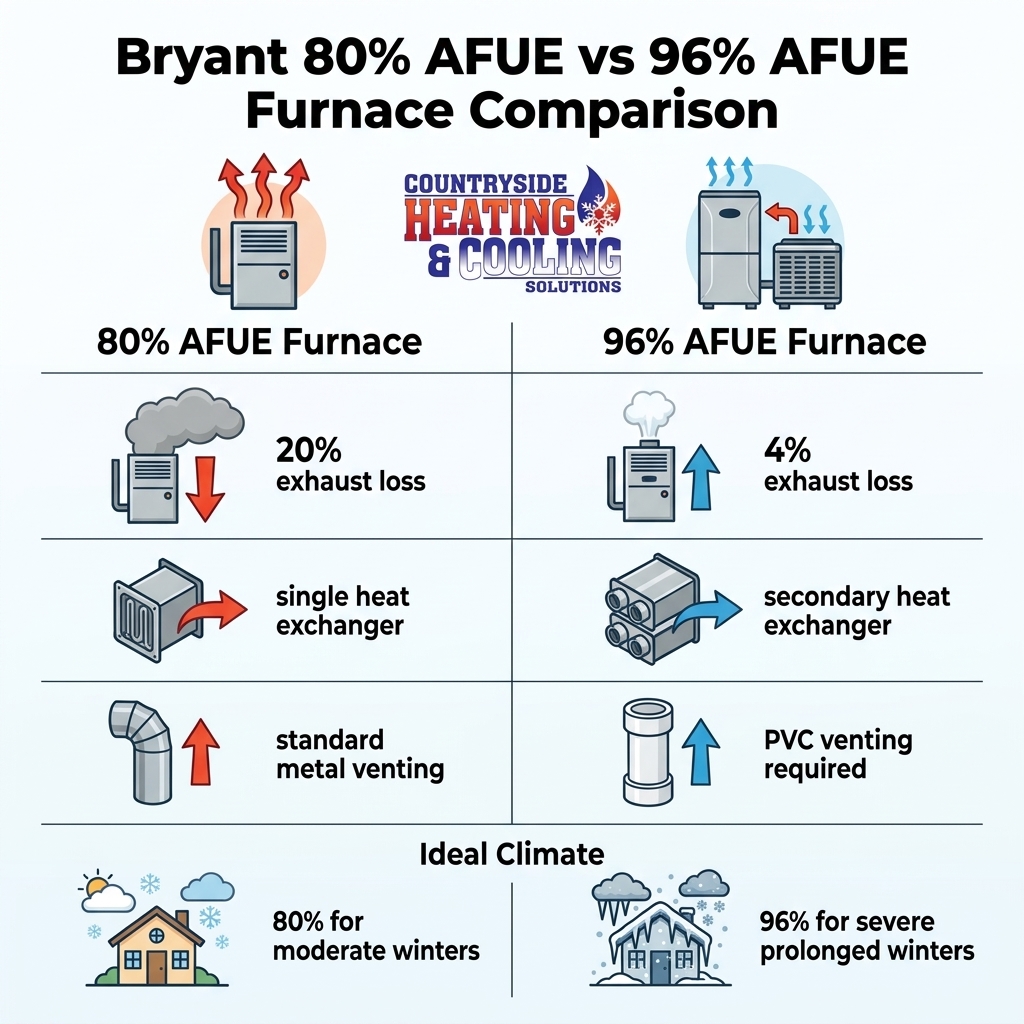
When you look at a standard 80% AFUE furnace, the math is straightforward. For every unit of energy the furnace consumes, 80% is successfully converted into warm air that circulates through your ductwork. The remaining 20% is lost as exhaust gas, venting out through your roof or chimney. While this is a massive improvement over decades-old furnaces that often operated at 60% efficiency, it still means a fifth of the energy you pay for escapes your home without keeping you warm.
The 96% AFUE Advantage
Contrast that standard baseline with a highly efficient model like a Bryant 96% AFUE Condensing Furnace. In this system, 96% of the fuel is converted directly into indoor heat, leaving only a 4% exhaust loss. That 16% difference in efficiency represents a substantial reduction in wasted energy over the entire lifespan of the equipment. Over a decade or more of operation, capturing almost all of the heat generated by the burner fundamentally changes how much energy your home requires to maintain a comfortable temperature.
Standard vs. Condensing Technology: The Engineering Inside
The significant leap in efficiency from 80% to 96% does not happen by accident. It requires a fundamental change in how the furnace is engineered. Standard furnaces rely on a relatively simple combustion process, while high-efficiency models utilize advanced condensing technology to extract every possible degree of warmth.
If you want a detailed look at how these systems stack up, a thorough furnace comparison reveals the mechanical differences that drive these efficiency ratings.
• Heat Exchanger Design — Bryant 80% AFUE Furnace: Single primary heat exchanger — Bryant 96% AFUE Furnace: Primary plus secondary heat exchanger
• Exhaust Loss — Bryant 80% AFUE Furnace: 20% of heat escapes outdoors — Bryant 96% AFUE Furnace: Only 4% of heat escapes outdoors
• Venting Material — Bryant 80% AFUE Furnace: Traditional metal B-vent — Bryant 96% AFUE Furnace: PVC piping (due to cooler, acidic exhaust)
• Condensate Management — Bryant 80% AFUE Furnace: None required (exhaust remains a gas) — Bryant 96% AFUE Furnace: Requires floor drain or condensate pump
• Ideal Application — Bryant 80% AFUE Furnace: Moderate climates or low-usage homes — Bryant 96% AFUE Furnace: Severe, prolonged winter climates
The Role of the Secondary Heat Exchanger
The secret behind the 96% AFUE rating is the secondary heat exchanger. In a standard 80% furnace, the combustion gases are still very hot when they are vented outside. A condensing furnace routes those hot gases into a secondary heat exchanger. This component captures the latent heat that would otherwise be wasted. As the heat is extracted, the exhaust gases cool down significantly and condense into a liquid state—which is exactly where the term "condensing furnace" originates. Bryant's specific engineering ensures this condensation is managed safely, maximizing fuel utilization and ensuring every ounce of energy is leveraged for your indoor comfort.
The Minnesota Climate Factor: Why Extreme Winters Shift the Balance
Efficiency ratings do not exist in a vacuum; they are heavily influenced by where you live. In regions with mild, short winters, a standard 80% furnace might be perfectly adequate because the heating system only runs intermittently. However, the long, severe winters in Maple Plain, MN demand continuous, heavy furnace operation for months on end. When the temperature drops below zero and stays there, your furnace becomes the hardest-working appliance in your home.
This prolonged heavy usage is exactly why the local climate shifts the balance toward high-efficiency models. When you explore Bryant HVAC products, you have to factor in the compounding effect of continuous operation. A 16% efficiency gap might seem moderate if you only run your heat for a few weeks a year. But when your system is running for hours every single day from November through March, that 16% reduction in wasted energy drastically reduces your overall seasonal energy consumption.
The Compounding Effect of Continuous Operation
Think of it like vehicle mileage. If you only drive a few miles a week, fuel efficiency isn't a massive concern. But if you commute hundreds of miles a day in harsh conditions, a highly efficient engine becomes a strategic necessity. A 96% AFUE model is specifically designed for homes facing harsh northern winters, ensuring that the heavy energy demands of the season are met with minimal waste.
Installation Nuances: Venting and Space Requirements
Upgrading to a high-efficiency condensing furnace is not a simple "plug and play" swap if you are replacing an older standard model. The mechanical differences dictate entirely different installation protocols. Understanding these nuances early in the fall ensures your home is physically prepared for the upgrade before freezing temperatures arrive.
Proper installation is critical to prevent operational faults, such as those issues that cause your Bryant furnace to keep shutting on and off.
1. Venting Material Changes: Standard 80% AFUE furnaces typically use traditional metal venting (known as B-vent) to safely expel hot exhaust gases up through a chimney or roof. Because 96% AFUE models extract so much heat from the exhaust, the remaining gases are significantly cooler and slightly acidic. This requires the installation of dedicated PVC piping, which is often routed directly out the side of the house.
2. Managing Liquid Condensation: As the secondary heat exchanger cools the combustion gases, water vapor condenses into a liquid. This means a 96% AFUE furnace produces a steady stream of water during operation. Installers must route a dedicated PVC drain line to a nearby floor drain.
3. Condensate Pump Installation: If your utility room does not have an accessible floor drain, a condensate pump must be installed to push the acidic water up and out of the basement safely.
4. Space and Clearance: Condensing furnaces often have different physical footprints and require specific clearances for the new PVC intake and exhaust pipes. Your installer will need to evaluate your mechanical room to ensure adequate space for the new configuration.
These logistical changes make early fall the perfect time for an upgrade. Complex PVC routing and drainage work is much easier to complete when technicians aren't battling snowbanks and sub-zero temperatures.
Evaluating Long-Term Energy Efficiency and Generic Incentives
When choosing between an 80% and a 96% AFUE furnace, it is vital to look beyond the initial installation day. The true value of a condensing furnace is realized over years of reduced energy consumption. By capturing 96% of the heat generated, your system runs shorter cycles and consumes less fuel to maintain your desired thermostat setting, which significantly lowers your seasonal energy usage.
Furthermore, high-efficiency heating equipment frequently qualifies for generic utility energy rebates and federal tax credits designed to encourage energy conservation. While programs vary by region and year, choosing a 96% AFUE system often opens the door to these incentives. We always recommend consulting with your local utility provider or a qualified tax professional to verify currently available incentive programs in your area.
To help bridge the gap between standard and high-efficiency models, many homeowners take advantage of flexible HVAC financing options. Financing allows you to invest in the superior 96% technology today while enjoying the long-term energy utilization benefits throughout the harsh Minnesota winters.
The Importance of Elite Installation for High-Efficiency Systems
Even the most advanced 96% AFUE Bryant furnace will underperform if it is not installed with precision. High-efficiency systems are incredibly sensitive to airflow, proper sizing, and exact venting specifications. If the PVC venting is pitched incorrectly, or if the condensate drainage is mishandled, the furnace will struggle to operate safely and efficiently.
This is where the expertise of your installation team becomes just as important as the equipment itself. Proper sizing and airflow calculations are critical to maximizing the lifespan of the unit. Choosing a highly awarded local dealer ensures peace of mind, proper calibration, and reliable long-term support. As a Bryant Medal of Excellence and Circle of Champions Award Winner, Countryside Heating & Cooling Solutions brings elite, brand-specific authority to every installation, ensuring your system operates exactly as the manufacturer intended.
One homeowner reached out during the fall when they needed a new Bryant furnace installed. After gathering multiple bids and researching their options, they chose to move forward with a comprehensive installation from a dedicated team. Because the installers took the time to properly calibrate the system and handle the complex venting correctly from day one, the furnace has operated with zero issues for over five years. That is the kind of reliability that only comes from elite, professional installation.
Frequently Asked Questions About Bryant Furnace Upgrades
Is a 96% efficient furnace worth it in Minnesota?
Yes, a 96% efficient furnace is highly beneficial in Minnesota due to the severe and prolonged winter climate. Because your heating system runs continuously for months, the 16% reduction in wasted energy compared to an 80% model drastically lowers your overall seasonal energy consumption. Over the lifespan of the unit, this improved fuel utilization makes the high-efficiency upgrade a smart long-term choice.
What is the difference between an 80% and 96% Bryant furnace?
The primary difference lies in how they handle exhaust heat. An 80% AFUE furnace uses a single heat exchanger, losing 20% of its heat through metal exhaust vents. A 96% AFUE Bryant furnace uses a secondary heat exchanger to capture latent heat from the exhaust, ensuring 96% of the fuel is converted to usable indoor heat while only 4% is wasted.
Do high efficiency Bryant furnaces require special venting?
Yes, high-efficiency Bryant furnaces require dedicated PVC venting rather than traditional metal B-vents. Because the secondary heat exchanger removes so much heat from the exhaust, the remaining gases are cool and slightly acidic. PVC pipe safely handles this acidic exhaust and is typically routed horizontally out the side of your home.
How long does a 96% furnace typically last?
When properly installed and maintained, a 96% AFUE condensing furnace typically lasts between 15 and 20 years. Consistent annual maintenance, including checking the condensate drain and secondary heat exchanger, is vital to reaching the upper end of that lifespan. Elite installation also plays a major role in preventing premature wear and tear.
Can I upgrade from an 80% to a 96% furnace using my existing ductwork?
In most cases, you can use your existing ductwork, but a professional must evaluate it first. High-efficiency furnaces require precise airflow to operate correctly, so your technician will check if your current ducts are properly sized and sealed. If the existing ductwork is undersized, it may need modifications to accommodate the new system's airflow requirements.
Make a Confident Choice for Your Next Heating System
Deciding between an 80% and a 96% AFUE Bryant furnace comes down to understanding your home's long-term needs. While an 80% AFUE furnace provides reliable, basic heating for moderate applications, a 96% AFUE condensing model offers superior energy utilization that is tailor-made for harsh northern winters. By capturing nearly all the heat it generates, a high-efficiency system minimizes waste and maximizes your comfort.
A clear, regionally-aware breakdown empowers you to make the best choice for your home without the guesswork. Don't wait until the first blizzard hits to evaluate your aging system. Schedule a consultation with an expert today to review your specific home layout, discuss your heating needs, and ensure your family stays reliably warm all winter long.
