.webp)

The Late-Summer Dilemma: To Cover or Not to Cover Your Air Conditioner
The late-summer to fall transition is just around the corner. As the nights grow cooler and families gear up for the back-to-school transition, you might find yourself asking: should you cover your AC unit at the end of summer? The rust debate is one of the most common seasonal dilemmas homeowners face. Here at Countryside Heating & Cooling Solutions, we hear this question from Maple Plain residents every August. Before the first frost hits, the instinct to protect your expensive outdoor equipment from the harsh elements is completely natural. However, doing the wrong thing can actually cause more harm than good. Before you grab a tarp and some bungee cords, it is critical to understand how your system is designed to handle the weather. If you want to protect your air conditioning systems for the long haul, our team recommends that the best step is to schedule your end-of-season AC maintenance rather than wrapping it in plastic.
As August fades into September, the looming threat of heavy Minnesota snow and freezing temperatures starts to weigh on every homeowner's mind. You spend time raking leaves, draining garden hoses, and winterizing the lawn mower. It seems completely logical to extend that same level of protection to your outdoor condenser. After all, nobody wants a machine filled with delicate electrical components sitting exposed to blizzards and ice storms.
The core debate: Homeowners are often torn between the fear of snow accumulation damaging the internal parts and the warnings from HVAC professionals about trapping moisture. It is a battle between what feels right intuitively and what the science of metal oxidation dictates.
Why the Intuitive Choice is Often the Wrong Choice
Many people assume that because we wear heavy coats to protect ourselves from the winter weather, our appliances need a "coat" as well. In our experience, this leads to the most destructive DIY mistake you can make during the late-summer to fall transition: tightly wrapping the entire outdoor condenser in a plastic tarp or a heavy-duty vinyl cover.
• The intention: Keeping snow, ice, and autumn leaves out of the fan blades and away from the delicate fins.
• The reality: Creating a sealed, artificial environment that blocks natural airflow, traps ground moisture, and accelerates the degradation of the very components you are trying to protect.
Modern air conditioning systems are designed with entirely different engineering principles than most homeowners realize. To make the best decision for your home's comfort system, we need to look at exactly how these units are built to survive the outdoors.
Built for the Elements: The Anatomy of an Outdoor Condenser
To understand why covering your unit is usually a mistake, you have to look at how manufacturers design outdoor condensers. These units are not fragile indoor appliances that were accidentally placed outside. They are heavily engineered pieces of equipment built specifically to live outside in places like Maple Plain, MN and surrounding areas, enduring decades of severe weather. When our technicians perform late-summer wear inspections, we see exactly how resilient these systems are.
When you look at your outdoor unit, you are looking at a masterclass in weather resistance. The materials chosen for its construction are specifically selected for their ability to shrug off rain, snow, sleet, and extreme temperature fluctuations.
1. Galvanized Steel Cabinets: The outer shell of your AC unit is typically made from heavy-duty galvanized steel. This metal is treated with a zinc coating that acts as a sacrificial barrier against rust, followed by a baked-on powder-coat finish that resists chipping and fading from UV rays.
2. Aluminum Fins: The delicate-looking fins that surround the unit are made of aluminum. Unlike iron or bare steel, aluminum does not rust in the traditional sense. When exposed to air, it forms a microscopic layer of aluminum oxide that actually protects the metal underneath from further corrosion.
3. Copper Tubing: The internal coils that carry the refrigerant are usually made of copper. Copper is highly resistant to corrosion from natural precipitation and is chosen specifically because it can handle the intense pressure and temperature changes of the cooling cycle while sitting out in the rain.
4. Sealed Electrical Contacts: The vital electrical components, such as the contactor and the capacitor, are housed within a weather-tight control box designed to keep direct rainfall and melting snow away from live voltage.
Natural Exposure vs. Artificial Environments
Natural snow accumulation on the outside of the unit does not inherently damage the internal coils. Snow is simply frozen water, and when it melts in the open air, it evaporates harmlessly into the breeze.
• Heavy Rain — How the Unit is Designed to Handle It: Water washes over the coils, cleaning away summer dust, and drains out the bottom. — What Happens if Covered: Cover blocks rain but traps rising ground moisture inside.
• Snow Accumulation — How the Unit is Designed to Handle It: Snow sits on the durable top grate and outer cabinet, melting harmlessly as temps rise. — What Happens if Covered: Cover prevents snow from entering, but traps condensation from the freeze-thaw cycle.
• High Winds — How the Unit is Designed to Handle It: Wind blows through the open fins, keeping the interior dry and free of persistent humidity. — What Happens if Covered: Cover blocks the wind, eliminating the unit's natural ability to dry itself out.
Contrast natural weather exposure with the artificial environment created by a tight plastic cover. By trying to protect the unit from the top-down threats of snow, you inadvertently create a bottom-up threat that the manufacturer never intended the unit to face.
The Science of Trapped Moisture: How Plastic Covers Accelerate Rust
The real danger to your air conditioner during a Midwest winter is not the snow falling from the sky; it is the moisture rising from the ground. As the local authority on HVAC longevity, Countryside Heating & Cooling Solutions has seen the firsthand damage of DIY plastic wrapping in the region. Time and time again during our end-of-season evaluations, we encounter systems that have aged prematurely simply because they were suffocated under a tarp.
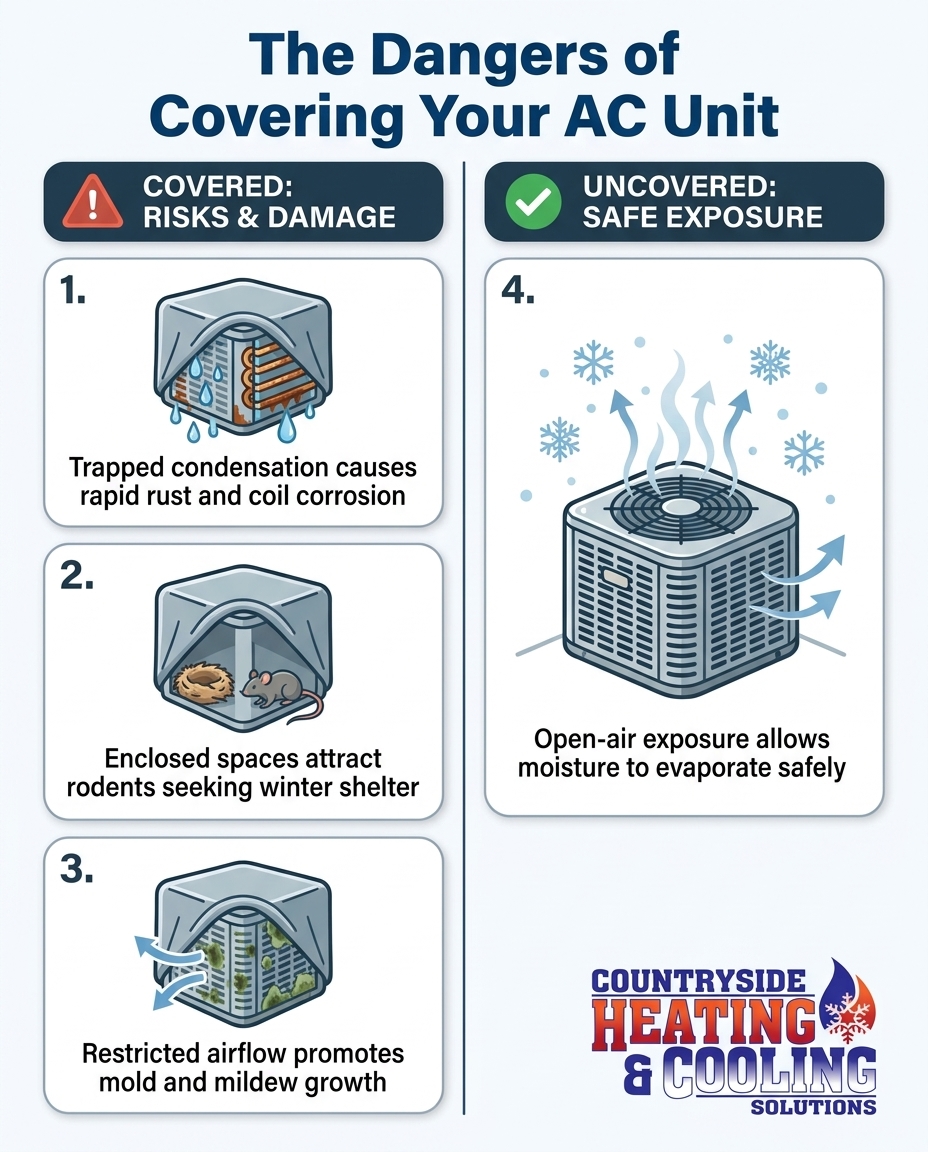
The Problem: The specific Minnesota freeze/thaw condensation cycle makes plastic tarps far worse than natural snow exposure. Throughout the winter, the ground beneath your AC unit holds moisture. Even on freezing days, the sun can heat the air trapped under a dark plastic cover. This causes ground moisture to evaporate and rise.
The Cause: Because the plastic tarp is non-breathable, that rising water vapor has nowhere to go. It hits the cold metal of your AC condenser and immediately condenses into water droplets. When the sun goes down and temperatures plummet, those water droplets freeze directly onto the copper coils, aluminum fins, and electrical wiring. This cycle repeats daily, creating a persistent, damp environment inside the unit.
The Solution: Leaving the sides of the unit exposed to the open air allows the winter wind to carry that evaporating ground moisture away before it can settle and condense on your equipment. Open-air exposure is the key to keeping the unit dry.
Oxidation and Your Condenser Coils
Moisture needs to evaporate; covers prevent this. When moisture is trapped on the coils for months on end, it accelerates a process called galvanic corrosion. This happens when two dissimilar metals (like copper and aluminum) are in contact in the presence of an electrolyte (dirty water from condensation). Prolonged dampness degrades the metal faster than freezing snow ever could, leading to micro-leaks in the refrigerant lines that will ruin your system.
Furthermore, restricted airflow under a tight cover promotes mold and mildew growth on the internal components. When spring arrives, turning on a damp, moldy unit forces your system to work harder. Speaking of temperature shifts, if you are wondering about the transition seasons, it is also important to understand the danger of running your AC when temperatures drop below 60 degrees, as improper operation in cold weather can cause internal freezing completely separate from winter storage issues.
The Unintended Consequence: Creating a Winter Haven for Rodents
Rust and corrosion are not the only threats born from trapping your unit under plastic. There is a biological threat that becomes highly active during the late-summer to fall transition. As temperatures begin to drop across the state, local wildlife goes into survival mode, desperately seeking out warm, dry places to build their winter nests.
Mice, chipmunks, and other rodents actively seek out enclosed, wind-protected spaces as the frost sets in. When you tightly wrap your air conditioner in a tarp, you are essentially building a luxury winter condo for neighborhood pests.
Why covered AC units attract pests:
• Protection from predators: A thick vinyl cover hides rodents from owls, hawks, and neighborhood cats.
• Protection from the wind: The cover blocks the biting winter wind, keeping the interior temperature slightly warmer than the exposed outdoors.
• Dry nesting material: Leaves and debris that blew into the unit during the fall stay perfectly dry under the cover, providing ready-made bedding.
Once rodents move into your condenser, they do not just sleep there. They chew. Rodents have teeth that constantly grow, meaning they need to gnaw on things to file them down. Inside an AC unit, they frequently chew through essential electrical wiring, strip the insulation off the refrigerant lines, and build dense nests directly inside the fan blades.
When spring rolls around and you pull the cover off, you may be greeted by severed wires, a seized fan motor, and a massive repair bill. Our team regularly responds to springtime service calls to clear out elaborate nests and replace chewed wiring that could have been completely avoided. We emphasize this rule of thumb: leaving the unit open to the wind deters pests naturally. Rodents hate drafting, windy, exposed spaces. By leaving the cover off, you make the unit an incredibly unappealing place for a mouse to spend the winter.
The Plywood Compromise: Protecting Against Ice and Debris Safely
Even after learning about the dangers of trapped moisture and rodents, many homeowners we speak with still feel uneasy leaving their unit completely unprotected. This is a valid concern, especially during the late-summer to fall transition when heavy oak and maple leaves are dropping, or in the dead of winter when heavy icicles hang from the roof eaves directly above the condenser.
Falling ice and heavy debris are legitimate concerns that can physically dent the fan grate or bend the aluminum fins. So, how do you protect the top of the unit without suffocating the sides? The answer our technicians suggest is the "plywood on top only" method.
The Safe Alternative: Top-Down Protection
1. Measure the top: Measure the top grate of your air conditioner.
2. Cut the wood: Cut a piece of standard exterior-grade plywood so that it overhangs the top edge of the unit by about one inch on all sides.
3. Place it carefully: Lay the plywood flat directly on top of the fan grate. This creates a hard shield that will deflect falling icicles, heavy wet snow, and autumn leaves.
4. Weigh it down securely: Do not use bungee cords that wrap around the sides. Instead, simply place two or three heavy bricks or a cinder block squarely in the center of the plywood to keep the winter winds from blowing it away.
This compromise is the perfect solution. It protects the fragile fan blades and internal cabinet from top-down physical damage while leaving all four sides completely open. The wind can still blow through the fins, moisture can still evaporate, and rodents are left without a windbreak. You get the peace of protecting your investment without the destructive side effects of a plastic wrap.
Pivoting to Fall: Professional Maintenance Over DIY Fixes
Ultimately, the best way to protect an AC unit is through proper end-of-season cleaning, not covering. Wrapping a dirty unit in plastic just seals in the dirt, grass clippings, and cottonwood seeds that accumulated over the summer, giving them months to rot and corrode the metal.
Before the first snow flies, we highly recommend taking a hose and gently washing away any organic debris from the outside of the fins. Clearing away leaves and dirt ensures that the unit can breathe properly during its dormant months. However, the most effective transition strategy involves looking at your home's total comfort system.
As the house gets closed up tightly for the winter, your focus should naturally shift from cooling to heating. In our experience serving Maple Plain, homeowners who rely on consistent routine maintenance and repairs for heating and cooling systems find that catching minor issues during the fall transition prevents mid-winter emergencies when the temperatures plummet below zero. Now is the exact right time to prepare your heating system for winter with a comprehensive professional inspection.
Addressing Indoor Air Quality Before Winter
As windows close and the house is sealed against the cold, your indoor air quality naturally drops. The same air is recirculated through your ductwork for months. Proper HVAC maintenance is directly linked to better air circulation and filtration during the heating season.
During a fall tune-up, our technicians don't just look at the furnace burners; they evaluate the airflow, check the blower motor, and ensure your filters are ready for the heavy workload ahead. If your home tends to feel stuffy or dry during the winter, exploring indoor air quality solutions now can make the next six months significantly more comfortable for your family.
Frequently Asked Questions About Winterizing AC Units
Do AC covers cause rust?
Yes, non-breathable AC covers are a leading cause of rust and corrosion. They trap evaporating ground moisture inside the unit, which condenses on the cold metal components. Because the cover blocks the wind, this moisture never dries, accelerating the oxidation of your copper coils and steel electrical contacts throughout the winter.
Should I cover my AC unit in the winter?
No, you should not fully cover your AC unit during the winter months. Modern outdoor condensers are specifically engineered to withstand freezing temperatures, snow, and rain. Fully wrapping the unit creates an artificial environment that traps moisture and invites rodents, causing far more damage than natural weather exposure.
How do I protect my outside AC unit from snow?
The safest way to protect your unit from heavy, falling snow or ice is to place a piece of plywood directly on top of the unit, weighed down with a few bricks. This shields the fan grate from top-down impacts while leaving the sides completely open so the unit can breathe and moisture can evaporate naturally.
What happens if I don't cover my air conditioner?
If you don't cover your air conditioner, it will function exactly as the manufacturer intended. Snow will accumulate on the outside, melt when the sun comes out, and evaporate harmlessly into the air. The internal components will remain well-ventilated, dry, and free of the destructive condensation that ruins covered units.
Can I use a breathable canvas cover instead of plastic?
While a breathable canvas cover is slightly better than a plastic tarp because it allows some vapor to escape, it is still generally unnecessary and can still provide a windbreak that attracts nesting rodents. If you must use a manufactured cover, ensure it only covers the top few inches of the unit and leaves the side coils completely exposed to the open air.
Protect Your Investment the Right Way This Fall
When asking yourself, should you cover your AC unit at the end of summer? The rust debate clearly favors leaving the plastic tarps in the garage. Natural snow exposure is drastically safer for your equipment than the trapped moisture, accelerated corrosion, and rodent infestations caused by fully wrapping the condenser.
If you have trees overhead or gutters that tend to form heavy icicles, remember to use the simple plywood method to protect the fan blades without restricting critical airflow. As we move deeper into the late-summer to fall transition, the focus should shift from DIY exterior covers to professional interior preparation. Give your system the care it actually needs to survive the season, and schedule an inspection with Countryside Heating & Cooling Solutions to ensure both your cooling and heating systems are fully prepped for the seasonal shift.
