.webp)

Navigating the Fall Temperature Rollercoaster
September in the Midwest brings a predictable but frustrating weather pattern, making Switching Your Bryant Thermostat from Cool to Heat: Common Pitfalls a highly relevant topic for local homeowners. The transition season arrives with sharp contrasts: you wake up to frosty, freezing mornings, only to find yourself sweating in the afternoon sun. This specific time of year—a September early fall with large daily temperature swings—creates a unique challenge for your home's climate control system. Your house is trapped between needing a furnace to take the morning chill off and an air conditioner to keep the afternoon humidity at bay.
Many homeowners rely on modern technology to handle this transition automatically. However, experiencing annoying system short-cycling and unnecessary wear because a Bryant thermostat is set to 'Auto' during the volatile temperature swings of a Minnesota September is a concrete problem our Countryside Heating & Cooling Solutions technicians see repeatedly. Your heating and cooling system begins to act erratically, turning on and off in rapid succession. You are suddenly faced with a decision: do you continue to rely on the thermostat's 'Auto' changeover feature, or do you step in and manually toggle between 'Heat' and 'Cool' during unpredictable early fall weather? Making the right choice determines how efficiently your system runs and how long your equipment lasts.
If you are struggling to keep your home comfortable during this seasonal shift and need professional insight, exploring our heating services is a great place to start.
Understanding the 'Auto-Changeover' Trap
The 'Auto' setting on modern climate controls is marketed as the ultimate set-it-and-forget-it convenience. In theory, Bryant thermostats with Auto-Changeover functionality monitor the indoor temperature and automatically decide whether to activate the furnace or the air conditioner. You set your desired parameters, and the computer does the rest. However, our team frequently finds that this automated logic breaks down quickly when exposed to the reality of early fall weather in the Midwest.
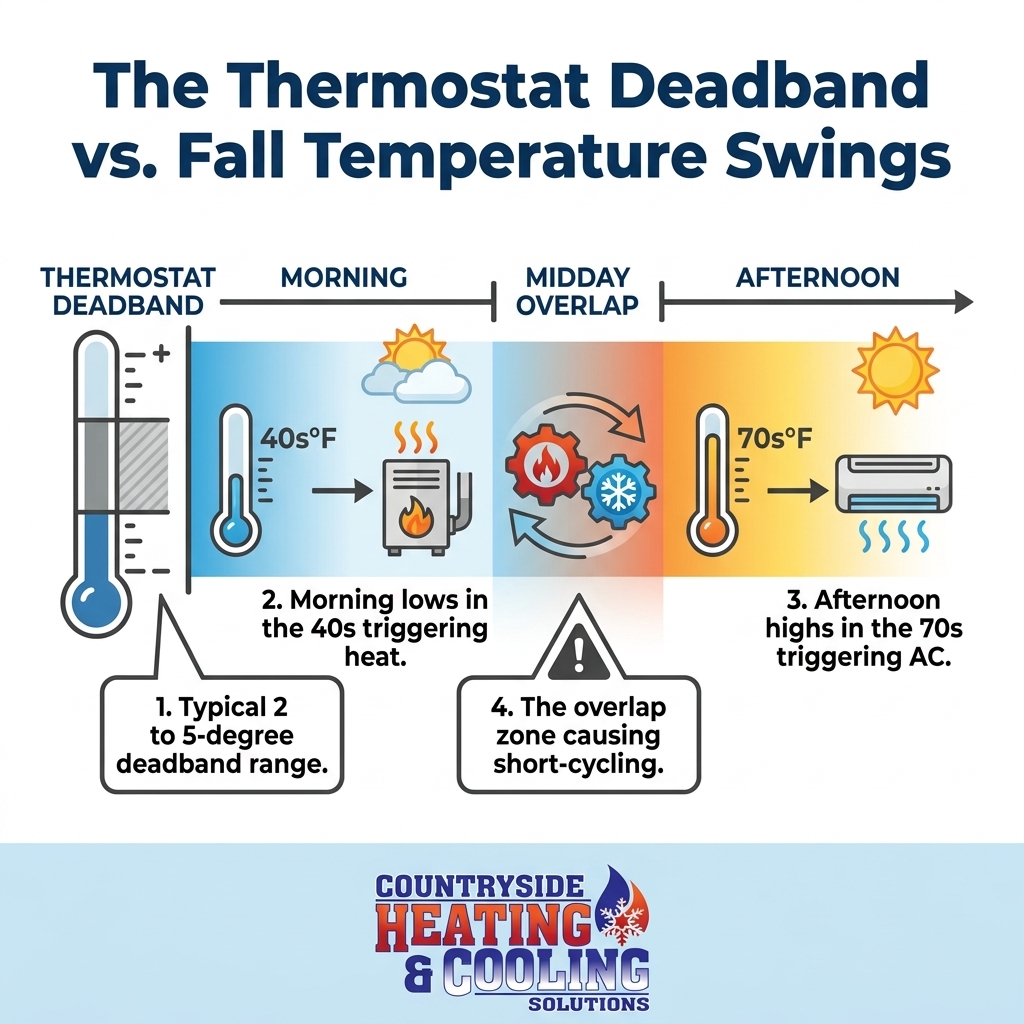
In our years of serving Maple Plain, MN, we know firsthand that early fall weather is notoriously volatile. It is completely normal to experience morning lows dropping into the 40s, followed by afternoon highs soaring into the 70s. This rapid 30-degree outdoor temperature swing creates the exact conditions that confuse an automated thermostat. The system detects the morning chill and fires up the furnace to warm the house. A few hours later, the sun hits the windows, the indoor temperature spikes, and the thermostat immediately commands the air conditioner to turn on. The system is essentially fighting itself, trying to balance two extremes within a single 24-hour period.
The Mechanics of the Deadband
To understand why this happens, our technicians often explain how thermostat logic processes temperature gaps. Auto-changeover features rely on a concept called a "deadband." The deadband is a programmed buffer zone—usually a 2 to 5-degree range—between your heating setpoint and your cooling setpoint.
• The heating setpoint: The temperature at which the furnace turns on (e.g., 68°F).
• The cooling setpoint: The temperature at which the AC kicks in (e.g., 72°F).
• The deadband: The 4-degree gap in between where neither system runs.
A narrow deadband is highly problematic in the Midwest. When the outdoor temperature swings wildly, the indoor ambient temperature easily breaches both ends of that narrow buffer zone in the same afternoon. Furthermore, the thermostat measures the ambient air immediately surrounding it, as well as the thermal mass of the wall it is mounted on. If the wall is still cold from the morning, but the room air is warming up rapidly from afternoon sunlight, the thermostat receives conflicting data. This results in "short-cycling," where the system rapidly switches between heating and cooling modes, never running long enough to properly condition the air or remove humidity.
When Thermostat Confusion Mimics a Broken System
When a heating and cooling system is fighting itself, the symptoms often look like a major mechanical failure. You might hear the furnace shut down, only to hear the outdoor AC compressor grind to life minutes later. The blower motor might run continuously without pushing noticeably warm or cold air. To a homeowner, this erratic behavior feels like a crisis. We find it incredibly common for people to assume their thermostat is completely broken when, in reality, it is simply following the Auto logic it was programmed with.
During a sudden cold snap last fall, one local homeowner thought their furnace had completely failed just as they needed it most. One of our technicians, Nick B., arrived to investigate the cold weather malfunction and quickly identified the issue. The furnace wasn't broken at all; the thermostat was caught in a logic loop due to a narrow auto-changeover setting. A quick adjustment to the settings restored the heat immediately. This type of scenario plays out constantly during our transition season service calls.
Knowing the difference between a confused thermostat and a broken one saves you time and stress. If your screen is blank, unresponsive, or flashing a specific fault code, the equipment may genuinely need a hard reset or a repair. You can learn more about resetting Bryant thermostat error codes to determine if a fault has occurred. However, if the screen is active and simply displaying "Auto," the erratic behavior is almost certainly due to the system trying to keep up with the September early fall with large daily temperature swings. A simple mode change prevents an unnecessary panic.
The Hidden Costs of System Short-Cycling
Allowing your system to rapidly switch between heating and cooling does more than just create an annoying background noise in your home. When our service team inspects equipment after a volatile fall season, we often see the immense mechanical and financial strain this places on your system. Bryant thermostats with Auto-Changeover functionality are built to exact specifications, but forcing the attached equipment to short-cycle violates the basic operational limits of residential HVAC systems.
When the furnace and air conditioner fight each other in a single 24-hour period, you are paying to heat air that you will pay to cool just a few hours later. This is a massive waste of energy that reflects directly on your utility bills. But the hidden costs go far beyond energy consumption. The real danger lies in the accelerated wear and tear on your system's most expensive components.
Wear and Tear on Critical Components
Every time an HVAC system starts up, it draws a massive surge of electricity—often five to seven times its normal running current. This startup phase is the most stressful moment for any mechanical system.
• Blower Motor Fatigue: The indoor blower motor is forced to start, stop, and restart constantly. This continuous cycling increases friction, generates excess heat in the motor windings, and significantly shortens the lifespan of the component.
• Compressor Strain: The outdoor AC compressor is the heart of your cooling system. Short-cycling prevents the refrigerant pressures from equalizing properly before the unit is asked to start again. Starting a compressor against unequalized pressure is incredibly damaging and can lead to premature failure.
• Ignition System Wear: Your furnace's hot surface igniter and gas valve are designed for steady, prolonged heating cycles. Rapid, short bursts of heat cause unnecessary thermal expansion and contraction, leading to cracked igniters or failing valves.
If you are looking for a system that handles transition seasons with more grace and fewer harsh startups, you might consider how a modern heat pump modulates its output to match the exact heating or cooling load of the home.
Manual vs. Auto: Making the Right Call for Your Bryant System
When weighing the convenience of the Auto mode against the practical reality of Midwest fall weather, the choice becomes clear. While it is tempting to let the computer make the decisions, the unpredictable nature of September weather demands a more hands-on approach.
As an award-winning Bryant dealer recognized with the Medal of Excellence and Circle of Champions, our team at Countryside Heating & Cooling Solutions understands the internal logic of this equipment better than anyone. Our definitive recommendation based on years of local, manufacturer-specific experience is this: manually switch your thermostat from Cool to Heat until winter temperatures stabilize.
Taking manual control protects the internal logic of the equipment and extends its lifespan. By forcing the system into a single mode, you eliminate the possibility of short-cycling caused by deadband breaches. You also ensure that your Bryant HVAC systems are allowed to run full, efficient cycles that properly condition the air and manage indoor humidity.
• System Cycling — Auto Mode (During Fall): High risk of short-cycling between heat and cool. — Manual Mode (During Fall): Runs long, efficient cycles in one dedicated mode.
• Component Wear — Auto Mode (During Fall): Accelerated wear on blower motors and compressors. — Manual Mode (During Fall): Normal wear; protects expensive startup components.
• Energy Efficiency — Auto Mode (During Fall): Poor; wastes energy fighting its own temperature sets. — Manual Mode (During Fall): High; only uses energy for the specific mode selected.
• Comfort Level — Auto Mode (During Fall): Inconsistent; often leaves the house feeling clammy. — Manual Mode (During Fall): Consistent; manages both temperature and humidity effectively.
Proper Steps for a Manual Seasonal Changeover
Switching your system manually is simple, but doing it in the correct sequence ensures you don't inadvertently stress the equipment. Follow these safe, non-technical steps our technicians recommend to transition your Bryant thermostat for the heating season.
1. Turn the system to 'Off': Before toggling between modes, switch the thermostat to the "Off" position. Wait at least three to five minutes. This allows the indoor blower motor to completely cycle down and gives the outdoor compressor time to equalize its internal pressures.
2. Adjust the mode to 'Heat': Once the system is completely quiet, navigate your thermostat menu or toggle switch from "Off" directly to "Heat." Do not stop on "Auto."
3. Set the temperature: Adjust your heating setpoint a few degrees above the current room temperature. This will send a clear, immediate call for heat to the furnace.
4. Listen for the startup sequence: A healthy furnace follows a specific order. First, you will hear a small draft inducer motor start up (a quiet hum). Next, you may hear the click of the gas valve and the whoosh of ignition. Finally, about 30 to 60 seconds later, the main indoor blower will kick on and push warm air through your vents.
5. Check your air filter: A seasonal changeover is the perfect time to inspect and replace your furnace filter. A clogged filter restricts airflow, which can cause the furnace to overheat and shut down on a safety limit switch.
By following these steps, you verify that the heating sequence is operating correctly before the deep winter freezes arrive.
Frequently Asked Questions About Bryant Thermostat Settings
Why is my Bryant thermostat short cycling?
In our experience, short cycling usually occurs when the thermostat is set to 'Auto' during volatile weather. Because the outdoor temperature fluctuates wildly, the indoor temperature frequently crosses the narrow 2 to 5-degree "deadband" between your heating and cooling setpoints. This confuses the system, causing it to turn the furnace and AC on and off in rapid succession. Manually setting the thermostat to a single mode usually resolves this immediately.
Do I need to reset my Bryant thermostat for heating season?
A hard reset is rarely necessary just for a seasonal changeover. Unless your thermostat is displaying a specific error code, is completely unresponsive, or has a blank screen, it does not need to be rebooted. Simply changing the system mode from "Cool" or "Auto" to "Heat" is all the logic board requires to begin operating the furnace.
How do I manually switch my Bryant thermostat to heat?
Always turn the system to "Off" before making the switch. Wait a few minutes for the blower and compressor to shut down completely. Then, use the mode button or touchscreen menu to select "Heat" and adjust your desired temperature. This brief pause prevents the equipment from receiving conflicting electrical signals during the transition.
Why are my AC and furnace running on the same day?
This happens when the 'Auto' changeover feature is active during large temperature swings. If a chilly morning drops the house temperature below your heating setpoint, the furnace turns on. If the afternoon sun then pushes the house temperature above your cooling setpoint, the AC turns on. The system is functioning exactly as programmed, but it is wasting energy by fighting the natural weather patterns.
What does the Auto setting actually do on my thermostat?
The Auto setting allows the thermostat to automatically toggle between heating and cooling. It relies on a programmed buffer zone, or deadband, to decide which system to activate. While convenient in mild, predictable climates, it often leads to unnecessary equipment cycling in regions like ours that experience sharp daily temperature drops and spikes.
Ensure Your System is Ready for the Cold
Taking a clear, logical approach to your thermostat settings prevents unnecessary wear and tear on your equipment. While automated features are designed for convenience, the volatile nature of a September early fall with large daily temperature swings makes manual control the smarter, safer choice. By taking the time to manually switch your system from Cool to Heat, you protect your blower motor, save on energy costs, and ensure your home stays comfortable without the erratic background noise of a system fighting itself.
We highly recommend keeping your thermostat in manual mode until the deep winter weather sets in and the need for air conditioning has completely passed. If you have manually switched your mode and your system is still short-cycling, making strange noises, or failing to produce warm air, it may be time for our professional team to take a look. Do not hesitate to schedule HVAC service to ensure your system is operating safely and efficiently before the real cold arrives. A clear, logical explanation of your system's behavior, followed by definitive action, is the best way to guarantee a warm, worry-free winter.
