.webp)

Why Is My Furnace Blinking Red on a Chilly Fall Morning?
Why is your furnace blowing cold air when you need it most, and what a blinking red light on your furnace control board actually means for your home's comfort? You walk over to the thermostat on the first chilly September morning in Maple Plain MN, turn the system to "heat," and wait for that familiar rush of warm air. Instead, the house stays cold, the vents remain silent, and when you check the basement, you notice a strange red light flashing steadily through a small window on the lower furnace panel. That flashing light is not just a generic warning—it is a highly specific diagnostic tool communicating exactly what went wrong.
If you are dealing with a flashing fault code and need professional help restoring your heat, you can rely on our expert technicians at Countryside Heating & Cooling Solutions. In our experience servicing all types of heating systems across the region, we know that getting ahead of these issues in early fall is the best way to keep your home warm.
With the rapid temperature drops typical of Maple Plain in early fall, a functioning furnace is critical before the deep freezes arrive. That blinking red light indicates your system has entered a protective lockout mode. The control board has detected a safety hazard or a mechanical failure and has proactively shut the system down to protect your home and the equipment itself. By learning how to read that specific LED blink sequence (e.g., 3 short flashes vs continuous blinking), you can become the diagnostician for the dispatcher, providing exact details to your technician before they even pull into your driveway.
Understanding Furnace Lockout Mode and the Control Board
Before you can decode the blinking light, you need to understand why your furnace is flashing in the first place. Modern heating systems are incredibly safe, largely because they are controlled by a sophisticated circuit board that acts as the "brain" of the operation. This board constantly monitors a series of safety switches during every single heating cycle.
When one of these safety switches trips—meaning it detects a condition outside of normal, safe operating parameters—the control board immediately halts the ignition sequence or shuts down the burners. This deliberate safety feature is known as "lockout mode." It is designed to prevent catastrophic failures, cracked heat exchangers, or severe hazards like carbon monoxide leaks and uncontrolled gas flow.
What Triggers a System Lockout?
A furnace does not enter lockout mode randomly. During the September pre-heating season, when systems fire up for the first time in months, our team typically sees a few highly common triggers. The control board will lock the system down if it detects any of the following critical faults:
• Ignition failures after multiple attempts: If the gas valve opens but the flame sensor does not detect a fire within a few seconds, the board shuts the gas off. If this happens three times in a row, the system locks out to prevent gas buildup.
• Overheating detected by the high limit switch: If the internal temperature of the heat exchanger gets too hot—usually due to severely restricted airflow—the limit switch trips to prevent the metal from warping or cracking.
• Draft or venting issues detected by the pressure switch: The furnace must safely exhaust combustion gases outside. If a bird's nest, ice, or a failing draft inducer motor prevents proper venting, the pressure switch refuses to let the furnace ignite.
Once the board shuts down the cycle, it begins flashing a specific code to tell you exactly which component failed. Understanding this code is the fastest way to get your system back online.
How to Safely Read LED Fault Codes Through the Sight Glass
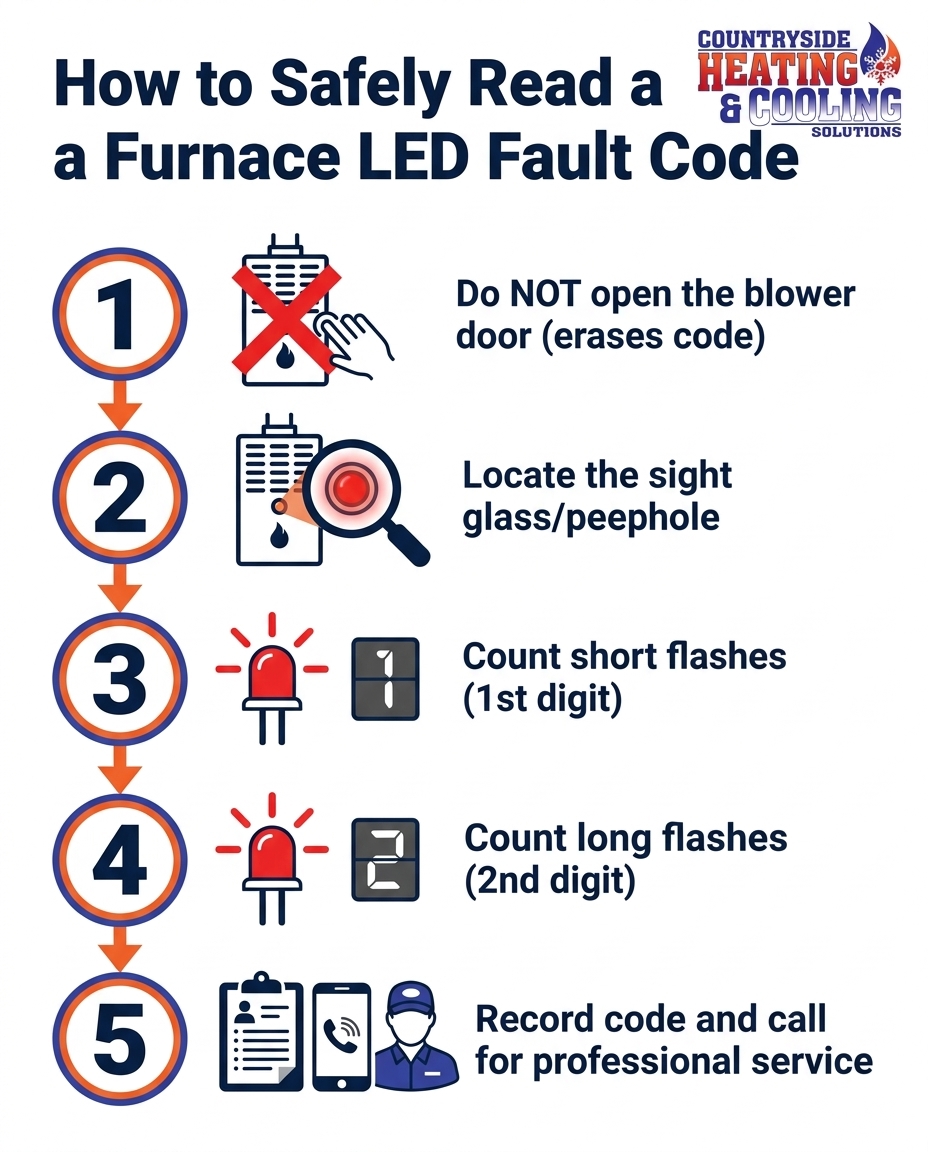
Reading a furnace fault code is simple, but there is one critical safety rule you must follow: NEVER open the blower compartment door while power is active.
Furnaces are equipped with a safety door switch. The moment you remove that lower panel, the switch pops out, instantly cutting all 120-volt power to the control board. When the board loses power, it completely erases the diagnostic code from its active memory. If you open that door, the blinking light stops, the code is gone, and a professional technician will have to start the diagnostic process blindly from scratch.
We see this happen frequently in Maple Plain. One local homeowner experienced a sudden furnace failure last fall. Because they left the door sealed and carefully noted the code before calling, our Countryside Heating & Cooling Solutions technician arrived fully prepared, explained the problem thoroughly before fixing it, and had the furnace fixed on the exact same day. If you want to schedule furnace repair service with maximum efficiency, follow these safe steps to read the code externally.
Step 1: Locate the Furnace Peephole
Leave your toolbox in the garage. All you need is your eyes and perhaps a notepad.
• Find the sight glass: Look at the bottom half of your furnace cabinet (the blower door). You will see a clear or tinted plastic window, usually about the size of a quarter.
• Adjust the lighting: If your basement or utility room is brightly lit, you may need to dim the room lights or cup your hands around the peephole to see the LED clearly.
• Wait for the cycle: Ensure your thermostat is still calling for heat so the board remains active and flashing.
Step 2: Count the Short and Long Flashes
Most modern control boards use a specific rhythm to communicate a two-digit code. You are looking for a sequence of short, rapid flashes followed by longer, slower flashes.
1. Observe the pause: Watch the LED until you see a distinct pause (usually about 2 to 3 seconds of no light). This pause indicates the beginning of the code sequence.
2. Count the short flashes (First Digit): After the pause, count the quick flashes. If it flashes three times quickly, your first digit is 3.
3. Count the long flashes (Second Digit): Immediately following the short flashes, the LED will blink more slowly. Count these. If it blinks slowly three times, your second digit is 3.
4. Record the sequence: In this example, your fault code is 33. Write this down exactly as you observed it.
Decoding Common Bryant and Carrier Flash Sequences
Different manufacturers use different coding systems, but the two-digit short-and-long flash sequence is the industry standard for Bryant and Carrier systems. As an award-winning Bryant Circle of Champions dealer, our team at Countryside Heating & Cooling Solutions diagnoses these specific Bryant and Carrier fault codes daily. Understanding the structure of these codes gives you incredible insight into what is happening inside your ductwork and combustion chamber.
If your furnace keeps shutting on and off, the LED blink sequence will tell you whether you are dealing with an airflow restriction, a venting blockage, or an electrical fault. Here is how the most common code categories break down.
Limit Switch Codes (Airflow Issues)
Codes starting with the number 1 or 4 (such as Code 13 or Code 33) frequently relate to limit switch lockouts. The limit switch monitors the temperature of the heat exchanger.
• The Cause: These codes are almost always caused by severe airflow restrictions. If the blower motor cannot push enough cold air over the heat exchanger, the heat builds up rapidly inside the cabinet.
• The Protection: The system shuts down to prevent the heat exchanger from cracking under extreme thermal stress. A cracked heat exchanger allows carbon monoxide to mix with your breathing air.
• Common Culprits: A completely clogged air filter, blocked return vents, or a failing blower motor.
Pressure Switch Codes (Venting Issues)
Codes starting with the number 3 (such as Code 31 or Code 32) usually indicate a pressure switch or draft safeguard issue. The pressure switch ensures toxic exhaust gases are safely leaving your home.
• The Cause: This code means the inducer motor is not creating enough negative pressure (draft) to pull exhaust gases through the flue.
• The Protection: The board refuses to open the gas valve, knowing that if it ignites the burners, the exhaust has nowhere to go.
• Common Culprits: A blocked PVC exhaust pipe (often from leaves or snow), water backed up in the condensate drain line, or a failing draft inducer motor.
Continuous Rapid Flashing
If the red light is blinking rapidly and continuously without any pauses, you are not looking at a two-digit code. A continuous rapid flash usually indicates a reversed polarity or grounding issue. This means the electrical voltage coming into the furnace is wired incorrectly, or the system has lost its earth ground. This requires an immediate electrical diagnostic.
What to Do Once You've Identified the LED Code
Once you have observed the LED blink sequence (e.g., 3 short flashes followed by 1 long flash) through the sight glass, you have completed your job as the homeowner. Now it is time to bridge the gap between identifying the problem and getting it safely repaired.
Write down the exact sequence of short and long flashes immediately. Do not attempt to reset internal limits, bypass safety switches, or open the gas valve yourself. Modern furnaces deal with highly combustible gas and 120-volt electricity; bypassing a safety switch to force the heat on is extremely dangerous and can lead to immediate fire hazards or carbon monoxide exposure.
The only safe DIY step you can take before calling for help is checking your air filter. If you pulled a limit switch code (like Code 33) and you know your filter hasn't been changed in six months, slide the old filter out. If it looks like a solid blanket of gray dust, replace it with a fresh one. Sometimes, restoring proper airflow is enough to clear a soft lockout once the system cools down.
If the filter is clean or the code persists, it is time to call your local provider for furnace repair in Maple Plain.
Relaying Information for Faster Repair
When you call the dispatch team, the information you provide dictates how quickly your heat is restored. Telling the dispatcher, "My furnace is broken," is fine, but telling them, "My furnace is in lockout and I am seeing 3 short flashes and 1 long flash on the control board," is vastly more helpful.
Our dispatch team saw this exact pattern with a Maple Plain customer last fall whose furnace stopped working unexpectedly. Because they provided precise details over the phone, our technician arrived with the right diagnostic mindset, knew exactly which pressure switch components to test, and was fast in figuring out the problem, restoring their heat in record time. Exact communication expedites the troubleshooting process.
The Danger of Ignoring Early Fall Furnace Warnings
It can be tempting to turn the breaker off and back on to clear the flashing light, hoping the furnace will just magically start working again. While resetting the power *will* clear the code and might even force the furnace to run for a few minutes, it is a dangerous gamble.
A furnace lockout is a symptom of a larger mechanical or airflow failure, not a random computer glitch. Safety switches do not trip for no reason. Resetting the power to clear the code without fixing the root cause forces the furnace to overheat or fail to vent all over again. Doing this repeatedly can lead to permanent, irreversible heat exchanger damage.
In our years of serving the local community, we've learned that September is the critical window for pre-season heating checks in Minnesota. Catching these lockouts now allows time for proper repairs before the first major October frost hits. Addressing the flashing light today prevents a total, freezing heating failure when temperatures drop into the single digits. Enrolling in a preventative maintenance plan ensures these safety switches and control boards are tested by a professional every single fall, long before you ever have to rely on the sight glass.
Frequently Asked Questions About Furnace Red Light Codes
What does a flashing red light on a furnace mean?
It means the furnace's control board has detected a fault and entered a protective lockout mode. The board shuts down the heating cycle to prevent damage or safety hazards. The specific rhythm of the flashing light acts as a diagnostic code to tell technicians exactly which component triggered the shutdown.
How do I read furnace error codes?
Look through the sight glass on the blower door and count the sequence of short and long flashes without opening the cabinet. Watch for a brief pause in the light, then count the fast blinks for the first digit, followed immediately by the slower blinks for the second digit. Write this exact sequence down.
Is a blinking red light on a furnace dangerous?
The light itself means the safety systems are working perfectly, but it indicates a potentially dangerous issue like overheating or poor venting. The furnace has locked itself out specifically to keep you safe from hazards like carbon monoxide leaks or electrical fires. You should never ignore the light or try to bypass the safety controls.
What does 3 red flashes on a furnace mean?
On many Bryant and Carrier models, codes starting with 3 indicate a pressure switch or draft safeguard issue. This generally means the furnace is failing to properly vent exhaust gases outside. It could be caused by a blocked flue pipe, a frozen exhaust vent, or a failing draft inducer motor.
Why is my furnace in lockout mode?
The system locks out to prevent damage or safety hazards after multiple failed ignition attempts or tripped safety switches. If the flame sensor cannot detect a fire, or if the limit switch detects severe overheating, the control board cuts the gas supply to prevent a dangerous buildup of raw fuel.
Will opening the furnace door erase the error code?
Yes, opening the door breaks the safety switch, cutting power to the board and clearing the diagnostic code. This is why it is absolutely critical to read the code through the plastic peephole before you ever touch the furnace panels. Once the code is erased, diagnosing the root cause becomes much more difficult.
Get Fast, Accurate Diagnostics for Your Heating System
Understanding what a blinking red light on your furnace control board actually means is the perfect first step in protecting your home this fall. By safely counting the flashes through the peephole, you gain a basic understanding of common codes—like limit switch or pressure issues—and know exactly what information to give your dispatcher.
However, while reading the code is safe for a homeowner, fixing the underlying mechanical or venting failure requires a licensed professional. Do not leave your winter comfort to chance by resetting the system and hoping for the best. Call our dispatch team today, share your exact flash sequence, and schedule a professional diagnostic visit so we can restore your heat safely and reliably.
