.webp)

The Hidden Cause of Late-Summer AC Breakdowns
Your air conditioner is running nonstop, but the house still feels uncomfortably warm and humid. If you are wondering why AC capacitors fail in August (and how to spot the bulge), you are experiencing one of the most common mid-season cooling emergencies. Many homeowners immediately assume their system is low on refrigerant or that the entire compressor has died. However, the culprit is frequently a small, inexpensive electrical component that has simply reached its breaking point after months of continuous work. At Countryside Heating & Cooling Solutions, our team typically sees a massive spike in these specific failures right around the back-to-school transition, when systems have been running hard all summer.
If you need immediate help, you can learn more about our air conditioning services or schedule AC service right now.
Cumulative thermal stress peaks during the August late-summer weeks. By the time this month arrives, your cooling system has already endured hundreds of hours of demanding run cycles. The intense ambient heat outside, combined with the heat generated internally by the system, creates a brutal environment for sensitive electrical parts. The capacitor takes the brunt of this punishment. Learning how to safely identify the signs of a failing capacitor from the outside of your unit can save you from a complete system breakdown and prevent permanent damage to your expensive compressor motor.
What an AC Capacitor Actually Does
To understand why this component fails, you first need to understand the heavy lifting it does every time your thermostat calls for cooling. A capacitor is essentially a high-voltage battery designed to store and release electrical energy in rapid, powerful bursts. It provides the massive initial jolt of energy required to start the heavy compressor and fan motors inside your outdoor condenser unit.
Air conditioning motors require significantly more torque to start turning than they do to keep running once they are up to speed. Think of it like pushing a heavy car: getting it rolling takes a tremendous amount of effort, but keeping it moving is much easier. The capacitor delivers that initial, forceful push. Without it, the motor simply cannot overcome its own resting inertia.
Inside the cylindrical metal casing of a capacitor, there is a very specific structure designed to handle this intense electrical load.
• Conductive layers: Thin layers of aluminum foil and specialized films are wound tightly together to store the electrical charge.
• Dielectric fluid: These conductive layers are completely submerged in a specialized oil.
• Temperature regulation: The dielectric fluid acts as an insulator and a coolant, absorbing the intense heat generated by the rapid discharge of high-voltage electricity.
Homes in the Maple Plain MN area rely heavily on these components to kickstart their systems multiple times an hour during the hottest parts of the day. As long as the internal oil remains stable, the capacitor can continue delivering the required torque. But when the environment pushes that oil beyond its limits, the component begins a rapid decline.
Why Cumulative Heat Destroys Capacitor Oil
The physical breakdown of a capacitor is a direct result of trapped, unrelenting heat. During a typical cooling season, a capacitor has time to cool down between cycles. However, the specific combination of high humidity and soaring temperatures forces continuous air conditioning cycling, maximizing thermal stress on the capacitor.
When the outdoor unit runs continuously to combat heavy indoor humidity, the capacitor never gets a chance to rest. The heat from the sun beating down on the metal cabinet, combined with the electrical heat generated internally, traps extreme temperatures inside the cylindrical casing. This sustained heat triggers a destructive chemical reaction within the component.
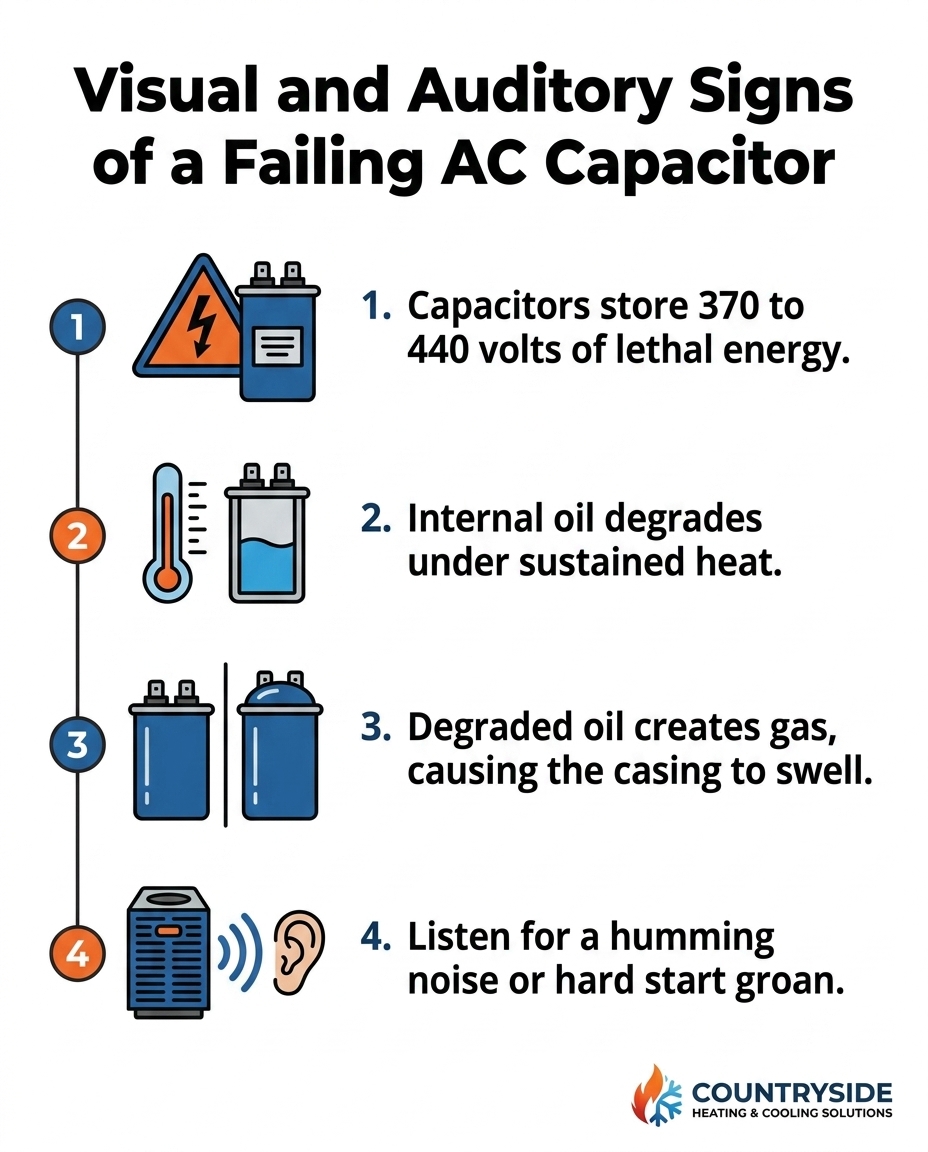
Under continuous extreme temperatures, the internal dielectric fluid begins to degrade and boil off. As this specialized oil breaks down, it releases chemical gases. Because the capacitor is a sealed metal cylinder designed to keep moisture out, these newly formed gases have absolutely nowhere to escape. The internal pressure builds immensely with every passing day of the August late-summer heatwave. A pattern we see often on late August service calls is a completely degraded capacitor that simply couldn't handle one more 90-degree afternoon.
• Early Summer (Normal Cycling) — Internal Temperature: Moderate (Allows cooling between cycles) — Dielectric Oil Status: Stable, effectively insulating layers — Casing Condition: Completely flat top
• Mid-Summer (Heavy Usage) — Internal Temperature: High (Brief resting periods) — Dielectric Oil Status: Warming, slight viscosity changes — Casing Condition: Flat, but stressed
• Late Summer (Continuous Running) — Internal Temperature: Extreme (No cooling periods) — Dielectric Oil Status: Degrading, boiling, releasing trapped gases — Casing Condition: Swelling upward under internal pressure
The breaking point: As the gases expand, they push against the weakest part of the metal casing—the top panel where the electrical terminals are located. This physical expansion is the defining characteristic of a ruined capacitor, and it is a structural failure that cannot be reversed.
Visual Signs: How to Spot the Bulge Safely
You do not need to be a technician to spot the physical evidence of expanding internal gases. You can safely perform a visual inspection without ever touching the unit or removing any access panels. Empowering yourself to spot this issue early is a critical part of proactive AC maintenance in Maple Plain.
Follow these safe, simple steps to inspect your outdoor condenser for physical component damage:
1. Locate the outdoor unit: Walk outside to your air conditioning condenser (the large metal box with the fan on top).
2. Grab a flashlight: Even in broad daylight, the shadows inside the metal cabinet can make it difficult to see small components clearly. A bright flashlight will help illuminate the electrical compartment.
3. Look through the top fan grate: Peer downward through the slotted metal grate that protects the fan blades. Look toward the corner of the unit where the electrical wires enter the cabinet.
4. Identify the capacitor: You are looking for a silver, cylindrical object that resembles a metal soda can. It will have several colored wires attached to the terminals on its top.
5. Check the shape of the top: A healthy, functioning capacitor has a completely flat top. If you see a swollen or mushroom-shaped top on the cylindrical capacitor, the internal oil has degraded, and the component has failed.
Visual inspection requires absolutely zero disassembly. Never attempt to unscrew the metal panels or reach your hands through the fan grate. If the top is domed, curved, or leaking a sticky fluid, turn your thermostat to the "off" position immediately to prevent further damage to the system.
Auditory Clues: When the Compressor Struggles
Sometimes, the electrical compartment is positioned in a way that makes it impossible to see the capacitor clearly through the top grate. In these cases, your ears become your best diagnostic tool. The sounds a struggling air conditioner makes are highly distinct and serve as a severe warning that the system is in distress.
The most common auditory clue is the "hard start" sound. When the thermostat calls for cooling, you may hear a loud, struggling mechanical groan coming from the outdoor unit. This sound occurs because the compressor motor is trying to turn over, but the failing capacitor cannot deliver enough torque to overcome the resting inertia. The motor strains against its own weight, drawing massive amounts of electricity in a desperate attempt to start.
Another tell-tale sign is a loud humming or buzzing noise coming from the outdoor unit while the large fan blades remain completely stationary. This electrical hum means the contactor has sent power to the unit, but the motors are locked in place without their necessary starting jolt. Letting the system continuously try to start with a dead capacitor can cause permanent, catastrophic damage to the compressor motor. The motor windings will quickly overheat, melting their protective insulation and causing an electrical short.
We frequently experience this firsthand; just recently, our dispatch team received a frantic call from a local homeowner whose AC unit stopped working unexpectedly during an end-of-season hot spell. One of our Countryside technicians was dispatched for same-day service, arriving quickly to diagnose the system. We discovered a failed capacitor was causing the unit to hum without starting. By turning the system off immediately when they heard the noise, the homeowner saved their compressor, and we repaired the AC quickly and efficiently.
If you hear these struggling mechanical groans or electrical buzzing sounds during the August late-summer heat, do not wait to see if the system will eventually start. Turn off the cooling function at your indoor thermostat immediately to cut the demand for power.
The Lethal Danger of DIY Electrical Repairs
Once you spot a swollen or mushroom-shaped top on the cylindrical capacitor, it can be tempting to look up replacement parts online. However, touching this component is extremely dangerous. Capacitors are not like standard household wiring; they store electrical energy at exceptionally high voltages, often ranging from 370 to 440 volts.
The most critical safety fact to understand is that this lethal charge remains stored inside the component even after the main power breaker to the AC unit has been completely turned off. Disconnecting the power stops new electricity from entering the unit, but it does nothing to drain the massive jolt of energy already waiting inside the capacitor's conductive layers.
A swollen capacitor is highly unstable. The internal pressure from the expanded gases means the casing is compromised. It requires specialized, heavily insulated tools to discharge the stored voltage safely before it can be removed. Attempting to pull the wires off a charged capacitor with standard garage tools can result in a fatal electrical shock.
Why DIY is dangerous here:
• Stored voltage: 440 volts can cause severe injury or death instantly.
• Unstable casing: The bulging metal can rupture if handled improperly.
• Incorrect sizing: Installing a capacitor with the wrong microfarad rating will slowly destroy your compressor.
• Hidden issues: A blown capacitor might be the symptom of a larger electrical short, such as a burnt AC compressor relay.
Leveraging our Bryant Medal of Excellence and strict satisfaction guarantee, our technicians at Countryside Heating & Cooling Solutions are held to the highest standards of electrical safety. The low cost of a professional capacitor replacement is never worth risking the extreme safety hazards of a DIY electrical repair.
Preventing Future Component Failures
While late-summer heatwaves are unavoidable, mid-season breakdowns do not have to be a yearly tradition. Shifting your focus toward proactive maintenance is the most effective way to prevent future component failures and protect the lifespan of your cooling system.
During a recent routine late-summer check of a local customer's cooling system, one of our technicians thoroughly tested the electrical components and detailed how proactive testing catches degraded oil early. In our years of servicing HVAC systems in the Maple Plain area, we always prioritize keeping our customers fully informed so they realize that capacitors do not go from perfectly healthy to completely swollen overnight.
Technicians test capacitor "microfarad" readings during routine tune-ups. A microfarad is the unit of measurement used to determine how much electrical charge the capacitor can hold. Long before the casing actually bulges, the microfarad reading will begin to drop. By measuring this electrical capacity, a certified professional can catch the degradation early and swap out the weakening component before it leaves you stranded in the heat.
Furthermore, regular maintenance eases the overall strain on electrical components. Keeping the outdoor condenser coils clean allows the system to release heat efficiently. This reduces the overall operating temperature inside the metal cabinet, which directly protects the capacitor's internal oil from boiling. Getting on a routine maintenance plan ensures these vital components are tested and the coils are cleaned before the hottest months arrive in the Maple Plain MN area.
Frequently Asked Questions About AC Capacitors
Understanding the nuances of electrical failures can help you make safer, faster decisions when your cooling system acts up in the August late-summer heat. Here are the most common questions homeowners ask about these vital components.
What does a blown AC capacitor look like?
It typically has a domed, swollen, or mushroom-shaped top instead of a flat surface, and may show signs of leaking fluid. When the internal oil overheats and degrades, it releases expanding gases. Because the metal cylinder is sealed, the pressure forces the weakest point—the top panel where the wires connect—to bulge outward. If the top is not perfectly flat, the component has failed.
Why do AC capacitors fail in the heat?
High temperatures break down the internal oil, creating expanding gases that compromise the component's ability to store and release energy. The capacitor relies on specialized dielectric fluid to insulate its conductive layers and regulate heat. Continuous running during hot weather prevents the component from cooling down, causing the oil to physically boil off and lose its insulating properties.
Can you visually tell if a capacitor is bad?
Yes, if the top is bulging, it is definitely bad. However, a capacitor can also fail internally while still looking perfectly normal, which requires a multimeter to test. A swollen casing is absolute proof of failure, but a flat casing does not guarantee the component is healthy. Technicians must test the microfarad output to confirm if a normal-looking capacitor is actually holding its required charge.
How long do AC capacitors usually last?
They generally last 10 to 20 years, but extreme seasonal heat, frequent power surges, and continuous running can significantly shorten their lifespan. An undersized unit that runs constantly will burn through capacitors much faster than a properly sized system. Keeping the condenser coils clean and ensuring the system isn't overworking can help the component reach its maximum expected lifespan.
Is it safe to touch an AC capacitor if the power is off?
No. Capacitors store a high-voltage charge that can cause severe injury or death even when disconnected from the power supply. Flipping the breaker at your electrical panel stops new power from flowing to the unit, but the capacitor acts as a battery, holding up to 440 volts of stored energy. It must be safely discharged with specialized insulated tools by a trained professional before it can be handled.
Restore Your Cooling Safely and Swiftly
Spotting the visual and auditory signs of electrical strain early is the best way to save your compressor from permanent damage. If you have noticed a humming noise, a groaning hard start, or a physically swollen casing through the fan grate, shutting the system down immediately is the smartest move you can make.
Reassure yourself that replacing a capacitor is a fast, routine job for a certified professional. Our team at Countryside Heating & Cooling Solutions carries fully stocked trucks with a wide range of microfarad ratings to ensure we can restore your comfort in a single visit. Do not risk your safety trying to handle high-voltage components yourself. Reach out for expert assistance to schedule AC service today. Understanding why AC capacitors fail in August (and how to spot the bulge) empowers you to act quickly, ensuring your Maple Plain MN area home stays cool and comfortable without risking a catastrophic compressor failure.
