.webp)

Hearing the Dreaded Click During Your First Fall Start-Up?
Are you currently struggling with diagnosing a furnace that clicks but refuses to ignite? You turn the thermostat from "cool" to "heat," wait for the familiar rush of warm air, and instead, you are met with a repetitive clicking sound followed by complete silence. This is a highly common and incredibly frustrating experience, especially during a September pre-heating season first start-up when you are just trying to make sure your home is ready for the changing weather.
Hearing a rapid clicking noise coming from your basement or utility closet can immediately trigger anxiety. Many homeowners worry that this sound indicates a severe electrical short, a dangerous gas leak, or an impending explosion. The good news is that this clicking is actually a normal part of your system's sequence of operations. The bad news is that the subsequent silence means a specific component has failed to do its job, and the system has shut itself down for your safety.
The short answer is: That clicking noise is your electronic spark ignitor attempting to light the gas. When the gas fails to light, the system aborts the process.
Before the severe, freezing winter temperatures arrive in our region, it is critical to address these ignition failures. You do not want to be left without a reliable heat source when the first major freeze hits. Fortunately, professional heating services can diagnose the exact cause of the ignition failure, whether it is a faulty sensor, a failing ignitor, or a stuck valve. By understanding what is happening inside that metal cabinet, you can make an informed decision about when to call in an expert.
Understanding Your Furnace's Sequence of Operations
To truly understand why your system is failing, you need to know what happens when things go right. Modern heating equipment does not simply turn on all at once. Instead, it follows a strict, step-by-step "sequence of operations." If any single step fails, the entire process halts. Our team at Countryside Heating & Cooling Solutions frequently sees this exact sequence failure when furnaces stop working during an early fall temperature drop here in Maple Plain. Recently, one of our technicians was dispatched to a local home, quickly identified exactly where the sequence was breaking down, and had the system fixed the same day.
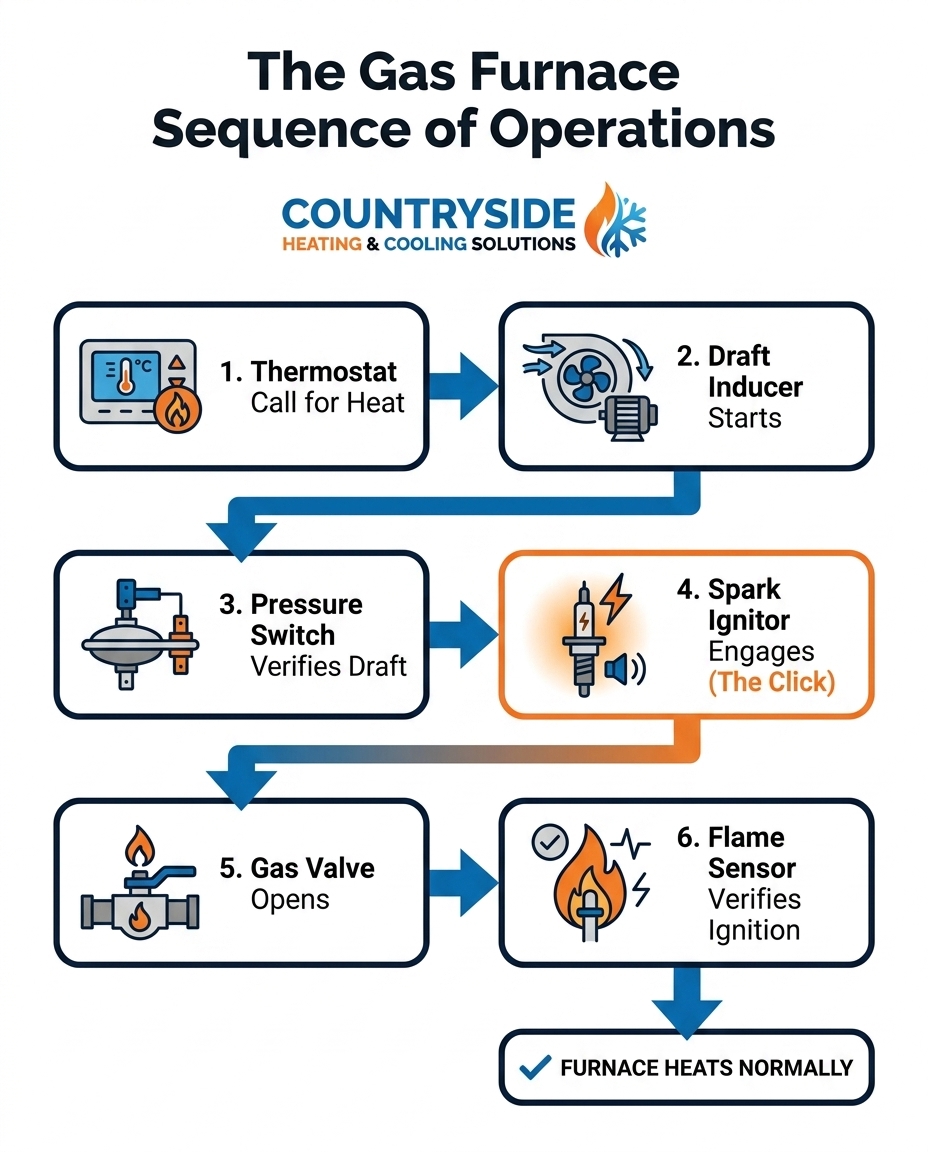
Here is the exact step-by-step process your heating system goes through every time your home needs warm air:
1. The Call for Heat: It all starts at your thermostat. When the indoor temperature drops below your set point, the thermostat sends a low-voltage electrical signal to the main control board.
2. The Draft Inducer Motor Starts: Before any gas is released, a small fan called the draft inducer motor turns on. You will usually hear this as a low humming or whirring sound. Its job is to clear any lingering combustion gases out of the heat exchanger and push them safely out the exhaust flue.
3. The Pressure Switch Verifies the Draft: The system needs to know the inducer motor is actually moving air. A safety device called a pressure switch detects the negative pressure created by the fan. If the venting is clear and the fan is working, the switch closes, allowing the sequence to continue.
4. The Spark Ignitor Engages (The Clicking Sound): Once the draft is confirmed, the control board sends power to the electronic spark ignitor. This component creates a rapid, high-voltage spark designed to ignite the incoming fuel. This is the exact clicking sound you are hearing.
5. The Gas Valve Opens: A fraction of a second after the ignitor begins sparking, the gas valve opens to supply fuel to the burners.
6. The Flame Sensor Confirms Ignition: Once the gas ignites, a small metal rod called a flame sensor sits directly in the fire. It detects the presence of the flame through a process called flame rectification. If it senses a strong, steady fire, it tells the control board to keep the gas flowing and turn on the main blower fan to distribute warm air through your home.
When you search online because your furnace clicks but won't ignite, you are experiencing a failure between step four and step six. The system is trying to light the fire, but something is preventing the flame from catching or being detected.
Why the System Shuts Down: The 3-Strike Safety Lockout
When a homeowner notices their furnace clicks but won't ignite, their first instinct is often frustration. Why does it just give up and shut down? The reality is that this shutdown is a vital, life-saving safety mechanism.
The danger of unburned fuel: If the gas valve opens and the spark ignitor fails to light the fuel, raw gas begins pouring into the combustion chamber. If the system continued to pump gas into your home without a flame to burn it, the gas would accumulate. A delayed ignition at that point could cause a dangerous small explosion, or the gas could leak into your living spaces.
To prevent this, manufacturers design these systems with a strict "3-strike" rule. Here is how the safety lockout works:
• Strike One: The system attempts to ignite. The ignitor clicks, the gas valve opens for a few seconds, and the flame sensor watches for a fire. If no flame is detected within about four to seven seconds, the control board immediately snaps the gas valve shut. The inducer motor will run for a bit longer to clear out any unburned gas.
• Strike Two: After a short purge period, the system tries again. You will hear the click, followed by silence.
• Strike Three: The system makes one final attempt. If the flame sensor still does not detect a fire, the control board enters a "hard safety lockout."
During a hard safety lockout, the system completely disables the ignition sequence. It will not try to light again until the lockout is reset (usually by turning the power to the unit off and back on, or waiting a preset amount of time like one hour).
This lockout is doing exactly what it was designed to do: protecting your home and your family. While it is inconvenient to be without heat, the system shutting down is a sign that the safety controls are working perfectly. The underlying problem is simply that the components responsible for starting or verifying the fire need attention.
Common Culprits Behind the Clicking Sound
If your system is stuck in a click-and-stop cycle, the breakdown is happening right at the moment of combustion. There are three primary components that fail at this exact stage. Understanding these common culprits helps clarify why professional diagnostics are necessary.
The Spark Ignitor
The most direct cause of a clicking sound with no fire is a weak or failing spark ignitor. Just like a spark plug in a car, an electronic ignitor undergoes immense stress. It sits in a harsh environment and is subjected to rapid temperature changes every time the system runs. Over time, the ceramic casing can crack, or the metal electrodes can wear down, corrode, or become coated in carbon buildup.
When this happens, the ignitor may still receive electricity and attempt to spark (hence the clicking noise), but the spark is too weak to actually ignite the gas mixture. A technician can test the electrical continuity of the ignitor to determine if it has failed completely and requires replacement. In our years of serving Maple Plain, our technicians have found that discovering a worn-out ignitor is one of the most common pre-season issues we uncover during early fall maintenance.
The Gas Valve
If the ignitor is producing a strong, healthy spark, the next logical culprit is a lack of fuel. The gas valve is an electromechanical device that opens to let fuel into the burners. It can fail in a few different ways:
• Electronic failure: The solenoid coil inside the valve that physically opens the gate can burn out. The control board sends the signal to open, but the valve simply does not respond.
• Mechanical blockage: Dirt, debris, or a buildup of internal pressure can cause the valve to physically stick in the closed position.
• Supply issues: Sometimes, the valve is fine, but the gas supply to the house has been interrupted, or a manual shutoff valve on the gas line was bumped into the closed position during the summer.
A defective gas valve is a serious issue. Because it controls the flow of combustible fuel, any malfunction here requires immediate professional attention from our team to ensure there are no dangerous leaks.
The Flame Sensor
Sometimes, the furnace actually does ignite, but it shuts off just a few seconds later. If you hear the click, hear a brief "whoosh" of flames, and then the system immediately shuts down, the culprit is almost certainly a dirty flame sensor.
The flame sensor is a delicate metal rod that sits in the path of the fire. Over months of operation, it can become coated in a thin layer of carbon, dust, or oxidation. This microscopic coating insulates the rod, preventing it from detecting the microamps of electrical current that flow through the flame. When the sensor fails to register the fire, the control board assumes the gas is not burning and shuts the valve off as a safety precaution. This is one of the most frequent issues that cause your furnace to keep shutting on and off.
• Clicking, no smell of gas, no flame — Likely Culprit: Gas Valve or Supply — What is Happening: The spark is firing, but no fuel is reaching the burners to be ignited.
• Clicking, faint gas smell, no flame — Likely Culprit: Spark Ignitor — What is Happening: Fuel is present, but the spark is too weak to ignite the mixture.
• Clicking, brief flame, instant shutoff — Likely Culprit: Flame Sensor — What is Happening: The fire starts, but the sensor is too dirty to "see" it, triggering a safety shutdown.
When to Stop Troubleshooting and Call a Professional
When facing a September pre-heating season first start-up failure, it is tempting to try and fix the problem yourself to save time. However, modern heating equipment involves high-voltage electricity, combustible natural gas, and complex safety boards. Knowing where to draw the line between basic homeowner checks and professional intervention is vital.
What you can safely check yourself:
• Check your thermostat batteries: A weak battery can cause erratic signals to the control board.
• Verify the power switch: Ensure the power switch on the side of the unit (which looks like a standard light switch) is flipped to the "ON" position.
• Check your air filter: A severely clogged filter can cause airflow issues that trip other safety switches.
• Check the gas supply: Ensure the manual gas valve on the pipe leading to the unit is parallel to the pipe (open), not perpendicular (closed).
When you must call a licensed professional:
If you have verified the power, gas supply, and filter, and the system is still stuck in a click-and-stop lockout, you must stop troubleshooting. Tampering with a gas valve, attempting to bypass safety switches, or trying to replace a high-voltage spark ignitor without proper training and licensing is highly dangerous.
Just last fall, our team responded to a Maple Plain homeowner who found that the cause of their heating issue was not immediately clear after basic checks. One of our technicians quickly identified the specific sequence failure, safely replaced the faulty component, and restored the heat without putting the home at risk. Professional diagnostics are required to safely test electrical continuity, measure microamps on a flame sensor, and verify proper gas pressure using specialized tools like manometers and multimeters.
As safety-first educators providing fast local emergency diagnostics, Countryside Heating & Cooling Solutions always recommends prioritizing your family's safety over a DIY fix. The best way to prevent these sudden failures is by scheduling routine furnace maintenance. A thorough tune-up allows our technicians to clean the flame sensor, test the ignitor's resistance, and verify gas valve operation before the cold weather ever hits.
Frequently Asked Questions About Furnace Ignition Failures
Why is my furnace clicking but not turning on?
The clicking noise you hear is the electronic spark ignitor attempting to light the gas supplied to the burners. If the system fails to turn on, it means there is either no spark being generated, no gas reaching the assembly, or a dirty sensor failing to detect the flame. Because the system cannot verify a safe fire, it aborts the startup sequence and shuts down to prevent unburned fuel from accumulating in your home.
Is a clicking furnace dangerous?
The clicking sound itself is not dangerous; it is a completely normal operational noise that happens every time the system starts up. What is important to understand is that the system shutting down afterward is a safety mechanism actively preventing danger. By locking out and stopping the flow of gas, the control board is protecting your home from a potential gas buildup or delayed ignition.
What does it mean when a furnace clicks 3 times?
Most modern heating systems are programmed to attempt ignition up to three times before giving up. If you hear the clicking sequence happen three distinct times, followed by complete silence and the blower fan shutting off, it indicates a hard safety lockout. The system has recognized a persistent failure to ignite and has disabled itself until a professional can diagnose the underlying issue and reset the safety controls.
Can I manually light my modern gas furnace?
No, you should never attempt to manually light a modern heating system. Older units used a standing pilot light that stayed lit all the time and could be relit with a match. Modern systems use electronic spark ignitors or hot surface ignitors that are controlled entirely by the system's circuit board. Attempting to introduce an open flame into a modern combustion chamber while the gas valve is opening is extremely dangerous and can result in severe injury or equipment damage.
How do you fix a furnace that clicks but won't ignite?
Fixing this specific issue requires a licensed HVAC technician to test the electrical components and gas flow. Depending on the exact point of failure, the technician will need to clean the flame sensor, replace a worn-out spark ignitor, or install a new gas valve. Because these repairs involve direct interaction with combustible gas and high-voltage circuitry, DIY repairs are strongly discouraged due to the significant safety hazards involved.
Get Your Heating System Ready for the Cold
When you are in the middle of diagnosing a furnace that clicks but refuses to ignite, it is easy to feel overwhelmed. However, a clicking system that locks out is simply doing its job to keep you safe. Whether the culprit is a dirty flame sensor, a worn spark ignitor, or a stubborn gas valve, this is a highly solvable issue when handled by trained experts.
Early fall is the absolute best time to address these lockouts. Ignoring a struggling ignition sequence now can lead to a complete breakdown later in the year. It is crucial to secure a reliable heating source before the severe Minnesota winter sets in. If you are dealing with a system that refuses to start, trust our local HVAC team at Countryside Heating & Cooling Solutions in Maple Plain MN for fast, reliable service. Schedule professional furnace repair services today to ensure your home stays warm, safe, and comfortable all winter long.
