.webp)

The Midnight Battle for Comfort: Freezing Downstairs, Roasting Upstairs
You toss and turn, kicking off the blankets, wondering exactly why your hallway thermostat is lying about the temperature in your bedroom. The air conditioner is running, but your upstairs sleeping quarters still feel incredibly stuffy. You walk downstairs for a glass of water, only to find the main floor feels like an absolute icebox. It is a frustrating, exhausting cycle that leaves many homeowners our team visits asking if their cooling equipment is broken, undersized, or simply failing to keep up with the August late-summer heat.
The truth we often share with our Maple Plain customers is that your central air conditioner is likely functioning exactly as it was designed to. The underlying issue is not a lack of cooling power, but rather a flaw in how your system measures the air. When you are forced to choose between keeping the main floor freezing or finding a smarter way to read temperatures upstairs, the decision point becomes clear. You need a system that knows exactly how warm it really is where you actually sleep.
If you are tired of this nightly temperature tug-of-war, upgrading the way your equipment senses heat is the first step. For comprehensive support with your air conditioning systems, our team can help you identify exactly where the airflow disconnect is happening in your specific floor plan.
The Physics of Second-Story Heat Traps
To understand why your upstairs feels so unbearable, our technicians always point to the natural mechanics of heat transfer. During Minnesota's hot, humid late summers (especially as families transition back to school in August), peak attic heat transfer causes heavy, warm air to become trapped in the upper levels of your home. Your second floor is always at a natural disadvantage due to basic physics.
The three main factors our experts see creating this heat trap include:
1. Convective heat rise: Warm air is naturally less dense than cold air. As your air conditioner pumps cold air into the house, that heavier cool air sinks to the lowest levels, displacing the warm air and forcing it up the stairwell into your second-story spaces.
2. Radiant attic heat: Throughout the day, the sun beats down on your roof. Even with good insulation, a significant amount of that radiant heat transfers through the ceiling into your upstairs bedrooms. By the time the August late-summer heat reaches its peak in the late afternoon, your upper floor has absorbed hours of thermal energy.
3. Airflow restrictions: Most homes have fewer return air vents upstairs than downstairs. When you close your bedroom door at night for privacy, you effectively cut off the room from the home's main ventilation loop. The cold air being pushed into the room has nowhere to go, and the hot air cannot be pulled back to the central unit for cooling.
Understanding Convection and Airflow Restrictions
Convection is a relentless force in a two-story home. As the cool air pools downstairs, the warm air naturally collects in the highest points of the house—your bedrooms. Standard return vents struggle to pull this hot air out of closed rooms, especially when the central unit is located far away in a basement or utility closet. The result is a stagnant pocket of hot, humid air that your central system cannot easily reach or measure.
The Single-Point Sensing Flaw: Why Your Thermostat is Blind to Your Bedroom
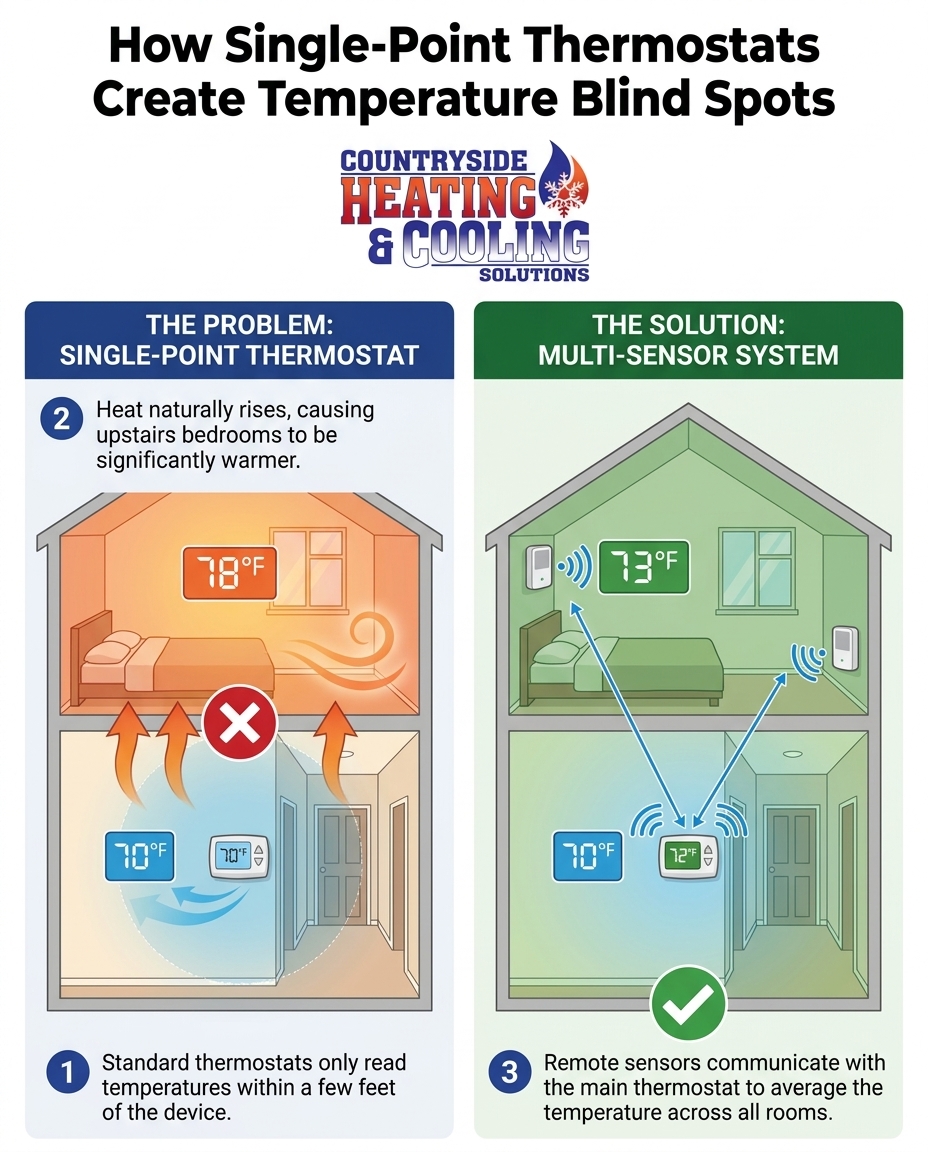
In our years of serving Maple Plain, a pattern we see often is the fundamental design limitation known as single-point temperature sensing. A standard thermostat only reads the air temperature within a few feet of the device itself. If your thermostat is mounted in a shaded, centrally located downstairs hallway, it has absolutely no idea what the temperature is in your sun-facing upstairs master bedroom.
Consider a typical late afternoon scenario. The downstairs hallway, protected from direct sunlight and naturally cooler due to sinking air, quickly reaches your desired setpoint. Meanwhile, the upstairs rooms are still baking. The thermostat senses the cool air in the hallway and shuts the entire system down, completely blind to the fact that you are dealing with a 72-degree hallway vs 78-degree bedroom situation.
• Main Floor Hallway — Environmental Factors: Shaded, interior walls, cold air sinks here — Thermostat Action: Reaches setpoint quickly, signals AC to shut off — Resulting Comfort Level: Perfectly cool (or uncomfortably cold)
• Upstairs Bedroom — Environmental Factors: Direct sunlight, roof heat transfer, warm air rises here — Thermostat Action: Unmonitored by standard hallway thermostat — Resulting Comfort Level: Stuffy, hot, and uncomfortable
The Illusion of the Setpoint
This single-point sensing flaw creates the illusion that your home has reached the target temperature. Because the hallway cools down much faster than the rest of the house, it leads to short-cycling. The air conditioner runs for a brief period, satisfies the hallway thermostat, and turns off before enough cool air has circulated to the upper levels. As we frequently assure our clients, your AC isn't necessarily broken; it is just measuring the wrong room.
The Downside of the 'Freeze the Main Floor' Strategy
When faced with a 72-degree hallway vs 78-degree bedroom, our team frequently encounters a common, frustrating workaround: homeowners cranking the main thermostat down to 65 degrees just to force the air conditioner to run long enough to cool the upstairs. While this might eventually push some cold air into your bedroom, we strongly advise against it because it creates a host of secondary problems.
First, there is the psychological frustration of having to wear sweaters downstairs just to sleep comfortably upstairs. Your home should be a sanctuary, not a climate-controlled puzzle you have to solve every evening. Overcooling the main floor is an inefficient band-aid fix that wastes massive amounts of electricity and drastically increases your monthly utility bills.
Wasted Energy and Equipment Strain
The hidden costs of overcooling that our technicians repair every season include:
• Excessive compressor wear: Forcing your central unit to run continuously to compensate for upstairs heat puts immense strain on the compressor and fan motors.
• Frozen evaporator coils: Pushing your system to run non-stop at extremely low setpoints can cause condensation to freeze on the coils, completely shutting down your cooling capacity.
• Uneven humidity levels: An overworked system often struggles to balance humidity, leaving the freezing downstairs feeling clammy and the hot upstairs feeling sticky.
This strategy forces your equipment to work far outside its optimal design parameters. It is an expensive, temporary workaround, not a permanent solution to uneven cooling.
How Remote Room Sensors Eliminate the Temperature Blind Spot
We recommend smart thermostat systems equipped with remote room sensors as the definitive solution to single-point sensing flaws. These small, wireless devices eliminate the blind spot by measuring the temperature exactly where you need it most.
Here is how our team uses remote sensors to solve the 72-degree hallway vs 78-degree bedroom problem:
1. Data collection: You place small, battery-operated sensors in the rooms that struggle the most with heat, such as the upstairs master bedroom or a sun-facing office.
2. Continuous communication: The sensors wirelessly transmit the exact temperature of those specific rooms back to the main smart thermostat in the hallway.
3. Temperature averaging: Instead of only looking at the hallway temperature, the smart thermostat calculates an average across all the sensors, keeping the air conditioner running until the whole house is balanced.
4. Priority scheduling: Advanced systems allow you to prioritize specific sensors at different times of day. We often help clients tell their system to only care about the bedroom sensor between 10:00 PM and 6:00 AM, ensuring perfect sleeping conditions.
Placing Sensors Where You Actually Sleep
To get the most out of this technology, proper placement is critical. You should position remote sensors on interior walls in your bedrooms, roughly five feet off the ground. Keep them out of direct sunlight, away from drafty windows, and far from supply vents that might blow cold air directly onto the device. When placed correctly, the system uses this highly accurate data to keep the AC running until your sleeping quarters reach the exact desired temperature.
Advanced Airflow Solutions for Stubborn Two-Story Houses
While remote sensors are incredibly effective at fixing thermostat blind spots, our installers know that some architectural designs simply cannot be balanced by a single central unit alone. In many older Maple Plain two-story homes, severe ductwork limitations or complex layouts require advanced airflow solutions to achieve true comfort.
If your central system is already pushing as much air upstairs as the ductwork allows, an HVAC zoning system might be the next step. Zoning uses motorized dampers installed directly inside your ductwork. These dampers open and close to direct cool air specifically to the upstairs zones that need it most, blocking off airflow to the downstairs once it reaches the target temperature. This works in perfect tandem with accurate temperature sensing to deliver air exactly where it is required.
When to Consider Supplemental Cooling
If altering your existing ductwork is not feasible, supplemental cooling offers a powerful alternative. Installing highly efficient ductless HVAC solutions in your primary bedrooms allows you to bypass the central ductwork entirely. A ductless mini-split provides targeted, independent cooling to a specific room, allowing you to sleep in a perfectly chilled environment without altering the temperature of the rest of the house. In our experience, this is often the most energy-efficient way to cool a stubborn second-story room at night. Furthermore, qualifying heat pump installations may even be eligible for federal tax credits or local utility incentive programs (we always advise readers to verify current programs with their utility or a tax professional).
Smart Thermostat Integration and Professional Optimization
Upgrading your home's temperature sensing capabilities requires more than just buying a device off the shelf. Advanced Wi-Fi thermostats that integrate seamlessly with remote sensors offer incredible benefits, but they must be properly matched to your existing heating and cooling equipment. Our team at Countryside Heating & Cooling Solutions has spent years configuring advanced Bryant smart thermostats and remote sensors to solve complex multi-level airflow issues in Maple Plain two-story homes.
The risks of DIY installation we frequently have to correct:
• Blown control boards: Modern HVAC systems use sensitive low-voltage wiring. Crossing the wrong wires during a DIY thermostat swap can instantly short out the main control board on your furnace or air handler.
• Lost efficiency features: Multi-stage air conditioners require specific wiring configurations to run at low speeds. Incorrect setup forces the system to run at full blast all the time, wasting energy.
• Communication errors: If the main unit and the remote sensors lose connection, the system may behave erratically. Knowing how to hard reset a glitchy Bryant Wi-Fi thermostat is helpful, but professional setup prevents these glitches from happening in the first place.
Choosing the Right System for Your Home
A licensed professional will ensure that your new smart thermostat is fully compatible with your specific air conditioner's capabilities. We will properly configure the staging, set up the sensor network, and ensure the entire system communicates flawlessly. Relying on professional optimization protects your equipment warranty and guarantees that your new sensors actually solve the airflow problem.
Frequently Asked Questions About Bedroom Cooling
Why is my bedroom hotter than the hallway?
Your bedroom gets hotter because warm air naturally rises to the highest point in your home through convection. Additionally, second-story bedrooms absorb radiant heat from the roof and attic throughout the day. Because the hallway is usually on a lower level and protected from direct sunlight, it stays naturally cooler, creating a significant temperature difference that we see every day in Maple Plain two-story homes.
Does it matter where your thermostat is located?
Yes, thermostat location is incredibly important for accurate temperature regulation. If a standard thermostat is placed in a cool, shaded hallway, it will shut off the cooling system long before the warmer parts of the house are comfortable. It only measures the air immediately surrounding it, making its location the primary driver of how long your system runs.
How can I balance the temperature in a two-story house?
Balancing a two-story house starts with upgrading to a smart thermostat with remote room sensors to ensure the system reads the temperature upstairs. We also suggest keeping your HVAC fan set to "ON" instead of "AUTO" to continuously circulate air. For severe imbalances, installing motorized zoning dampers or a supplemental ductless system provides the most precise control.
Do remote thermostat sensors really work?
Yes, remote thermostat sensors are highly effective at correcting temperature blind spots. They wirelessly transmit the temperature of the room they are in back to the main control unit. This allows the system to average the temperature across the whole house or prioritize cooling for a specific room during certain times of the day.
Will keeping my bedroom door open help cool the room faster?
Keeping your bedroom door open generally improves cooling by allowing better airflow back to the central return vents. When a door is closed, it can restrict the hot air from escaping the room, making it harder for the air conditioner to push new, cold air inside. If you must sleep with the door closed, ensure there is an adequate gap under the door or a dedicated return vent in the room.
Achieve Balanced Comfort Without Overworking Your AC
You do not have to accept a freezing main floor just to sleep comfortably upstairs during the August late-summer heat. The frustration of uneven cooling usually traces back to the simple fact that your system is measuring the wrong room. By addressing the single-point sensing flaw, you can finally achieve a balanced, comfortable home environment as you transition into the back-to-school season.
Upgrading to a smart thermostat with remote room sensors is a highly effective way to eliminate temperature blind spots and reduce unnecessary strain on your cooling equipment. If you are ready to stop fighting with your thermostat, it is time to have a professional assess your home's unique airflow challenges. Reach out to our local experts today to schedule HVAC service and discover the best solution for your home.
