.webp)

The September Filter Aisle Dilemma: More Filtration Isn't Always Better
The September pre-heating season is officially here, and understanding MERV Ratings Explained: Why a MERV 13 Filter Might Suffocate Your Older Furnace is the most important step you can take before turning on your thermostat. Here at Countryside Heating & Cooling Solutions, we know that as you prepare your Maple Plain home for the upcoming cold weather, you will likely find yourself standing in the hardware store filter aisle, staring at a massive wall of options. The marketing on the boxes is highly persuasive, promising to eliminate microscopic allergens, pet dander, and smog. Your instinct is naturally to reach for the highest-rated "hospital-grade" filter available.
However, what the packaging does not tell you is that maximizing your Indoor Air Quality through a dense filter can come at a massive cost to your heating equipment. Homeowners often assume that if a standard filter is good, a premium maximum-allergen filter must be better. For older residential systems, our team typically sees this assumption lead to catastrophic heating failures.
Your furnace relies on a specific volume of air moving through the system to operate safely. When you install a highly restrictive filter, you inadvertently choke off that vital air supply. This hardware store dilemma represents a critical decision point: you must choose between chasing absolute maximum filtration and ensuring your older furnace actually survives the winter without overheating. True indoor air quality should never come at the expense of suffocating your heating equipment.
Decoding the Numbers: What MERV Actually Means for Your Airflow
To understand why a premium filter can cause so much trouble, you have to look at the rating system itself. MERV stands for Minimum Efficiency Reporting Value. This scale, developed by the American Society of Heating, Refrigerating and Air-Conditioning Engineers (ASHRAE), measures how effectively a filter captures particles of varying sizes passing through it. The higher the MERV rating, the finer the filtration. While that sounds like a pure benefit, it introduces a significant mechanical trade-off when it comes to your home's heating services.
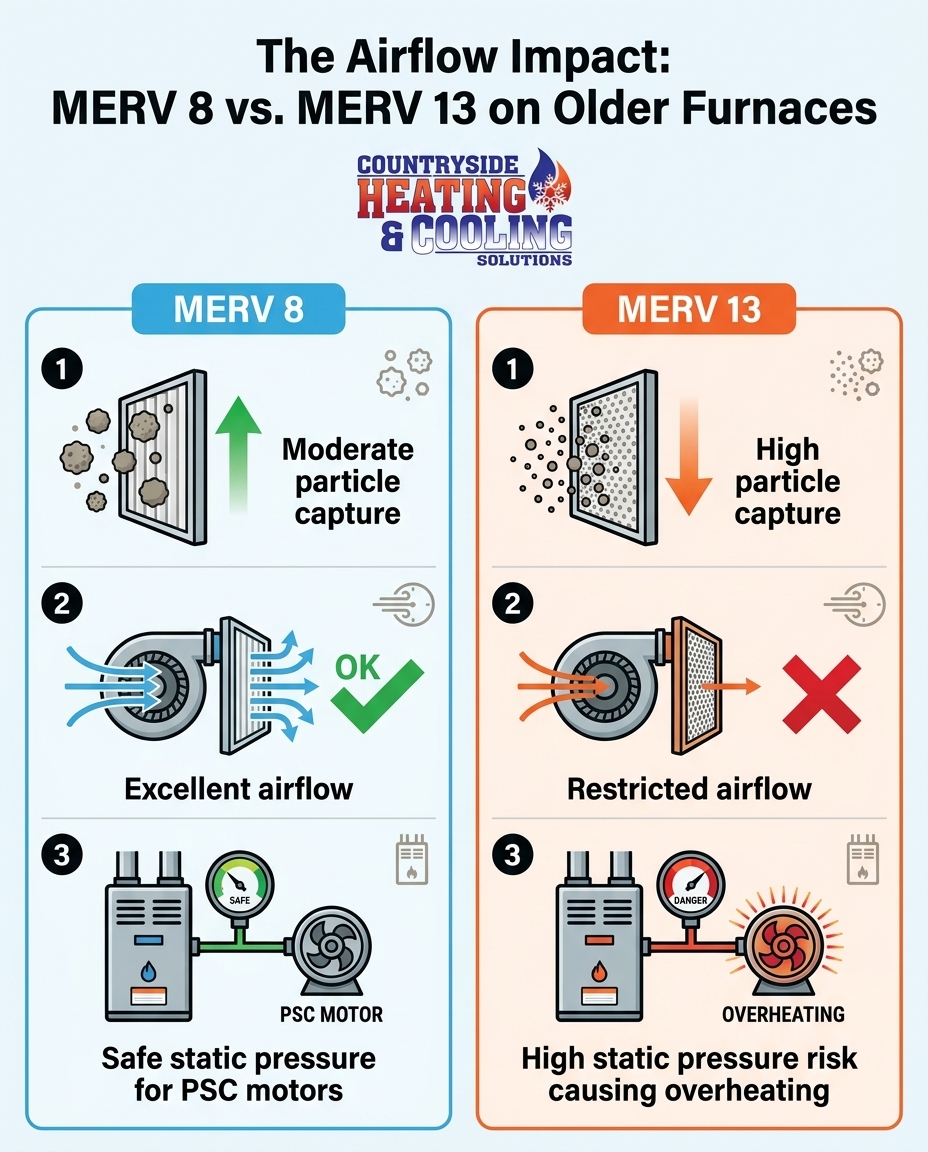
A MERV 13 filter is designed to catch microscopic particles, including bacteria and virus carriers. To achieve this, the filter media is woven incredibly tight and folded into dense pleats. While it excels at trapping dust, this dense material significantly restricts the volume of air that can physically pass through the fibers. By contrast, a standard MERV 8 filter allows the system to breathe freely while still capturing common household dust, pollen, and lint.
This restriction introduces a concept known as static pressure. Static pressure is the resistance to airflow within your ductwork and heating system. Think of it like drinking a thick milkshake: using a wide straw (MERV 8) takes very little effort, but trying to pull that same milkshake through a tiny coffee stirrer (MERV 13) requires an immense amount of force. When you install a dense filter, the static pressure spikes, forcing your equipment to fight against a massive wall of resistance just to circulate air through your home.
• MERV 8 — Particle Capture: Captures dust, pollen, lint, and mold spores. — Airflow Breathability: Excellent. Allows standard blowers to move high volumes of air. — Impact on Static Pressure: Low. Keeps resistance within safe operating limits for older systems.
• MERV 13 — Particle Capture: Captures microscopic allergens, bacteria, and fine smoke. — Airflow Breathability: Highly restricted. Acts as a dense barrier in the return duct. — Impact on Static Pressure: High. Can push static pressure beyond the motor's design capabilities.
The Hidden Danger to Older Furnaces: PSC vs. ECM Motors
The severity of a high MERV filter depends entirely on the type of blower motor sitting inside your furnace. Modern, high-end furnaces are often equipped with Electronically Commutated Motors (ECM), which are variable-speed. If an ECM detects an increase in static pressure from a dense filter, it can automatically ramp up its power and spin faster to push the required amount of air through the restriction. Older residential furnaces, however, operate on entirely different technology.
Most older systems are built with Permanent Split Capacitor (PSC) motors. These are reliable, single-speed workhorses, but they are not smart. A PSC motor operates at a fixed speed and has no ability to adjust its output based on resistance. When a MERV 13 filter is installed, the PSC motor is suddenly faced with a massive spike in static pressure, and it simply cannot overcome the barrier.
Because older systems were never engineered to push air through hospital-grade materials, the motor just keeps spinning at its fixed speed while moving a fraction of the necessary air. This causes the motor itself to run hotter and draw more electricity, all while failing to deliver the required airflow to the rest of the heating system.
Why PSC Motors Can't Overcome High Static Pressure
Understanding the limitations of a PSC motor is the key to preventing a mid-winter breakdown. When comparing a MERV 13 vs MERV 8 filter on an older system, the mechanical differences become obvious quickly:
• Fixed operational output: A PSC motor only knows one speed. It cannot ramp up power to force air through a dense, restrictive barrier.
• Increased mechanical strain: When faced with a dense filter, the blower wheel spins in a partial vacuum. The motor works significantly harder, runs hotter, and experiences accelerated wear and tear.
• Reduced air volume: Because the motor cannot overcome the resistance, the actual volume of air (measured in Cubic Feet per Minute, or CFM) moving through the ductwork drops dramatically.
• Heat distribution failure: This inefficiency directly impacts the furnace's ability to distribute heat throughout the home, leaving rooms feeling cold even while the system runs constantly.
How a Restrictive Filter Triggers a Furnace Overheating Lockout
When an older furnace is starved of air by a restrictive MERV 13 filter, the resulting failure is not just a matter of poor heating—it is a mechanical safety event. A dense filter acts exactly like a piece of cardboard placed over the return vent. By suffocating the system, it triggers a dangerous chain reaction inside the cabinet.
During a cold snap last fall, our technicians at Countryside Heating & Cooling Solutions responded to a Maple Plain homeowner whose furnace stopped working entirely. Because of the cold weather, they called us for help immediately. Our team quickly identified the issue: a highly restrictive filter had choked the system. We removed the blockage, addressed the safety limits, and heat was restored quickly. This scenario is a pattern we see often, and it follows a predictable sequence.
Here is the mechanical chain of events that leads to a system lockout:
1. The heat exchanger ignites: The burners fire up, generating intense heat inside the metal heat exchanger tubes.
2. Airflow is choked off: Because the dense filter restricts the return air, there is not enough cold indoor air blowing over the heat exchanger to absorb and carry away the heat.
3. Temperatures spike rapidly: Without sufficient airflow to cool the metal, the heat exchanger rapidly overheats, reaching dangerous temperatures inside the cabinet.
4. The high-limit switch trips: A vital safety sensor detects the severe overheating and immediately shuts off the gas burners to prevent a fire hazard or a cracked heat exchanger.
5. The system locks out: If this cycle repeats multiple times, the furnace control board will initiate a hard lockout, refusing to turn on until a professional resets the system.
If you find yourself dealing with issues that cause your furnace to keep shutting on and off, a suffocating filter is often the primary culprit. You must strictly avoid attempting to bypass furnace safeties or manually resetting tripped high-limit switches without addressing the underlying airflow restriction. Bypassing a safety switch removes the only protection your home has against a catastrophic overheating event.
The Severe Consequences of a Winter Lockout in Minnesota
A furnace lockout is frustrating in any climate, but in the Maple Plain area, it elevates from a minor inconvenience to a severe safety emergency. The long, severe winters in Minnesota mean that heating equipment operates under incredibly heavy, continuous loads for months at a time. During a deep freeze, a furnace might run almost non-stop just to maintain a baseline indoor temperature.
When you combine heavy continuous operation with the airflow restriction of a high MERV filter, you create the perfect storm for a breakdown. The compounding effect of the furnace struggling to breathe while running for hours on end guarantees that the high-limit switch will eventually trip. If this happens in the middle of a sub-zero night, your home's internal temperature will plummet rapidly, putting your family's comfort at risk and introducing the dangerous possibility of frozen, bursting water pipes.
Just last fall, our dispatch team took an emergency call from another local homeowner who found themselves needing same-day service when their furnace stopped working abruptly just as the temperatures dropped. One of our expert technicians arrived, diagnosed a severe airflow restriction caused by a dirty, high-MERV filter, and got their heat running again the same day. While they were lucky to get rapid service, relying on emergency repairs during a blizzard is a stressful position to be in. Airflow restrictions must be resolved during the September pre-heating season, long before the deep freeze sets in, to ensure reliable performance when you need it most.
Finding the Right Balance: Protecting Equipment Without Sacrificing Air Quality
You do not have to choose between breathing clean air and protecting your older heating equipment. The goal is to find the right balance, and that often means stepping away from the maximum-allergen marketing hype. Our team at Countryside Heating & Cooling Solutions would rather give you honest, practical advice that prioritizes the longevity of your older equipment over upselling trendy but potentially harmful high-MERV filters.
For the vast majority of older residential systems, standard MERV 8 filters represent the perfect sweet spot. A MERV 8 filter provides excellent protection against common household dust, lint, and debris, keeping the internal blower motor and heat exchanger clean. Most importantly, it allows the system to breathe freely, keeping static pressure low and preventing the dangerous overheating cycles associated with dense filters. When looking at a MERV 13 vs MERV 8 comparison for an older PSC motor, we recommend the MERV 8 every time for equipment safety.
Instead of relying on a single, highly restrictive filter to clean your entire home's air, advocate for more frequent filter changes. Swapping a standard filter every 30 to 60 days during heavy use months keeps airflow optimal. If you have severe allergies and need higher indoor air quality, there are alternative purification strategies that operate independently of the furnace blower. Standalone HEPA room purifiers, professionally installed UV germicidal lights, and dedicated whole-home air purifiers can drastically improve your air quality without adding a single ounce of static pressure to your aging furnace. Keeping your system clean through routine maintenance plans also ensures that dust isn't recirculating through your ductwork.
When to Call a Professional for Airflow and Static Pressure Diagnostics
If your furnace has been short-cycling, shutting off prematurely, or struggling to heat your home after a filter change, it is time to bring in an expert. Guessing at airflow issues can lead to permanent damage to your heat exchanger. A professional diagnostic visit goes far beyond just looking at the filter; it involves precise measurements to ensure your system is operating safely.
During the September pre-heating season, our HVAC professionals can perform a static pressure test. By inserting specialized probes into the ductwork, they can measure the exact resistance your blower motor is fighting against. This testing ensures that your ductwork and your filter are properly matched to your motor's specific capabilities. If the static pressure is too high, we can recommend adjustments to lower the resistance and protect the motor.
Furthermore, if your system has been running with a restrictive filter for a long time, a professional must inspect the heat exchanger for stress damage. Repeated overheating events weaken the metal, potentially leading to microscopic cracks that can leak combustion gases. A comprehensive pre-season tune-up will verify that the high-limit switch is functioning safely, the motor is drawing the correct amount of power, and the system is fully prepared for the heavy Minnesota winter. Do not wait for a freezing night to find out your system is suffocating—schedule HVAC service early to guarantee a warm, safe season.
Frequently Asked Questions
Can a high MERV filter damage my furnace?
Yes, a high MERV filter can cause significant damage to older furnaces. Dense filters restrict airflow, causing the system's internal temperature to spike rapidly. Over time, this repeated overheating can crack the heat exchanger or burn out the blower motor.
Why does my furnace keep shutting off with a new filter?
If your furnace shuts off shortly after installing a new filter, the system is likely overheating. A restrictive filter starves the furnace of air, causing the heat exchanger to get too hot. The high-limit safety switch then trips, shutting down the burners to prevent a fire hazard.
Is MERV 8 or 13 better for an older furnace?
MERV 8 is significantly better for older furnaces equipped with standard PSC blower motors. A MERV 8 filter captures common household dust and debris while allowing the system to breathe easily. A MERV 13 filter is often too dense and creates dangerous levels of static pressure.
What happens if my furnace filter is too restrictive?
If the filter is too restrictive, your blower motor will struggle to pull air through the return ducts. This leads to a drop in airflow, cold spots throughout the house, and a furnace that constantly overheats and short-cycles. Eventually, the system will lock out entirely and refuse to run.
How often should I change my standard furnace filter during a heavy winter?
During a heavy Minnesota winter when your furnace runs continuously, you should check your standard filter every 30 days. Replacing it every 1 to 2 months ensures that dust buildup does not restrict airflow, keeping your heating equipment running efficiently and safely.
