.webp)

The Frustrating Reality of Smart Thermostat Upgrades on Legacy Boilers
You picked up a sleek new Wi-Fi device for your September pre-heating season prep, expecting a quick weekend upgrade, but instead you are left wondering exactly why smart thermostats struggle with older boiler systems in the Twin Cities. You turn off the breaker, pop the old dial thermostat off the wall, and expect to find a neat row of colorful wires ready to plug into a modern backplate. Instead, you find just two old wires emerging from the wall. You wire them up anyway, flip the breaker back on, and nothing happens. Or worse, the new touchscreen flickers to life, but down in the basement, your previously reliable boiler starts clicking erratically and failing to ignite.
Homeowners often purchase smart thermostats to improve their energy efficiency, expecting a simple plug-and-play installation process. However, attempting to install these advanced digital devices on older regional radiant systems frequently results in immediate power loss, dropped Wi-Fi connections, or highly erratic boiler behavior. Faced with a malfunctioning heating system right as the weather begins to turn, you arrive at a critical decision point: do you risk a DIY electrical workaround to force the device to work, or do you hire a professional to properly adapt the system before the winter freeze sets in? If you are currently dealing with a blank screen or a chattering boiler relay, it is time to schedule an appointment with a local expert.
Resolving this technical mismatch early is absolutely critical. Modern thermostats and legacy boilers speak two fundamentally different electrical languages, and forcing them to communicate without the proper translation hardware can leave your home without heat exactly when you need it most.
The Architectural Divide: Minneapolis-Area Older Homes vs. Modern HVAC Tech
The root of this compatibility issue lies in the rich architectural history of the region. Minneapolis-area older homes, particularly those built before 1950, feature incredibly robust and reliable radiant heating infrastructure. Whether utilizing cast iron radiators, baseboard water pipes, or early in-floor heating, these legacy boiler systems were engineered for longevity. However, they were built decades before Wi-Fi networks, full-color touchscreens, and continuous-power smart devices became the household standard.
Modern smart thermostats are essentially small, wall-mounted computers. They require a constant, uninterrupted 24-volt power supply to maintain their wireless connectivity, run background algorithms, download weather updates, and keep their screens active. The fundamental clash occurs when this 21st-century technology demands continuous electrical power from a mid-20th-century heating system that was designed strictly for simple mechanical switching.
Minnesota's extreme freezing winters demand reliable, continuous heating, making the integrity of these older radiant systems paramount. When a modern thermostat is improperly integrated into a historic home's heating infrastructure, it compromises the very reliability that has kept the house warm for half a century.
Understanding the Simple 2-Wire Circuit
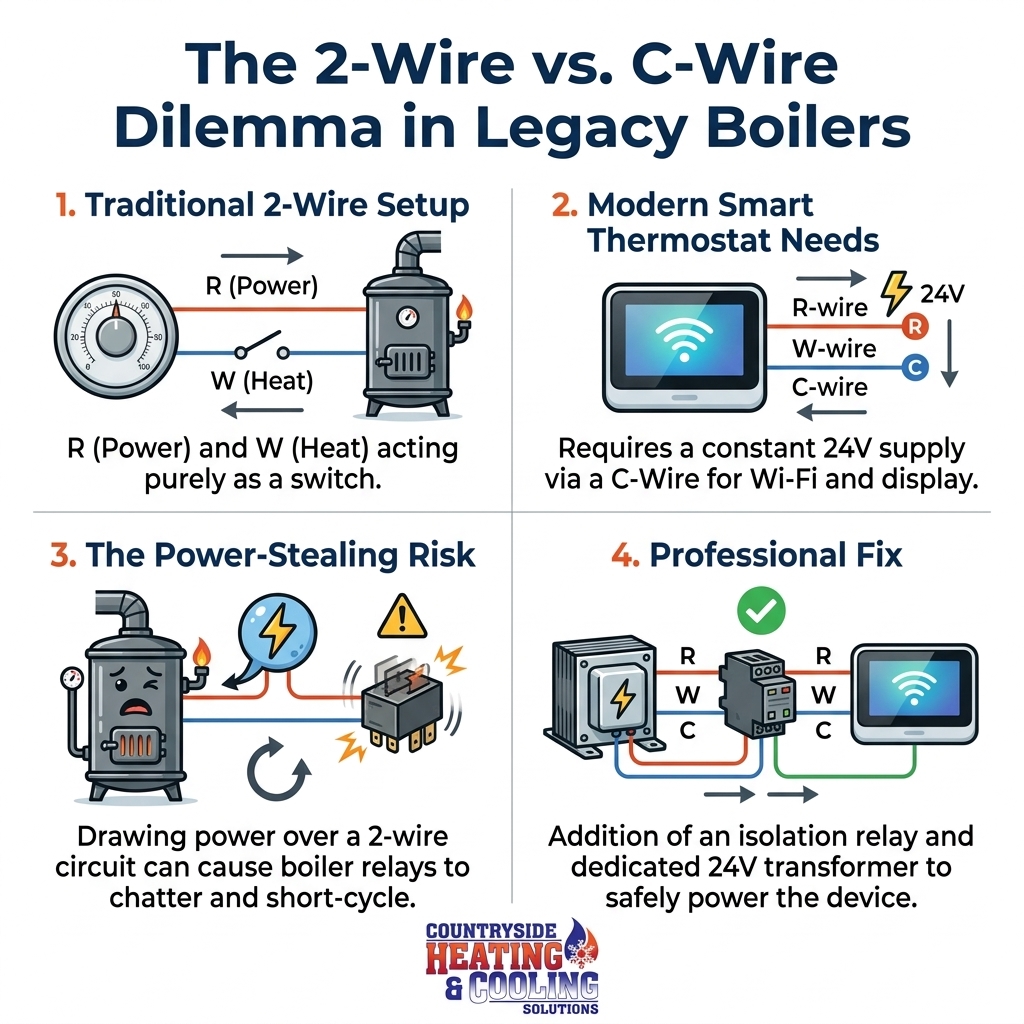
To understand why modern thermostats fail on these systems, you have to look at how older 2-wire radiant boilers operate. Traditional thermostats act as a basic mechanical on/off switch using just two wires (typically labeled R for power and W for heat).
• The R Wire: This wire carries a low-voltage current from the boiler's transformer up to the thermostat.
• The W Wire: This wire runs back down to the boiler's control valve or relay.
• The Switching Action: Inside an old dial thermostat, a mercury switch or a bimetallic strip simply connects the R wire to the W wire when the room gets cold. This closes the circuit, signaling the boiler to fire.
Crucially, this traditional circuit simply closes to signal for heat and opens to stop it. The old dial thermostat did not draw any power for itself; it merely acted as a bridge for the electrical current to pass through.
What is a C-Wire, and Why Do Older Radiant Boilers Lack It?
If modern smart thermostats are small computers, they need a power cord. In the world of HVAC wiring, that power cord is the "C-wire" or Common wire. The C-wire completes a continuous 24-volt circuit, providing dedicated, uninterrupted power to the thermostat's internal components regardless of whether the heating system is currently running or idle.
Because legacy 2-wire radiant boilers only needed to complete a simple switch circuit to turn the heat on and off, there was no historical reason for the original installers to run a third or fourth wire through the walls. The concept of a thermostat needing its own independent power supply simply did not exist when these homes were constructed.
Without a C-wire, a modern smart thermostat is starved of the continuous electricity it needs to function properly. Many smart thermostat installation guides and companion apps assume the homeowner has a modern forced-air furnace setup, which almost always includes a C-wire. This leaves owners of older boilers incredibly confused when their wall wiring doesn't match the app's diagrams.
• Primary Function — Legacy 2-Wire Boiler System: Simple mechanical switching (On/Off) — Modern Smart Thermostat Needs: Continuous computing, Wi-Fi, background data
• Power Source — Legacy 2-Wire Boiler System: None required at the thermostat level — Modern Smart Thermostat Needs: Requires continuous 24V power supply
• Wiring Present — Legacy 2-Wire Boiler System: R (Power) and W (Heat) only — Modern Smart Thermostat Needs: Requires R, W, and C (Common) at minimum
• Failure Risk — Legacy 2-Wire Boiler System: Virtually zero (highly robust mechanical parts) — Modern Smart Thermostat Needs: High risk of power loss without dedicated C-wire
When you attempt to install a device that requires three wires onto a system that only provides two, the device will immediately begin looking for alternative ways to keep its screen on and its Wi-Fi connected.
The Mechanics of Failure: Power-Stealing and Boiler Short-Cycling
When a smart thermostat realizes it does not have a dedicated C-wire, many models will attempt a risky workaround known as "power stealing." To compensate for the missing continuous power line, the thermostat attempts to draw a trickle of electricity directly through the heating circuit (the R and W wires) while the system is idle.
On a modern furnace, this trickle charge is usually ignored by the control board. However, on older 2-wire radiant boilers, this trickle charge is highly problematic. The sensitive zone valves and relays on a legacy boiler are designed to activate the moment they sense any electrical current. The trickle charge from the power-stealing thermostat can falsely signal the boiler's relays to activate.
Because the trickle charge isn't strong enough to fully open the valve or keep the burner ignited, the relay immediately drops back down. This results in "chattering" relays—a rapid, rhythmic clicking sound coming from the boiler room. This phenomenon forces the boiler into short-cycling, where the equipment rapidly tries to turn on and off without actually heating the home.
Short-cycling places immense wear and tear on legacy boiler components. It degrades the gas valves, burns out the ignition modules, and risks severe, permanent equipment damage. If you ever have to reset a glitchy Wi-Fi thermostat just to get your heat to turn on, you are likely experiencing the symptoms of a severe power mismatch.
Recognizing the Symptoms of a Power Mismatch
If you have recently installed a smart thermostat on an older boiler, watch for these distinct warning signs:
• Frequent disconnections: The thermostat frequently drops its Wi-Fi connection or displays low battery warnings on the screen.
• Phantom clicking: Clicking noises coming from the boiler room or the wall itself even when the heat isn't running.
• Screen blanking: The thermostat screen goes completely dark when the boiler attempts to fire.
• Inconsistent temperatures: The boiler runs for only a minute or two before shutting off, leaving the house cold.
Why September Pre-Heating Season Prep is the Wrong Time for DIY Hacks
September is the critical window for pre-heating season prep in the Twin Cities. The days might still be mild, but average October nighttime temperatures rapidly drop into the freezing range. This brief transition period is when many homeowners discover their new smart thermostats are incompatible with their legacy boilers, leading to a scramble for solutions.
Attempting DIY electrical workarounds—such as installing aftermarket isolation relays, bridging wires, or altering the boiler's internal control boards—carries incredibly high risks if not executed by a licensed professional. Online forums are filled with "hacks" for bypassing the C-wire requirement, but these generic tutorials rarely account for the specific voltage sensitivities of a 40-year-old local boiler system.
A botched DIY electrical job in early fall can easily result in a catastrophic heating failure on the first freezing night of winter. Minnesota winters leave absolute zero margin for error; a heating failure when it is well below freezing is a genuine emergency that threatens your plumbing and your home's structural safety. One local homeowner reached out during a brutal winter freeze when it was 10 below zero outside and their heating completely failed; fortunately, a technician was able to arrive within an hour after-hours to restore the heat. Relying on unverified DIY electrical hacks puts you at direct risk of facing a similar, easily preventable emergency.
Professional adaptation ensures the smart thermostat works flawlessly without compromising the safety or reliability of the home's primary heat source. If you are unsure about your system's compatibility, it is always safer to consult experts familiar with all Twin Cities service areas and their unique architectural challenges.
Bridging the Gap: Professional Solutions for Smart Boiler Integration
The good news is that you do not have to choose between modern convenience and legacy reliability. Professionals can safely bridge the technology gap without replacing your highly reliable older boiler. The key is isolating the smart thermostat's power needs from the boiler's sensitive switching circuit.
When you bring in a local expert, they have several safe, code-compliant methods to solve the C-wire dilemma. The most straightforward solution is running an entirely new multi-strand thermostat wire through the walls to provide a true, dedicated C-wire. However, in historic homes with lath and plaster walls, running new wire is often destructive or impossible without major renovations.
When new wire cannot be pulled, professionals typically install a 24V isolation relay combined with an external transformer. This setup creates a dedicated power loop exclusively for the smart thermostat. The thermostat gets the continuous electricity it needs to run its Wi-Fi and touchscreen, while the isolation relay acts as a protective barrier. When the thermostat calls for heat, the relay safely closes the old 2-wire circuit on the boiler without passing any trickle charges or electrical interference down to the legacy equipment.
Having this work done correctly is vital. During a sudden cold snap in the fall, another local customer found their furnace had completely stopped working due to control issues; technician Nick B. quickly identified the underlying electrical fault and safely restored the heat on the spot. Professional interventions like this ensure that your modern upgrades respect the historic architecture of the home while delivering the exact efficiency you wanted in the first place. For more details on system compatibility, you can always review our HVAC frequently asked questions.
Frequently Asked Questions About Smart Thermostats and Older Boilers
Why does my smart thermostat keep losing power on my boiler?
Your thermostat is likely losing power because it lacks a dedicated C-wire (Common wire) to provide a continuous 24-volt electrical supply. Older boiler systems use a 2-wire circuit designed only to act as an on/off switch, which does not provide enough steady electricity to keep a modern Wi-Fi thermostat powered. When the internal battery drains, the device shuts down.
Do I need a C-wire for an older boiler?
Yes, if you want to use a modern smart thermostat reliably, you will need a C-wire or a professionally installed workaround. While some thermostats claim to work without one by "power stealing," this practice frequently causes electrical interference and erratic behavior on older radiant boiler systems. A dedicated power source is the only way to ensure long-term stability.
Why is my boiler short-cycling with a new thermostat?
Short-cycling happens when a power-stealing thermostat sends a trickle of electricity down to the boiler to charge its own battery. This tiny electrical current can trick the boiler's sensitive legacy relays into thinking the thermostat is calling for heat, causing the system to rapidly click on and off. Over time, this rapid cycling can severely damage your boiler's components.
Can you use a smart thermostat with radiant heat?
Yes, you can absolutely use a smart thermostat with radiant heat, provided the electrical bridge between the two systems is set up correctly. Because radiant heat takes longer to warm up and cool down than forced air, you will also need to adjust the thermostat's internal settings (often called "True Radiant" or "Radiant Mode") to prevent the house from overheating.
How do professionals safely add C-wire functionality to a legacy system?
Professionals typically add C-wire functionality by either pulling a brand-new multi-strand wire through the walls or by installing an isolation relay near the boiler. The isolation relay uses a separate plug-in transformer to power the thermostat independently, completely separating the smart device's power demands from the boiler's delicate 2-wire switching circuit.
Secure Your Twin Cities Heating System Before the Freeze
Upgrading to a smart thermostat shouldn't mean sacrificing the proven reliability of your older radiant boiler. Understanding the technical limitations of a 2-wire system and the critical role of the C-wire is the first step to a safe, effective, and lasting home upgrade. By recognizing why these systems clash, you can avoid the dangers of power-stealing and short-cycling that ruin legacy equipment.
You deserve a clear, technically accurate solution from professionals who truly understand Twin Cities legacy heating systems. Don't risk a DIY electrical workaround that could leave you without heat on a freezing January night. Ensure your home is prepped, protected, and properly wired by relying on expert heating services before the severe winter weather hits.
