.webp)

Are You Guessing When It Comes to a Sudden August AC Breakdown?
Is your cooling system suddenly blowing warm air just as the season winds down, leaving you searching for The 5,000 Dollar Rule: A Framework for Approaching Late-Season AC Failures to figure out your next move? You are not alone in this frustration. Dealing with a malfunctioning air conditioner is stressful at any time of year, but an unexpected failure during the late August back-to-school transition adds a unique layer of chaos. Your family's schedule is already packed, the house is uncomfortably warm, and you are suddenly forced to make a major home investment decision under pressure.
When faced with a dying system, many homeowners rely on gut feelings or panic, hoping a quick fix will magically resolve the underlying wear and tear. However, guessing is a risky strategy when it comes to major home appliances. That is where a structured, math-based approach comes into play. By utilizing a logical calculation rather than emotional reactions, you can evaluate your options objectively. If you need professional guidance to assess the true condition of your system, exploring comprehensive air conditioning services is the best first step toward restoring your home's comfort reliably.
The Late-Summer Dilemma: Suffer Through or Take Action?
As summer draws to a close, it is incredibly tempting to ignore a struggling air conditioner. You might think that because autumn is just around the corner, you can simply open some windows, run a few box fans, and wait out the heat. Alternatively, you might be tempted to pay for a minimal, temporary band-aid fix just to keep the system limping along until October.
However, Minnesota's specific late-summer climate makes this a dangerous gamble. Here in the Maple Plain area, our team at Countryside Heating & Cooling Solutions knows that August often brings lingering, intense heatwaves combined with high humidity. It is practically impossible to simply "suffer through" these conditions until fall without risking your family's comfort, sleep quality, and even safety. Relying on a failing system during these brutal temperature spikes rarely ends well.
The Hidden Risks of Delaying Action
Pushing a compromised air conditioner to its absolute limits during a heatwave creates a cascade of negative effects throughout your home. When you choose to delay a proper resolution, you trigger several predictable consequences:
1. Spiking energy consumption: A failing system has to run twice as long to produce half the cooling. This constant operation draws excessive electricity, driving your monthly utility bills significantly higher.
2. Secondary equipment damage: When one component fails—like a struggling blower motor or a freezing evaporator coil—it puts immense strain on the rest of the system. What started as a localized issue can quickly destroy the compressor.
3. Compromised indoor air quality: An air conditioner that cannot properly cool also cannot properly dehumidify. High indoor humidity creates a damp environment that encourages mold growth and makes the air feel heavy and stagnant.
Rather than waiting for a total, catastrophic failure on the hottest afternoon of the year, establishing a structured decision-making process is critical right now. If you are currently deciding when an older AC is worth fixing, stepping back and looking at the raw data is the only way to protect your long-term investment.
Decoding the 5,000 Rule: Math Over Emotion
When an HVAC technician hands you an estimate for a major repair, the immediate reaction is often sticker shock followed by indecision. Should you sink that money into your current unit, or is it time to cut your losses? The 5,000 rule provides a clear, mathematical framework to cut through the confusion.
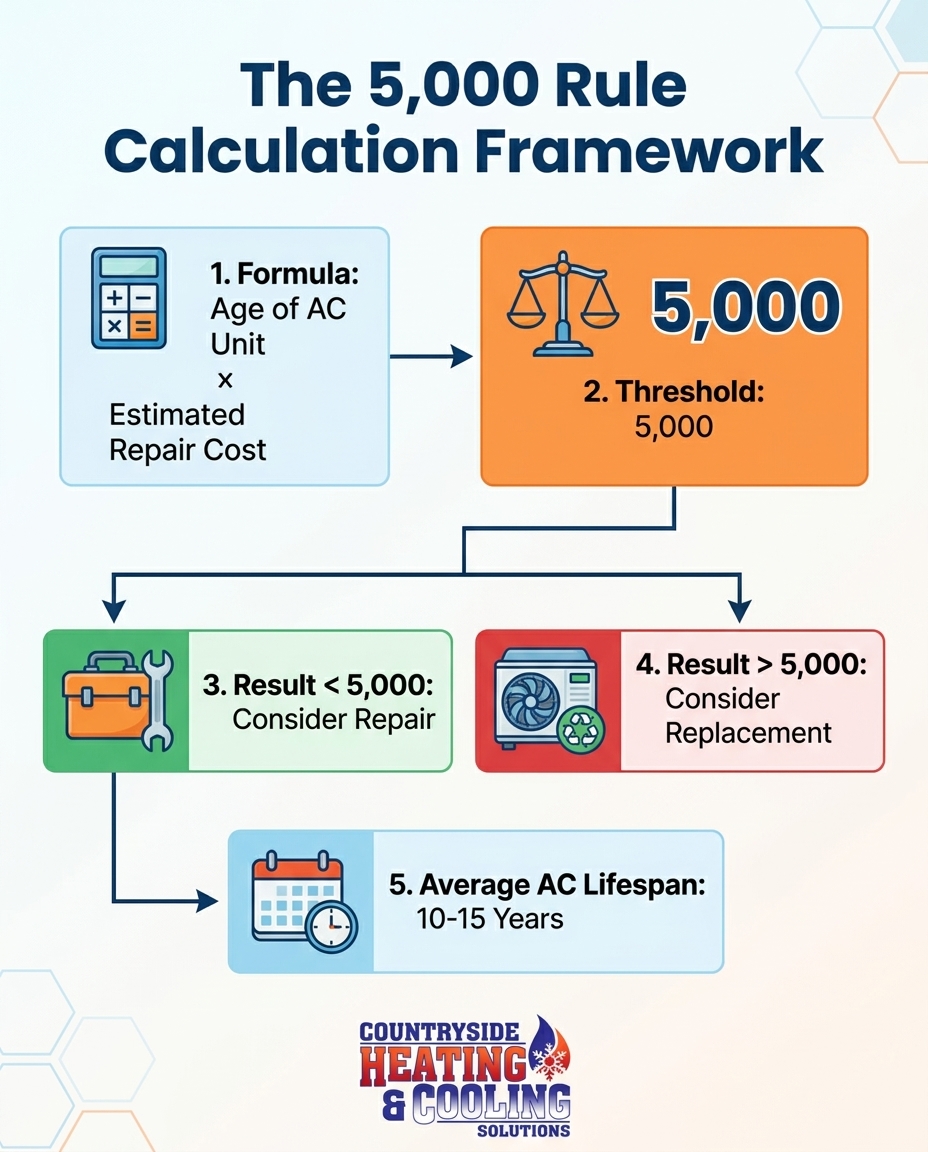
The formula is straightforward: you multiply the age of your equipment in years by the estimated repair cost. The resulting number acts as an index value. If that calculated index exceeds 5,000, the framework strongly suggests that replacing the unit is the wiser financial decision. If the number falls well below 5,000, repairing the system is generally a safe and logical choice.
Why the Index Matters
It is vital to understand that the 5,000 threshold is an index value used to gauge long-term viability, not a strict dollar amount you are expected to pay. By combining the two most critical factors—how old the machine is and how severe the current breakdown is—the formula provides a balanced look at your system's remaining lifespan. This objective math removes the panic from sudden breakdowns. You no longer have to wonder if you are making the right choice; the calculation points you in the right direction.
At Countryside Heating & Cooling Solutions, we use this exact framework to provide transparent, honest assessments. Over our years of serving the Maple Plain community, a pattern we see often is homeowners feeling pressured into unnecessary late-season repairs that will only fail again next year. If the math indicates that your current system is at the end of its road, taking the time to compare new air conditioners ensures you make an informed upgrade that will serve your home for the next decade or more.
Scenario A: When a Late-Season Repair Makes Financial Sense
The framework does not automatically default to replacing your equipment. In fact, there are many situations where the formula yields a number well below the 5,000 threshold, indicating that a repair is the most sound financial move. Younger units that have been consistently maintained and are suffering from minor component failures are prime candidates for rapid, same-day repairs.
For example, our technicians recently responded to a local family who needed same-day service during the early fall transition when their air conditioner suddenly stopped cooling. Because the unit was relatively young and the issue was isolated, our team was able to arrive the same day, accurately diagnose the problem, and repair the system quickly. The calculation clearly supported fixing the unit, extending the lifespan of a well-maintained system that still had years of efficient operation left to give.
Comparing the Variables
To better understand when a repair is justified, it helps to look at how different factors interact within the framework. The table below outlines the general conditions that push the calculation in either direction.
• Equipment Age — Pro-Repair Indicators (Index < 5,000): Under 10 years old — Pro-Replacement Indicators (Index > 5,000): 10-15 year old AC unit (or older)
• Maintenance History — Pro-Repair Indicators (Index < 5,000): Consistent annual tune-ups performed — Pro-Replacement Indicators (Index > 5,000): Rarely serviced, heavily neglected
• Nature of Breakdown — Pro-Repair Indicators (Index < 5,000): Minor electrical parts (capacitors, contactors) — Pro-Replacement Indicators (Index > 5,000): Major mechanical failure (compressor, coil leak)
• Warranty Status — Pro-Repair Indicators (Index < 5,000): Parts are still under manufacturer warranty — Pro-Replacement Indicators (Index > 5,000): Warranty has completely expired
When your system aligns with the pro-repair indicators, spending money on a fix is an investment in continued comfort. You are simply replacing a worn wear-and-tear part, allowing the core machinery to continue doing its job effectively.
Scenario B: When the Math Points Toward Replacement
Conversely, there are times when the math delivers a hard truth: your air conditioner has reached the end of its functional life. When you multiply the age of a 10-15 year old AC unit by a significant repair estimate for a major component like a compressor or an evaporator coil, the resulting index number easily shatters the 5,000 threshold. In these scenarios, the framework strongly advises against a band-aid fix.
Sinking a large sum of money into a dying, out-of-warranty system is a poor investment. Even if the immediate repair is successful, the surrounding aging components are highly likely to fail in the near future, trapping you in an endless cycle of service calls. Modernizing the system now provides immediate peace of mind, reliable cooling, and significant efficiency gains.
Navigating the Replacement Process
Facing a full system replacement can feel daunting, but professional guidance makes all the difference. We recently guided a Maple Plain homeowner through this exact overwhelming process during a brutal August heatwave when their AC developed severe issues requiring full equipment replacement. Our technicians took the time to explain the entire process clearly, performed the installation efficiently, and followed up afterward. The new equipment was confirmed to be working perfectly, leaving the homeowner completely satisfied and relieved to be off the repair treadmill.
If your calculation points toward replacement, exploring options for AC installation in Maple Plain ensures that you receive a properly sized, expertly installed system that will reliably handle the next decade of extreme summer weather.
Hidden Variables: Efficiency, SEER Ratings, and Aging Equipment
While the mathematical formula is an excellent starting point, there are supporting data points and hidden variables that further bolster the argument for replacement when dealing with older equipment. Age does not just increase the likelihood of breakdowns; it actively degrades the system's performance day by day.
According to Department of Energy (DOE) and ENERGY STAR guidelines, central air conditioners typically last 10 to 15 years. Once a unit crosses that decade mark, its internal components have endured thousands of hours of friction, heat, and vibration. This wear takes a measurable toll on efficiency.
The True Cost of an Aging System
Older units lose their SEER (Seasonal Energy Efficiency Ratio) rating over time. A unit that was rated at 14 SEER a decade ago might only be operating at a 9 or 10 SEER equivalent today due to coil degradation and compressor wear. This means that even if you fully repair the broken part, the unit will still cost significantly more to run than a modern system.
Consider these hidden variables when evaluating your old equipment:
• Frequent refrigerant leaks: Older systems utilizing outdated refrigerants are prone to micro-leaks, requiring constant, expensive recharging.
• Declining airflow: Aging blower motors struggle to push conditioned air to the furthest rooms of your house, resulting in uneven cooling and hot spots.
• Obsolete technology: Modern systems feature variable-speed compressors that provide precise humidity control and whisper-quiet operation, features that older single-stage units simply cannot match.
• Financial incentives: Upgrading to a high-efficiency system often qualifies you for generally applicable energy rebates or federal tax credits. While you should always verify current programs with your utility provider or tax professional, our team frequently sees these incentives help homeowners offset the initial investment of a new system.
The Psychological Trap of Pushing It to Spring
When a major breakdown occurs in late August, a very specific psychological trap catches many homeowners. Because the weather will soon cool down, the flawed logic of "we can just deal with it next year" begins to take hold. You might think that shutting the system off and ignoring it until May is a clever way to delay a major expense.
However, delaying a necessary replacement does not eliminate the problem; it simply pushes the stress, inconvenience, and financial burden to the first hot day of next spring. When you ignore the issue now, you guarantee that your family will wake up to a sweltering house the moment the weather turns warm again.
The Advantages of the Late-Summer Window
Handling the replacement during the late August back-to-school transition actually provides several distinct advantages. Right now, you are acutely aware of how poorly your old system was performing. You know which rooms were too hot and how high your energy bills climbed. This fresh perspective helps you make better choices when selecting a new system.
Furthermore, waiting until the first heatwave of spring puts you at the back of the line. The first 80-degree day of the year triggers a massive surge in service calls, leading to longer wait times for installations and potential equipment shortages. By utilizing the framework to make a confident decision now, you secure your installation on your own timeline, ensuring your home is perfectly prepared long before the next cooling season begins.
Frequently Asked Questions About the 5,000 Rule
What is the 5,000 rule for HVAC?
The 5,000 rule is a mathematical calculation used to determine whether you should repair or replace a failing HVAC system. It is calculated by multiplying the system's age in years by the estimated repair cost. If the total exceeds 5,000, industry standards recommend that replacement is generally the wiser financial decision. This framework helps homeowners make objective choices based on data rather than emotion.
At what age should you replace an AC unit?
Most central air conditioning systems have a functional lifespan of 10 to 15 years. Once a system reaches this age bracket, its internal components suffer from significant wear and tear, and the likelihood of major mechanical failure increases drastically. Furthermore, the system's energy efficiency drops significantly after a decade, meaning it costs much more to operate than a modern replacement.
Is it worth fixing an older AC unit?
Whether it is worth fixing an older unit depends entirely on the outcome of the formula and the specific nature of the breakdown. Minor fixes on well-maintained units can absolutely be worth it if the calculation stays well under the threshold. However, major component failures—such as a dead compressor or a leaking evaporator coil—on old units usually aren't worth the investment, as another expensive part is likely to fail soon after.
How do you calculate whether to repair or replace an air conditioner?
You start by using the 5,000 rule as your primary baseline calculation to gauge the immediate financial logic of the repair. From there, you must factor in secondary costs that the formula doesn't explicitly capture. These include rising monthly energy bills due to lost efficiency, the frequency of past breakdowns, and whether your home is suffering from poor indoor air quality or uneven cooling.
Does the 5,000 rule apply to both heating and cooling?
Yes, the framework works exceptionally well for furnaces and heat pumps as well as air conditioners. The underlying logic of balancing the age of the machinery against the severity of the repair applies to any major mechanical system in your home. It provides a universal, reliable baseline for evaluating all major HVAC investments, ensuring you never throw good money after bad.
Get a Transparent Assessment Before Fall Arrives
Navigating a sudden cooling failure during the chaotic late August back-to-school transition is overwhelming, but you do not have to figure it out alone. Relying on objective math protects your home and your wallet from risky, short-term band-aids. By applying this logical framework, you can confidently determine the best path forward for your family's comfort.
If your system is struggling and you need accurate numbers to plug into the formula, it is time to get a professional evaluation. Our team at Countryside Heating & Cooling Solutions provides honest, transparent diagnostics based on years of local experience, so you know exactly what you are dealing with. Do not wait for the system to fail completely; schedule an HVAC assessment today to ensure your home remains comfortable through the final weeks of summer and reliably efficient for years to come.
