.webp)

The Hidden Air Quality Shift When the School Year Begins
The late August back-to-school transition is finally here, and tackling back-to-school allergens with whole-home UV purifiers is likely the most effective way to protect your household this season. While you are busy organizing backpacks, adjusting sleep schedules, and preparing for the busy fall months, a hidden shift is happening inside your home. As the school doors open, your children are suddenly exposed to a wide array of new environments, crowded classrooms, and shared spaces. Inevitably, they bring those microscopic visitors back home.
At the very same time, late-summer allergens like ragweed are reaching their absolute peak outdoors. This creates a compounding problem for your indoor air quality. You are suddenly dealing with a surge of both biological pathogens and environmental allergens circulating through your living spaces. If you are currently evaluating your indoor air quality solutions, you face a critical decision point: are standard air filters enough to protect your household, or is it time to look at proactive defense mechanisms?
Most homeowners assume their standard HVAC filter is a catch-all solution for dirty air. However, standard filters are inherently passive. They wait for air to pass through and attempt to catch floating debris. When you are dealing with microscopic viruses brought home from the classroom, passive trapping often falls short. This is where advanced indoor air quality solutions, specifically duct-mounted UV lights, step in to provide an active, neutralizing defense mechanism for your entire home.
The Perfect Storm: Trapped Air and Compounding Pathogens
The problem: Every autumn, families experience what many refer to as the "back-to-school plague." Just a few weeks into the semester, respiratory illnesses, sniffles, and common colds seem to spike across the community. This isn't just a coincidence of timing. It is the direct result of behavioral changes and environmental factors colliding.
The cause: During the late August back-to-school transition, the weather outside is still quite warm. In Maple Plain MN and surrounding areas, lingering August humidity creates ideal conditions for biological growth in damp, dark places like your ductwork. Because the heat and humidity are still present, your windows remain shut tight, and your air conditioner runs continuously. You are effectively sealing your home tightly to keep the cool air in, which inadvertently traps biological contaminants indoors.
When you combine peak ragweed pollen counts with new school-borne viruses in a tightly sealed house, you create the perfect storm for poor indoor air quality. Furthermore, as families start adjusting your thermostat schedule for the back-to-school season, the way air circulates through the home changes. If the system fan is set to "auto," the air only filters when the cooling cycle runs, allowing stagnant air to pool in bedrooms and living areas.
The solution: To combat this compounding threat, homes require more than just passive airflow management. They need active purification that addresses the specific biological threats thriving in the humid, trapped air of late summer.
How Sealed Homes Amplify Contaminants
Understanding how your home breathes is the first step in fixing the problem. Modern, energy-efficient homes are built to be remarkably airtight. This is excellent for keeping your utility bills low, but it severely limits natural ventilation.
• Lack of fresh air exchange: Without drafty windows or open doors, the same volume of air is continuously recirculated through your HVAC system.
• Multiplying exposures: Continuous air recirculation means that a single airborne virus brought home from a classroom can pass through the shared living spaces multiple times an hour.
• Humidity as a catalyst: The combination of lingering summer humidity and trapped air creates a breeding ground for mold spores and bacteria within the ductwork itself.
Because your home is designed to trap air, you must implement active purification strategies to clean that trapped air continuously.
The Limits of Trapping: Why Standard HVAC Filters Fall Short
To understand why a proactive approach is necessary, we have to clarify the mechanical limitations of traditional 1-inch air filters. Many homeowners believe that buying the most expensive pleated filter at the hardware store will solve all their air quality issues. Unfortunately, that is fundamentally incorrect based on how these filters are designed to operate.
Standard HVAC filters were invented to protect the internal mechanical components of your furnace and air conditioner, not to sanitize the air you breathe. Their primary job is to stop large physical debris from coating the blower motor or the delicate fins of the evaporator coil.
Traditional filters are highly successful at capturing large physical particles. If you have an issue with visible dust, pet dander, or dog hair circulating through your home, a standard pleated filter will do an excellent job of trapping those irritants. However, the threats associated with the late August back-to-school transition are largely microscopic.
Viruses, bacteria, and certain mold spores are incredibly small—often measuring less than 0.3 microns in diameter. To put that in perspective, a single grain of pollen is massive compared to a cold virus. These microscopic biological threats easily slip right through the woven fibers of standard fiberglass or pleated filters. Worse yet, if a standard filter does manage to catch a biological contaminant, it does not kill it. If your ductwork has high humidity, that captured bacteria or mold spore can actually multiply directly on the filter's surface.
Physical Filtration vs. Biological Neutralization
The HVAC industry uses the MERV (Minimum Efficiency Reporting Value) rating system to grade filters. While a higher MERV rating means tighter weaving and better trapping, it still relies entirely on physical filtration.
• Primary Function — Standard HVAC Filter (Trapping): Protects HVAC equipment from large debris — Whole-Home UV Purifier (Neutralizing): Sanitizes air and internal HVAC surfaces
• Mechanism — Standard HVAC Filter (Trapping): Catches particles in a woven physical media — Whole-Home UV Purifier (Neutralizing): Uses targeted light waves to destroy DNA/RNA
• Effect on Viruses — Standard HVAC Filter (Trapping): Most viruses pass straight through the gaps — Whole-Home UV Purifier (Neutralizing): Actively neutralizes viruses so they cannot replicate
• Maintenance — Standard HVAC Filter (Trapping): Must be replaced every 1-3 months — Whole-Home UV Purifier (Neutralizing): Bulbs typically require annual replacement
• Biological Growth — Standard HVAC Filter (Trapping): Can harbor mold/bacteria if damp — Whole-Home UV Purifier (Neutralizing): Prevents mold/bacteria growth entirely
Physical filtration is a necessary baseline, but its limitations regarding viruses make a secondary, active neutralizing system essential for complete home protection.
The Power of Neutralizing: How Whole-Home UV Purifiers Work
If trapping biological threats isn't enough, the solution lies in active neutralization. This is achieved through a technology known as Ultraviolet Germicidal Irradiation (UVGI). While the name sounds highly technical, the science behind it is straightforward and incredibly effective for residential indoor air quality.
UVGI utilizes specific wavelengths of ultraviolet light—specifically UV-C—to target and destroy microorganisms. Unlike the UV-A and UV-B rays that cause sunburns, UV-C light is germicidal. When airborne viruses, bacteria, and mold spores pass through the intense light field generated by a duct-mounted UV purifier, the light penetrates their cellular walls.
The UV-C energy fundamentally disrupts the DNA and RNA of these microorganisms. Once their genetic material is scrambled, the pathogens are rendered completely inert. They can no longer function, infect a host, or replicate. Even if the neutralized particle continues to float through your home, it is completely harmless.
This active neutralization is a massive step up from the passive trapping of standard filters. You are no longer waiting to catch a germ in a net; you are actively sanitizing the air as it circulates. Both ASHRAE (The American Society of Heating, Refrigerating and Air-Conditioning Engineers) and the EPA have published extensive guidelines supporting the efficacy of UV surface and air treatment in reducing indoor biological contaminants.
For homeowners in Maple Plain MN and surrounding areas looking for top-tier protection, integrating a system like the Evolution Air Purifier provides this exact type of active, whole-home neutralization.
Targeting Viruses, Mold, and Bacteria
A properly installed UV light system provides a multi-faceted defense against the specific threats that spike during the fall transition.
• Destroying mold spores: UV lights installed near the indoor cooling coil continuously shine on the dampest part of your HVAC system, destroying mold spores before they can colonize and spread through your vents.
• Neutralizing airborne viruses: As air cycles from your children's bedrooms, through the return vents, and past the UV light, the viruses brought home from classrooms are subjected to lethal doses of UV-C energy.
• Continuous cleaning effect: Because the system treats the air every single time the fan runs, your home benefits from a continuous, compounding cleaning effect that improves the air quality hour by hour.
Integrating UV Protection with Your Existing Climate Control
One of the most common questions homeowners have is how a whole-home UV purifier actually fits into their current heating and cooling setup. The good news is that these systems are designed to integrate seamlessly with your existing equipment, operating silently and completely out of sight.
Whole-home UV lights are typically mounted directly inside the main supply or return ductwork, or positioned directly over the indoor evaporator coil of your air conditioning system. Because the light is contained entirely within the sheet metal of your HVAC system, there is no visible light in your living spaces, and it poses zero risk to your family's eyes or skin.
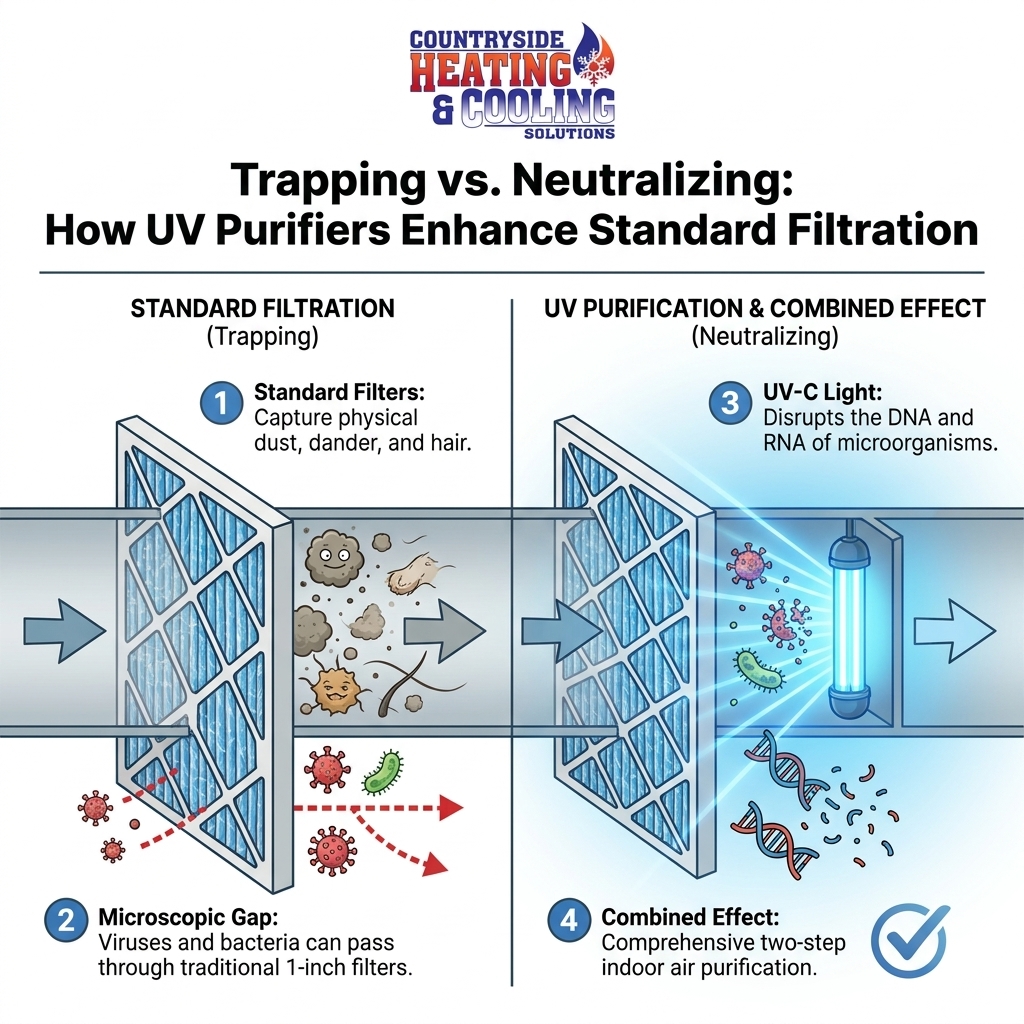
It is vital to understand that a UV light does not replace your standard air filter. Instead, it creates a comprehensive two-step purification process. You still need the physical filter to catch the dust and dirt, allowing the UV light to focus entirely on the microscopic biological threats.
A critical safety note: Installing a whole-home UV purifier is not a do-it-yourself project. These systems require cutting into your home's ductwork, handling high-voltage electrical connections, and ensuring precise placement for maximum airflow exposure. Professional installation is strictly required to ensure proper placement, safe electrical integration, and optimal performance.
The Two-Step Air Purification Strategy
When properly installed by a professional during the late August back-to-school transition, your HVAC system transforms into a highly effective air sanitization plant for your home.
1. Step 1: Physical Trapping. The air is pulled from your home and passes through the standard air filter. This first line of defense captures the large physical allergens—like ragweed pollen, pet dander, and heavy household dust.
2. Step 2: Biological Neutralization. Immediately after passing through the filter, the air enters the UV-C light field. Here, the microscopic biological threats—like cold viruses, flu strains, and airborne bacteria—are neutralized and rendered harmless before the air is pushed back into your living spaces.
Prioritizing Whole-Home Health and Family Comfort
While the science of Ultraviolet Germicidal Irradiation is fascinating, the technical specifications aren't what truly matter at the end of the day. What matters is the ultimate benefit to your family: a healthier, more comfortable living environment.
When you transition from merely trapping dirt to actively neutralizing viruses, you are taking a definitive step toward better whole-home health. There is a profound peace of mind that comes with knowing the air circulating through your children's bedrooms, your home office, and your family room is being actively sanitized multiple times an hour.
At Countryside Heating & Cooling Solutions, our commitment goes far beyond simply fixing broken air conditioners. We view comprehensive family comfort as our primary mission. We firmly believe that indoor air quality upgrades are not just optional equipment add-ons; they are vital investments in your whole-home well-being. By addressing the air quality proactively, you are creating a sanctuary where your family can breathe easier, sleep better, and stay healthier.
Framing proactive air quality management as an essential part of your back-to-school preparation routine just makes sense. You buy the school supplies, you adjust the bedtime routines, and you schedule the physicals. Ensuring the air inside your home in Maple Plain MN and surrounding areas is fortified against the inevitable influx of fall germs is the logical next step in protecting your household.
Protecting Your Household Through the Fall Transition
As the late August back-to-school transition shifts into the cooler months of autumn, your home will remain tightly sealed against the changing weather. Now is the time to ensure your air quality strategy is up to the task.
The core difference between trapping particles and neutralizing biological threats is the difference between a dirty filter and a sanitized home. Standard filters simply cannot stop the microscopic viruses that thrive during the fall season. By integrating a whole-home UV purifier, you actively destroy these pathogens, ensuring your family breathes clean, safe air all season long.
Don't wait for the first round of back-to-school sniffles to take action. If you are ready to evaluate your home's current defenses, reach out to an expert to schedule HVAC service and see if your current system can accommodate a UV upgrade today.
Frequently Asked Questions
Do UV lights in HVAC really work for allergies?
Yes, UV lights are highly effective at reducing specific types of allergens, particularly mold spores and mildew. While they do not trap physical pollen or dust, they destroy the biological allergens that thrive in damp ductwork. By eliminating mold growth inside your system, a UV light significantly reduces the airborne spores that commonly trigger severe allergic reactions indoors.
Can whole-house UV lights kill viruses in the air?
Whole-house UV lights are specifically designed to neutralize airborne viruses. When a virus passes through the UV-C light field inside your ductwork, the light energy disrupts its DNA and RNA. This damage renders the virus completely inert, meaning it can no longer infect a host or replicate, effectively sanitizing the air as it circulates.
What is the difference between a UV air purifier and a HEPA filter?
The primary difference lies in their operational mechanics: HEPA filters trap particles, while UV purifiers neutralize biologicals. A HEPA filter uses an incredibly dense web of fibers to physically catch microscopic debris, including some viruses and bacteria. A UV air purifier uses light energy to destroy the genetic material of living pathogens, ensuring they are dead rather than just trapped on a surface.
Are HVAC UV lights safe for homes?
HVAC UV lights are completely safe for residential use when installed correctly by a licensed professional. Because the UV-C bulb is housed entirely inside the enclosed sheet metal of your ductwork or air handler, no harmful light escapes into your living areas. The system operates out of sight, safely sanitizing the air without exposing your family to direct UV rays.
How do whole-home UV purifiers integrate with standard ductwork?
Whole-home UV purifiers are mounted directly into the main supply or return trunks of your existing HVAC system. A technician cuts a precise opening in the sheet metal, inserts the UV lamp so it spans the width of the duct, and hardwires the unit into the system's electrical supply. This allows the purifier to treat 100% of the air flowing through the system without restricting airflow.
Why is late summer a critical time for indoor air quality upgrades?
Late summer represents a unique intersection of high outdoor allergens and new indoor pathogens. As kids return to school, they bring home new viruses just as ragweed pollen peaks and lingering humidity encourages mold growth. Upgrading your indoor air quality during this window ensures your home is proactively protected before you seal the windows for the upcoming winter.
