.webp)

The Hidden Cause of Late-Summer AC Struggles
Your air conditioner is running nonstop, but the house still feels uncomfortably warm. You check the thermostat, and the indoor temperature is hovering several degrees above your set point. When you want to know what a chemical coil wash actually does for a struggling AC unit, the answer begins with understanding the invisible barrier suffocating your system. As the cooling season progresses, your outdoor unit continuously pulls in massive volumes of air, acting as a giant filter for every particle floating through your yard.
At Countryside Heating & Cooling Solutions, our technicians see this exact scenario play out every August. By the time the heavy heat hits, your system is battling severe late-summer wear. The delicate metal fins on the outside of your unit have spent months accumulating a microscopic layer of organic matter, dust, and environmental debris. This hidden buildup forces a critical decision point for homeowners: attempting a basic surface rinse with a garden hose or investing in a professional chemical treatment. A superficial cleaning simply will not solve the deep mechanical strain that causes your system to run continuously. Restoring true efficiency requires addressing the root cause of restricted airflow at a microscopic level.
If you are tired of paying high utility bills for a house that never quite cools down, it is time to look at professional air conditioning services. Having our experts evaluate your system allows you to schedule HVAC service before a struggling unit turns into a complete breakdown.
The Anatomy of a Clogged Condenser Coil
To understand why your air conditioner loses its cooling capacity, you have to look closely at the outdoor condenser unit. The exterior walls of this unit are made up of thousands of delicate, tightly packed aluminum fins. These fins are designed to maximize surface area, allowing heat to escape from the refrigerant circulating inside the copper tubes. However, this dense geometry also makes the fins a perfect magnet for microscopic particles.
After years of servicing AC units in our local climate, our team knows that the outdoor environment creates a perfect storm for system blockages. The specific combination of high summer humidity and heavy cottonwood shedding in Maple Plain MN creates a sticky, dense blockage that adheres stubbornly to these aluminum fins. The fluffy seeds mix with damp air, exhaust, and yard dust to form a solid barrier.
This accumulation happens in distinct, progressive stages:
1. Initial Adhesion: Sticky pollen and humid air create a tacky microscopic film across the outer edges of the aluminum fins.
2. Debris Trapping: Larger particles, specifically cottonwood seeds and grass clippings, stick to the tacky film, bridging the tiny gaps between the fins.
3. The Insulating Blanket: As the unit continues pulling air through the sides, dust and dirt are packed tightly behind the cottonwood layer, forming a dense, "felt-like" blanket of grime.
4. Internal Blockage: The suction of the fan pulls this sticky matrix deep into the core of the coil, far beyond what the naked eye can see from the outside.
Because of this internal migration, visual inspections are incredibly deceiving. A condenser coil can look reasonably clean on the outside after a rainstorm while remaining entirely blocked internally. Our technicians routinely discover severe internal blockages during standard system evaluations. For example, a local homeowner recently called us right as the back-to-school transition began because their AC couldn't keep up with the August heat; our lead technician evaluated the equipment, explained the hidden buildup we found deep within the fins, and kept the customer fully informed about the system's actual condition. This proactive approach is exactly why routine AC maintenance in Maple Plain is so vital for preventing late-season failures.
How Embedded Debris Spikes Refrigerant Operating Pressures
The Problem: Your air conditioner does not actually "create" cold air; it removes heat from your home and transfers it outside. The fundamental role of the outdoor condenser coil is to release that captured indoor heat into the outdoor air. When the aluminum fins are choked by a dense layer of embedded debris, this critical heat transfer process is severely restricted.
The Cause: The "felt-like" blanket of summer grime acts as a powerful thermal insulator. Instead of dissipating into the yard, the heat remains trapped inside the system's copper tubing. This creates a dangerous mechanical chain reaction. Because the heat cannot escape, the temperature of the refrigerant remains artificially high as it cycles back toward the compressor. The compressor, which acts as the heart of your system, is suddenly forced to pump much hotter, denser gas than it was designed to handle. This trapped heat forces the compressor to run hotter, work harder, and operate for much longer cycles just to achieve a fraction of its normal cooling output.
The Solution: Clearing the internal pathways is the only way to normalize the system. Blocked airflow connects directly to dangerous spikes in system pressure and an elevated risk of thermal overload. When our technicians connect their digital gauges to a struggling system, we immediately look at the refrigerant operating pressures. Abnormally high pressure on the discharge line is a classic indicator that the condenser coil is suffocating. Understanding the difference between a dirty coil and low refrigerant is a critical diagnostic step, as both issues cause the system to blow warm air, but they require entirely different mechanical solutions.
• Clean Condenser Coil — Heat Transfer Efficiency: Optimal (Heat escapes freely) — Compressor Workload: Normal (Standard cycle times) — Refrigerant Operating Pressures: Stable and within manufacturer specifications
• Fouled Condenser Coil — Heat Transfer Efficiency: Poor (Heat is trapped by debris) — Compressor Workload: Extreme (Continuous running, high heat) — Refrigerant Operating Pressures: Dangerously high, risking thermal overload
Why a Superficial Garden Hose Rinse Falls Short
A pattern we see often at Countryside Heating & Cooling Solutions is well-meaning homeowners reaching for the nearest garden hose when faced with a dirty outdoor unit. While keeping the immediate area free of leaves and large debris is helpful, we strongly advise against relying on a simple water rinse, as it is mechanically inadequate for resolving deep coil fouling.
The mechanics of water pressure: The water pressure from a standard residential hose pushes straight inward against the exterior of the unit. Because the debris is tightly packed between the narrow aluminum fins, hitting it with a direct stream of water often acts like a ramrod. Instead of washing the organic matter away, the water pressure forces the sticky, felt-like blanket even deeper into the core of the coil where it becomes permanently lodged.
The risk of structural damage: The aluminum fins on a high-efficiency air conditioner are incredibly thin and delicate. Using improper water pressure—especially from a spray nozzle set to a concentrated stream or, worse, a pressure washer—can instantly bend or flatten these fins. Flattened fins permanently block airflow, turning a dirty unit into a permanently damaged unit that requires expensive physical combing or complete replacement.
The lack of chemical breakdown: Furthermore, water alone lacks the chemical properties required to break down sticky, organic matter and baked-on summer grime. The buildup on your AC unit contains tree sap, oily exhaust from lawnmowers, and sticky pollen. Water simply rolls off these hydrophobic substances. Because a hose cannot dissolve these bonds, it cannot remove the internal blockage, meaning it will not effectively lower the dangerous refrigerant operating pressures causing your system to struggle.
The Mechanics of a Professional Chemical Coil Wash
To truly understand what a Chemical Coil Wash actually does for a struggling AC unit, we must look at the science of professional maintenance. Our team at Countryside Heating & Cooling Solutions brings award-winning expertise to every service call, and this is highly evident when contrasting our thorough, professional-grade foaming process with the ineffective, superficial DIY hose-downs we frequently encounter. Our licensed technicians use specialized, professional-grade chemical cleaners specifically formulated for HVAC applications.
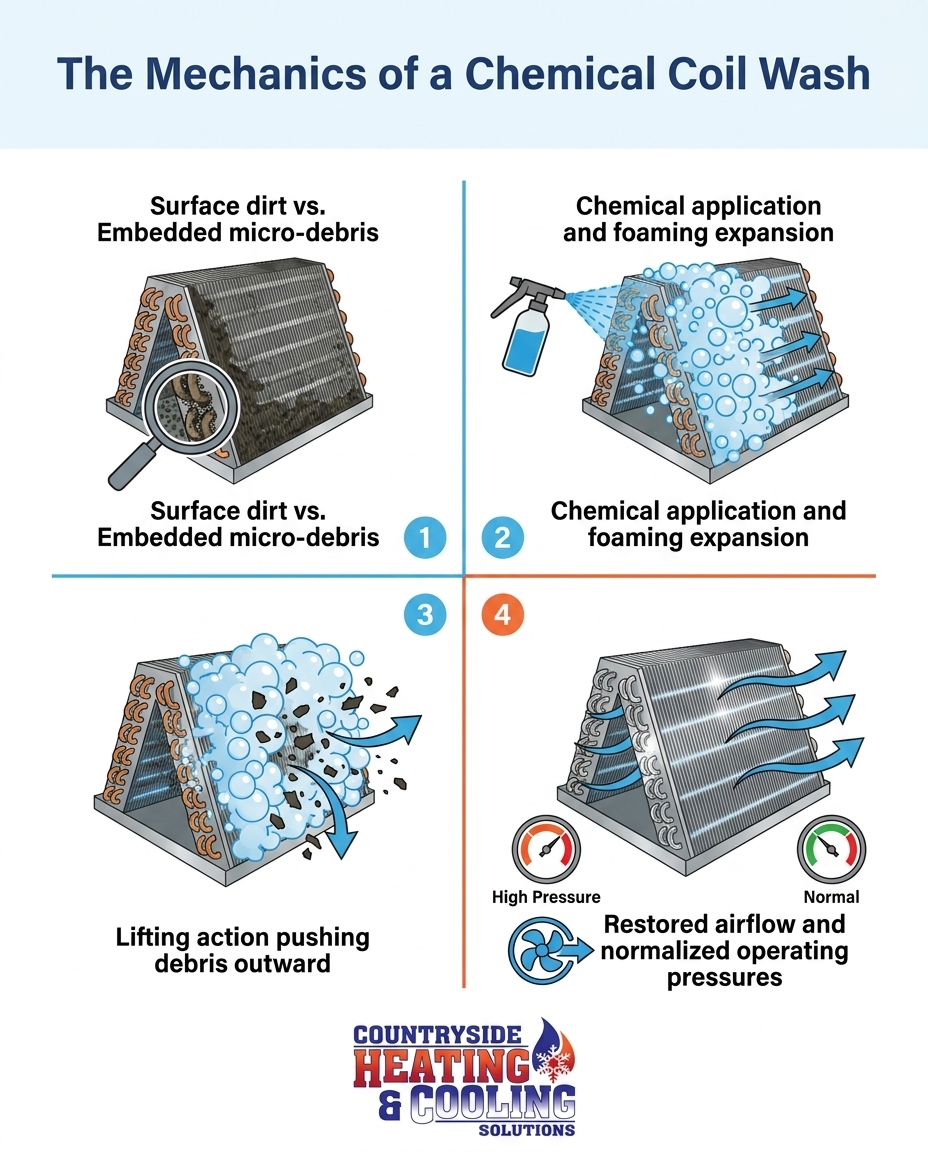
These advanced alkaline or acidic foaming agents are designed to attack the exact type of organic buildup found in local environments. The process relies on a precise chemical reaction and mechanical lifting action, rather than brute force water pressure.
The Expansion and Lifting Phase
The true power of a professional wash happens at the microscopic level during the application phase.
• Application of the foaming agent: Our technicians apply the chemical solution evenly across the entire surface of the coil using a low-pressure sprayer, ensuring the liquid penetrates deep into the fin gaps before it begins to react.
• The active bubbling process: Upon contact with organic debris and oxidation, the liquid triggers an active chemical reaction, expanding rapidly into a thick, shaving-cream-like foam. This reaction breaks down the sticky bonds holding the sap, pollen, and dust to the metal.
• Forcing hidden debris outward: Because the liquid penetrates deep inside the coil before expanding, the foam grows from the inside out. This outward expansion physically pushes the embedded micro-debris out to the surface of the fins, safely lifting it away without requiring damaging high-pressure sprays.
The Neutralization and Clearance Phase
Once the chemical has done the heavy lifting, our technicians safely remove the dissolved contaminants and restore the system to a neutral state.
• Safely rinsing away residue: Using a gentle, high-volume, low-pressure water flow, the technician rinses away the expanded foam, carrying the lifted debris and chemical residue completely out of the unit.
• Verifying clear pathways: The technician inspects the fin gaps to ensure the microscopic airflow pathways have been fully restored, allowing light and air to pass through unobstructed.
• Confirming the drop in strain: Finally, we verify the success of the wash by monitoring the system as it runs, confirming a measurable drop in system operating strain and normalized internal pressures.
Measuring the Impact on Your AC's Performance
The benefits of a proper chemical wash extend far beyond simply having a cleaner-looking outdoor unit. It is a vital intervention for your system's mechanical health and overall energy efficiency. According to Department of Energy (DOE) data, dirty condenser coils can increase an air conditioner's energy consumption by up to 30%. When your system is forced to run continuously against severe August late-summer wear, that massive drop in efficiency translates directly into wasted electricity.
Immediate workload reduction: Restoring optimal heat transfer immediately reduces the workload on the compressor. When the hot refrigerant can easily dissipate its heat through clean aluminum fins, the compressor does not have to pump against extreme resistance. The system cools the home faster, cycles off sooner, and draws significantly less amperage during operation.
Preventing premature failure: The long-term benefit of this process is preventing premature mechanical breakdowns during the hottest weeks of the year. Thermal overload is one of the leading causes of catastrophic compressor failure. By removing the insulating blanket of debris, you allow the compressor to operate within its safe temperature range, drastically extending the lifespan of your most expensive HVAC component.
Restored comfort: In our experience, this is the most important factor for our customers' daily lives—this deep-cleaning process allows the system to finally reach the thermostat set point efficiently. Instead of listening to your unit run endlessly while the house stays warm, you get crisp, reliable cooling. Investing in comprehensive Minnetonka AC maintenance ensures your system has the clear airflow it needs to perform exactly as the manufacturer intended.
Frequently Asked Questions About Coil Cleaning
Does cleaning AC coils really help?
Yes, cleaning your AC coils is absolutely critical for restoring heat transfer and lowering your home's energy consumption. When coils are clear of debris, the system can easily expel heat outdoors, which directly prevents the compressor from overheating and failing. Routine professional cleaning keeps your system running efficiently and extends its operational lifespan.
Why is my AC running constantly in late summer?
By late summer, your outdoor unit has accumulated months of summer grime, pollen, and cottonwood fluff, which severely restrict airflow. Because the system cannot properly expel heat through these blocked fins, it is forced to run longer, continuous cycles to try and cool the home. Removing this blockage is usually the first step in restoring normal cycle times.
Is a garden hose enough to clean AC coils?
No, a standard garden hose only removes loose surface dirt and is ineffective against baked-on grime. In fact, direct water pressure can actually push sticky debris deeper into the unit and easily bend the delicate aluminum fins. Proper cleaning requires professional foaming chemicals that expand to push dirt outward safely.
What happens if AC condenser coils are left dirty?
If condenser coils are left dirty, system efficiency plummets, causing your system to run constantly and leading to significantly higher utility bills. More importantly, the trapped heat creates extreme thermal strain on the compressor. Over time, this mechanical stress leads to frequent breakdowns and potential catastrophic compressor failure.
How often should a chemical coil wash be performed?
A thorough chemical coil wash is typically performed once a year as part of comprehensive professional maintenance. However, homes located near heavy foliage, busy roads, or heavy cottonwood trees may require more frequent attention. Our licensed technicians can evaluate your operating pressures to determine if a mid-season wash is necessary.
Giving Your Struggling AC a Fresh Start
Understanding what a chemical coil wash actually does for a struggling AC unit highlights the mechanical necessity of removing deep, embedded micro-debris. An air conditioner cannot function properly if it cannot breathe. Removing the sticky, insulating blanket of summer grime is not just about cleanliness; it is a critical investment in the lifespan of your compressor and the efficiency of your entire cooling system.
If your system is running constantly but failing to keep your home comfortable, do not wait for a complete breakdown. Have our professionals evaluate your system's operating pressures and inspect the internal condition of your condenser coils. Take the proactive step to schedule HVAC service today, and give your equipment the fresh start it needs to cool your home efficiently.
