.webp)

Why a Maintenance Plan Is the Smartest Thing You Can Do for Your Heating System
How a maintenance plan extends equipment life is simpler than most homeowners think: regular, scheduled care prevents the small problems that silently wear your system down before they become the expensive failures that leave your family cold in January.
Here is a quick look at what a maintenance plan actually does for your equipment:
• Catches small issues early before they cause full system failure
• Reduces unplanned breakdowns by up to 75%, according to industry data
• Cuts overall maintenance costs by as much as 25% over time
• Keeps your manufacturer warranty valid — most HVAC makers require annual service
• Extends system lifespan so you get more years out of a major investment
• Improves energy efficiency, which means lower monthly utility bills
Think about it this way. Your home's heating and cooling system runs roughly 3,300 hours every single year. If that were a car traveling at 65 mph, it would rack up over 214,000 miles in the same period. Nobody skips oil changes and tire checks at that mileage — and your heater deserves the same respect.
In Minnesota, where winters are long and temperatures can swing dramatically, that workload is even harder on your equipment. A system that never gets professional attention will age faster, work harder, and fail sooner. One that follows a consistent maintenance plan can reach or even exceed its expected 15 to 20-year service life.
This guide walks you through exactly how to make that happen.
Understanding How a Maintenance Plan Extends Equipment Life
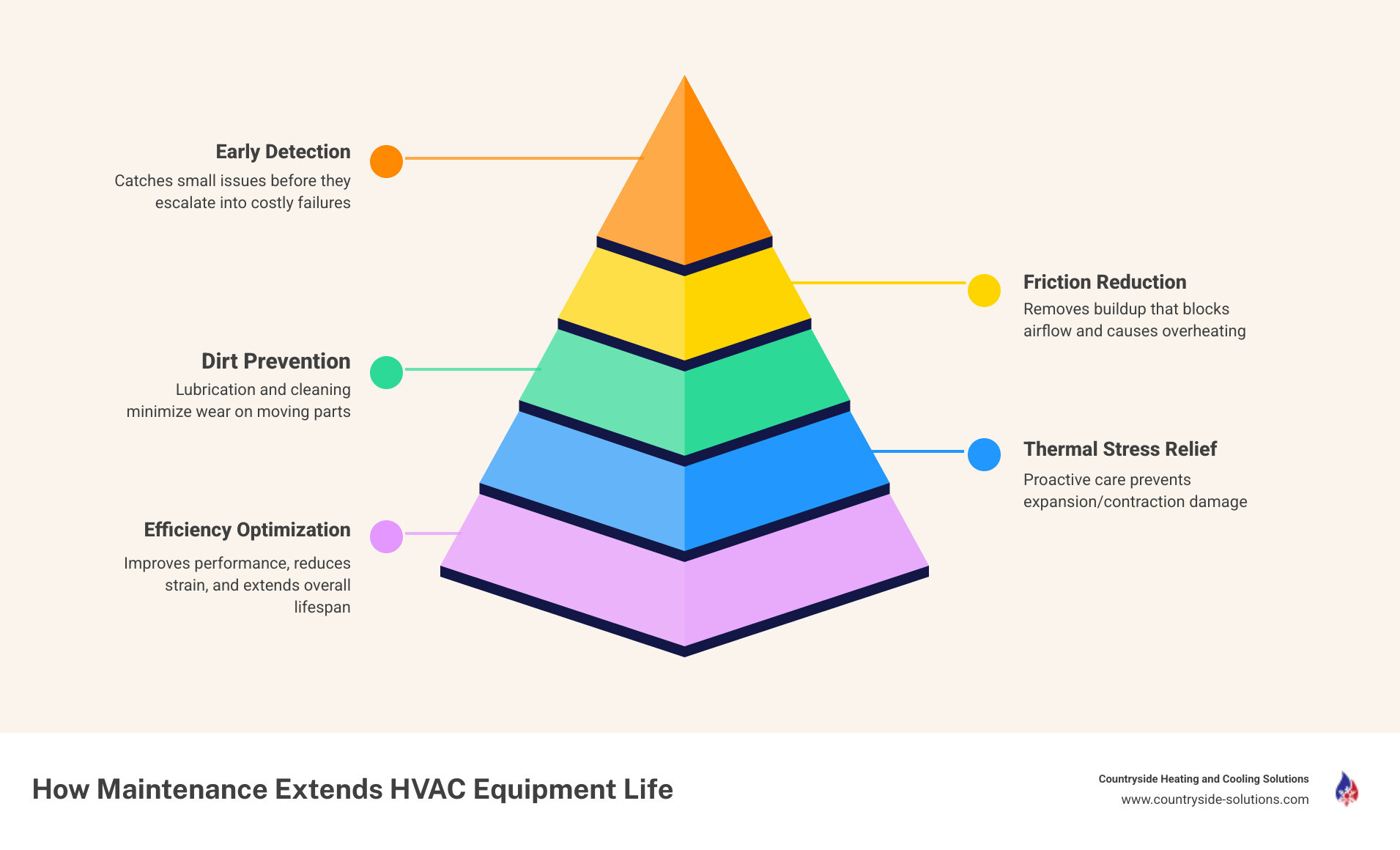
At its core, a maintenance plan is about physics and reliability. Every time your furnace or air conditioner kicks on, metal parts move against each other, electrical currents surge through wires, and air forces its way through filters and coils. Without intervention, this leads to three primary "system killers": friction, heat, and dirt.
When we talk about The Benefits Of Servicing Your Air Conditioning Systematically, we are really talking about reducing the workload on the most expensive components of your home. Thermal stress is a major factor in Minnesota. Our systems go from sitting idle to running at full capacity for weeks on end. This rapid cycling and intense operation cause components to expand and contract, eventually leading to cracks in heat exchangers or failures in blower motors.
By following a structured plan, we ensure that the system is operating within its designed parameters. We check that the gas pressure is correct, the electrical connections are tight, and the "blood" of the system—the air or refrigerant—is flowing without obstruction.
Proactive Care vs. Run-to-Failure Strategies
Many homeowners in places like Eden Prairie or Minnetonka fall into the "run-to-failure" trap. This means they only call us when the heat stops working. While we are always ready to help with a Furnace Maintenance Eden Prairie MN call, waiting for a breakdown is the most expensive way to manage your home.
Reactive repairs often happen at the worst times—like a Friday night during a polar vortex. Research shows that proactive care can reduce unplanned downtime by as much as 75%. When we perform a scheduled check, we can see that a capacitor is bulging or a belt is fraying. Replacing those small parts during a scheduled visit costs a fraction of an emergency service call and prevents the secondary damage that occurs when a part fails while the system is under heavy load.
How a Maintenance Plan Extends Equipment Life Through Part Replacement
One of the most significant ways how a maintenance plan extends equipment life is through the strategic replacement of wear-and-tear items. Think of your HVAC system like a high-performance engine. If you let a $20 belt snap, it might take out a $500 motor with it.
We prioritize using high-quality parts that match your system’s original specifications. This is vital for warranty compliance. Most major manufacturers, like Bryant, require proof of annual maintenance to honor their 5- or 10-year warranties. If a major component fails and you haven't had your annual tune-up, you could be on the hook for the full replacement cost.
Beyond the big components, we look at the small details. For example, Tips To Extend Water Heaters Lifespan often involve checking the anode rod. In a furnace, it’s about checking heat exchanger integrity and blower motor belt tension. These small adjustments keep the system efficient and prevent the "domino effect" of equipment failure.
Essential Components of an Effective HVAC Maintenance Program
A truly effective maintenance plan isn't just a quick "look-over." It needs to be a comprehensive audit of the system’s health. Whether you are looking for a Boiler Maintenance Guide Maple Plain MN or a standard furnace check, the core tasks remain the same:
1. Deep Cleaning: Dust and pet hair act as insulation on coils and motors, causing them to overheat.
2. Lubrication: Moving parts like bearings and motors need oil to prevent metal-on-metal grinding.
3. Electrical Tightening: Vibration from the system can loosen wires over time, leading to shorts or fires.
4. Sensor Calibration: If your thermostat or internal sensors are off by just a few degrees, the system will work much harder than necessary.
5. Safety Inspections: We check for carbon monoxide leaks and ensure all safety shut-offs are functioning correctly.
Why Cleaning and Lubrication are Vital for Longevity
Friction is the enemy of any mechanical system. When we perform AC Maintenance Chanhassen MN, we focus heavily on friction reduction. A motor that isn't properly lubricated has to pull more "amps" (electrical power) to spin. This extra power generates heat, which breaks down the motor's internal insulation, leading to a premature burnout.
Similarly, dirt is an insulator. If your outdoor AC condenser is covered in cottonwood seeds or dirt, it can't release heat effectively. This forces the compressor to run longer and hotter. By keeping these components clean and slick, we reduce energy waste and ensure the system doesn't "stress itself to death" during a humid July afternoon in Waconia.
How a Maintenance Plan Extends Equipment Life via Documentation
Data is a powerful tool for longevity. When you have a professional maintenance plan, you build a "medical history" for your equipment. This documentation is crucial for several reasons:
• Warranty Validation: As mentioned, you need proof of service to keep your coverage active.
• Resale Value: If you sell your home in Wayzata or Excelsior, showing a decade of perfect service records can significantly increase your home's value.
• Performance Tracking: We can look at past records to see if your system is starting to draw more power or if refrigerant levels are slowly dipping, which helps us catch tiny leaks before they become big ones.
• Lifespan Predictions: Knowing the history helps us answer the common question: "How Long Does A Bryant HVAC Last?" With records, we can tell you exactly how your specific unit is holding up compared to the average.
Step-by-Step: Creating Your Home Maintenance Schedule
While we handle the heavy lifting, a maintenance plan is a partnership between the homeowner and the technician. In Minnesota, your schedule should revolve around the change of seasons.
• Filters — Spring (Pre-Cooling): Check/Replace — Fall (Pre-Heating): Check/Replace
• Outdoor Unit — Spring (Pre-Cooling): Clean debris & cottonwood — Fall (Pre-Heating): Clear leaves & brush
• Vents — Spring (Pre-Cooling): Ensure all are unobstructed — Fall (Pre-Heating): Ensure all are unobstructed
• Professional — Spring (Pre-Cooling): AC Tune-up & Refrigerant Check — Fall (Pre-Heating): Furnace/Boiler Safety Inspection
• Thermostat — Spring (Pre-Cooling): Update to "Cool" settings — Fall (Pre-Heating): Update to "Heat" settings
When we perform HVAC Maintenance Orono MN, we also suggest keeping an "Asset Inventory." Write down the model number, serial number, and installation date of your furnace, AC, and water heater. This helps us bring the right parts the first time and helps you track the age of your equipment.
Identifying Warning Signs Before Total Failure
Even with a plan, you should keep your ears and nose open. Your system will often tell you it's struggling before it actually quits. If you notice any of the following, it’s time to call us for a check-up:
• Unusual Noises: Banging, whistling, or screeching are never good signs.
• Short-Cycling: If your furnace turns on and off every few minutes, it’s likely overheating or has a failing sensor.
• Rising Utility Bills: If your gas or electric bill jumps and the weather hasn't changed, your system is losing efficiency.
• Uneven Heating: If the bedroom is freezing but the living room is a sauna, your blower or ductwork needs attention.
• Odors: A "burning" smell that lasts more than a few minutes or a musty scent should be investigated immediately.
Understanding What Happens When You Get Your Furnace Serviced can help you feel more confident in identifying these signs early. Our technicians don't just fix what's broken; they look for the "why" behind the symptom.
The Role of Professional Inspections and Fluid Analysis
There are some things a homeowner simply can't do. Testing for carbon monoxide, checking refrigerant pressures, and analyzing combustion gases require specialized, expensive tools.
For those with modern systems, we use smart diagnostics. This is like a "blood test" for your heater. We can see exactly how much heat is being exchanged and if there are any "wear metals" or contaminants in the system. For heat pump owners, our Heat Pump Maintenance Wayzata MN Guide emphasizes the importance of checking the reversing valve and refrigerant charge—tasks that require EPA certification to handle safely.
Best Practices for Maximizing System Performance
To get the most out of your maintenance plan, there are a few "best practices" you can follow year-round:
• The 1-Month Rule: Check your air filter every month. If you have pets or allergies, you’ll likely need to change it more often than the "3-month" suggestion on the box.
• Clear the Perimeter: Keep at least two feet of clear space around your outdoor AC unit. Don't let bushes, weeds, or storage bins crowd it.
• Thermostat Discipline: Use a programmable thermostat to avoid massive temperature swings. Cranking the heat up to 80 when you get home doesn't warm the house faster; it just makes the system work at maximum stress for longer.
• Vent Awareness: Don't close off more than 10% of the vents in your home. This creates back-pressure that can damage your blower motor.
Following Summer HVAC Maintenance Tips like these ensures that when our NATE-certified technicians arrive for your scheduled visit, they are fine-tuning a healthy system rather than trying to resuscitate a dying one.
Environmental Protection and Proper Storage
In Minnesota, our equipment faces brutal elements. From heavy snow to corrosive road salt that can blow onto units near streets, the environment is a constant threat.
When we talk about Prepare For Summer With Plymouth Air Conditioning Maintenance, we often discuss protecting the unit from the "off-season" debris. While you shouldn't wrap your AC in a plastic tarp (which traps moisture and causes rust), a breathable cover for the top of the unit can prevent leaves and ice from damaging the fan blades during the winter. Keeping the area around your furnace dry and well-ventilated is equally important to prevent corrosion on the cabinet and internal components.
Frequently Asked Questions about HVAC Longevity
How often should I schedule professional maintenance?
Ideally, you should have your system inspected twice a year: once for the heating system in the fall and once for the cooling system in the spring. Usage patterns in the Twin Cities metro area are intense, and How Often Should The Heater Be Inspected usually comes down to "at least once a year" to maintain your warranty and ensure safety. If you have an older system (over 10 years old), more frequent checks can help catch the inevitable wear-and-tear of aging components.
Does maintenance really lower my monthly utility bills?
Yes, significantly. A neglected AC unit can consume up to 25% more energy than a maintained one. When coils are dirty and filters are clogged, the motors have to work harder and run longer to achieve the same temperature. By following Proper Heating Maintenance Tips, you ensure the heat transfer is as efficient as possible, which keeps your money in your pocket instead of sending it to the utility company.
Can I perform all maintenance tasks myself?
While there are many Essential Furnace Maintenance Tips For Your Home DIY Tips—like changing filters and cleaning vents—most of the longevity-extending work requires a professional. Working with high-voltage electricity, natural gas, and pressurized refrigerants poses serious safety risks. Furthermore, a NATE-certified technician has the trained eye to spot a hairline crack in a heat exchanger that a homeowner would likely miss, which is a critical safety issue for your family.
Conclusion: Partnering with Countryside for Long-Term Comfort
At Countryside Heating and Cooling Solutions, we’ve spent years helping families in Buffalo, Chanhassen, Delano, and across the Minneapolis-Saint Paul metro area keep their homes comfortable. We know that your HVAC system is one of the biggest investments in your home, and we treat it that way.
Our NATE-certified technicians are experts in how a maintenance plan extends equipment life. We don't just check boxes; we provide the meticulous care that prevents breakdowns and maximizes efficiency. With our guaranteed next-business-day service, you never have to worry about being left in the cold.
Whether you need a one-time tune-up or want to explore our Comprehensive AC Maintenance Plans, we are here to help. Our service area covers everything from the shores of Lake Minnetonka to the quiet streets of Medina and Watertown.
Don't wait for the first blizzard or the first heatwave to find out if your system is ready. Protect your investment with our professional service plans today and enjoy the peace of mind that comes with a well-maintained home. Give us a call at Countryside Heating and Cooling Solutions—we’ll make sure your heater stays alive much longer than a Minnesota winter.
