.webp)

The Hidden Moisture Trap in Late-Summer Walk-Out Basements
You head down the stairs to your finished lower level expecting a comfortable retreat, but instead, you hit a wall of clammy, heavy air. If you are trying to figure out the secret to managing humidity in Lakeville walk-out basements as summer winds down, you are certainly not alone. The main floor of your house likely feels perfectly fine, yet your lower level smells unmistakably musty and feels damp to the touch. This frustrating scenario is a concrete problem that peaks every year during the late August / back-to-school transition. Homeowners are left at a decision point: do you rely on a noisy portable dehumidifier, try adjusting your central fan settings, or invest in a whole-home dehumidification system to protect your finished space?
If you need immediate help evaluating your system and finding a permanent fix, explore our HVAC Services to see how we can restore your indoor comfort.
Why the Transition Season Exposes Air Quality Flaws
During the peak heat of July, your air conditioner runs almost constantly. That long runtime naturally pulls a massive amount of moisture out of your indoor air. However, as the season shifts toward autumn, the outdoor dynamics change drastically. The ambient temperatures begin to cool down, meaning your home does not heat up as quickly during the day.
Because the thermostat registers a comfortable temperature much sooner, your cooling equipment shuts off faster. The problem is that the outdoor humidity often remains incredibly high during this transition period. Standard cooling simply is not enough to manage indoor air quality during this shift, leaving your lower level vulnerable to trapped moisture.
Understanding the Physics of Lakeville Walk-Out Basements
Walk-out basements present a unique architectural challenge. Unlike a fully subterranean basement that is entirely surrounded by soil, a walk-out design is half-buried and half-exposed to the outside elements. This specific layout is incredibly common in Lakeville walk-out basement homes, taking advantage of the region's rolling topography. However, this beautiful design creates a complex indoor microclimate that requires specialized Indoor Air Quality strategies to manage properly.
The Stack Effect Explained
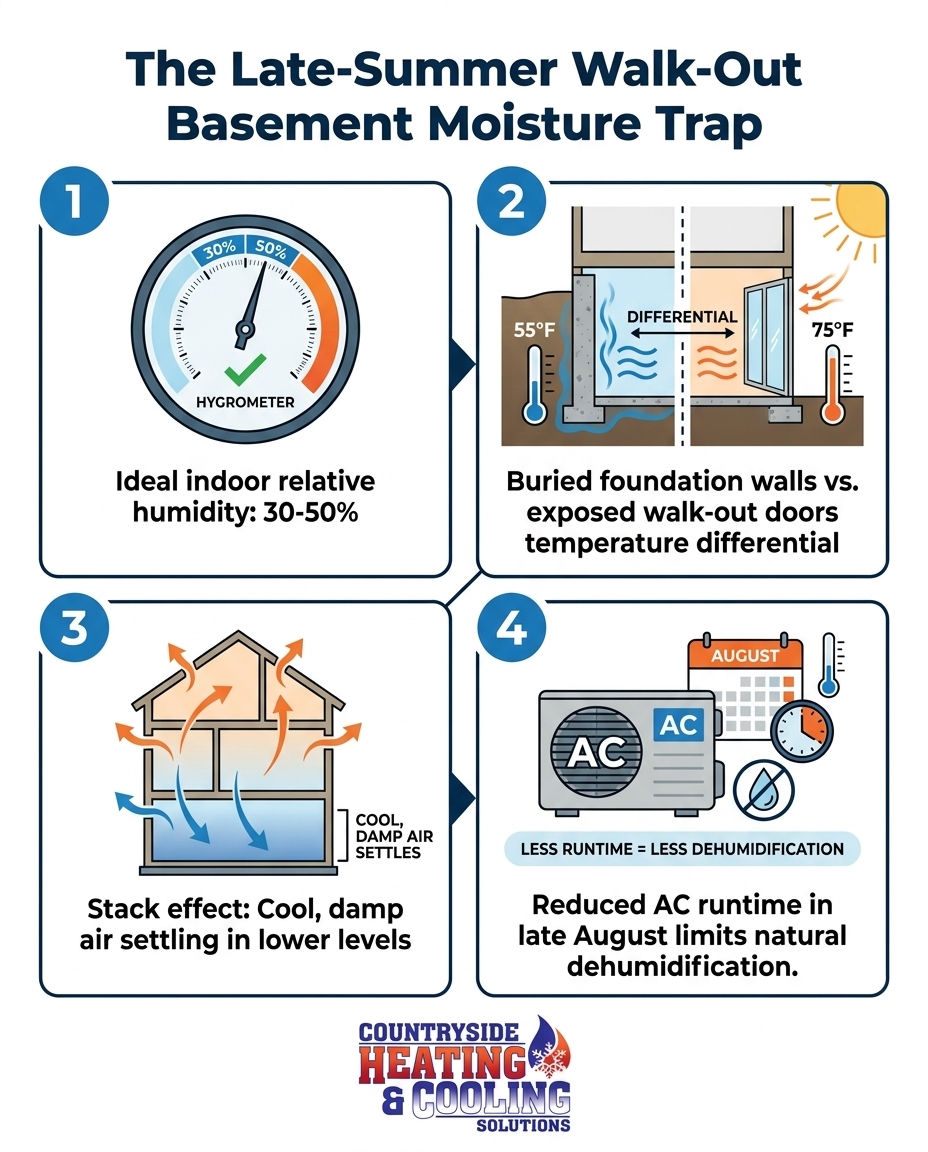
Multi-level homes operate under a principle known as the stack effect. Warm air naturally rises to the upper floors of your house, while cool, dense air sinks to the lowest point. Because cold air holds less moisture than warm air, the relative humidity in that sinking air spikes as the temperature drops. Your finished lower level effectively becomes a catchment basin for dense, moisture-laden air. Without proper air circulation and dedicated moisture removal, that damp air stagnates, creating the perfect environment for mold and mildew to thrive.
Thermal Bridging in Half-Buried Walls
The layout of a walk-out lower level creates stark temperature differentials. The walls that are buried underground benefit from the natural insulating properties of the earth, keeping them consistently cool. Meanwhile, the exposed exterior wall—complete with large patio doors and windows—faces fluctuating outdoor temperatures and direct sunlight.
This sharp contrast in insulation properties encourages thermal bridging. Warm, moist indoor air comes into contact with the cooler surfaces near the buried foundation walls or the glass of the patio doors, causing the moisture in the air to reach its dew point. The result is rapid condensation on your walls, windows, and floors.
Why Standard Air Conditioning Struggles in Late August
Standard air conditioners are designed to do two things simultaneously: lower the air temperature (sensible cooling) and remove moisture (latent cooling). However, the system is controlled entirely by the thermostat, which only measures temperature. This creates a significant blind spot during the late August / back-to-school transition in Minnesota.
Our specific late-summer climate pattern frequently delivers dropping ambient temperatures coupled with lingering high dew points. It might only be 74 degrees outside, but the air feels incredibly heavy and muggy. Because the temperature is relatively mild, your Air Conditioning system satisfies the thermostat setting very quickly. The unit turns on, cools the house down to 70 degrees in just ten or fifteen minutes, and then shuts off.
Unfortunately, fifteen minutes is not nearly enough time for the cooling coil to wring the excess moisture out of the indoor air. The system effectively short-cycles, leaving the lower levels of your home cold but extremely clammy. The AC has done its job according to the thermostat, but it has completely failed to dehumidify the space, leaving your finished basement feeling like a damp cave.
Signs Your Finished Basement is Trapping Excess Moisture
Identifying a humidity imbalance early is critical to protecting your home. Moisture damage often happens slowly, hiding behind drywall or under flooring before it becomes a major structural issue. In Lakeville walk-out basement homes, the symptoms usually present themselves physically before they cause permanent damage.
According to ASHRAE guidelines, your ideal indoor relative humidity should stay between 30% and 50%. When levels creep above 60% for extended periods, mold and mildew begin to actively grow. Watch for these clear warning signs:
• Visible condensation: Water droplets forming on the inside of your walk-out patio doors or exterior-facing basement windows.
• Musty odors: A distinct, earthy smell that hits you halfway down the stairs, even when the main level smells completely fresh.
• Clammy surfaces: Leather furniture, carpet, or bedding in the lower level feeling damp or sticky to the touch.
• Cupping floors: Hardwood or luxury vinyl planks beginning to warp or lift at the edges due to moisture absorption from the concrete slab.
• Peeling paint: Blistering or flaking paint along the baseboards or lower sections of the drywall.
Portable Dehumidifiers vs. Whole-Home Air Quality Solutions
Once you recognize the moisture problem, the next step is deciding how to fix it. Many homeowners immediately purchase a standalone unit from a big-box store. While these can offer a temporary bandage, they often fall short of providing a permanent, comfortable solution. Understanding the differences between localized and comprehensive moisture control is essential, especially when dealing with local HVAC challenges in the Twin Cities.
Limitations of Portable Units
Portable dehumidifiers are designed for small, enclosed spaces. When placed in expansive Lakeville walk-out basement homes, they simply lack the capacity to pull moisture from multiple rooms. They are notoriously loud, making it difficult to watch television or sleep while they run. Furthermore, they require constant manual emptying. If the bucket fills up while you are at work, the unit shuts off, and your basement spends the rest of the day absorbing moisture.
Advantages of Integrated Systems
Whole-home dehumidification systems integrate directly into your existing central ductwork. Instead of trying to treat a single room, they pull air from the entire house, remove the excess moisture, and distribute dry, comfortable air back through every vent. They operate quietly out of sight, drain automatically into your floor drain, and are controlled by a digital hygrostat that monitors moisture levels 24/7.
• Coverage Area — Portable Dehumidifier: Single room or small open area — Whole-Home System: Entire home via central ductwork
• Maintenance — Portable Dehumidifier: Requires daily manual emptying — Whole-Home System: Drains automatically; annual filter change
• Noise Level — Portable Dehumidifier: Loud, disruptive compressor noise in living space — Whole-Home System: Whisper-quiet, housed in the mechanical room
• Efficiency — Portable Dehumidifier: High energy draw for limited moisture removal — Whole-Home System: High-capacity removal with lower operating costs
Safe HVAC Adjustments for Immediate Relief
If you are waiting for a professional evaluation, there are a few safe, immediate steps you can take to help manage the moisture levels in your home. These adjustments do not require specialized tools, but they can help mitigate the dampness during the late August / back-to-school transition.
1. Adjust your central fan settings: Check your thermostat and switch the fan setting from "AUTO" to "ON." This forces the blower motor to run continuously, even when the cooling cycle is off. This constant circulation helps mix the heavy, damp basement air with the drier air on the upper floors, reducing stagnation and preventing moisture from settling.
2. Avoid drastically over-cooling: It is tempting to drop your thermostat down to 65 degrees just to force the air conditioner to run longer and dry out the basement. However, this strategy backfires. It wastes massive amounts of energy, turns your main floor into an icebox, and can actually cause your ductwork to sweat, creating secondary moisture problems.
3. Check exterior drainage: Walk outside and inspect the area around your walk-out patio doors. Ensure that your gutters are clear and that the downspouts are actively directing rainwater at least six feet away from the foundation. Exterior water pooling against the half-buried walls will rapidly increase indoor humidity levels.
4. Keep interior doors open: Promote airflow in the lower level by leaving bedroom and bathroom doors open. Trapped air in closed-off basement rooms becomes stale and humid much faster than air in open, circulating spaces.
Tailoring HVAC Systems to Minnesota's Unique Architecture
When it comes to managing indoor air quality, cookie-cutter cooling solutions almost always fail in multi-level walk-out homes. A system designed for a single-story slab-on-grade house will not effectively manage the complex thermal dynamics of a half-buried lower level.
This is where deep local expertise in Twin Cities and Minnesota home architecture becomes vital. Understanding exactly how Lakeville walk-out basement homes are constructed allows for highly effective, tailored HVAC design. A generic installation might cool the air, but a tailored solution manages the entire indoor environment.
A professional inspection maps the airflow through your specific floor plan, measures the humidity levels accurately across different zones, and identifies exactly where the moisture is settling. By analyzing your existing ductwork and equipment capacity, a professional can design a permanent fix that integrates seamlessly with your home. If you are tired of battling dampness, it is time to Schedule HVAC Service and get a customized evaluation.
Restore Comfort to Your Walk-Out Basement Before Fall
Addressing the moisture imbalance in your lower level is crucial before the crisp fall weather sets in and you close your windows for the winter. The dampness you feel during the late August / back-to-school transition will only compound as the heating season begins if left unresolved.
You do not have to settle for a basement that smells musty or feels uncomfortable. A clear explanation of your home's unique airflow challenges, combined with actionable HVAC upgrades, will provide lasting satisfaction and protect your finished spaces. Consult a local expert to evaluate your walk-out basement's specific needs, and take the right steps to restore total comfort to your entire home today.
Frequently Asked Questions
Why is my finished basement so humid even with the AC running?
Your AC is likely short-cycling due to mild outdoor temperatures. The system cools the house quickly and shuts off before it has time to run long enough to remove the latent moisture from the air. Because cold, damp air sinks, that remaining humidity settles in your finished basement.
How do I stop condensation in a walk-out basement?
Stopping condensation requires balancing the temperature and the humidity levels. You must lower the indoor relative humidity below the dew point using a dedicated dehumidifier, while ensuring adequate airflow across cold surfaces like patio doors and buried foundation walls.
Should I run my HVAC fan to reduce basement humidity?
Switching your HVAC fan to the "ON" position can help circulate stagnant air. This constant movement mixes the damp basement air with the drier air upstairs, preventing moisture from settling in the lowest points of your home, though it will not actively remove moisture like a dehumidifier does.
What should basement humidity be in summer?
According to ASHRAE guidelines, indoor relative humidity should be maintained between 30% and 50%. Keeping your basement humidity within this range ensures optimal comfort and prevents the growth of mold, mildew, and dust mites.
Is a whole house dehumidifier better than portable for a basement?
Yes, a whole-home system is far superior for large finished basements. It ties directly into your central ductwork to treat the entire home, operates quietly, drains automatically, and removes significantly more moisture per day than a standard portable unit.
Can poor drainage outside my walk-out doors cause indoor humidity?
Absolutely. If gutters overflow or downspouts dump water near your foundation, that moisture seeps into the surrounding soil. The hydrostatic pressure forces that moisture through the concrete foundation walls and directly into your basement's indoor air.
