.webp)

Navigating the Late-August Weather Whiplash
The late-August back-to-school transition is just around the corner, bringing with it a familiar weather pattern that tests the limits of your home's climate control. As we approach the transition month: managing indoor comfort when days are hot and nights are cold becomes the daily challenge for homeowners in Maple Plain, MN, and the surrounding Midwest areas. At Countryside Heating & Cooling Solutions, our technicians see firsthand how afternoon highs pushing well into the 80s, only to see overnight lows plummet into the low 50s, create a unique dilemma for your home's mechanical systems.
If you leave your air conditioning on a static summer setting, you end up paying for unnecessary cooling when the outside air is already crisp and cold. Worse, running mechanical cooling during these low-temperature nights forces your equipment to operate outside its designed parameters. Navigating this seasonal shift requires a strategic approach to home comfort—one that balances the use of fresh air ventilation with targeted mechanical cooling. If you are tired of waking up freezing only to be sweating by mid-afternoon, our team is here to help you rethink your late-summer strategy.
The decision point for most homeowners comes down to knowing exactly when to open the windows and when to rely on the thermostat. By adopting smart transition strategies, you can maintain a comfortable indoor environment without trapping excess humidity inside your living spaces. More importantly, giving your cooling system a break during these cool evenings significantly reduces wear and tear right before the fall heating season begins. If your system is already struggling to keep up with these swings, it might be time to schedule HVAC service with our local experts to ensure everything is operating efficiently.
• Thermostat Setting — Peak Summer (July): Static hold (e.g., 72°F 24/7) — Transition Month (Late August): Programmed setback after 9 PM
• Ventilation — Peak Summer (July): Windows locked and sealed — Transition Month (Late August): Strategic overnight opening
• Fan Usage — Peak Summer (July): Auto mode only — Transition Month (Late August): Circulate mode for fresh air
• System Focus — Peak Summer (July): Maximum dehumidification — Transition Month (Late August): Balancing temperature swings
The Mechanical Danger: What is the Lowest Outside Temp to Run AC?
A common question our technicians get during the late-August back-to-school transition is whether it is safe to leave the thermostat set to "cool" overnight. The short answer is that running your cooling system when the outdoor temperature drops too low can cause severe mechanical issues. Understanding the limits of your equipment is the first step in preventing an unexpected breakdown.
The 60-Degree Threshold Explained
In our years of servicing residential cooling systems across the Midwest, we always remind our customers of the general rule: avoid running the compressor when outside temperatures fall below 60 degrees Fahrenheit. Air conditioners are engineered to operate within a specific range of outdoor ambient temperatures. When the air outside is hot, the refrigerant inside your outdoor condenser can efficiently release the heat it absorbed from inside your home. However, when the outdoor temperature drops below that critical 60-degree mark, the physics of the refrigeration cycle begin to change rapidly.
At lower temperatures, the pressure of the refrigerant inside the system drops. Your air conditioner relies on a precise balance of pressure and temperature to phase-change the refrigerant from a liquid to a gas and back again. When the ambient air is too cold, the refrigerant does not absorb enough heat to fully vaporize in the indoor coil. This throws the entire thermodynamic cycle out of balance, leading to the very real danger of running your AC when nights drop below 60 degrees.
How Cold Nights Lead to Frozen Coils
One of the most frequent late-summer repair calls we field at Countryside Heating & Cooling Solutions involves a frozen evaporator coil. Because the refrigerant pressure has dropped, the temperature of the indoor coil plummets below freezing. As warm, slightly humid indoor air blows across this super-chilled coil, the moisture in the air condenses and immediately freezes onto the metal fins.
Signs your system may be freezing up include:
• Reduced airflow: A block of ice restricts the amount of air the blower motor can push through the vents.
• Warm air from vents: If the coil is completely encased in ice, the system can no longer remove heat from the air.
• Excessive water pooling: When the ice eventually melts, it can overwhelm the condensate drain pan, leading to water damage around the indoor unit.
• Strange noises: A struggling compressor or a blower motor fighting against a blocked coil will often sound louder or higher-pitched than normal.
If the system continues to run with a frozen coil, liquid refrigerant can travel backward through the suction line and enter the compressor. Compressors are designed to pump gas, not liquid. This phenomenon, known as "liquid slugging," can destroy the compressor's internal valves, leading to a catastrophic and highly expensive failure.
Avoiding the Morning Humidity Trap with Strategic Ventilation
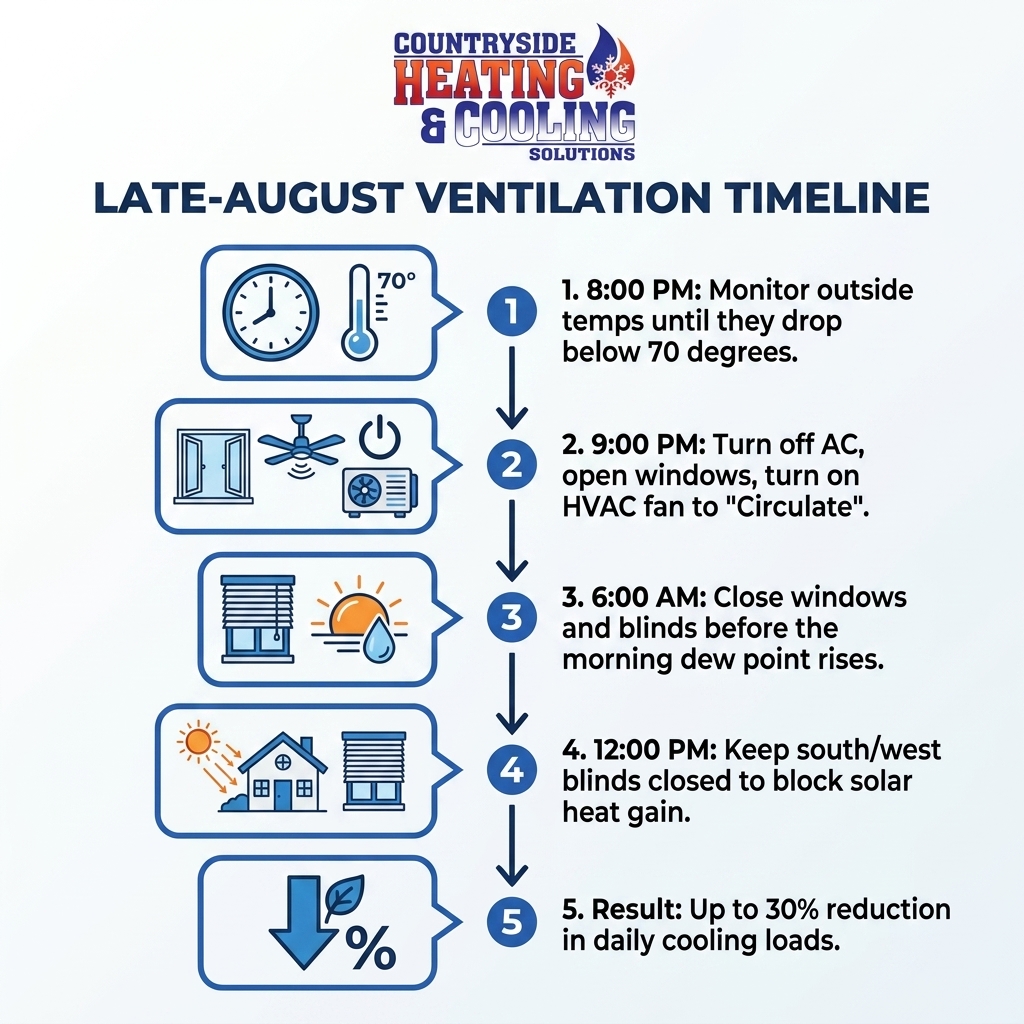
Our team frequently recommends taking advantage of cool overnight temperatures in Maple Plain MN and surrounding Midwest areas as a smart way to reduce your daily cooling load. In fact, utilizing natural overnight ventilation can reduce your reliance on mechanical cooling by up to 30 percent during the transition month. However, opening your windows introduces a new variable: Midwest morning humidity. If you do not time your ventilation correctly, you risk trading thermal comfort for a sticky, uncomfortable indoor environment.
The Science of the Morning Dew Point
To master natural ventilation, you have to look past the temperature and focus on the dew point. The dew point is the temperature at which air becomes 100 percent saturated with moisture. In late summer, the Midwest is notorious for high morning dew points. When cold night air meets the rising morning sun, the moisture in the air becomes highly palpable.
Dew point affects your perceived indoor comfort much more than strict temperature. Air at 72 degrees with a low dew point feels crisp and refreshing. That exact same 72-degree air with a high dew point feels clammy, heavy, and warm. If you leave your windows open too late into the morning, you invite this heavy moisture into your home. Once that moisture is trapped inside, your air conditioner will have to work twice as hard later in the day to dehumidify the space, completely negating the energy savings you gained overnight. For comprehensive strategies on managing this moisture, exploring indoor air quality solutions with our experts can provide effective whole-home dehumidification options.
A Step-by-Step Overnight Ventilation Routine
Successfully cooling your home with fresh air requires a disciplined routine. We suggest the following steps to capture the dry, cool air of the evening and seal the house before the morning moisture rolls in.
1. Monitor the outdoor temperature: Wait until the outdoor thermometer reads at least 3 to 5 degrees cooler than your indoor thermostat before opening any windows. This usually occurs between 8 PM and 10 PM during late August.
2. Create cross-ventilation: Open windows on opposite sides of the home. Place a box fan in one window blowing inward (on the cooler, shaded side of the house) and another fan blowing outward to exhaust the stale indoor air.
3. Shut down early: This is the most critical step. You must close all windows and lock them by 6 AM, or whenever the sun begins to hit your home. Do not wait for the house to feel warm before closing up.
4. Seal the envelope: Draw the blinds and curtains on east-facing windows immediately to prevent the morning sun from heating the freshly cooled air.
Smart Thermostat Strategies for the Transition Month
Managing the late-August back-to-school transition is much easier when you have a programmable or smart thermostat doing the heavy lifting. However, the settings you used in July will not serve you well when the nights turn cold. Adjusting your thermostat's programming ensures your system responds appropriately to the extreme daily temperature swings without wasting energy—a strategy we strongly advocate for all our Maple Plain customers.
Optimizing Fan Settings for Natural Cooling
Most thermostats have a fan switch with two primary settings: "Auto" and "On." Some advanced models also include a "Circulate" feature. Understanding how to use these settings is vital for transition-month comfort.
In "Auto" mode, the blower fan only runs when the compressor or furnace is actively heating or cooling the air. In "On" mode, the fan runs continuously, regardless of what the outdoor unit is doing. During the transition month, if you have opened your windows to capture the cool night air, switching your HVAC fan to "On" or "Circulate" is a highly effective strategy. The blower motor will pull the fresh, cool air from the open windows through your return ducts and distribute it evenly throughout every room in the house. This prevents cold spots near the windows and ensures the entire home benefits from the natural temperature drop, all without engaging the power-hungry compressor.
Preventing the AC-to-Furnace Tug-of-War
One of the biggest mistakes we see homeowners make during the transition month is utilizing the "Auto Changeover" setting on their thermostat. This feature allows the thermostat to automatically switch between heating and cooling based on the indoor temperature. While convenient in theory, it is a massive waste of energy during late summer.
If you leave the system in Auto Changeover, the furnace might kick on at 4 AM when the house drops to 66 degrees, only for the air conditioner to roar to life at 2 PM when the afternoon sun pushes the living room to 76 degrees. Your systems end up fighting each other within the same 24-hour period. Countryside Heating & Cooling Solutions brings a deep understanding of local Minnesota climate swings, and our team always recommends setting a wider temperature "deadband" during this season. A deadband is the buffer zone between your heating and cooling setpoints. By widening this gap to 8 or 10 degrees (for example, heat at 65°F, cool at 75°F), you allow the home to naturally fluctuate with the late-summer weather without triggering unnecessary mechanical intervention. Better yet, switch the thermostat manually from "Cool" to "Off" during the evening hours.
Preparing Both Systems: Why Late Summer is Maintenance Prime Time
The transition month is not just about managing daily comfort; our maintenance crews view this as the perfect operational window to evaluate the health of your entire HVAC infrastructure. While the weather in Maple Plain MN and surrounding Midwest areas is still relatively mild, you have a brief opportunity to address summer wear and tear while simultaneously preparing for the harsh winter ahead.
Putting the Air Conditioner to Bed
Before you completely shut down your cooling system for the year, we highly recommend a thorough inspection and cleaning. Over a long Midwest summer, the outdoor condenser unit is subjected to harsh conditions. Cottonwood seeds, grass clippings, dust, and pollen get sucked into the delicate aluminum fins of the condenser coil. If this debris is left in place over the winter, it can trap moisture against the metal, accelerating corrosion and reducing the unit's lifespan.
End-of-summer AC checklist:
• Clear the perimeter: Trim back any late-summer vegetation that has grown within two feet of the outdoor unit.
• Wash the fins: Gently rinse the outside of the condenser coil with a standard garden hose (never a pressure washer) to remove loose debris.
• Inspect the insulation: Check the foam insulation on the larger copper refrigerant line. If it has degraded from UV exposure, it should be replaced to ensure efficiency next season.
• Listen for oddities: Pay attention to how the compressor sounds during its final runs of the season. Grinding or rattling noises indicate electrical or mechanical wear that should be addressed now.
Waking Up the Furnace
Just as important as putting the AC to bed is waking the furnace up. You never want the first time your furnace fires up to be during an unexpected October freeze. Testing the heating system in late August or early September gives you plenty of time to address issues without the stress of an emergency.
During a recent late-summer transition, our dispatch team received a call from a local homeowner who wanted us to proactively check both their heating and cooling systems before the weather turned. One of our expert technicians arrived, checked everything from the AC condenser to the furnace heat exchanger, and explained exactly what was done and how the equipment looked. That proactive approach ensured their systems were competently serviced by our team and ready for the extreme shifts ahead. Proper heating system preparation involves checking the ignitor, testing the flame sensor, and ensuring the blower motor transitions smoothly from cooling speeds to heating speeds. Furthermore, the air filter that captured all your summer pollen must be swapped out for a fresh one before the furnace begins moving hot air.
Supplemental Cooling Techniques to Reduce Daily AC Loads
Even with smart thermostat programming and excellent overnight ventilation, the late-August back-to-school transition still delivers hot, sunny afternoons. To prevent your air conditioner from working overtime during these peak hours, you can employ several supplemental cooling techniques. These strategies focus on managing the heat that enters your home and maximizing the perceived comfort of the air that is already inside.
Maximizing Ceiling Fan Efficiency
Ceiling fans are one of the most misunderstood appliances in the home. They do not lower the temperature of the room; they cool the people in the room. By creating a wind-chill effect, a ceiling fan evaporates moisture from your skin, making the air feel significantly cooler than the thermostat reads.
During the transition month, ensure your ceiling fans are rotating counterclockwise (when looking up at them). This pushes a column of air straight down. Because of this evaporative cooling effect, you can comfortably set your thermostat up to 4 degrees higher without noticing a difference in comfort. If you normally keep the house at 72°F, a ceiling fan allows you to push the thermostat to 76°F, saving substantial energy. However, remember the golden rule of ceiling fans: turn them off when you leave the room. Leaving a fan running in an empty space just wastes electricity and adds a tiny amount of motor heat to the house.
Blocking Solar Heat Gain
The sun is the primary driver of your home's daily cooling load. Radiant energy passes through your windows and heats the floors, furniture, and air inside. Managing this solar heat gain is crucial for maintaining the cool air you captured during your overnight ventilation routine.
Effective heat-blocking strategies:
• Window treatments: Close the blinds, shades, or curtains on south- and west-facing windows by noon. These exposures take the brunt of the afternoon sun.
• Appliance management: Minimize indoor heat generation during the hottest part of the day. Opt for outdoor grilling instead of using the indoor oven, and delay running the dishwasher or dryer until after sunset.
• Outdoor shading: If your AC condenser sits in direct afternoon sunlight, consider planting a shade tree or installing an awning nearby. Just ensure you maintain at least two feet of clearance for proper airflow. A condenser operating in the shade draws cooler air, making the heat exchange process slightly more efficient.
By combining natural ventilation, thermostat management, and supplemental cooling techniques, you can successfully bridge the gap between summer and fall, keeping your home comfortable and your equipment safe.
Frequently Asked Questions
What is the lowest outside temp to run AC?
The general cutoff for running a standard residential air conditioner is 60 degrees Fahrenheit. Operating the system below this threshold alters the pressure of the refrigerant, which can lead to mechanical failures. If the outdoor temperature drops into the 50s, it is best to turn the cooling system off entirely.
Is it ok to run AC when it's 60 degrees outside?
Running your AC exactly at 60 degrees is risky and generally not recommended by manufacturers. At this temperature, the indoor evaporator coil is highly susceptible to freezing over due to low refrigerant pressure. Instead of mechanical cooling, rely on natural ventilation or ceiling fans when it is this cool outside.
Should I turn off my AC if I open windows at night?
Yes, you should always turn your air conditioner off before opening windows. Leaving the system on while windows are open forces the AC to attempt to cool the entire neighborhood, wasting massive amounts of energy. Furthermore, the system will run constantly as it tries to dehumidify the endless supply of outside air.
How do you transition your thermostat from AC to heat?
The best way to transition is manually, utilizing a wide temperature deadband. Avoid the "Auto Changeover" setting, which can cause the AC and furnace to run on the same day. Set your cooling threshold a few degrees higher and your heating threshold lower to allow the house to adapt naturally to daily temperature swings.
How does high morning humidity affect indoor cooling loads?
High morning humidity drastically increases the workload on your air conditioner. If you leave windows open too late into the morning, the heavy, moisture-laden air gets trapped inside your home. Your AC must then consume significant energy just to remove this excess moisture before it can effectively lower the air temperature.
Can running the HVAC fan instead of the AC help cool the house at night?
Yes, running the HVAC fan in the "On" or "Circulate" position is an excellent nighttime strategy. If your windows are open, the blower motor will pull the cool, fresh outside air through the house and distribute it evenly. This provides excellent comfort and air circulation without the high energy cost of running the outdoor compressor.
Transitioning with Confidence
Mastering the transition month requires a balance of natural ventilation, strategic thermostat programming, and timely equipment care. By understanding how to manage hot days and cold nights, you protect your HVAC system from unnecessary strain while keeping your living space perfectly comfortable. If you need clear, actionable advice on preparing your equipment for the changing seasons, reach out to our team at Countryside Heating & Cooling Solutions to ensure your home is ready for whatever the Midwest weather brings next.
