.webp)

Navigating Extreme Temperature Swings During Fall Transitions
You wake up to a freezing house and bump up the thermostat, but by 3 p.m., the indoor temperature has climbed to an uncomfortable 78 degrees. This classic autumn dilemma leaves many homeowners constantly adjusting their thermostats, unsure of how to manage their indoor comfort without causing severe damage to their equipment. When our customers search for home maintenance tips and troubleshooting during these volatile weather shifts, the most critical decision point we help them navigate is deciding exactly when to stop relying on cooling equipment and safely test dormant heating systems.
If you are looking for professional guidance to navigate this seasonal shift, our technicians at Countryside Heating & Cooling Solutions invite you to explore our air conditioning services to ensure your system is protected.
In our experience serving the Twin Cities region, a minor hesitation in your HVAC system during a mid-fall October startup can easily escalate into a severe, no-heat emergency by December if ignored. The temptation to run the air conditioner during a brief afternoon warm-up is strong, but doing so when the overnight temperatures have already plummeted puts incredible strain on mechanical components that are not designed for cold-weather operation. Proactive management of this transition is essential not just for your immediate comfort, but for long-term home safety and the overall longevity of your heating and cooling equipment. By understanding the mechanical limits of your system, you can make informed decisions that protect your investment.
The 60-Degree Rule: What Is the Lowest Outside Temp to Run AC?
The problem: As the seasons change in Maple Plain MN, our team frequently fields calls from homeowners experiencing days where the indoor temperature feels stuffy, even though the outdoor air is quite cool. The immediate reaction is to turn on the air conditioner to quickly cool the house down. However, doing so when the outside temperature is too low introduces severe risks to the system.
The cause: At Countryside Heating & Cooling Solutions, we align with HVAC manufacturers who generally recommend 60 degrees Fahrenheit as the absolute minimum safe temperature for running an air conditioning unit. Air conditioners are fundamentally designed to remove heat from the inside of your home and release it outdoors. Operating them in cold ambient conditions severely disrupts this delicate thermodynamic process. When the outside air is too cold, the refrigerant inside the system behaves differently, and the internal pressures drop below the safe operating range designed by the manufacturer. If you want to understand the deeper mechanics of this limitation, you can read more about why running your AC below 60 degrees is dangerous.
The solution: We advise our customers that the most effective way to protect your system is to actively monitor local weather forecasts rather than relying solely on your indoor thermostat. If the outside temperature is hovering near or below 60 degrees, open your windows to utilize natural cross-ventilation instead of forcing the mechanical cooling system to run. Running the system below this threshold significantly increases the risk of catastrophic mechanical failure, which will require extensive repairs.
Why the Ambient Temperature Matters
To truly understand the 60-degree rule, it helps to look at the relationship between the outside air and your condenser's ability to function. The outdoor unit of your air conditioner houses critical components, including the compressor and the condenser coils, which are highly sensitive to cold conditions. The system relies on a specific range of outdoor temperatures to maintain the correct pressure levels for the refrigerant to change from a liquid to a gas and back again. When ambient temperatures drop, this pressure drops alongside it, preventing the system from absorbing and releasing heat efficiently. This disruption is the root cause of the mechanical failures associated with cold-weather operation.
Mechanical Risks: What Happens to the Compressor and Coils?
Running your air conditioner when the weather is too cold is not just inefficient; it is actively destructive to the internal machinery. Our service crews have seen firsthand how the rapid temperature drops typical of the Twin Cities area make these mechanical failures a common risk during sudden cold snaps, especially during a mid-fall October startup. Understanding the physical damage that occurs can help you resist the urge to flip the cooling switch on a chilly autumn afternoon.
Compressor lubricant thickening: The primary risk of running an AC in cold weather involves the oil that lubricates the compressor. Just like the oil in your car's engine, the lubricant inside your air conditioner has a specific viscosity. In cold weather, this oil thickens and becomes sluggish. When the compressor attempts to run with thickened oil, it suffers from a lack of lubrication, leading to severe metal-on-metal friction. This friction can quickly burn out the compressor motor, resulting in a total system failure.
Frozen evaporator coils: A secondary, but equally damaging, risk we often diagnose is the freezing of the indoor evaporator coils. Because the system cannot absorb enough heat from the indoor air when the internal pressures are too low, the condensation that naturally forms on the coils can freeze into a solid block of ice. This ice blocks airflow entirely, forcing the blower motor to work harder while delivering zero cooling to the home.
Liquid slugging: Perhaps the most catastrophic failure is a phenomenon known as liquid slugging. Under normal conditions, refrigerant returns to the compressor as a gas. In cold weather, the refrigerant may not fully boil off, meaning it returns to the compressor as a liquid. Because liquids cannot be compressed, the compressor attempts to compress this liquid and physically destroys its own internal valves and pistons in the process. A pattern we see often is that these mechanical failures are entirely preventable by strictly adhering to the 60-degree temperature guideline.
Making the Switch: Safely Transitioning to Your Heating System
Once the 60-degree threshold is consistently breached in Maple Plain MN, our technicians recommend officially retiring the air conditioning unit for the season and preparing your heating equipment. Bridging the gap between shutting off the AC and initiating the first heating cycle requires a deliberate, careful approach to ensure safety and efficiency. If you need our team's assistance preparing your cooling equipment for its winter hibernation, consider scheduling professional AC maintenance in Maple Plain.
We always suggest following these essential steps to transition your system safely:
1. Commit to the seasonal shutdown: Turn your thermostat from "Cool" to "Off." If your outdoor unit has a dedicated disconnect switch, you may choose to flip it to prevent the system from accidentally turning on during a random warm afternoon.
2. Clear the mechanical room: A furnace that has sat dormant all summer often becomes surrounded by stored items. Before initiating the first ignition, ensure there is a clear perimeter of at least three feet around the furnace. Remove any boxes, cleaning supplies, or flammable materials from the immediate area.
3. Test on a mild afternoon: Do not wait for the first freezing night to turn on your heat. Test your furnace during a mild afternoon when you are home and awake. This allows you to monitor the system closely and ensures that if there is a malfunction, you are not left without heat in the middle of a freezing night.
4. Monitor the initial cycle: Pay close attention to the sounds and smells during the first 15 minutes of operation. A dormant furnace accumulates dust on the heat exchangers and burners over the summer, which leads to physical reactions when the flames first ignite.
Decoding First-Startup Symptoms: Harmless Dust vs. Mechanical Red Flags
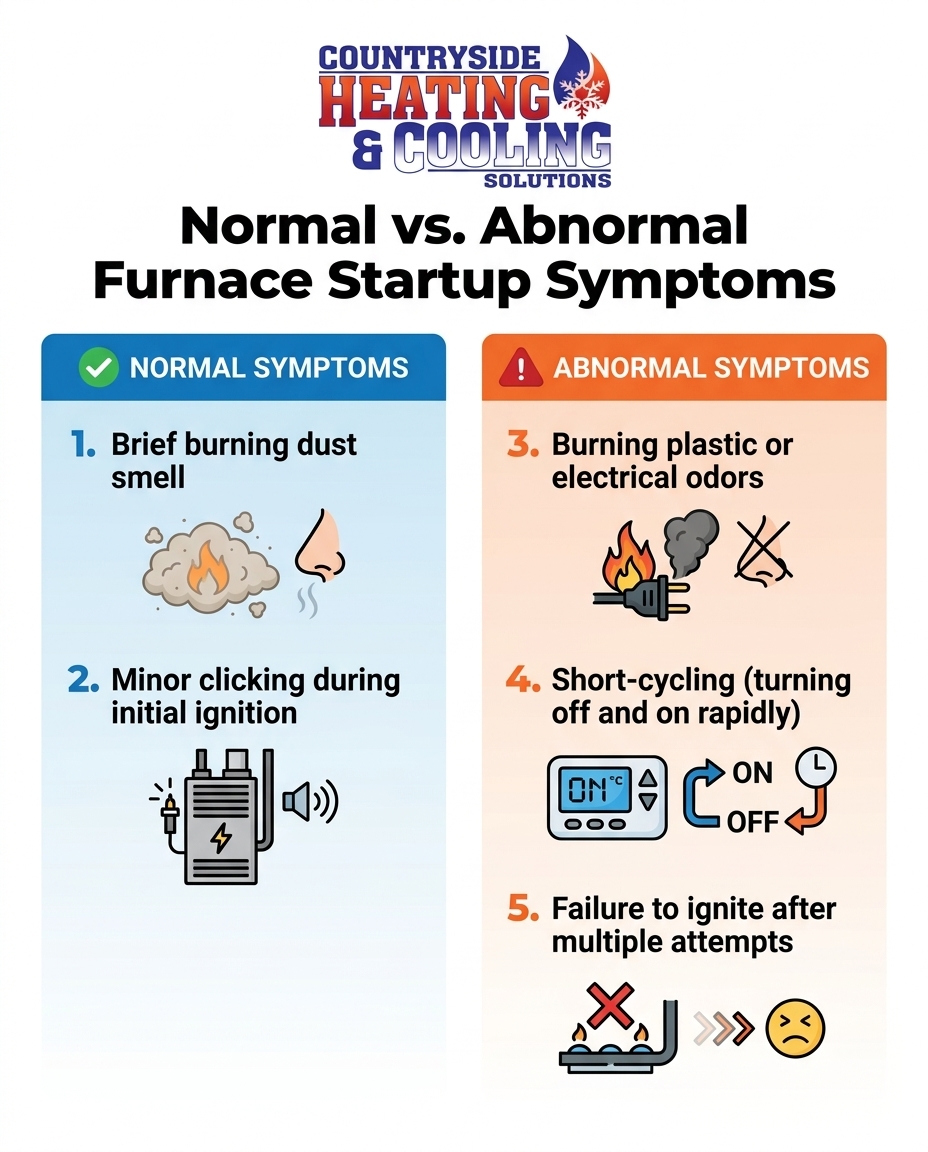
During a mid-fall October startup, evaluating your furnace's behavior is a critical decision point. From our years of troubleshooting local heating systems, we've learned that you must be able to distinguish between normal seasonal quirks and dangerous mechanical failures. The physical reality of a dormant furnace means that certain smells and sounds are expected, while others demand immediate shutdown.
• Brief burning dust smell — Classification: Harmless / Normal — What It Means: Accumulated summer debris (dust, pet dander) is burning off the heat exchanger. The smell should dissipate within 15 to 30 minutes of the first cycle.
• Burning plastic or electrical odors — Classification: Red Flag / Abnormal — What It Means: Indicates melting wire insulation, an overheating blower motor, or a failing electrical component. Shut the system down immediately.
• Minor clicking before ignition — Classification: Harmless / Normal — What It Means: The electronic ignition system is sparking to light the burners. A few clicks are standard operation.
• Short-cycling (rapid on/off) — Classification: Red Flag / Abnormal — What It Means: The furnace is overheating and tripping its high-limit safety switch, often due to a clogged filter or a failing flame sensor. This requires professional diagnosis.
• Failure to ignite — Classification: Red Flag / Abnormal — What It Means: Indicates a deeper issue with the pilot light, a dirty flame sensor, or a disrupted gas supply. Repeated failed attempts can cause gas buildup.
When to Skip DIY and Call a Licensed Professional
While changing your air filter and clearing the area around your equipment are excellent homeowner tasks, internal furnace diagnostics require specialized knowledge. Enforcing safety constraints is paramount when dealing with natural gas, high-voltage electricity, and combustion gases. Guessing whether a symptom is a normal quirk or a dangerous mechanical failure puts your home's safety at immense risk.
Internal diagnostics require licensing: Our licensed experts at Countryside Heating & Cooling Solutions stress that internal furnace diagnostics, gas line checks, and electrical troubleshooting must always be handled by a professional. Attempting to clean a flame sensor, adjust gas pressure, or bypass safety switches without proper training can lead to gas leaks, electrical fires, or carbon monoxide exposure. If you notice any of the red-flag symptoms mentioned earlier, the safest course of action is to turn the system off at the thermostat and call for help.
The value of proactive fall diagnostics: A proactive fall diagnostic ensures that both your recently retired air conditioner and your newly active furnace are in safe, efficient working condition. Leveraging a 'Satisfaction Guaranteed' approach and utilizing expert technicians reassures homeowners in Maple Plain MN that they can trust the diagnostic process completely. Scheduling a routine evaluation is a standard, stress-free part of homeownership that provides ultimate peace of mind.
Just recently, one of our local homeowners reached out for a routine check and maintenance visit during the fall season. The technician arrived on time, conducted a polite and thorough inspection, and the homeowner ultimately decided to explore preventative maintenance plans to keep their system protected year-round. This proactive approach eliminates the anxiety of wondering if the system will hold up during a sudden cold snap.
Securing Long-Term Reliability for Winter and Beyond
The steps you take during a mid-fall October startup dictate how your system will perform through the harshest months of the year. Proper shutdown of the air conditioner and professional startup of the furnace work together to extend the lifespan of both systems. When you respect the 60-degree rule and keep your AC off during cold weather, you preserve the compressor and ensure it will be ready to perform flawlessly when summer returns.
Preventing unexpected breakdowns: Ongoing, documented maintenance is the most effective way to prevent unexpected breakdowns. When our professionals evaluate your heating system in the fall, we can identify and correct minor hesitations—such as a slightly dirty flame sensor or a weakened capacitor—before they escalate into major emergencies in December. Consistent professional care ensures the system is ready to perform efficiently year after year, saving you from the stress of a mid-winter failure. Additionally, if your aging system is beyond repair, proactive fall maintenance gives you time to explore generic utility incentive programs and federal tax credits that may apply to qualifying high-efficiency installations.
Another long-term customer of ours scheduled a routine visit for their furnace and air conditioning systems last winter. After receiving professional maintenance work on both units, they noted their continued satisfaction with the high quality of the service. Building this kind of relationship with a trusted HVAC provider means you never have to face seasonal transitions alone.
Frequently Asked Questions About Fall HVAC Transitions
What happens if you run AC in cold weather?
Running your AC in cold weather causes the internal compressor lubricant to thicken, leading to severe metal-on-metal friction. Additionally, the low ambient temperatures cause internal pressures to drop, which can freeze the indoor evaporator coils solid. Ultimately, operating the system in these conditions can destroy the compressor entirely.
At what temperature should you switch from AC to heat?
HVAC manufacturers and our team at Countryside generally advise that 60 degrees Fahrenheit is the absolute lowest temperature at which you should run an air conditioner. Once outdoor temperatures consistently drop below this 60-degree threshold in Maple Plain MN, it is time to turn off the cooling system and test your heating equipment.
Why does my furnace smell like burning dust?
During the summer months, dust, pet dander, and other airborne debris settle on your furnace's heat exchanger and burners. When you turn the heat on for the first time in the fall, these settled particles incinerate, creating a temporary burning dust smell. This is a normal physical reaction that our technicians tell homeowners to expect, and it should dissipate quickly.
Can I run my AC if it's 50 degrees outside?
No, we strongly advise against running your air conditioner when it is 50 degrees outside. Operating the system at this temperature forces the compressor to run with thickened oil and risks sending liquid refrigerant back into the compressor, which will cause catastrophic mechanical damage.
How long does the burning smell last when turning on the heat?
The normal burning dust smell associated with a first-time fall startup typically lasts between 15 and 30 minutes. If the smell persists for several hours, or if it smells like burning plastic or electrical wires, shut the system down immediately and call a professional.
What is short-cycling in a furnace during fall startup?
Short-cycling occurs when a furnace turns on, runs for only a few minutes, and abruptly shuts off before reaching the set temperature on the thermostat. This is a critical mechanical red flag that often indicates the system is overheating and tripping its internal safety limit switches.
Ensure a Safe Transition Before the Deep Freeze
Successfully navigating the transition from cooling to heating requires patience and a clear understanding of your equipment's limits. By respecting the 60-degree rule for your air conditioner and closely monitoring the initial startup of your furnace during a mid-fall October startup, you protect your home from preventable mechanical failures. Always prioritize a clear, safe explanation of your system's health over taking unnecessary risks with internal DIY repairs.
If you experience any red-flag symptoms—such as short-cycling, electrical odors, or a failure to ignite—our team is ready to help. To ensure your equipment is fully prepared for the changing seasons, schedule AC service and a comprehensive furnace diagnostic with Countryside Heating & Cooling Solutions today.
