.webp)

The Abrupt End of Fresh Air: Why Early Fall Brings a Dust Surge
Before the first freeze hits, managing indoor dust accumulation when the windows finally close is one critical step every homeowner must take to protect their family's comfort. Summer weather is fleeting, and as September arrives, crisp fall temperatures prompt you to shut your windows and doors tight. This sudden shift completely changes the environment inside your living space. By sealing up the house, you inadvertently trap lingering summer allergens, fresh pet dander, and existing household dust indoors with absolutely no escape route.
Understanding this seasonal shift is the first step to improving your home's indoor air quality before the deep winter freeze sets in. Here in Maple Plain, our team at Countryside Heating & Cooling Solutions knows that Minnesota's rapid transition from a humid summer to a crisp fall forces an abrupt sealing of homes almost overnight. When this happens, your home loses all natural ventilation. The fresh breezes that once carried stale air and microscopic particles out of your living rooms are gone. Suddenly, your home's HVAC system becomes solely responsible for filtering 100% of the indoor air you breathe. The core problem we see for most homeowners during this September pre-heating season transition is that standard 1-inch fiberglass filters completely fail to handle this sudden surge in trapped particulate matter.
The Hidden Airborne Load
Most people do not realize how much debris floats through their home on a daily basis. During the summer, open windows dilute this airborne load. Once the house is sealed, the concentration of airborne particles spikes dramatically. You might start noticing a thick layer of dust settling on your coffee table just days after you wiped it down, or you might find yourself waking up with a scratchy throat and congested sinuses. These are the immediate symptoms of a home that has lost its fresh air exchange. Relying on basic, thin filters designed only to catch large debris means this fine dust simply passes through your ductwork and recirculates back into your living space, over and over again.
Understanding Your Home's Building Envelope in September
To truly solve the fall dust surge, you have to understand the mechanics of your home's "building envelope." The building envelope is the physical separator between the conditioned and unconditioned environment of a building—including the resistance to air, water, heat, light, and noise transfer. It consists of your roof, subfloor, exterior doors, windows, and exterior walls. During the summer, when windows are open, your building envelope is intentionally breached to allow for natural cooling and air exchange.
Once you lock those windows shut in early fall, the building envelope becomes a sealed box. According to Environmental Protection Agency (EPA) data, indoor air can become two to five times more polluted than outdoor air, and this ratio worsens significantly once natural ventilation is eliminated. The dust you see accumulating isn't blowing in from the outside; it is being generated entirely from within your sealed home.
Daily Dust Generation Sources:
• Human skin cells: The average person sheds millions of dead skin cells every day, forming a massive percentage of household dust.
• Pet dander and hair: Dogs and cats continuously shed microscopic flecks of skin and fur, which become trapped in the sealed environment.
• Textile fibers: Every time you walk across a carpet, sit on a fabric sofa, or fold laundry, tiny fibers are released into the air.
• Cooking particulates: Frying, baking, and sautéing release fine oils and smoke particles that linger in stagnant air.
Because these daily activities continuously generate dust that now has no escape route, your strategy must shift from simply "cleaning more" to "filtering better." You cannot vacuum your way out of poor indoor air quality if the particles remain suspended in the air. This is the exact moment in the season when upgrading to a dedicated, high-efficiency system, such as an Evolution Air Purifier, becomes a necessary consideration rather than a luxury. By addressing the air at the mechanical level, you capture the dust before it ever has a chance to settle on your furniture or enter your lungs.
How Trapped Particulates Overwhelm Standard Heating Systems
The combination of a newly sealed building envelope and the initial activation of your home's heating equipment creates a perfect storm for poor indoor air quality. Throughout the idle late-summer weeks, airborne dust slowly settles inside your inactive ductwork. When the temperature drops and your thermostat triggers the heat for the first time, the blower motor roars to life, forcing a massive volume of air through those dusty channels.
The First Cycle of the Season
That first heating cycle forces weeks of settled debris directly into your newly sealed living space. Without proper filtration, this creates an immediate, noticeable spike in airborne particles. The air might smell slightly dusty or burnt, and you will likely see motes of dust dancing in the sunlight streaming through your windows.
Standard 1-inch fiberglass filters are completely inadequate for this scenario. It is a common misconception that these cheap filters are meant to clean the air you breathe. In reality, they are designed solely to protect the internal components of your heating system from large debris like hair and heavy lint. They have a very low Minimum Efficiency Reporting Value (MERV) rating, meaning fine dust, pollen, and pet dander pass right through their loose fiberglass weave.
If you ignore this settled dust, it compounds over the months. A pattern we see often during our winter service calls involves severely neglected systems. Just last year, a Maple Plain homeowner reached out to our team because their furnace and ductwork were extremely dirty, leading to poor system performance and dusty air. Our technicians cleaned the furnace and ductwork, showing them before and after pictures, and the system looked brand new after the deep clean. You can prevent this level of severe winter buildup by addressing your filtration strategy during the September pre-heating season transition. A dirty system exacerbates the dust problem by recirculating the exact same particulate matter continuously throughout the home, coating your coils, blower motor, and living areas in an ever-thickening layer of grime.
The Technical Advantage of Upgrading Your Filtration Strategy
Mitigating the trapped particulate load requires a technical upgrade. In our experience helping local families improve their indoor air, the decision point for most homeowners comes down to continuing the frustrating cycle of replacing cheap 1-inch filters every 30 days versus investing in a high-capacity media cabinet that houses 4-inch to 5-inch media filters.
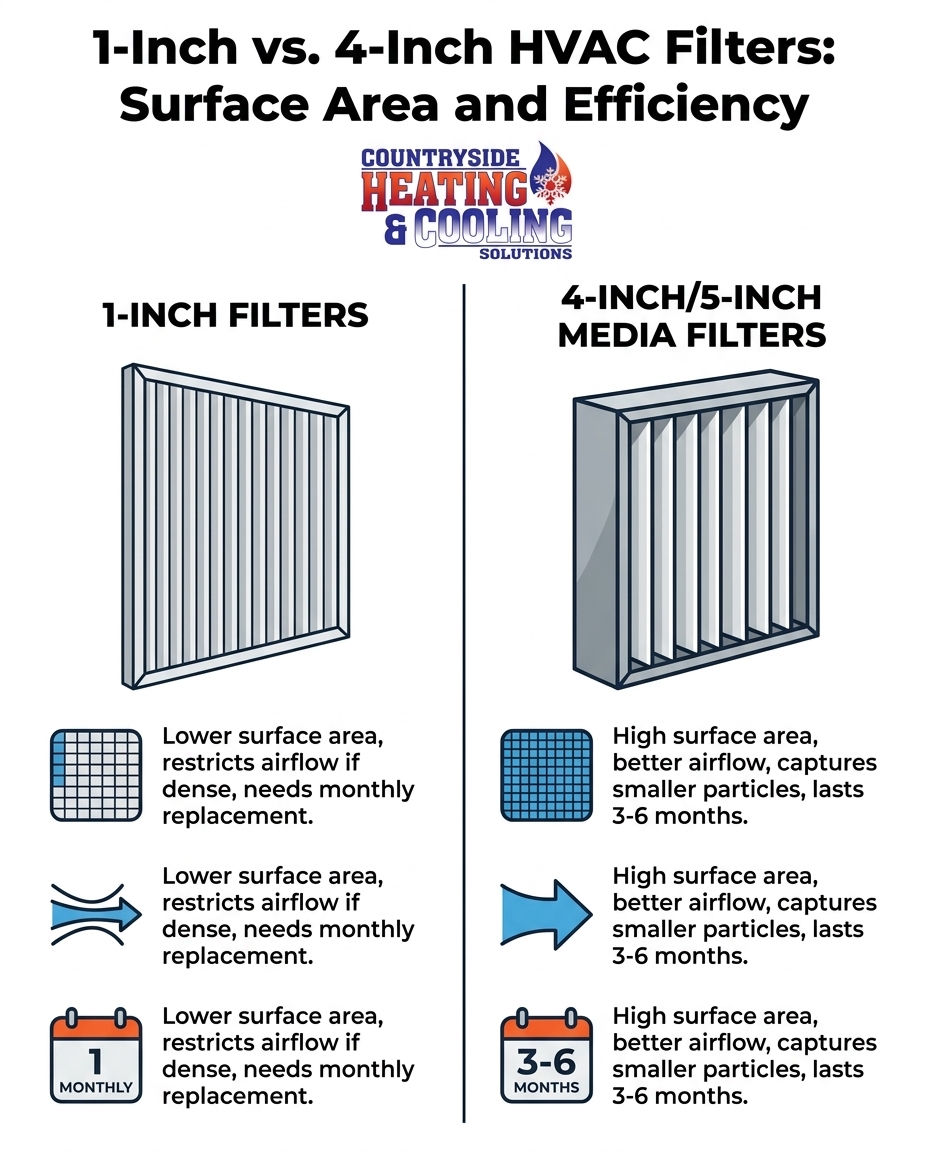
The secret to superior filtration is surface area. A standard 1-inch filter has very little surface area. If you try to increase its efficiency by buying a "high allergen" 1-inch filter, the weave is so tight that it acts like a piece of cardboard, severely restricting critical HVAC airflow. This pressure drop forces your blower motor to work harder, driving up your energy bills and risking premature equipment failure.
Comparing Filtration Options:
• Primary Purpose — Standard 1-Inch Fiberglass Filter: Protects HVAC equipment from large debris — 4-Inch to 5-Inch Media Filter: Improves indoor air quality and protects equipment
• Surface Area — Standard 1-Inch Fiberglass Filter: Very low (flat surface) — 4-Inch to 5-Inch Media Filter: Extremely high (deeply pleated material)
• Particle Capture — Standard 1-Inch Fiberglass Filter: Catches < 20% of particles (lint, hair) — 4-Inch to 5-Inch Media Filter: Catches up to 95% of fine particles (pollen, dander)
• Airflow Restriction — Standard 1-Inch Fiberglass Filter: High restriction if a dense material is used — 4-Inch to 5-Inch Media Filter: Low restriction due to massive surface area
• Replacement Frequency — Standard 1-Inch Fiberglass Filter: Every 30 days — 4-Inch to 5-Inch Media Filter: Every 3 to 6 months
Thicker media filters solve the airflow problem through deep pleating. If you were to unfold a 4-inch or 5-inch media filter, the material would stretch out for several feet. This massive increase in surface area allows the filter to capture significantly smaller particulates—like microscopic pollen, mold spores, and pet dander—without restricting the airflow your furnace needs to operate safely. For homeowners struggling with fall allergies, exploring the best air purifiers for homes in cold dusty climates often starts with this foundational upgrade to a thick media filter cabinet.
Beyond Standard Filters: Addressing Severe Indoor Allergens
While upgrading to 4-inch to 5-inch media filters provides a massive improvement for the average home, some environments require a more aggressive approach. Homes with multiple pets, residents with severe respiratory conditions, or properties located near dusty agricultural areas often suffer from extreme particulate loads during the fall. In these cases, passive filtration is simply not enough.
Passive vs. Active Purification
Passive filtration relies entirely on air happening to pass through a physical barrier. It catches dust like a net catches fish. Active purification, on the other hand, actively neutralizes threats in the air. Advanced whole-home solutions integrate directly into your existing ductwork to treat 100% of the circulated air. These systems often use a combination of electrostatic attraction to pull tiny particles out of the air stream and ultraviolet (UV) technology or specialized ionization to neutralize airborne pathogens, bacteria, and viruses.
Leveraging our team's specialized expertise to recommend specific, high-quality indoor air quality solutions like the Bryant Evolution Air Purifier serves as a definitive upgrade for severe dust accumulation. These premium systems do not just trap dust; they actively charge the particles, pulling them out of the air like a magnet. This level of technology addresses the microscopic fine particulate matter (PM2.5) that standard filters miss, ensuring that the air circulating through your sealed building envelope remains pristine, regardless of how long the windows stay shut.
Essential Pre-Heating Season Steps for a Cleaner Home
Preparing your home for the sealed-in months requires proactive maintenance. Taking the right steps during the September pre-heating season transition ensures that your system runs efficiently and your indoor air remains clean all winter long.
Based on years of maintaining heating systems across the Maple Plain area, our team recommends this checklist to properly prepare your home's HVAC system:
• Schedule professional maintenance: The most important step is to schedule HVAC service to clean internal components before heavy winter usage begins. A technician will clean the blower motor, check the heat exchanger, and remove the summer dust buildup from inside the cabinet.
• Ensure all supply and return vents are unblocked: Walk through your home and check every floor and wall register. Furniture, rugs, or curtains blocking these vents disrupt proper airflow, forcing the system to work harder and reducing the amount of air that actually makes it back to the filter.
• Maintain optimal indoor humidity levels: Overly dry fall air causes microscopic dust particles to lose mass and stay airborne much longer. Maintaining an indoor humidity level between 35% and 50% helps dust settle faster so it can be drawn into the return vents and captured by the filter.
• Verify proper filter sizing and installation: A filter only works if all the air passes through it. Check your filter slot for air bypass gaps. If the filter is too small or improperly seated, dusty air will simply flow around the edges, entirely defeating the purpose of the filter.
Frequently Asked Questions About Fall Indoor Dust
Why is my house suddenly so dusty in the fall?
Closing your windows eliminates the natural ventilation that diluted indoor air all summer. Trapped indoor dust, skin cells, and pet dander are now forced to recirculate continuously through your home. Additionally, initial heating cycles blow settled dust from your ductwork directly into your newly sealed living space.
Do 4-inch HVAC filters work better than 1-inch filters?
Yes, 4-inch to 5-inch media filters offer significantly more surface area due to their deep pleats. This massive surface area allows them to capture much smaller particles, like pollen and fine dust, without restricting critical airflow to your furnace. They also require less frequent replacement, typically lasting three to six months.
How do I improve indoor air quality when windows are closed?
The most effective method is to upgrade to a high-efficiency media filter or a dedicated whole-home air purifier. You should also ensure regular HVAC maintenance to keep internal components clean. Finally, controlling indoor humidity helps prevent dry air from keeping fine dust suspended in your breathing space.
Does keeping windows open reduce dust?
Keeping windows open introduces fresh air that dilutes indoor pollutants, but it can also bring in outdoor allergens like pollen and agricultural dust. Once temperatures drop in the fall, leaving windows open is no longer viable for comfort or energy efficiency, making mechanical filtration absolutely necessary.
What is the best HVAC filter for managing heavy household dust?
A 4-inch to 5-inch pleated media filter is generally the best baseline defense for heavy household dust. For homes with severe allergies or high pet dander, dedicated whole-home air purifiers offer the highest level of active particulate removal and pathogen neutralization.
Prepare Your Home for a Cleaner, Healthier Fall
The sudden fall dust surge is a natural, unavoidable consequence of sealing your home against the dropping temperatures. Upgrading your filtration strategy from basic 1-inch filters to advanced media cabinets or active purifiers is the most effective technical solution available. By taking action during the September pre-heating season transition, you can breathe easier all winter. Encourage your family to explore advanced indoor air quality options before the deep winter freeze sets in, ensuring a clean, comfortable environment for the months ahead.
