.webp)

What Happens to the HVAC Warranty When You Buy a Home?
Have you found yourself looking at a property inspection report and asking, does transferring a Bryant HVAC warranty work when buying a new home? It is a common question that our team at Countryside Heating & Cooling Solutions sees catching many buyers off guard during late-summer real estate closings. A frequent misconception in the real estate market is that manufacturer warranties are tied exclusively to the physical address of the property and automatically pass to whoever holds the deed. In reality, manufacturer coverage is tied to the original registered owner, meaning the warranty does not simply hand itself over when the keys change hands.
To ensure your equipment remains protected during your move, learn more about Bryant HVAC systems or schedule HVAC service today.
Discovering a newer, high-efficiency heating and cooling system during a home tour is a major selling point. However, that excitement can quickly turn into a financial liability if the proper administrative steps are ignored. The period immediately following your closing date is a critical decision point. Buyers must actively initiate a transfer process with the manufacturer before strict deadlines expire. Failing to do so can result in a significantly reduced coverage term, leaving you financially responsible for major component failures just as the late-summer back-to-school season transitions into colder autumn weather.
Taking control of this process requires understanding exactly what you are inheriting. By verifying the equipment's history and executing the required paperwork promptly, you secure a vital financial safety net. Navigating this transition smoothly is an essential, yet often overlooked, step in the modern home-buying journey.
Understanding Bryant Warranty Terms for Subsequent Owners
Not all manufacturer warranties offer the same level of protection, and the coverage you receive depends entirely on the actions of the previous owner—and your actions immediately after closing. In our years of installing and maintaining systems in Maple Plain MN area homes, we have found that while the manufacturer offers a strong baseline level of protection, extending that protection requires timely registration, and maintaining it through a property sale requires a formal transfer.
If the original homeowner registered the equipment within the required window (usually 90 days of installation), the system typically carries an extended 10-year parts warranty. This covers major internal components like the compressor, evaporator coil, and blower motor against manufacturer defects. If the original owner failed to register the equipment, the system defaults to a standard 5-year parts warranty.
The quick fix: Always ask the seller for the original registration certificate during the negotiation phase to confirm which baseline you are working with.
The Difference Between Original and Transferred Coverage
For subsequent owners, the rules shift. Even if the system currently holds a 10-year registered warranty, that extended coverage will automatically revert to the standard 5-year term if the new buyer does not successfully complete the transfer process. It is also important to note that base manufacturer warranties cover functional parts, not the labor required to diagnose or replace them.
• Original Owner (Registered) — Typical Parts Coverage: 10 Years — Action Required: Register within 90 days of install
• Original Owner (Unregistered) — Typical Parts Coverage: 5 Years — Action Required: None (Automatic default)
• Subsequent Owner (Transferred) — Typical Parts Coverage: Remaining balance of 10 Years — Action Required: Transfer within 90 days of closing
• Subsequent Owner (Not Transferred) — Typical Parts Coverage: Defaults to 5 Years from install date — Action Required: None (Coverage is reduced)
Maintaining the balance of a 10-year warranty provides immense long-term value. One local homeowner who needed a new Bryant furnace installed noted that after receiving top-notch installation and customer service from our crew, their furnace has had zero issues for over five years. Securing the warranty transfer ensures that if an unexpected component failure does occur in year seven or eight, the replacement parts are fully covered.
How to Perform a Bryant Warranty Lookup Before Closing
You should never wait until the ink is dry on your mortgage documents to find out if the air conditioner is actually covered. The best time to verify the status of the equipment is during the home inspection phase of your late-summer real estate closings. By taking a proactive approach, you can gather all the necessary data before the stress of moving day arrives.
Performing a bryant warranty lookup is a straightforward process, but it requires specific information directly from the physical equipment. Here is exactly how our team recommends verifying the coverage status of your future home's system:
1. Request equipment details during inspection: Ask your licensed home inspector to photograph the data plates on both the indoor furnace/air handler and the outdoor condenser.
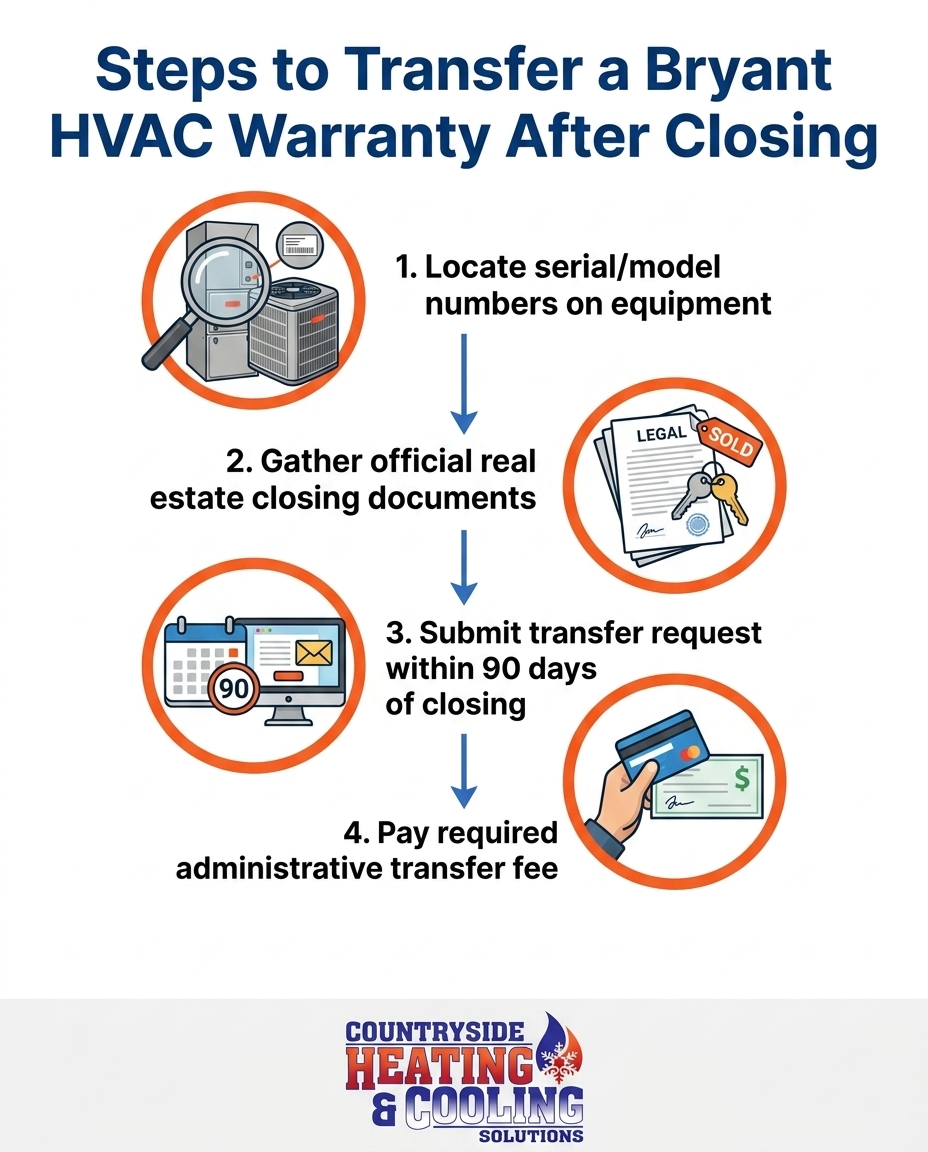
2. Locate the serial and model numbers: The data plate is usually a silver or white sticker located on the back or side of the outdoor unit, and inside the front panel of the indoor unit. You need both the model number (which identifies the type of unit) and the serial number (which identifies the specific unit and its manufacturing date).
3. Execute the lookup: Visit the official manufacturer website and navigate to the warranty verification section. Enter the serial numbers to view the current registration status, the original installation date, and the exact terms of the active coverage.
4. Consult a local professional: If the online portal shows discrepancies, reach out to a local dealer who provides air conditioning services. We have access to dealer-level portals and can help clarify complex registration histories.
This verification step is crucial. It tells you definitively whether the home's cooling system is still under the original 10-year term, or if it has already reverted to a 5-year term due to the previous owner's failure to register. Knowing this information upfront allows you to plan your future maintenance budget accurately.
The Critical 90-Day Transfer Window
The most important detail to understand about assuming an existing warranty is the strict manufacturer deadline. Bryant generally requires warranty transfers to be fully processed and completed within 90 days of the real estate closing date. This is a hard deadline set by the manufacturer, and in our experience handling HVAC administration, exceptions are rarely granted for buyers who simply forgot or were unaware of the rule.
Missing this 90-day window has immediate financial consequences. If the paperwork is not submitted in time, the extended 10-year parts coverage is voided for the new owner, and the system instantly reverts to the standard 5-year warranty, calculated from the original date of installation. If the system is already six years old and you miss the transfer window, your coverage drops to zero on day 91.
This timeline is especially critical for buyers navigating late-summer real estate closings. Maple Plain MN area homes experience a drastic shift from hot, humid summers to freezing winters. A closing in late August puts your 90-day deadline squarely in late November. This means the deadline hits just as freezing temperatures arrive and your furnace begins working its hardest.
The takeaway: Do not let the chaos of unpacking distract you. Treat the warranty transfer with the same urgency as transferring the electric bill or setting up the internet. Make it a priority during your first week in the new house to ensure your heating system is fully protected before the first major winter storm hits.
Required Documentation for a Successful Transfer
Successfully transferring the coverage requires more than just a phone call. The manufacturer requires specific proof that the property has changed hands and that you are the new legal owner. Our team always advises clients to gather this documentation early in the process to prevent delays that could push you past the 90-day deadline.
During late-summer real estate closings, you will be handed a massive stack of paperwork. Keep the following items easily accessible, as you will need them to complete the transfer:
• Official closing documents: You must provide a copy of the closing disclosure or the settlement statement (often referred to as a HUD-1). This document proves the exact date the property legally transferred to your name, which starts the 90-day countdown.
• Complete equipment information: Gather the serial numbers, model numbers, and brand names for every piece of HVAC equipment on the property, including the outdoor condenser, indoor furnace, and any specialized indoor air quality accessories.
• Administrative transfer fee: Manufacturers typically require a generic administrative fee to process the change of ownership. Be prepared to submit this payment along with your documentation.
• Transfer request form: This form can usually be obtained through the manufacturer's website or provided by a licensed local dealer who can submit the paperwork on your behalf.
Why Post-Closing Maintenance is Just as Important as the Warranty
Filing the paperwork protects you against manufacturer defects, but a warranty is not a substitute for physical equipment care. In fact, most manufacturer warranties include clauses that require proof of regular, professional maintenance for the coverage to remain valid. If a compressor fails because the system was choked by a filthy filter or low refrigerant levels that were never addressed, the manufacturer can rightfully deny the claim.
Because you cannot be entirely sure how well the previous owner cared for the system, our technicians highly recommend scheduling a comprehensive system check shortly after moving into Maple Plain MN area homes. This initial visit allows our professionals to inspect the heat exchanger, test the electrical components, and ensure both heating and cooling functions are operating safely and efficiently.
Think of this initial service visit as establishing a baseline for the equipment's health. For instance, another customer requiring a new fireplace and garage heater installation highlighted that our installers were highly professional, discussed the process beforehand, and completed a clean install. That same level of professional care and transparent communication is exactly what a new homeowner needs when evaluating an inherited system and setting up heating solutions for the upcoming winter.
What we check during a baseline inspection:
• Airflow and duct integrity: Ensuring no hidden blockages are straining the blower motor.
• Refrigerant charge: Verifying the cooling system has the exact amount of pressure required by the manufacturer.
• Safety controls: Testing limit switches and flame sensors to prevent winter heating hazards.
Navigating Warranty Rules with a Local Bryant Expert
Moving into a new home is inherently overwhelming, and translating dense manufacturer guidelines only adds to the stress. Trying to determine if the previous owner properly registered the equipment five years ago, or figuring out exactly which components fall under the parts warranty, can quickly become frustrating during late-summer real estate closings.
This is where relying on an established, recognized local expert makes a massive difference. As a multi-year Bryant Circle of Champions Award Winner and Medal of Excellence recipient, our team at Countryside Heating & Cooling Solutions interacts with these dealer portals daily. We understand exactly what documentation is required to push a transfer through successfully without unnecessary delays.
Our trusted local technicians can also pull the complete service history if we previously maintained the home, giving you peace of mind about the system's reliability. If you want to dive deeper into exactly what your inherited coverage entails, spending time decoding your Bryant air conditioner warranty can help you understand the nuances between parts coverage, labor costs, and diagnostic fees before a repair is ever needed.
Frequently Asked Questions About Bryant HVAC Warranties
Are Bryant HVAC warranties transferable to a new owner?
Yes, they are transferable if the new owner acts quickly and follows the manufacturer's specific guidelines. The new homeowner must initiate and complete the transfer process within 90 days of the official real estate closing date. Failure to transfer the coverage within this strict window usually results in the extended warranty reverting to a shorter standard term, leaving the new owner with less protection for their Maple Plain MN area homes.
How do I do a Bryant warranty lookup?
You begin by locating the serial and model numbers printed on the equipment's data plate, which is typically found on the exterior of the outdoor unit and the interior panel of the indoor unit. Once you have those numbers, you can use the official manufacturer website's lookup tool to verify the current registration status and original installation date. Alternatively, contacting a licensed local dealer like Countryside Heating & Cooling Solutions allows us to run the numbers through our professional portal to confirm the exact remaining term.
How long is a Bryant AC warranty?
A properly registered bryant ac warranty typically covers functional parts for 10 years for the original owner. However, if the system was never registered after installation, or if a subsequent owner fails to complete the transfer paperwork correctly, the system usually carries a standard 5-year parts warranty. Always verify the installation date to know exactly how much time remains on either term.
What does a Bryant air conditioner warranty actually cover?
The standard manufacturer bryant air conditioner warranty covers functional internal parts that fail due to a defect in materials or workmanship. This includes major components like the compressor, coils, and internal motors. It generally does not cover the labor costs required to install the new parts, routine seasonal maintenance, diagnostic fees, or failures caused by neglect and improper use.
Is there a fee to transfer an HVAC warranty when you buy a house?
Yes, manufacturers typically require a nominal administrative fee to process the change of ownership in their systems. This generic transfer fee must be submitted along with the required closing documentation and the formal transfer request form. The fee covers the administrative costs of updating the legal registration records to ensure future claims are processed smoothly.
Secure Your Coverage and Schedule Your Post-Move Inspection
Taking ownership of a new home comes with a long checklist, but securing your heating and cooling coverage should be near the top. Completing the transfer paperwork promptly ensures you do not lose valuable years of protection due to a missed deadline. By acting within the 90-day window, you safeguard your budget against unexpected component failures as the seasons change.
Once the paperwork is filed, the next crucial step is establishing a relationship with a trusted local professional to evaluate the physical equipment. A thorough inspection sets a clear baseline for the system's health, ensuring it operates safely and efficiently. Do not wait for the first freezing night to find out how well your inherited system performs. Take action today to verify your coverage, submit your transfer documents, and let our experienced team schedule HVAC service to ensure your home remains comfortable all year long.
