.webp)

Why Ventilation Benefits for Energy-Efficient Homes Matter More Than You Think
Understanding the ventilation benefits for energy-efficient homes starts with a simple truth: the tighter your home, the more you need controlled fresh air. Here is a quick summary of the key benefits:
- Healthier indoor air — removes contaminants like formaldehyde, mold spores, and VOCs that build up in sealed spaces
- Moisture control — prevents condensation, mold growth, and structural damage
- Lower energy bills — HRV systems can save up to 36% in heating energy compared to ventilating without heat recovery
- Less HVAC wear — proper ventilation reduces the workload on your heating and cooling equipment
- Consistent comfort — balanced airflow eliminates stuffy rooms and uneven temperatures
- Better air quality for allergy and asthma sufferers — continuous fresh air dilutes indoor pollutants year-round
Most homeowners in the Minneapolis–Saint Paul area focus on insulation, smart thermostats, and energy-efficient appliances when they think about saving money on utilities. Ventilation rarely makes the list — but it should be near the top. When you seal a home tightly to keep Minnesota's brutal winters out, you also seal in moisture, stale air, cooking odors, cleaning chemicals, and airborne allergens. Research shows that indoor contaminants like formaldehyde and hexanal can increase by 2 to 10 times when a home's ventilation system is turned off. That is not a small problem.
The good news is that modern mechanical ventilation systems — especially Heat Recovery Ventilators (HRVs) and Energy Recovery Ventilators (ERVs) — are designed to solve exactly this tension. They bring in fresh outdoor air while holding onto most of the energy you already paid to heat or cool. The result is a home that is both airtight and breathable, energy-smart and healthy.
Why Mechanical Ventilation is Essential for Airtight Homes
Older homes often had enough leaks and gaps to let fresh air sneak in whether anyone wanted it or not. That was not exactly efficient, but it did create some accidental ventilation. Modern homes are different. Better insulation, tighter windows, improved air sealing, and weatherization all reduce uncontrolled air leakage. Great for efficiency. Not so great if fresh air has nowhere to come from.
That is why mechanical ventilation is so important in newer and upgraded homes across Maple Plain and the western Twin Cities suburbs. If a home is airtight, fresh air needs to be brought in on purpose, at the right rate, and in the right places.
Mechanical ventilation helps by:
- Diluting indoor pollutants from people, pets, cleaning products, furnishings, and building materials
- Removing moisture generated by showers, cooking, laundry, and everyday living
- Reducing stale, stuffy conditions
- Supporting more even temperatures from room to room
- Protecting the home without throwing away all the energy used for heating and cooling
This balance matters because space conditioning can make up a very large share of household energy use in efficient homes. When we improve the building envelope without planning for air exchange, we solve one problem and create another.
Whole-house ventilation systems are designed for this exact challenge. As we explain in our guide to proper ventilation, controlled air exchange is one of the foundations of healthy indoor living. For homes that are sealed tightly, it is not a luxury add-on. It is part of how the house is supposed to work.
Standards such as ASHRAE 62.2 also reflect this idea by setting minimum ventilation guidance for residential indoor air quality. In plain English: homes need enough fresh air to stay healthy, and relying on random leaks or occasional window opening is usually not enough.
You can also learn more about how air exchange affects comfort and indoor conditions in this overview of air exchangers and the indoor environment.
Health and Structural Risks of Inadequate Airflow
Poor ventilation does more than make a house feel stuffy. It can affect both the people living inside and the materials holding the home together.
Health risks
Without enough airflow, indoor pollutants build up. That can include:
- VOCs from paints, flooring, cabinetry, and household products
- Combustion byproducts from gas appliances or fireplaces
- Fine particles from cooking
- Pet dander, dust, and allergens
- Mold spores in damp conditions
For some households, that means headaches, irritated eyes, congestion, coughing, worsened allergy symptoms, or asthma flare-ups. Even strong odors that linger for hours after cooking or smoking are often a sign the home is not exchanging enough air.
Moisture and mold risks
Mold needs moisture to grow. Bathrooms, kitchens, basements, and laundry areas are common trouble spots, especially during Minnesota winters when windows stay shut and indoor humidity has nowhere to go. A little condensation may not seem dramatic, but repeated wetting on windows, trim, drywall, or attic surfaces can turn into a real problem.
Visible warning signs include:
- Fogged windows
- Frost on the inside of glass
- Damp spots on ceilings or walls
- Peeling paint
- Mildew smell
- Mold around vents, sashes, or corners
There is also hidden moisture to worry about. Humid air can move into wall or attic assemblies and condense on cold surfaces. Over time, that can contribute to rot, insulation damage, and reduced building durability.
And yes, condensation can even damage electronics. Bringing a cold laptop or phone into a warm, humid room is a small-scale example of what moisture does when temperature and humidity are out of balance.
Maximizing Ventilation Benefits for Energy Efficient Homes
The goal is not simply to move air. The goal is to move the right amount of air in a controlled way while preserving comfort and efficiency.
That is where balanced ventilation shines. Unlike basic exhaust-only setups, balanced systems bring fresh air in and remove stale air at roughly equal rates. This helps avoid pressure imbalances that can pull in unwanted air from attics, crawlspaces, garages, or wall cavities.
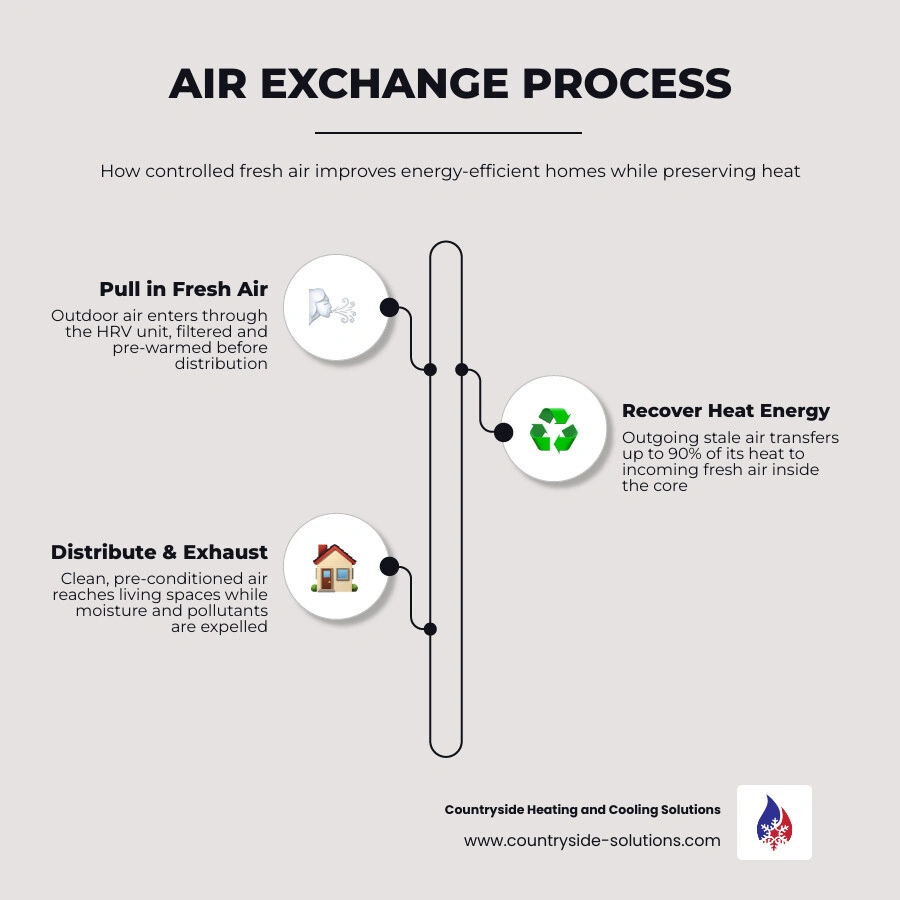
For energy-efficient homes, the biggest win often comes from heat recovery. Instead of exhausting conditioned indoor air and replacing it with raw outdoor air, a recovery ventilator transfers heat from outgoing air to incoming air. In winter, that means the fresh air entering your home is pre-warmed. Your heating system does less work, and the house feels more comfortable.
This is one reason air exchangers are so valuable in colder climates like ours. If you want a closer look at how these systems work, visit our air-to-air exchanger services page.
Understanding HRV and ERV Ventilation Benefits for Energy Efficient Homes
HRVs and ERVs are often mentioned together, and for good reason. Both are balanced ventilation systems. Both bring in fresh air and exhaust stale air. Both recover energy that would otherwise be wasted. But they do not behave exactly the same.
| Feature | HRV | ERV |
|---|---|---|
| Transfers heat | Yes | Yes |
| Transfers moisture | No, or very little | Yes |
| Best fit | Cold climates with excess indoor winter humidity | Mixed or humid conditions, or homes that get too dry |
| Main benefit | Removes stale air while recovering sensible heat | Recovers heat and moderates humidity transfer |
| Minnesota use case | Often ideal for winter condensation and window frost issues | Can be useful when winter air feels overly dry |
For many homes in Maple Plain, Minnetonka, Wayzata, Orono, and surrounding communities, an HRV is often the stronger fit because winter humidity control is such a common issue. If you are seeing window condensation, frost, or that “why does my house smell like wet mittens?” feeling, an HRV may be the better tool.
An ERV, on the other hand, transfers both heat and some moisture. That can help in homes where indoor air becomes uncomfortably dry during the heating season.
The climate question matters:
- In cold, dry climates, HRVs are commonly preferred because they help remove excess indoor moisture.
- In more humid or mixed conditions, ERVs are often useful because they help manage both temperature and humidity.
Both system types can recover a large share of the energy from outgoing air. Research and industry guidance commonly place energy recovery effectiveness in the roughly 70% to 80% range, with some systems performing even higher under the right conditions.
The best choice depends on your home's tightness, occupancy, humidity patterns, existing HVAC setup, and comfort concerns. That is why sizing and system design matter just as much as equipment type.
Long-Term Ventilation Benefits for Energy Efficient Homes and HVAC Longevity
A well-designed ventilation system can help lower the burden on your heating and cooling equipment over time.
Research on a high-performance home found that continuous HRV operation reduced annual heat pump energy use by about 7% compared with ventilating without heat recovery. During heating months, savings reached as high as 36%. In very efficient homes, especially those built to advanced performance standards, heat recovery ventilation can produce even larger combined savings for space heating and fan energy versus basic supply-only approaches.
Why does this matter for your HVAC system?
- Lower humidity can make summer air feel more comfortable
- Controlled fresh air reduces hot and cold swings between rooms
- Preconditioned ventilation air means the furnace or heat pump is not constantly warming icy outdoor air from scratch
- Better air movement can reduce strain caused by stale, damp indoor conditions
Ventilation does not replace heating or cooling, of course. But it helps the whole system work smarter.
It also supports indoor air quality year-round. If you want to explore that angle further, our article on enhancing indoor air quality with ventilators covers how fresh air systems support cleaner breathing and better comfort.
Identifying Signs Your Home Needs Better Ventilation
Sometimes poor ventilation announces itself loudly. Other times it acts like a quiet houseguest causing trouble in the background.
Common signs your home may need better ventilation include:
- Condensation or frost on windows in winter
- Persistent cooking, tobacco, pet, or musty odors
- Mold or mildew in bathrooms, basements, or around windows
- Rooms that feel stuffy even when the thermostat is set correctly
- Excessive indoor dust
- Worsening allergy or asthma symptoms indoors
- Uneven temperatures between rooms
- Humidity that feels sticky in summer or trapped in winter
One of the biggest clues is odor persistence. If last night's salmon or this morning's bacon still seems to be hanging around by evening, air exchange is probably falling short.
Another clue is condensation. When moist indoor air hits a cold surface, water appears. If you routinely see droplets on windows or dampness on colder surfaces, the home is likely holding too much moisture.
In many energy upgrades, this issue shows up right after new windows, added insulation, or air sealing. Homeowners are happy the drafts are gone, then wonder why the house suddenly feels stuffy. The answer is often simple: the home became tighter, but ventilation did not improve with it.
Our post on the need for an air exchanger in your home goes deeper into the warning signs and why they matter.
Maintenance and Natural Ventilation Strategies
Even the best ventilation system needs a little attention to keep doing its job.
Basic maintenance tasks
For most mechanical ventilation systems, homeowners should stay on top of:
- Cleaning or replacing filters on schedule
- Cleaning grilles and fan covers
- Checking outdoor intake and exhaust hoods for blockage
- Inspecting the heat recovery core as recommended by the manufacturer
- Watching for unusual noise, vibration, or reduced airflow
- Scheduling professional inspection and balancing when needed
A general rule of thumb is to check filters every few months and have the system professionally serviced at recommended intervals. Annual cleaning and inspection is a smart baseline for many homes, especially before or during the heating season.
Proper commissioning also matters. A ventilation system should be tested and adjusted so it actually delivers the intended airflow. Close enough is not really close enough here.
How natural ventilation can help
Natural strategies can complement mechanical ventilation, though they usually cannot replace it in a tight Minnesota home.
Helpful options include:
- Opening windows strategically during mild weather
- Using cross-ventilation when outdoor conditions are favorable
- Taking advantage of the stack effect by opening higher and lower windows to encourage airflow
- Running bathroom fans during showers and kitchen exhaust during cooking
- Using landscaping and shading to reduce cooling load and support comfort
Spot ventilation is especially useful. Bathrooms should have effective exhaust, and kitchens should vent cooking moisture and particles outside. Research-based guidance often points to at least 50 CFM for bath fans and 100 CFM for kitchen range hoods.
Still, natural ventilation has limits. On very cold days, very humid days, or during allergy season, opening windows is not always practical. Mechanical systems give you reliable control no matter what the weather is doing outside.
Frequently Asked Questions
Can proper ventilation reduce my monthly energy bills?
Yes, it can, especially when the system includes heat recovery.
This sounds backward at first. Bringing in outdoor air seems like it should increase energy use. But in an airtight home, unmanaged moisture and stale air can make heating and cooling less efficient and less comfortable. Heat recovery ventilation helps by tempering incoming air before it reaches your living space.
Research found that continuous HRV use reduced annual heat pump energy use by about 7% compared with ventilation without heat recovery, and heating-season savings reached up to 36% in some conditions. In very high-performance homes, the combined savings can be even greater versus less efficient ventilation strategies.
The biggest energy benefits usually come when ventilation is:
- Properly sized
- Balanced
- Matched to the home's climate and humidity needs
- Integrated well with the rest of the HVAC system
- Maintained over time
What is the difference between spot ventilation and whole-house systems?
Spot ventilation handles pollution and moisture at the source.
Examples include:
- Bathroom exhaust fans
- Kitchen range hoods
- Laundry area exhaust
These systems are great for short bursts of high moisture or odors. Think showers, cooking, and that one smoke alarm-triggering skillet incident we will politely call “enthusiastic searing.”
Whole-house ventilation is different. It provides steady, controlled air exchange throughout the home. It is designed to dilute everyday pollutants that build up all day long, not just during cooking or bathing.
In most efficient homes, the best approach is both:
- Spot ventilation for bathrooms and kitchens
- Whole-house ventilation for continuous fresh air and moisture control
How often should I service my mechanical ventilation system?
Homeowners should inspect filters regularly and follow the manufacturer's cleaning schedule, but most systems benefit from professional service on a routine basis.
A practical approach for May 2026 standards and homeowner best practice is:
- Check filters every 3 to 6 months
- Clean grilles and accessible fan components at least yearly
- Inspect outdoor hoods for leaves, lint, or snow blockage
- Schedule professional inspection and airflow verification periodically, especially if comfort or humidity issues appear
If your system runs continuously, regular maintenance matters even more. Dirty filters and blocked cores reduce airflow, reduce recovery performance, and make the system work harder than necessary.
Conclusion
In efficient homes, ventilation is not the enemy of energy savings. It is one of the reasons those savings remain healthy, comfortable, and sustainable. Fresh air, moisture control, balanced pressure, and heat recovery all work together to protect both your indoor environment and your HVAC equipment.
At Countryside Heating and Cooling Solutions, we help homeowners across Maple Plain and the Minneapolis-Saint Paul metro area find practical ways to improve comfort and indoor air quality without sacrificing efficiency. As a family-owned company serving the area since 1974, we believe a well-sealed home should still feel fresh, healthy, and easy to live in.
If you are dealing with condensation, stale air, winter window frost, or comfort issues after air sealing, our team can help you choose the right ventilation approach for your home. You can also learn more about professional ventilator installation services or explore more indoor comfort and ventilation solutions through our indoor air quality services.
Fresh air should not be a luxury. In an energy-efficient home, it is part of the plan.
