.webp)

Understanding What is a SEER2 Rating on an AC Unit
When you look at a new air conditioner today, you’ll see a bright yellow EnergyGuide label prominently displayed. The most important number on that label is the SEER2 rating. But what exactly is it? SEER2 stands for Seasonal Energy Efficiency Ratio 2. It is a mathematical calculation that divides the total cooling output of the unit (measured in BTUs) by the total electric energy input (measured in watt-hours) during a typical cooling season.
In simpler terms, it measures how much "cooling" you get for every dollar you spend on electricity. In May 2026, we are well into the era where SEER2 is the gold standard. The Department of Energy (DOE) introduced this updated metric to replace the original SEER rating, which had been in place since the early 1990s. The shift was necessary because the original testing didn't account for the way air actually moves through a home's ductwork.
The industry generally categorizes SEER2 ratings into three efficiency tiers:
- Standard Efficiency (13.4 – 15.1): These units meet the baseline legal requirements for installation. They are reliable but lack the advanced energy-saving features of higher-tier models.
- High Efficiency (15.2 – 17.0): These systems often include two-stage compressors and provide a noticeable reduction in monthly utility bills compared to standard models.
- Premium Efficiency (17.0+): These are the "Teslas" of the HVAC world. Often featuring variable-speed technology, they offer the highest energy savings, best humidity control, and the quietest operation.
What is a SEER2 Rating on an AC Unit vs. Original SEER?
You might be wondering why the "2" was added to the end of the acronym. The difference lies in the testing pressure. The original SEER test was conducted with an external static pressure of 0.1 inches of water column (in. w.c.). However, most residential duct systems are much more restrictive than that.
The SEER2 testing protocol increases that pressure to 0.5 in. w.c.—a five-fold increase that much more accurately reflects the "real-world" conditions of a home in places like Minnetonka or Eden Prairie. Because the testing is harder, a unit’s SEER2 numerical value is usually about 4.5% lower than its old SEER value. For example, an old 15 SEER unit might only be a 14.3 SEER2 unit under the new, tougher rules. This change ensures that when we install a system in your home, the efficiency rating on the box matches the performance you actually experience.
What is a SEER2 Rating on an AC Unit for ENERGY STAR Qualification?
For many of our customers in the Twin Cities metro area, the goal isn't just to stay cool—it's to do so while taking advantage of federal tax credits and local rebates. To earn the ENERGY STAR 6.1 certification in 2026, a split-system air conditioner typically needs a SEER2 rating of 17 or higher and an EER2 of 12 or higher.
Under the Inflation Reduction Act, homeowners may be eligible for significant tax credits when installing high-efficiency equipment. These incentives can help offset the initial investment of a premium system, making high-efficiency comfort more accessible for families in Wayzata, Edina, and beyond.
Regional Minimums and Efficiency Standards in 2026
The Department of Energy recognizes that a home in Minnesota has different cooling needs than a home in Arizona. Because of this, they have established regional minimum efficiency standards.
| Region | Minimum SEER2 (Split AC) | Minimum SEER2 (Heat Pump) |
|---|---|---|
| Northern States (including MN) | 13.4 | 14.3 |
| Southern/Southwestern States | 14.3 | 14.3 |
| Packaged Units (Nationwide) | 13.4 | 13.4 |
For our service area—including Maple Plain, Long Lake, and Independence—the minimum allowable rating for a new central air conditioner is 13.4 SEER2. However, if you are installing a heat pump (which provides both heating and cooling), the nationwide minimum is 14.3 SEER2.
Comparing SEER2, EER2, and HSPF2
While SEER2 is the "big name" in efficiency, it’s not the only acronym you’ll see.
- EER2 (Energy Efficiency Ratio 2): This measures how efficiently the unit cools at a specific, high outdoor temperature (usually 95°F). While SEER2 is an average over a whole season, EER2 tells us how the unit performs during those brutal July heatwaves we occasionally get in the Twin Cities.
- HSPF2 (Heating Seasonal Performance Factor 2): If you are looking at a heat pump, this is the heating equivalent of SEER2. It measures the efficiency of the heating side of the system over the course of a winter.
The Impact of Compressor Technology on Efficiency
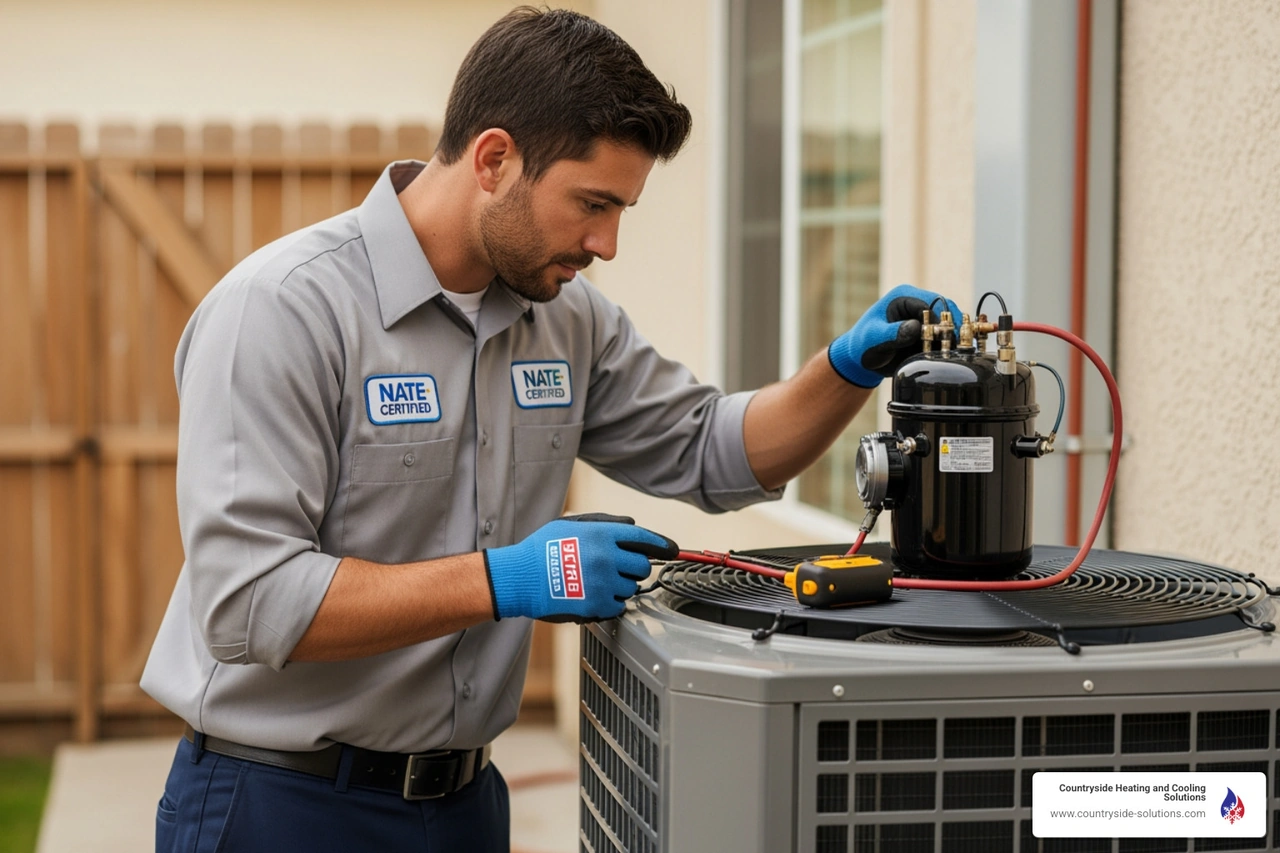
The "engine" of your air conditioner is the compressor. The type of compressor inside your unit is the biggest factor in determining its SEER2 rating.
- Single-Stage Compressors: These are either 100% "on" or 100% "off." They operate like a light switch. They are common in standard efficiency (13.4–15.1 SEER2) units. While effective, they can lead to slight temperature swings and higher energy spikes when they kick on.
- Two-Stage Compressors: These have a "high" and a "low" setting. They run on the lower setting most of the time to save energy and only kick into high gear when it’s exceptionally hot outside. These typically land in the high-efficiency (15.2–17.0 SEER2) category.
- Variable-Speed (Inverter) Compressors: These are the gold standard. They can adjust their speed in tiny increments, running at anywhere from 25% to 100% capacity. This allows them to maintain a perfectly consistent temperature and achieve SEER2 ratings of 20, 22, or even higher.
Benefits of Upgrading to High SEER2 Systems
Investing in a higher SEER2 rating offers benefits that go beyond just the monthly bill:
- Massive Energy Savings: Upgrading from an old 14 SEER unit to a modern 20 SEER2 unit can reduce your cooling energy consumption by roughly 30% to 43%.
- Superior Humidity Control: In Minnesota, "it's not just the heat, it's the humidity." Variable-speed systems run longer, lower-intensity cycles, which allows them to remove significantly more moisture from the air. A home at 76°F with 45% humidity feels much more comfortable than a home at 72°F with 60% humidity.
- Environmental Impact: Lower energy consumption means a smaller carbon footprint for your household.
- Quiet Operation: High SEER2 units often include sound blankets and variable-speed fans that operate "quiet as a whisper," so you can enjoy your backyard in Mound or Orono without the roar of a loud fan.
Factors to Consider When Choosing Your Rating
Is the highest SEER2 rating always the best choice? Not necessarily. The "right" rating depends on several factors specific to your home and lifestyle.
- Home Size and Layout: A larger home in Lake Minnetonka will see a much faster return on investment from a high SEER2 unit than a small seasonal cottage.
- Insulation and Windows: If your home has poor insulation or old single-pane windows, a high-efficiency AC will work harder than it should. We often recommend looking at the "whole home" efficiency.
- Usage Patterns: Do you keep your AC at 68°F all summer, or do you prefer to open the windows and only use the AC on the hottest days? Heavy users benefit more from premium efficiency.
- The "Manual J" Calculation: At Countryside Heating and Cooling Solutions, we don't guess. Our NATE-certified technicians perform a Manual J load calculation to determine the exact size and efficiency level your home requires. An oversized high-efficiency unit is just as wasteful as an undersized old one.
If you’re trying to decide between different models, we recommend checking out our furnace and AC comparison guide to see how different efficiency levels stack up against each other.
Frequently Asked Questions about SEER2
What is considered a "good" SEER2 rating?
In 2026, a "good" rating for most homeowners in the Minneapolis–Saint Paul metro area is generally between 16 and 18 SEER2. This range offers a great balance between upfront cost and long-term energy savings, and it often qualifies for the best rebates.
Does a higher SEER2 rating make the AC quieter?
Generally, yes. Higher SEER2 ratings usually come with variable-speed or two-stage compressors. Because these units don't always run at full blast, they produce much less noise than standard single-stage units. Many premium units are so quiet you have to stand right next to them to know they are running.
How do I find the SEER2 rating on my current unit?
If your unit was manufactured after January 2023, the SEER2 rating should be on the yellow EnergyGuide sticker. If that's missing, you can look for the model number on the manufacturer's data plate (usually located on the side of the outdoor unit) and search for it online. If your unit is older than 2023, it will have a SEER rating, not a SEER2 rating.
Conclusion
Understanding what is a SEER2 rating on an AC unit is the first step toward a cooler, more cost-effective summer. Whether you live in Buffalo, Maple Grove, or Waconia, choosing the right efficiency level can transform your home into a sanctuary of comfort while keeping your energy bills in check.
At Countryside Heating and Cooling Solutions, we’ve been serving the Western Suburbs and the greater Twin Cities area since 1974. Our family-owned business is built on trust, quality workmanship, and a commitment to our community. Our NATE-certified technicians are experts in navigating the latest 2026 efficiency standards to find the perfect solution for your specific home.
Don't wait for the first heatwave of July to realize your old system isn't up to the task. Schedule your high-efficiency AC consultation today and let us help you find the perfect SEER2-rated system for your home and budget.
