.webp)

Why Is My Heating System Making Noises on the First Cold Day?
Are you wondering what is causing those sudden, startling sounds from your ductwork now that the weather has finally turned? At Countryside Heating & Cooling Solutions, our team fields dozens of calls every fall from residents dealing with whistling vents and banging ducts: troubleshooting early heating season noises is a common reality on the first chilly September mornings in Minnesota. Turning on the furnace for the very first time after months of inactivity often reveals a few surprises. The sharp temperature drop overnight in September prompts a sudden switch from air conditioning to heating, forcing your dormant system into immediate action. The decision you face right now is figuring out whether these sounds are harmless seasonal adjustments or warning signs of restricted airflow and failing equipment.
The short answer is: Whistling is typically an airflow restriction caused by high static pressure, while banging is usually the physical result of thermal expansion as cold metal reacts to a sudden blast of hot air. Understanding the difference allows you to take the right steps to protect your system.
Need immediate help with your system? Learn more about our heating services to ensure your home stays comfortable and safe all season long.
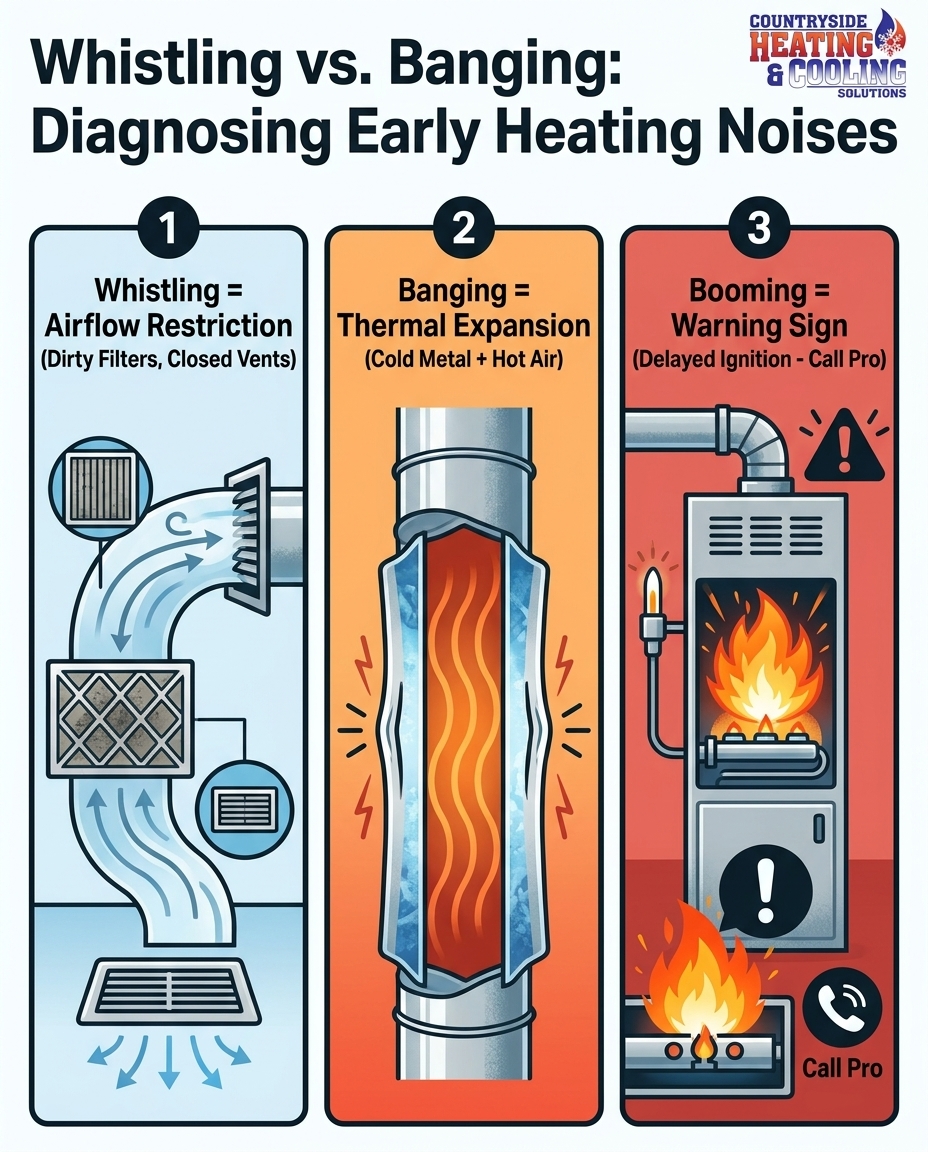
The Physics of Banging Ducts: Understanding Thermal Expansion
When you hear a loud pop, bang, or metallic clang echoing through your walls, your first instinct might be to assume something inside the furnace has broken. However, in the vast majority of cases, this sound is a basic physical reaction known as thermal expansion. Metal naturally expands when it is heated and contracts when it cools down. Your home's ductwork is essentially a massive network of thin sheet metal, making it highly susceptible to these temperature shifts.
In northern climates, the extreme temperature delta causes aggressive thermal expansion. Your ducts have been sitting at cooler baseline temperatures all summer long, often chilled by the air conditioning. When the first major cold snap hits and you turn on the heat, ambient cold ductwork is suddenly flooded with hot furnace air. This rapid change in temperature forces the sheet metal to expand quickly. As the metal flexes outward, it often buckles at the seams or along the broad, flat sides of the trunk line, creating a loud "pop" or "bang." In the HVAC industry, this specific type of metal flexing is often referred to as "oil-canning."
As local HVAC experts who have spent years helping homeowners navigate Minnesota's rapid seasonal transitions, the team at Countryside Heating & Cooling Solutions sees this phenomenon constantly in Maple Plain area homes. A certain amount of expansion noise is entirely normal and expected for standard residential ductwork, especially during the extreme shifts of early autumn.
Why the First Cycle is Always the Loudest
The very first time your furnace kicks on in the fall, the temperature difference between the cold metal and the heated air is at its absolute peak. The initial blast of heat causes the most dramatic physical expansion of the entire season. You will likely hear the loudest bangs during this first cycle.
As the heating season progresses and the ductwork maintains a slightly warmer baseline temperature, the extreme flexing usually subsides. The noises often become less noticeable, reducing to a soft ticking or clicking sound as the system regulates. If the banging remains aggressively loud every single time the furnace turns on deep into the winter, it may indicate that your ducts are undersized or lack proper mounting brackets, but the initial fall popping is generally harmless.
• Single loud pop or bang — Typical Location: Main ductwork trunk line — Likely Cause: Thermal expansion (oil-canning) — Level of Concern: Low (Normal for early season)
• Soft ticking or clicking — Typical Location: Along branch ducts in walls — Likely Cause: Minor metal expansion/contraction — Level of Concern: Low (Normal operation)
• Loud boom from the unit — Typical Location: Inside the furnace cabinet — Likely Cause: Delayed gas ignition — Level of Concern: High (Requires immediate repair)
High-Pitched Whistling: How Summer Habits Restrict Fall Airflow
While banging is usually a harmless physical reaction, a high-pitched whistling sound is an aerodynamic issue that requires your attention. Whistling occurs when the blower motor forces a large volume of air through a restricted space. Think of it like blowing air through your lips: a wide-open mouth makes no sound, but pursing your lips creates a whistle. The same principle applies to your home's ductwork.
One of the most common culprits for fall whistling is actually a leftover habit from the summer cooling season. Many homeowners close vents in unused rooms on the main floor or basement to force more air conditioning up to the second floor. When the first chilly September mornings in Minnesota arrive, they turn on the heat but forget to reopen those vents. Closing more than 20% of a home's supply registers drastically increases the static pressure inside the ductwork. The system is still trying to push the same volume of air, but with fewer escape routes, the air forces its way through the tiny gaps in the closed vent louvers, creating a loud, high-pitched squeal.
Beyond closed vents, accumulated dust and neglected maintenance play a massive role in airflow restriction. Just as you might notice your vents smell like burning dust during that first cycle, that same dust is often clogging your air filter. A dirty, heavily soiled filter acts like a wall, forcing the blower motor to pull air through restricted gaps around the filter housing, which also causes a whistling sound. Neglected seasonal maintenance causes all sorts of unexpected operational issues. For example, our technicians recently helped a local homeowner during the early fall because their gas fireplace needed a new part after sitting unused for months; our team identified the issue, installed the component, and had the unit looking better than new. Just like fireplaces, furnaces and ductwork require attention and a clear path for air to flow after months of dormancy.
The Danger of High Static Pressure
Static pressure is simply defined as the resistance to airflow within your HVAC system. A system with high static pressure is working much harder than it was designed to. Ignoring whistling vents is dangerous because that restricted airflow can lead to severe equipment damage. If the hot air generated by the furnace cannot escape the ductwork quickly enough, the heat exchanger can overheat. Modern furnaces are equipped with high-limit switches that will shut the system down if it gets too hot, but repeatedly tripping this switch causes excessive wear and tear.
High static pressure also puts immense strain on your blower motor. Over time, pushing against that resistance will cause the motor to burn out prematurely. If you hear whistling, you will often notice other symptoms, such as poor airflow in distant rooms, uneven heating, or a furnace that cycles on and off too rapidly.
Safe DIY Troubleshooting: What You Can Check Today
Before you assume your furnace is failing, there are several safe, non-technical steps you can take to troubleshoot airflow issues. At Countryside Heating & Cooling Solutions, we designed this checklist to help homeowners rule out simple restrictions without crossing into professional repair territory. If you are hearing whistling or excessive rattling in Maple Plain area homes, follow these steps.
• Walk the entire house: Go through every room, including basements and guest bedrooms, and ensure all supply registers are fully open. The louvers should be set to allow maximum airflow.
• Check for blocked returns: Return vents pull air back into the system. Ensure no heavy furniture, rugs, or thick curtains are blocking these grilles. A blocked return starves the system of air and causes intense whistling at the blower.
• Inspect and replace the air filter: Turn off the thermostat, locate your furnace filter, and pull it out. If you cannot see light through it, it is time for a replacement. A fresh filter instantly reduces static pressure.
• Secure loose vent covers: Sometimes a rattling or buzzing sound is simply a loose metal register cover vibrating against the floor or wall. Tighten the mounting screws to see if the noise stops.
• Check the damper positions: If your ductwork has manual dampers (small metal levers on the outside of the ducts), ensure they are adjusted parallel to the duct line, which indicates they are open.
A critical warning: While checking filters and opening vents is perfectly safe, you must never open the furnace cabinet to attempt internal repairs. Adjusting internal blower speeds, modifying gas valves, or altering the electrical components requires specialized training and licensing. If the simple steps above do not resolve the noise, it is time to consult an expert. You can review our HVAC FAQ for more insights on what constitutes a safe homeowner check versus a professional repair.
When Normal Noises Become Warning Signs
While thermal expansion and closed vents account for most early-season noises, it is vital to delineate between harmless seasonal sounds and critical issues that require immediate professional intervention. Ignoring the wrong sound can leave you without heat when you need it most.
One of the most concerning sounds is a loud booming or a banging noise that sounds like a small explosion coming directly from the furnace cabinet, rather than the ductwork. This is a classic symptom of delayed ignition. In a healthy furnace, the gas burners ignite instantly. When burners are dirty or misaligned, the gas can build up inside the combustion chamber for a few seconds before finally catching a spark. When it does ignite, the excess gas creates a miniature explosion, resulting in a loud boom. This is a serious safety hazard that can crack the heat exchanger and allow dangerous gases into your home.
Another major warning sign is the sound of scraping metal or a continuous, aggressive grinding noise. This usually points to a failing blower motor or a loose blower wheel that has detached from its mount and is scraping against the metal housing. If you hear this, turn the system off immediately to prevent the motor from destroying itself.
One Maple Plain homeowner found this out the hard way when their furnace stopped working entirely during a sudden fall cold weather snap. Fortunately, our Countryside Heating & Cooling Solutions technician quickly identified the failing component and restored the heat, but ignoring early warning noises often leads to these complete, stressful breakdowns. It is crucial to address these warning signs during the fall before the extreme Minnesota winter weather hits. A minor mechanical issue in September can easily become an emergency no-heat situation in January. High static pressure from restricted airflow or a struggling motor will only worsen as the system runs continuously during the deep freeze. Scheduling a professional pre-season tune-up is the best way to catch these issues early. Technicians can adjust blower speeds, clean burners to prevent delayed ignition, and verify that your ductwork is properly sized for your home. Exploring HVAC service plans ensures your system gets this vital attention every single fall.
Frequently Asked Questions About Heating System Start-Up Noises
When the heat kicks on for the first time, it is natural to have questions about the sounds echoing through your home. Here are the most common concerns our technicians hear from homeowners in Maple Plain area homes during the early heating season.
Why is my heating vent whistling?
Whistling is caused by restricted airflow forcing its way through tight spaces, creating an aerodynamic squeal. This is most commonly the result of dirty air filters, closed supply vents, or blocked return registers. When the blower motor tries to push a high volume of air against these restrictions, the static pressure spikes, and the resulting air velocity generates a high-pitched whistle at the vent openings.
Is it normal for ductwork to bang when the heat turns on?
Yes, a single pop or bang is usually normal thermal expansion as cold metal heats up rapidly. When ambient cold ductwork is suddenly filled with hot air from the furnace, the sheet metal expands and flexes, often "oil-canning" or buckling slightly at the broad sides. However, loud booms coming from the furnace itself could indicate delayed ignition, which requires professional repair.
How do I stop my air vents from making noise?
Start by replacing your air filter and ensuring all vents in the home are fully open and unblocked by furniture or rugs. Securing loose register covers with a screwdriver can also stop rattling. If the noise persists after these basic checks, a professional may need to adjust your blower motor speeds, clean the blower wheel, or inspect the ductwork for sizing issues.
Can closed vents cause whistling?
Yes. Closing vents increases the static pressure inside the ductwork, forcing the same volume of air through smaller, restricted gaps. Many homeowners close vents in the summer to redirect air conditioning, but leaving them closed in the fall strains the heating system. This high pressure forces air rapidly through the louvers, creating a high-pitched aerodynamic whistle.
How long does thermal expansion noise last?
The popping typically happens within the first few minutes of a heating cycle as the extreme temperature delta causes the metal to expand. It may occur again briefly as the system cools down and the metal contracts after the furnace shuts off. While the noise is loudest during the first few weeks of fall, it usually becomes less noticeable as the season progresses and the ductwork maintains a warmer baseline temperature.
Restore Quiet Comfort to Your Home This Fall
Navigating the transition from summer cooling to fall heating doesn't have to be a noisy, stressful experience. Understanding the physics behind thermal expansion and the mechanics of airflow gives you the peace of mind to know exactly what your system is doing on those first chilly September mornings in Minnesota. By following the clear, non-technical checklist our team recommends to rule out simple issues like dirty filters and closed vents, you can often restore quiet comfort to your home in a matter of minutes.
However, if the whistling persists, or if those normal bangs start to sound like dangerous booms from the furnace cabinet, it is time to bring in an expert. Don't let a minor airflow restriction turn into a major mid-winter breakdown. Take action today to schedule HVAC service and ensure your heating system is safe, efficient, and ready to handle whatever the season brings.
