.webp)

Is Your Bryant Thermostat Trying to Tell You Something About Your Furnace?
When the October chill sets in, searching for home maintenance tips and troubleshooting is a common first step if your heating system suddenly stops responding. You walk past your hallway wall control, expecting to turn up the heat, only to find a completely blank screen or a flashing error code. At Countryside Heating & Cooling Solutions, we know how incredibly frustrating it is to deal with a non-responsive thermostat right when you need warmth the most. However, what looks like a broken thermostat is frequently a symptom of a much larger issue hidden inside your heating equipment.
If you are dealing with communication errors on Bryant HVAC systems, understanding the root cause is critical. As we approach the October first freeze, your home's safety and comfort depend on reliable heat. A blank screen or a system malfunction alert does not necessarily mean your wall control has failed. In our experience, these alerts are actually furnace lockouts—protective measures designed to shut down your system before a minor mechanical failure turns into a major safety hazard.
The underlying reality: Your thermostat is the messenger. When your furnace detects a dangerous condition, such as overheating or a failure to ignite, it cuts power or sends an error signal to the thermostat. Addressing these warnings promptly before the deep winter freeze hits is essential. While there are a few basic checks our team recommends you safely perform on your own, understanding when to call a professional can save your home from frozen pipes and extensive damage.
Decoding Common Bryant Thermostat Alerts and Blank Screens
When your heating system fails to operate, the first place you look is the thermostat. In our years of serving homeowners in Maple Plain and surrounding Hennepin County, we have seen firsthand how waking up to a freezing house and a dead thermostat screen is a stressful experience. Bryant systems, particularly the advanced Evolution and Preferred series, are designed to communicate specific faults, but interpreting those signals can be confusing.
A completely blank screen usually indicates a complete loss of low-voltage power. Your thermostat does not plug into a wall outlet; it draws a 24-volt current directly from the furnace control board. If a safety switch trips, a component overheats, or a power surge occurs, the furnace protects itself by blowing a small automotive-style fuse on its control board. When that fuse blows, the power to the thermostat is instantly severed. If you need more details on fixing a blank Bryant thermostat screen, our technicians typically find that electrical connections and furnace fuses are the primary culprits.
Other common causes for a blank screen include a tripped household circuit breaker, a blown transformer inside the furnace, or a safety switch that has been activated by a clogged condensate drain line. These are not thermostat failures; they are system-wide power interruptions.
Why Is My Bryant Evolution Thermostat Showing a System Malfunction?
Bryant Evolution systems use a proprietary communication bus to talk to the furnace, rather than traditional low-voltage wires. This allows the system to provide highly detailed diagnostic information. When the Evolution control board detects a problem, it will display a "System Malfunction" or "System Event" alert directly on the screen.
Common triggers our team sees for a System Malfunction alert include:
• Ignition failure: The furnace attempted to light the burners multiple times but failed to detect a flame.
• Limit switch trips: The internal temperature of the heat exchanger exceeded safe operating limits, usually due to poor airflow.
• Communication faults: The wiring between the indoor unit, outdoor unit, and the wall control has been compromised or degraded.
It is important that you do not repeatedly reset the system at the breaker if this error persists. Resetting the power will temporarily clear the error code, but it forces the furnace to attempt another unsafe startup sequence. If the system locks out a second time, it is confirming a hard mechanical failure that requires professional diagnostic tools.
Normal Dust Burn-Off vs. Dangerous Burning Smells
One of the most common concerns we hear about during the October first freeze is the strong odor that fills the house when the heat kicks on. Understanding the difference between normal seasonal odors and dangerous hazards can help you determine if your system is operating safely or if it is about to trigger a protective lockout.
During the highly humid Minnesota summers, your heating system sits completely dormant. Over those several months, dust, pet dander, and airborne particulates settle directly onto the furnace's heat exchanger and burners. When you activate the heating cycle for the first time in the fall, the heat exchanger rapidly reaches hundreds of degrees, incinerating that accumulated debris. This produces a distinct "burning dust" smell that often circulates through your vents.
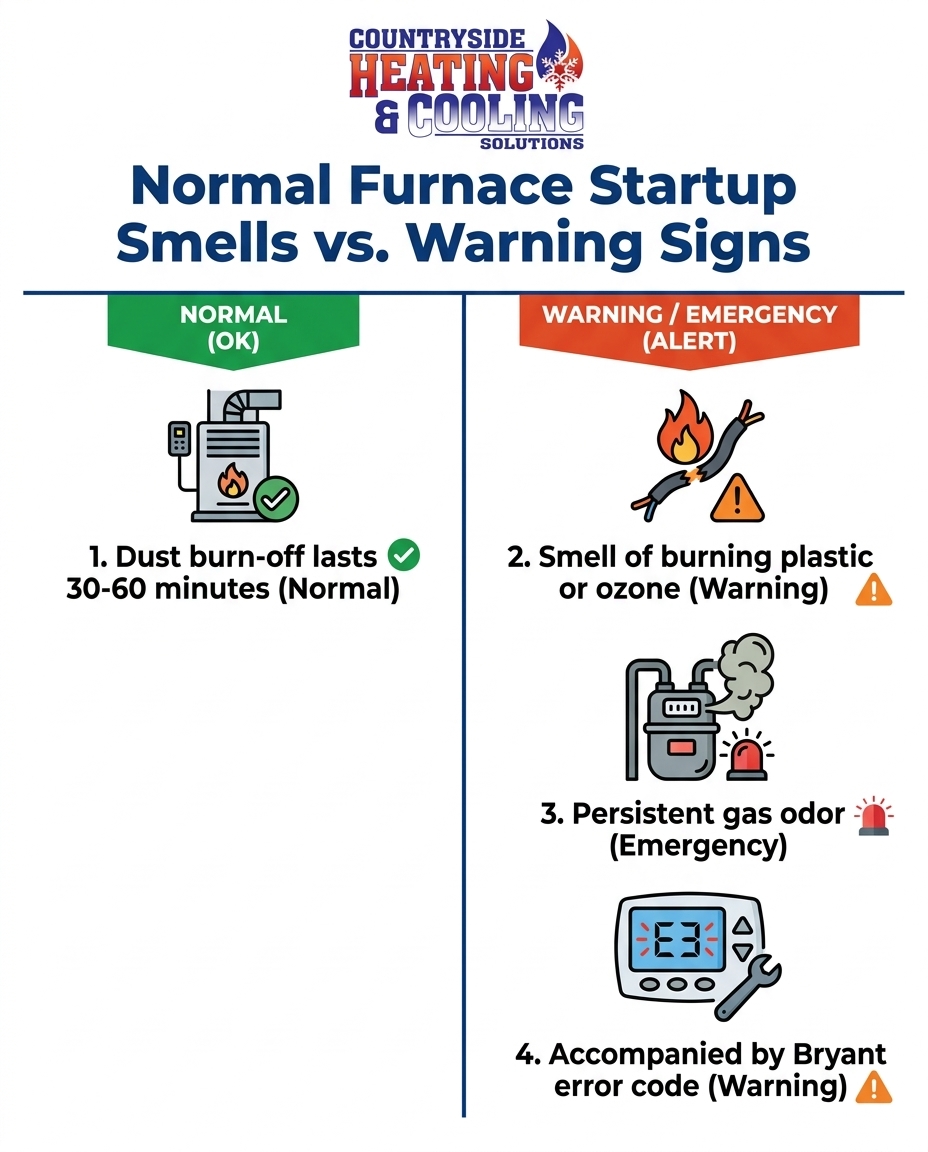
This normal burn-off typically dissipates within 30 to 60 minutes. However, if the smell persists, or if it smells like melting plastic, electrical ozone, or raw gas, you are facing a serious safety hazard. These dangerous odors often accompany a thermostat error code, as the furnace's internal safety mechanisms engage to prevent a fire or gas leak.
• Burning Dust / Musty — Typical Cause: Incineration of summer dust buildup on the heat exchanger. — Expected Duration: 30 to 60 minutes after the first fall startup. — Action Required: Monitor the system. Open windows if necessary to ventilate.
• Electrical / Ozone — Typical Cause: Overheating blower motor, failing capacitor, or frayed wiring. — Expected Duration: Continuous while the system is running. — Action Required: Turn off the system immediately at the thermostat and call for service.
• Melting Plastic — Typical Cause: Foreign object in the ductwork or melting wire insulation. — Expected Duration: Continuous and worsening over time. — Action Required: Shut off power at the breaker panel and request emergency service.
• Rotten Egg / Sulfur — Typical Cause: Natural gas leak near the furnace or gas valve failure. — Expected Duration: Present even when the furnace is not actively running. — Action Required: Evacuate the home, leave the doors open, and call your gas utility provider.
The Link Between Dirty Air Filters and Furnace Short-Cycling
If your thermostat seems to be working, but the house isn't getting warm, you might be dealing with short-cycling. Short-cycling occurs when the furnace turns on, runs briefly, and then shuts off completely before reaching the set temperature on the thermostat. This is one of the most common causes of furnace lockouts our technicians encounter, and it is frequently tied to something you can control: the air filter.
When an air filter becomes clogged with dust and debris, it severely restricts the volume of air flowing through the system. Your furnace relies on that constant airflow to carry heat away from the internal heat exchanger and distribute it through your home. Without adequate heating system performance and airflow, the heat exchanger rapidly overheats.
To prevent the metal from cracking or starting a fire, a safety device called the high-limit switch detects this extreme temperature and immediately shuts the burners down. The blower fan may continue to run to cool the system, but the heat stops. Once the unit cools, it tries to start again, only to overheat and shut down once more. This rapid on-and-off cycle puts immense strain on the equipment.
Just this past fall, our team responded to a local homeowner whose furnace stopped working entirely during a cold snap. One of our technicians arrived quickly, identified the issue as a severely restricted airflow problem causing the system to overheat, and restored heat the same day. In many cases, simply replacing a neglected filter can prevent this exact scenario.
Here is how we recommend checking your filter before calling for help:
1. Locate the filter cabinet: This is usually found between the main return air duct and the furnace body.
2. Turn off the power: Switch the furnace power off before opening the cabinet to prevent dust from being sucked into the blower.
3. Inspect the media: Pull the filter out and hold it up to a light source. If you cannot see light shining through the pleats, the filter is completely blocked.
4. Replace with the correct size: Insert a fresh filter, ensuring the airflow arrows point directly toward the furnace body.
When a Thermostat Issue is Actually a Furnace Lockout
If you have verified your filter is clean and your thermostat has power, but the heat still won't engage, you are likely dealing with a hard lockout. A hard lockout is a built-in safety protocol where the furnace control board refuses to initiate the ignition sequence because it has detected a recurring mechanical failure or an unsafe operating condition.
In our experience maintaining heating systems across Maple Plain and surrounding Hennepin County, we know these units endure heavy workloads. Over time, internal components degrade. When a furnace receives a call for heat from the thermostat, it runs through a strict sequence of operations. First, the draft inducer motor turns on to clear residual gases. Next, a pressure switch verifies adequate venting. Then, the ignitor glows, the gas valve opens, and finally, a flame sensor confirms the burners are lit.
If any single step in this sequence fails—for example, if a dirty flame sensor fails to detect the fire, or if a failing inducer motor cannot clear the exhaust—the control board aborts the startup. After a few failed attempts, the furnace enters a hard lockout. The thermostat cannot "fix" these issues. Resetting the thermostat or flipping the breaker will not solve the underlying mechanical failure; it will only force the system to attempt another doomed startup.
Bypassing safety switches or attempting DIY repairs on gas valves and electrical components is incredibly dangerous. As a Bryant Medal of Excellence and Circle of Champions award winner, our team at Countryside Heating & Cooling Solutions has elite, factory-backed expertise in diagnosing these specific Bryant communication errors. Trusting a certified professional ensures that the root cause of the lockout is resolved safely and permanently.
Safe Homeowner Troubleshooting Steps
Before you request a service visit from our team, there are a few safe, basic checks you can perform. It is entirely possible that a simple oversight is preventing your system from running. Running through this checklist ensures you don't pay for a service call just to have a technician flip a switch or change a battery.
We recently helped a customer who needed same-day service when their furnace broke down unexpectedly. Our technician arrived, thoroughly explained the underlying problem with the unit's safety mechanisms, and fixed the furnace right away. While professional help is often necessary, you can rule out the easy fixes first by checking your HVAC troubleshooting FAQs and following these steps.
• Check the thermostat batteries: If your thermostat relies on AA or AAA batteries rather than hardwired power, swap them out for a fresh set. A low battery can cause erratic behavior or a blank screen.
• Verify the system settings: Ensure the thermostat is explicitly set to "Heat" (not "Auto" or "Cool") and that the set temperature is at least three degrees higher than the current room temperature.
• Inspect the electrical panel: Check your home's main circuit breaker box. If the breaker labeled "Furnace" or "HVAC" has tripped, push it fully to the "Off" position, then firmly back to "On."
• Check the furnace power switch: There is usually a standard-looking light switch mounted on or near the side of the furnace. This is the main power disconnect. Ensure it hasn't been accidentally bumped into the "Off" position.
• Inspect the furnace doors: Furnaces have a safety switch that cuts power if the front access panels are loose. Verify that the doors are firmly seated and latched into place.
Frequently Asked Questions About Bryant Thermostats and Furnace Startups
Why is my Bryant thermostat not turning on the heat?
If your Bryant thermostat is not turning on the heat, our technicians often find the issue is a lack of communication between the wall control and the furnace control board. This can be caused by a tripped circuit breaker, a blown low-voltage fuse inside the furnace, or an open safety switch. First, verify that the thermostat is set to "Heat" and the temperature is set higher than the room. If the settings are correct, check your air filter and breaker panel before calling for professional diagnostics.
Is it normal for my furnace to smell when I turn it on?
Yes, it is very common to experience a burning dust smell during the first fall startup. Over the summer, dust and debris settle on the heat exchanger. When the system turns on for the first time, this dust is incinerated, causing a distinct musty or burning odor. This smell should completely dissipate within 30 to 60 minutes. If you smell electrical ozone, melting plastic, or natural gas, shut the system down immediately as these are severe safety hazards.
How do I know if my furnace short-cycling is a safety hazard?
Short-cycling becomes a safety hazard when it is caused by severe overheating inside the furnace cabinet. If your furnace runs for only a few minutes before shutting off, it is likely tripping the high-limit safety switch due to restricted airflow. The most common culprit we see is a severely clogged air filter. If replacing the filter does not resolve the rapid on-and-off cycling, you must have the system inspected, as continuous overheating can crack the heat exchanger and introduce carbon monoxide into your home.
Why is my Bryant thermostat blank?
A blank Bryant thermostat screen usually means the device has lost its 24-volt power supply from the furnace. This is rarely a failure of the thermostat itself. The most frequent causes are a tripped household circuit breaker, a blown 3-amp fuse on the furnace control board, or an open furnace door switch. Additionally, if a safety sensor (like a condensate overflow switch) trips, it will cut power to the thermostat to prevent the system from running.
How do I reset my Bryant thermostat safely?
To safely reset your Bryant thermostat, you should power cycle the entire heating system at the main electrical panel. Locate the circuit breaker for your furnace, flip it to the "Off" position, wait exactly 60 seconds, and then flip it back to "On." This allows the furnace control board to reboot and re-establish communication with the thermostat. We strongly advise against performing this reset multiple times; if the error returns, the system is actively protecting itself from a mechanical failure.
What Bryant Evolution error codes require an emergency service call?
Any Bryant Evolution error code indicating an "Ignition Lockout," "High Limit Trip," or "System Malfunction" that persists after a single power reset warrants a professional service call. These codes mean the furnace has repeatedly failed to light safely or has overheated to a dangerous level. Ignoring these specific alerts and attempting to force the system to run can lead to severe equipment damage or potential safety risks in your home.
How does the Maple Plain climate affect my heating system's startup?
In our experience, the extreme temperature swings and high summer humidity in Maple Plain put immense stress on heating systems. Because furnaces sit completely dormant through humid summers, they accumulate significant dust and moisture, which can lead to dirty flame sensors and early-season odors. When the October freeze hits, the sudden demand forces these dormant parts to work at maximum capacity immediately, increasing the likelihood of startup failures and safety lockouts if the system hasn't been properly maintained.
Ensure Your Bryant System is Ready for the Minnesota Winter
Navigating the early days of the heating season requires paying close attention to what your equipment is telling you. A blank thermostat screen, a flashing error code, or a persistent burning smell are not just minor inconveniences; they are critical warning signs. The safety mechanisms built into your Bryant system are designed to protect your home from overheating, electrical faults, and dangerous gas issues.
As the October first freeze approaches, our team at Countryside Heating & Cooling Solutions advises against relying on generic advice to just "wait and see" if a problem fixes itself. While changing your air filter and checking your breakers are excellent first steps, persistent short-cycling and recurring lockouts demand professional attention. Do not ignore the warning signs your thermostat is displaying. If you are experiencing communication errors or startup failures, schedule HVAC service today to ensure your system is operating safely and reliably before the harsh winter weather arrives.
