.webp)

The Chill of the First October Frost: Turning on Your Heating System
You switch your thermostat to 'heat' as the first October frost hits, but instead of cozy warmth, you are greeted by an alarming burning smell. If you are searching for home maintenance tips and troubleshooting, few things cause more sudden anxiety than an unfamiliar odor coming from your air vents. You immediately wonder if your house is safe, or if you need to shut the system down right away.
At Countryside Heating & Cooling Solutions, we hear this anxiety firsthand from homeowners across Maple Plain every fall. During the rapid transition from humid summer days to freezing fall nights, your dormant HVAC components experience sudden and significant thermal stress. Your heating system has been sitting idle for months, collecting dust and settling into a dormant state. When that first real cold snap arrives, firing up the furnace puts an immediate load on those rested parts.
The immediate dilemma: You need to know when to wait out a strange smell and when to immediately call for professional help. While you may still need to Schedule AC Repair for lingering summer issues that you put off, your immediate focus right now is heating safety. Understanding the difference between a normal seasonal quirk and a dangerous system failure is the key to keeping your home comfortable and safe as winter approaches.
Why Your Furnace Smells Like Burning Dust (And Why It's Usually Normal)
If you notice a distinct smell of burning dust during the first October frost, take a deep breath. In the vast majority of cases our technicians see, this specific odor is completely harmless and simply part of the seasonal startup process.
The Science of Summer Dust Accumulation
Throughout the long summer months, your heating system sits quietly in the background. Even if you run your air conditioner daily, the specific components responsible for generating heat—namely the heat exchanger and the gas burners—remain completely inactive. Over time, these idle heating components become natural traps for airborne particles. Pet dander, household dust, and microscopic debris settle onto the cold metal surfaces.
When your thermostat finally calls for heat, the ignition sequence begins. The burners ignite, and the heat exchanger rapidly warms up, often reaching temperatures exceeding 140 degrees Fahrenheit within moments. As the metal heats up, the accumulated layer of summer dust instantly incinerates. This rapid burn-off creates a very noticeable, somewhat earthy burning smell that gets pushed through your ductwork and into your living spaces.
The 20-Minute Rule for Safe Burn-Off
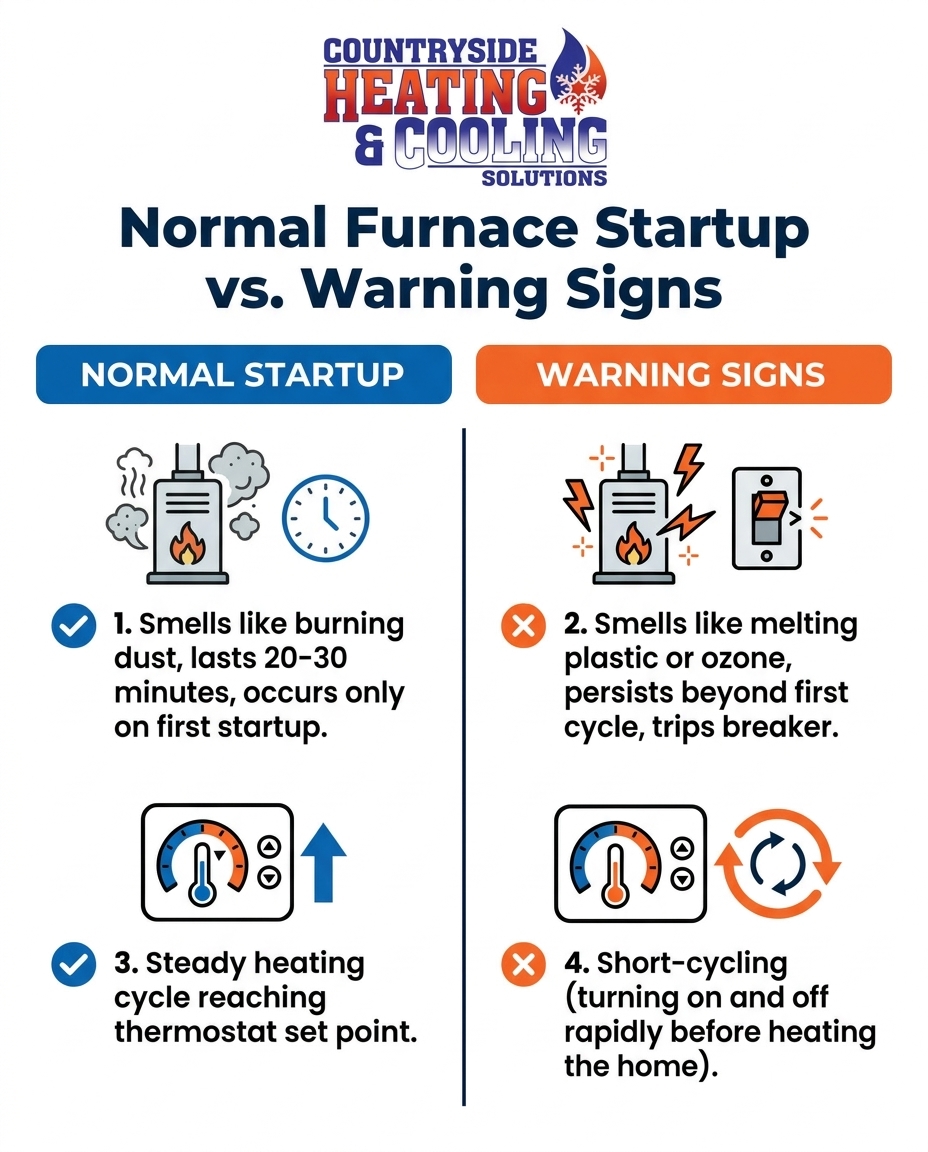
How do you know if the smell is just harmless dust? In our years of servicing local furnaces, we've found the most reliable metric is time. A normal dust burn-off should dissipate entirely within the first 20 to 30 minutes of continuous operation.
• Monitor the duration: Start a timer when you first notice the smell. If it fades quickly as the system runs, your furnace is simply cleaning house.
• Ventilate the space: To help clear the air faster, open a few windows slightly to allow fresh air to circulate during this initial startup phase.
• Watch for repetition: This dust burn-off should only happen once. If you smell burning dust every single time the furnace kicks on throughout October, you likely have a severely clogged air filter or an issue with your blower motor pulling in excess debris.
Persistent Odors and Electrical Smells: When to Worry
While burning dust is normal, certain odors are immediate red flags. If the air coming from your vents smells harsh, chemical, or synthetic, you are likely dealing with a dangerous component failure rather than a harmless seasonal quirk.
Identifying Acrid Plastic or Ozone Smells
You must be able to differentiate between organic dust and synthetic melting odors. An electrical fire or melting plastic creates an acrid, sharp smell that stings the nose and often smells like ozone or burning rubber. If you detect this type of odor, or if any burning smell persists beyond that initial 20-minute window, you must shut the system down immediately at the thermostat. Do not wait to see if it gets better.
• Earthy, burning dust — Likely Cause: Summer dust burning off the heat exchanger — Required Action: Wait 20-30 minutes; ventilate home
• Melting plastic or rubber — Likely Cause: Failing blower motor belt or melting wire casing — Required Action: Shut off immediately; call a professional
• Sharp ozone or electrical fire — Likely Cause: Overheating circuit board or seized motor — Required Action: Shut off at breaker; request emergency service
Common Electrical Component Failures
Electrical failures in your heating system share many similarities with summer cooling failures. Just as you might research an AC Contactor vs. Bad Capacitor issue during a July heatwave, your furnace relies on similar relays, capacitors, and wiring to operate safely. Dormant periods exacerbate electrical wear. Moisture from humid summer air can cause subtle corrosion on furnace control boards and relay switches. When high voltage surges through these compromised parts during the first October frost in western Hennepin County, our technicians frequently see wires overheat, insulation melt, and motors seize, producing that unmistakable electrical burning smell.
Furnace Short-Cycling: A Hidden Danger Before Deep Winter
Beyond strange smells, the way your furnace runs during its first few days of operation tells you a lot about its health. One of the most destructive hidden dangers our team encounters is a phenomenon known as short-cycling.
What Exactly is Short-Cycling?
Short-cycling occurs when your furnace turns on, runs for a very brief period (often just a minute or two), and then shuts off abruptly before the house reaches the temperature set on your thermostat. A healthy heating cycle should run continuously for 10 to 15 minutes, pushing steady, warm air into your rooms until the desired temperature is achieved.
If you notice your system rapidly turning on and off, you have a serious problem. Just last fall, our team received an emergency call from a local homeowner whose furnace stopped working entirely after a period of rapid clicking and starting. They needed to get the heat back on quickly before the house grew too cold. Fortunately, one of our technicians arrived, quickly identified the short-cycling issue, and restored the heat before the situation became a true emergency.
The Threat to Your Heat Exchanger
Why is short-cycling so dangerous? It forces your system to work incredibly hard, starting and stopping the heavy motors repeatedly. This massive strain significantly reduces the lifespan of the equipment. More importantly, it poses a severe risk to your heat exchanger.
The mechanics of metal fatigue: Every time your furnace fires up, the metal heat exchanger expands from the intense heat. When the cycle ends, the metal cools and contracts. Normal cycles allow for gradual, safe expansion and contraction. Short-cycling causes rapid, continuous temperature fluctuations. This constant stress leads to metal fatigue, which eventually causes the heat exchanger to crack. A cracked heat exchanger is a critical safety hazard because it allows deadly carbon monoxide exhaust gases to leak directly into your home's breathing air. Diagnosing short-cycling early is crucial to avoid emergency no-heat situations and safety hazards when sub-zero Minnesota temperatures arrive.
Why You Should Avoid DIY Electrical and Sensor Diagnostics
When a furnace acts up, it is tempting to look up quick fixes online. However, attempting to repair electrical issues, clean sensitive flame sensors, or diagnose short-cycling without a licensed professional is incredibly risky.
Modern HVAC systems contain high-voltage electrical components that can cause severe injury if mishandled. Furthermore, the internal safety mechanisms—like limit switches and rollout sensors—are designed to shut the system down to prevent fires and gas leaks. Bypassing these safety switches or improperly cleaning a flame sensor with the wrong materials can lead to fatal carbon monoxide exposure or electrical fires.
The Environmental Protection Agency (EPA) strongly recommends professional annual pre-season maintenance to ensure indoor air quality and safe operation. A professional diagnostic visit accurately pinpoints the root cause rather than guessing. Recently, one of our Maple Plain customers arrived home from a fall vacation to a completely broken furnace. Rather than attempting a risky DIY repair, they called Countryside Heating & Cooling Solutions for help. Our technician arrived quickly, diagnosed the complex electrical fault, and fixed the furnace at a great value, restoring their comfort safely.
Working with our professional team means you benefit from a comprehensive Satisfaction Guarantee. This ensures you do not end up paying for misdiagnosed electrical issues or parts you do not actually need. For reliable, safe diagnostics, always rely on professional HVAC Services.
Wrapping Up the Cooling Season: Don't Forget Your AC
While ensuring your furnace is ready for the first October frost is your top priority, neglecting your air conditioning unit during the fall transition is a common mistake we see. Preparing your entire HVAC system for winter requires attention to both heating and cooling components.
Leaving your AC exposed and unmaintained throughout a harsh western Hennepin County winter can lead to seized motors, rusted electrical relays, and severe performance issues next spring. Take these steps to properly wrap up the cooling season:
• Clear outdoor debris: Remove fallen leaves, twigs, and dirt from around the outdoor condenser unit before the first heavy snowfall buries it.
• Check the insulation: Ensure the insulation on the refrigerant lines running from the house to the outdoor unit is intact and not chewed by pests.
• Schedule comprehensive care: Booking professional Air Conditioning Services now prevents lingering summer wear and tear from worsening over the winter.
• Bundle your maintenance: To save time, request AC Maintenance in Maple Plain at the exact same time as your pre-winter heating inspection.
Ensuring Peace of Mind for the Minnesota Winter
Navigating the shift into winter does not have to be stressful. By understanding the clear difference between a harmless 20-minute dust burn-off and critical warning signs like persistent melting plastic odors or rapid short-cycling, you can protect your equipment and your family.
Guessing about your family's winter safety is never worth the risk. If you smell something acrid, or if your system refuses to run a full heating cycle, taking immediate action is the best way to prevent a minor fault from becoming a major breakdown. When local homeowners ask our team for reliable home maintenance tips and troubleshooting, our best advice is always to schedule a professional diagnostic check before the deep freeze sets in. Ensuring your system is thoroughly inspected gives you the peace of mind you need to stay warm, safe, and comfortable all winter long in Maple Plain and western Hennepin County.
Frequently Asked Questions
Why does my heater smell like burning when I turn it on for the winter?
Your heater smells like burning because dust and debris settle on the heat exchanger and burners during the idle summer months. When you turn the system on for the first time, temperatures quickly exceed 140 degrees, causing this accumulated dust to safely burn off. This process creates a distinct, earthy burning smell that usually clears up quickly.
How long should a furnace smell when first turned on?
The initial burning dust smell should dissipate within the first 20 to 30 minutes of continuous operation. If the odor persists beyond this timeframe, or if it returns every time the furnace cycles on, it indicates a problem. Lingering smells often point to a clogged air filter or an electrical issue that requires professional attention.
Why is my furnace turning on and off quickly?
When a furnace turns on and off rapidly, it is experiencing a malfunction known as short-cycling. This is often caused by a dirty flame sensor, a severely clogged air filter restricting airflow, or a malfunctioning thermostat. The system shuts itself down prematurely as a safety precaution to prevent overheating.
Is it dangerous if my furnace short cycles?
Yes, short-cycling is quite dangerous for the longevity and safety of your heating system. The rapid expansion and contraction of the metal heat exchanger causes severe metal fatigue, which can eventually lead to cracks. A cracked heat exchanger allows deadly carbon monoxide gases to leak into your home's breathing air.
What is the difference between normal startup smells and electrical burning?
Normal startup smells resemble burning dust or a slightly earthy odor and fade within 30 minutes. Electrical burning smells are sharp, acrid, and often resemble melting plastic, burning rubber, or ozone. If you detect an electrical or synthetic smell, you should shut the system down immediately to prevent a fire hazard.
Can a bad relay cause my heating or cooling system to short cycle?
Yes, a failing electrical relay can absolutely cause your system to short cycle. If the relay cannot maintain a consistent electrical connection, it will drop the voltage to the blower motor or gas valve, causing the system to stutter and shut down prematurely. Diagnosing relay issues requires a professional with a multimeter to test high-voltage components safely.
