.webp)

Why Smart Thermostat Benefits for Homeowners Are Worth Paying Attention To
The smart thermostat benefits for homeowners are real, measurable, and — especially here in the Minneapolis–Saint Paul area — felt every single month on your utility bill. Heating and cooling account for nearly half of the average American household's annual energy spend. That's over $900 a year just to stay comfortable. If your thermostat is still a basic dial or even an older programmable model, there's a good chance you're spending more than you need to.
Here's a quick look at the core benefits:
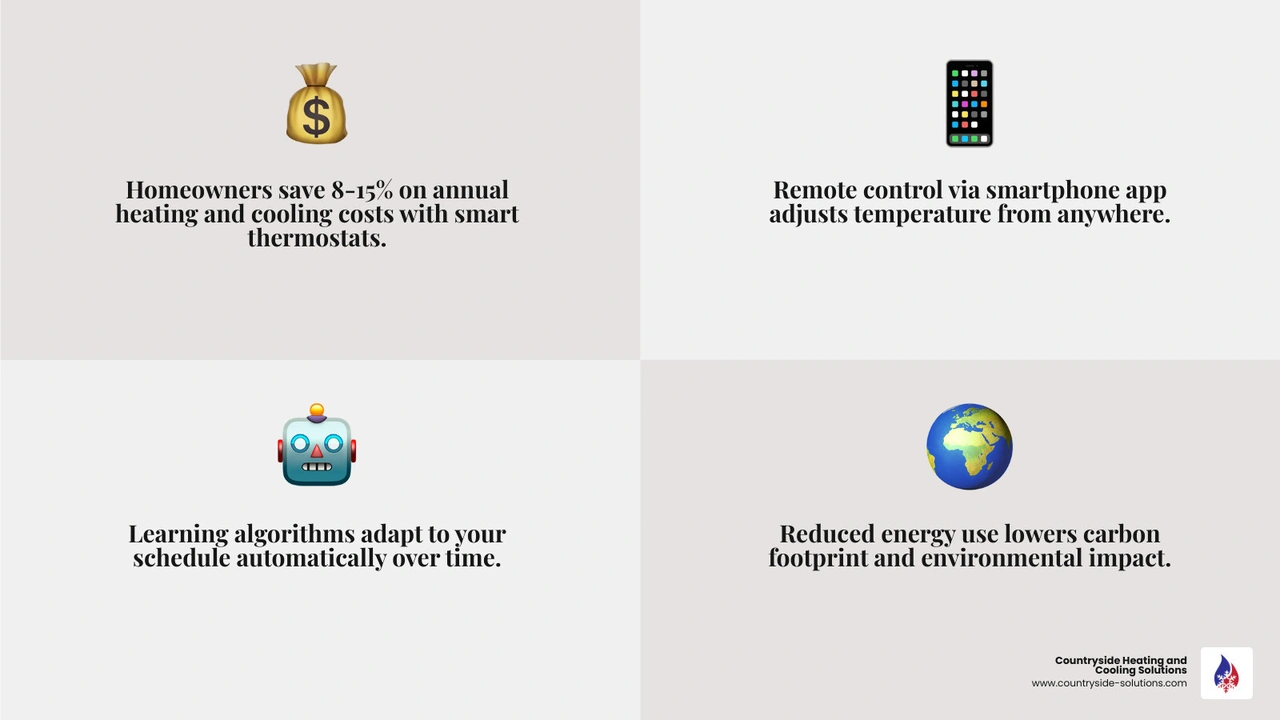
- Lower energy bills - Most homeowners save 8–15% on heating and cooling costs annually
- Remote control - Adjust your home's temperature from anywhere using a smartphone app
- Learning algorithms - The thermostat adapts to your schedule automatically over time
- Geofencing - Your system responds to when you leave or return home, so you're never heating an empty house
- Smart home integration - Works with Alexa, Google Assistant, and Apple HomeKit
- Maintenance alerts - Get notified about filter changes and potential HVAC issues before they become costly repairs
- Environmental impact - Reduced energy use means a smaller carbon footprint
- Home value - Energy-efficient upgrades are increasingly attractive to buyers
Minnesota winters are brutal and summers can be surprisingly humid. That combination means your HVAC system works hard year-round — and a smarter way to control it isn't just a convenience, it's a practical upgrade that pays for itself. Most homeowners see a return on their investment within one to two years.
The frustrating truth? Millions of homeowners already own programmable thermostats that could save them money — but studies show that between 40% and 70% of people with programmable models never actually use the scheduling features because the interface is too complicated. Smart thermostats solve that problem by doing the work for you.
This guide walks you through everything you need to know: the features that matter, how much you can realistically save, what to check before buying, and how to get the most out of your new device in a Twin Cities home.
Smart vs. Traditional: Why the Upgrade Matters
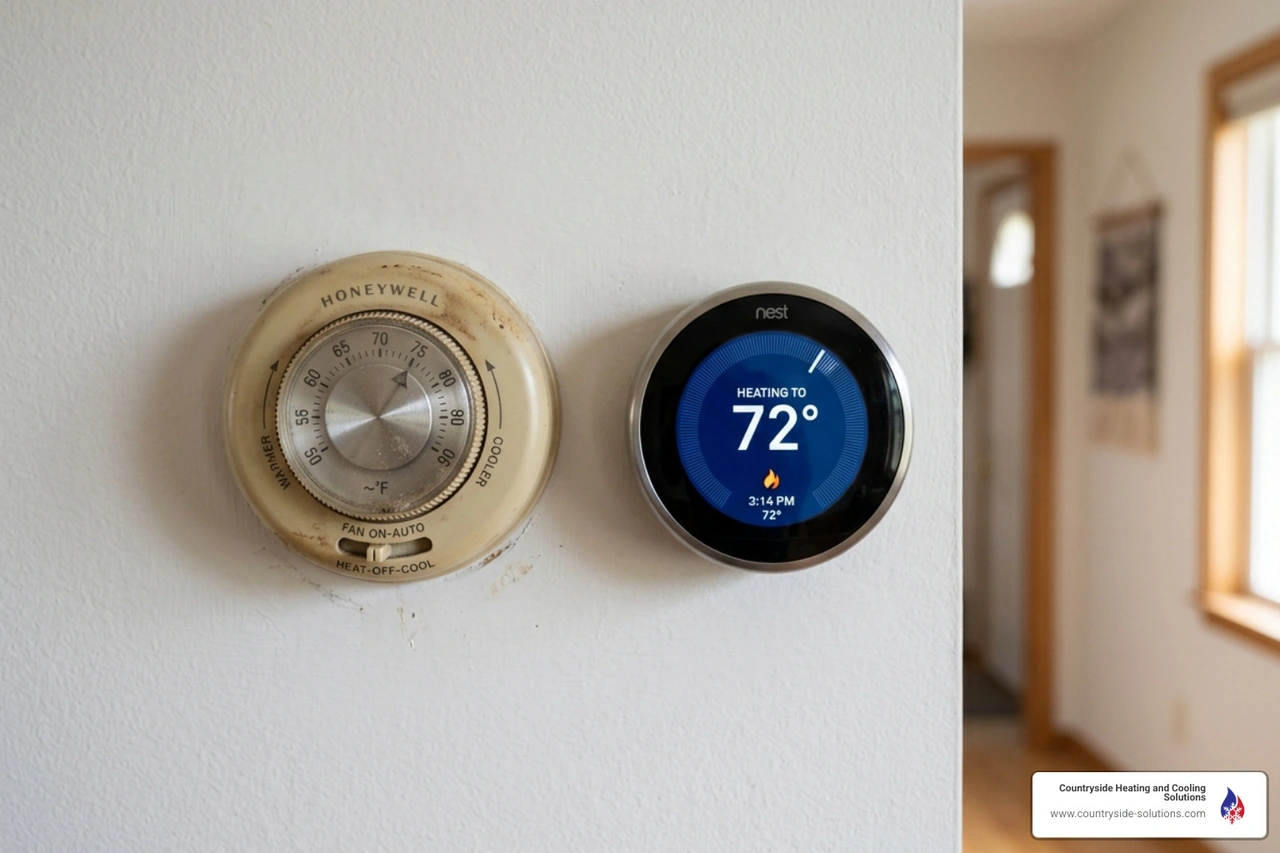
For decades, the thermostat was just a simple box on the wall with a slider or a dial. You turned it up when you were cold and down when you were hot. While traditional thermostats are reliable, they are entirely reactive. They don't know if you've left for work, they don't know if a heatwave is coming, and they certainly don't know if your furnace is about to fail.
The transition to smart technology represents a shift from mechanical control to intelligent home management. A smart thermostat is Wi-Fi enabled, allowing it to communicate with your smartphone, local weather stations, and even other devices in your home. This connectivity eliminates the "human error" factor that leads to massive energy waste.
When you are dialing new AC thermostat right, the goal is precision. Traditional thermostats often have a "swing" or variance that can lead to overshooting your target temperature, causing your system to run longer than necessary. Smart models use advanced sensors and algorithms to maintain a much tighter temperature range, ensuring you stay comfortable without burning extra fuel or electricity.
The Failure of Programmable Models
You might think, "I already have a programmable thermostat, so I'm covered." Unfortunately, the data suggests otherwise. While programmable units were a great invention, they are notoriously difficult to use. Many homeowners find the tiny buttons and "block-style" scheduling menus so frustrating that they simply leave the unit on "Hold" at a single temperature 24/7.
In fact, research indicates that 40% to 70% of homeowners with programmable thermostats never actually program them. This creates a "usability gap" where the potential for savings exists, but the reality is just a high energy bill. Smart thermostats bridge this gap by replacing clunky menus with intuitive smartphone apps and automation that doesn't require manual input to be effective.
Top Smart Thermostat Benefits for Homeowners in the Twin Cities
Living in places like Wayzata, Minnetonka, or Eden Prairie means preparing for extreme temperature swings. We go from sub-zero January nights to humid July afternoons. In this climate, the smart thermostat benefits for homeowners become even more significant because our HVAC systems are under constant demand.
The most immediate benefit is financial. On average, ENERGY STAR certified smart thermostats save users about 8% on their total utility bills. When you look specifically at heating and cooling—which, as we mentioned, is the lion's share of your bill—the savings can jump to 12% for heating and 15% for cooling. For a household spending $2,300 a year on energy, that is a substantial amount of money back in your pocket.
Beyond the money, there is the sheer factor of personalized comfort. Finding the ideal temperature setting for thermostat in summer can be a balancing act between staying cool and saving money. A smart thermostat can manage this balance for you, gradually adjusting the temperature so you never walk into a sweltering house.
If you've ever wondered what temperature should you set your air conditioner at in the summer, a smart thermostat can help you find your "sweet spot" by tracking your manual adjustments and suggesting more efficient settings that don't sacrifice your comfort.
Maximizing Smart Thermostat Benefits for Homeowners Through Learning Algorithms
Some of the most popular smart thermostats on the market today don't even require you to set a schedule. They use "learning algorithms" to watch your behavior. If you consistently turn the heat down to 64 degrees at 10:00 PM, the device learns that pattern. After a week or two, it begins doing it for you.
By automatically implementing temperature setbacks—adjusting the temperature by 7° to 10° F for eight hours a day—you can save up to 10% a year on heating and cooling. The "learning" feature ensures these setbacks happen when you're asleep or at work, so you never actually feel the temperature change; you only see the results on your bill.
Environmental and Maintenance Smart Thermostat Benefits for Homeowners
We all want to do our part for the planet. By reducing unnecessary HVAC runtime, smart thermostats directly lower your home's carbon footprint. If every home in the U.S. used a certified smart thermostat, the greenhouse gas savings would be equivalent to taking millions of cars off the road.
There is also a "health and safety" aspect to these devices. Following a proper HVAC maintenance frequency guide Minnesota is essential for system longevity. Smart thermostats act as a first line of defense by:
- Sending filter change alerts: Based on actual runtime, not just a calendar date.
- Predictive diagnostics: Some models can sense if your furnace is taking too long to reach a target temperature, which could indicate a failing component.
- Power outage recovery: They save your settings in permanent memory, so your home stays protected even after a Twin Cities summer storm knocks out the power.
Advanced Features: How Automation Drives Efficiency
The real "magic" of a smart thermostat lies in the features that go beyond simple temperature control. These tools allow the device to understand the context of your life.
| Feature | Manual Thermostat | Programmable Thermostat | Smart Thermostat |
|---|---|---|---|
| Remote Access | No | No | Yes (via App) |
| Auto-Learning | No | No | Yes |
| Geofencing | No | No | Yes |
| Energy Reports | No | No | Yes |
| Weather Sync | No | No | Yes |
| Voice Control | No | No | Yes |
Geofencing uses the GPS in your smartphone to create a virtual perimeter around your home. When the last person leaves the "fence," the thermostat automatically enters "Away" mode to save energy. As you cross the perimeter on your way back from work in Minneapolis or St. Paul, the thermostat kicks back into "Home" mode so the house is the perfect temperature the moment you walk through the door.
Occupancy sensors are another game-changer. If you have a room that is always too hot or too cold—like a home office or a nursery—you can place a remote sensor there. The thermostat will then prioritize the temperature in that specific room rather than just the hallway where the main unit is located.
Furthermore, these devices can help you take advantage of federal tax credits for heat pump upgrades. When paired with high-efficiency equipment, a smart thermostat ensures you are getting every bit of performance out of your investment.
Smart Home Ecosystem Integration
In 2026, the modern home is more connected than ever. Smart thermostats integrate seamlessly with voice assistants like Amazon Alexa, Google Assistant, and Apple HomeKit. You can simply say, "Alexa, set the temperature to 72 degrees," without getting off the couch.
Some advanced setups even connect your thermostat to smart blinds. During a hot July afternoon in Chanhassen, your thermostat can tell your blinds to close to block out solar heat gain, reducing the load on your air conditioner. It's a holistic approach to energy management that was impossible just a decade ago.
Installation and HVAC Compatibility Essentials
Before you run out and buy the latest model, there are a few technical details to consider. Most smart thermostats require a C-wire (Common Wire). This wire provides a continuous stream of 24V power to the thermostat to keep the Wi-Fi connected and the touchscreen lit up. Older homes in areas like Hopkins or Orono might not have this wire.
If you are unsure how often should you service your HVAC in Minnesota, an installation appointment is the perfect time to find out. A professional can check your wiring, install a C-wire adapter if needed, and ensure your Wi-Fi signal is strong enough at the thermostat's location.
Professional vs. DIY Setup
While many smart thermostats are marketed as DIY-friendly, professional installation by a NATE-certified technician offers several advantages:
- System Calibration: We ensure the thermostat's sensors are accurately reading the room's temperature.
- Warranty Protection: Some manufacturers offer extended warranties if the device is professionally installed.
- Complex Systems: If you have a multi-stage system, a heat pump, or a zoned HVAC system (where different floors have different controls), professional setup is essential to prevent damage to your equipment.
- Voltage Verification: We make sure your system isn't a high-voltage line voltage system (common in some older baseboard heaters), which can fry a standard smart thermostat.
Frequently Asked Questions about Smart Thermostats
Is a smart thermostat worth the investment for my home?
Absolutely. While the upfront cost is higher than a basic model, the ROI is one of the fastest of any home upgrade. Between the 8–15% energy savings and the frequent utility rebates offered by local providers in the Twin Cities, most units pay for themselves in 12 to 24 months. Plus, many models are ENERGY STAR certified, meaning they've been field-tested to prove they actually deliver the savings they promise.
Will a smart thermostat work with my older furnace or AC?
In the vast majority of cases, yes. Most smart thermostats are designed to work with 24V "forced air" systems installed after 1975. However, they are generally not compatible with electric baseboard heat, proprietary communicating systems, or some very old boilers without a special adapter. If you live in an older home in Excelsior or Long Lake, it’s best to have a technician verify compatibility first.
Can a smart thermostat increase my home's resale value?
Yes. Modern buyers are looking for "turn-key" homes with smart features. A smart thermostat signals that the home has been well-maintained and is energy-efficient. It’s a low-cost upgrade that makes your property stand out in a competitive market like Maple Grove or Eden Prairie.
Conclusion
Upgrading to a smart thermostat is one of the easiest ways to improve your home's comfort while simultaneously lowering your monthly expenses. Whether you're looking for the convenience of remote control, the "set it and forget it" ease of learning algorithms, or the peace of mind that comes with maintenance alerts, the smart thermostat benefits for homeowners are undeniable.
At Countryside Heating & Cooling Solutions, we’ve been helping our neighbors in Maple Plain and across the Twin Cities stay comfortable since 1974. Our NATE-certified technicians have the expertise to ensure your new smart thermostat is perfectly integrated with your existing HVAC system for maximum efficiency.
Don't let a "dumb" thermostat waste your hard-earned money. Experience the difference that modern technology and professional service can make.
Ready to upgrade your home's intelligence? Schedule your professional smart thermostat installation with Countryside Heating & Cooling Solutions today!
