.webp)

The High Cost of a 'Money-Saving' Habit
You might be tempted to shut the registers in an empty guest bedroom to save a little money, completely unaware of the reality behind closing vents in unused rooms: why this common practice destroys HVAC efficiency. It seems like a logical, straightforward way to cut down on utility bills. If nobody is using the basement or the spare room, why pay to cool it? Homeowners across the country try this strategy every year, shutting off airflow to specific zones in hopes of forcing that cold air into the master bedroom or living room instead.
Here is the thing: your home comfort equipment does not operate like a light switch. You cannot simply turn off a room and expect the main unit to scale back its energy consumption. Instead, this habit causes unseen, cumulative damage to your equipment. The strain becomes especially severe during demanding periods like August end-of-season cooling, when your unit has already been running hard for months and the outdoor humidity remains high.
The hidden danger: Blocking airflow forces your equipment to work significantly harder to move the exact same amount of air. Modern forced-air systems are carefully calibrated to breathe in and breathe out a specific volume of air. When you block the exhalation, the entire system chokes. In our years serving Maple Plain and the surrounding communities, our team at Countryside Heating & Cooling Solutions has seen firsthand how this 'money-saving' trick leads to preventable equipment failure. We want you to understand exactly how your system breathes, so you can avoid unnecessary repair bills.
Opening all of your registers is the absolute best way to protect your blower motor and prevent your evaporator coil from turning into a block of ice. If you want to maximize the lifespan of your air conditioning systems, the first step is walking through your home and ensuring every single vent is fully open and unobstructed by furniture or rugs.
Why Closing Registers Doesn't Actually Save Energy
The belief that closing a vent saves energy is rooted in a fundamental misunderstanding of how central heating and cooling works. When you flip off a light switch in a spare room, you break the electrical circuit. The light bulb stops drawing power, and your electric meter slows down. Because we interact with electricity this way every day, it is easy to assume that closing a floor register tells your central air conditioner to stop producing cold air for that specific square footage.
The short answer is that your system simply does not work that way. Your central air unit continues generating the exact same volume of conditioned air regardless of how many vents are open or closed. The blower motor is rated to push a specific amount of cubic feet per minute (CFM) through your ductwork. If you close off twenty percent of your home's vents, the blower does not power down by twenty percent. Instead, it tries to shove 100 percent of the air through 80 percent of the openings.
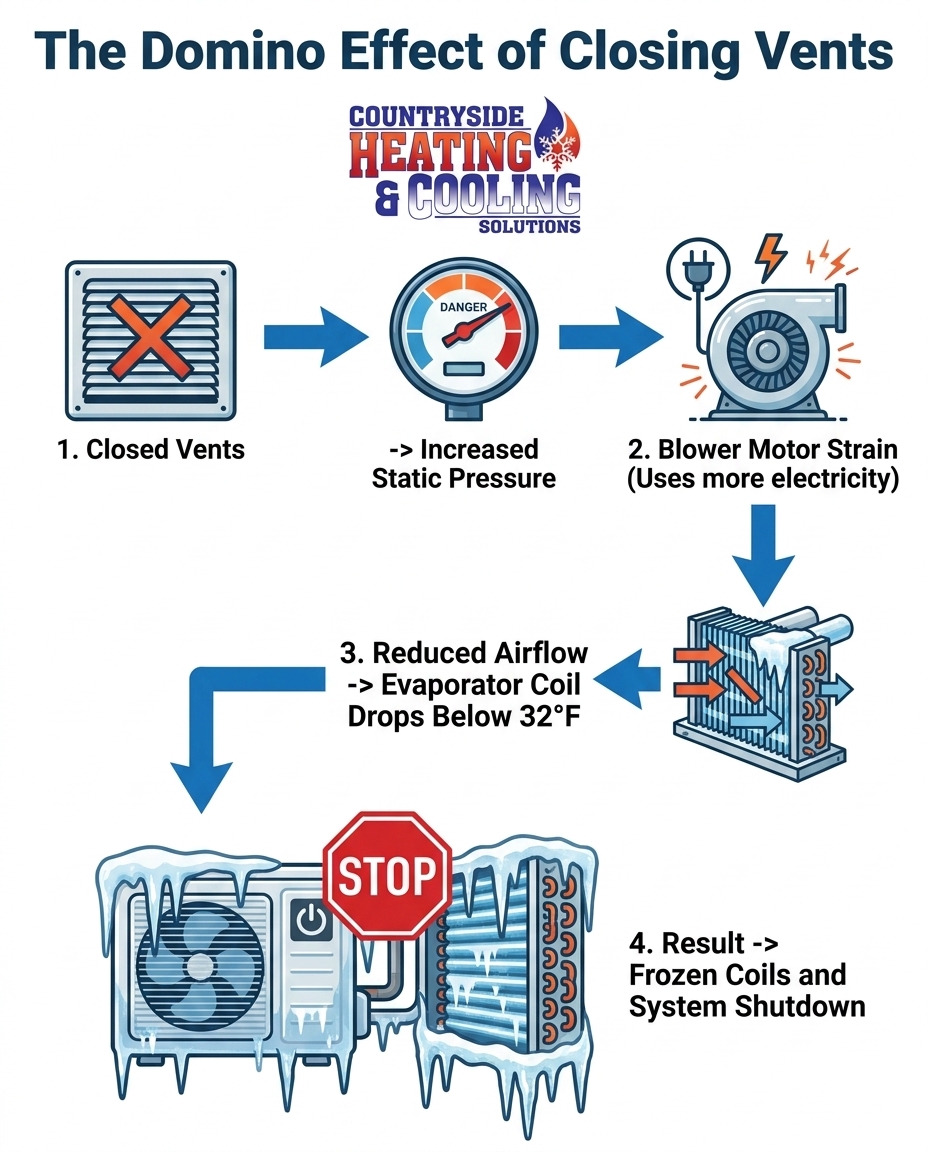
This diverted air simply increases static pressure inside the ductwork. The system has to push harder against this resistance, which forces the blower motor to draw more electricity, entirely defeating your goal of saving money on your utility bill.
The Light Switch Fallacy
HVAC systems operate as a closed, whole-house loop. They rely on a delicately balanced relationship between the supply vents (which blow conditioned air out) and the return vents (which pull stale air back in).
• The DIY method: Closing vents manually disrupts this loop. The air backs up in the supply ducts, the blower motor strains against the pressure, and the return ducts starve for air.
• True mechanical zoning: If you actually want to control temperatures room-by-room, you need a professional zoning system. This involves mechanical dampers installed directly inside the ductwork, paired with variable-speed equipment and multiple thermostats that safely regulate airflow without causing damage.
• Closing a guest room vent — What You Think Happens: Saves energy by not cooling an empty room. — What Actually Happens: Increases static pressure, forcing the motor to draw more power.
• Shutting basement registers — What You Think Happens: Forces more cold air upstairs to the bedrooms. — What Actually Happens: Creates duct leaks as pressurized air escapes through seams.
• Blocking vents with furniture — What You Think Happens: Hides ugly grilles without affecting the system. — What Actually Happens: Chokes the system's airflow, leading to frozen evaporator coils.
The Physics of Forced Air: Understanding Increased Static Pressure
To truly understand why closing vents is so destructive, we need to look at the physics of forced air. The core concept here is static pressure. In non-technical terms, static pressure is the resistance to airflow within your duct system. It is the friction and pushback that your blower motor has to overcome to circulate air throughout your house.
Modern forced-air systems are specifically designed and balanced for a target static pressure, typically around 0.5 inches of water column. Engineers size the ductwork, select the blower motor, and design the vents to maintain this exact balance.
The garden hose analogy: Think about a garden hose running at full blast. The water flows out smoothly. Now, put your thumb halfway over the opening. You have not reduced the amount of water coming from the spigot, but you have drastically raised the internal pressure inside the hose. The water sprays out aggressively, and the hose itself bulges and becomes rigid. Closing vents does the exact same thing to your ductwork. You are putting a thumb over the end of the hose, creating dangerously increased static pressure.
This increased static pressure forces the blower motor to work against heavy resistance. If you suspect your system is already struggling with poor airflow or strange noises, it is always best to schedule HVAC service so a professional can measure your static pressure and correct the balance.
How Blower Motors React to Restriction
Different types of blower motors handle this intense pressure in different, but equally damaging, ways.
• Standard PSC Motors: Older, single-stage motors will simply try to push through the blockage. They will overheat, wear out their bearings prematurely, and eventually burn out entirely, leading to an expensive replacement.
• ECM Variable-Speed Motors: Modern, high-efficiency motors are designed to maintain a specific airflow. If they sense resistance from closed vents, they will automatically ramp up their RPMs to overcome the restriction. This means your "energy-saving" trick actually causes your high-efficiency motor to consume massive amounts of electricity.
Frozen Coils: The Late-Summer Nightmare
The most immediate and dramatic consequence of restricted airflow is a frozen evaporator coil. This problem frequently rears its head during the most demanding cooling months. The heat exchange process relies on a delicate temperature balance. Your indoor coil, which sits above your furnace or air handler, gets extremely cold as refrigerant pumps through it. It absolutely needs a constant, heavy flow of warm house air blowing over it to prevent the refrigerant from dropping below freezing.
When you choke off airflow by closing vents, there is not enough warm air passing over that coil. The evaporator coil temperature drops rapidly below 32 degrees Fahrenheit. The natural condensation that forms on the coil during the cooling process instantly turns to ice. This creates a rapid domino effect: the ice layer further blocks airflow, causing more ice to form, until the entire coil is encased in a solid block of ice.
This risk peaks heavily during August end-of-season cooling. Systems have accumulated wear, air filters might be slightly dirty, and units are running constantly. With Maple Plain's humid late summers, the high moisture content in the air accelerates this process, quickly turning that humidity into thick ice when airflow is restricted.
Just last August, during the busy back-to-school transition, our technicians responded to a Maple Plain family whose AC failed completely when their system froze solid overnight. Because they reached out to our Countryside team immediately, we arrived the same day to safely thaw the unit and identify restricted airflow from closed guest-room vents as the culprit before permanent compressor damage occurred.
Signs Your AC Coil is Freezing
Catching a frozen coil early can save your compressor from catastrophic failure. If you notice any of these symptoms, turn your thermostat off immediately and leave the fan set to "on" to help thaw the ice.
• Reduced airflow: The air coming from your open vents feels weak or barely noticeable.
• Warm air blowing: The system is running, but the air coming out is warm or room-temperature instead of crisp and cold.
• Visible ice: You can see frost or thick ice on the copper refrigerant lines outside by your condenser unit.
• Water pooling: As the ice slowly melts during off-cycles, it can overwhelm your drain pan, causing water to pool around the base of your indoor unit.
If you are dealing with system freezing, it is also important to understand the running your AC in cooler temperatures, as low outdoor temperatures can also cause pressure drops that lead to ice formation.
Collateral Damage: Duct Leaks and Poor Indoor Air
Beyond the immediate threat of a frozen coil or a burned-out motor, high static pressure quietly destroys your home's ductwork. Pressurized air acts like water; it will always seek the path of least resistance. When you close vents and spike the internal pressure, that conditioned air has to go somewhere.
Excessive pressure forces air out through tiny gaps, joints, and seams in your ductwork. Instead of cooling your living room, you end up pushing perfectly conditioned, expensive air straight into your attic, basement, or crawlspace. Over time, the pressure can actually blow duct seams apart, turning minor leaks into massive energy losses.
The reverse effect on air quality: The supply and return sides of your system must remain balanced. If the supply side is highly pressurized and leaking air into the attic, the return side becomes starved for air. It creates a vacuum effect. To compensate, the return ducts will start pulling in unconditioned air through tiny gaps in the walls, floorboards, or unsealed return plenums.
This means your system actively sucks dusty, humid, and dirty air from wall cavities and crawlspaces directly into your home. This cycle drastically degrades your indoor air quality, introduces allergens, and forces the system to run much longer cycles to compensate for the lost conditioned air. Maintaining proper airflow by keeping vents open is just as much about breathing clean air as it is about saving energy.
Looking Ahead: Winter Consequences for Heating Systems
The dangers of increased static pressure do not magically disappear when the leaves change color. This myth is dangerous year-round, and closing vents can cause even more severe damage to your heating equipment during the colder months.
Your air conditioner and your furnace share the exact same blower motor and the exact same ductwork. When winter arrives, the furnace heat exchanger takes on the critical job of warming the air. The heat exchanger gets incredibly hot, and it relies on a massive, steady flow of cold return air to absorb that heat and carry it into your living spaces.
If restricted airflow prevents the heat exchanger from dissipating heat quickly enough, the furnace will rapidly overheat. To prevent a fire, the furnace's internal high-limit switch will trip, shutting down the burners while leaving the fan running to cool the metal down. This leads to "short-cycling," where the furnace turns on and off every few minutes without ever properly heating the house.
Here in Maple Plain, our team knows firsthand how extreme Minnesota's seasonal shifts can be: your ductwork must handle both high-demand AC in humid late summers and heavy furnace loads during harsh sub-zero winters. Proper airflow balance is critical year-round. Over time, the constant overheating and rapid cooling stresses the metal of the heat exchanger. Eventually, the metal will crack. A cracked heat exchanger is a catastrophic failure that can leak deadly carbon monoxide into your home, almost always requiring a total system replacement. Protecting your heating systems starts right now by ensuring every register is open and unobstructed.
Better Alternatives for Managing Home Comfort
We understand the frustration of having a home with uneven temperatures. A freezing basement or a stuffy upstairs bedroom is uncomfortable, but choking your HVAC system is not the right way to fix it. If you want to balance temperatures and save money without destroying your equipment, there are much safer, highly effective alternatives.
1. Keep all vents fully open: Walk through every room in your house. Ensure the louvers on the floor, wall, or ceiling registers are completely open. Make sure no heavy furniture, solid rugs, or heavy drapes are blocking the airflow.
2. Utilize the 'circulate' fan setting: Instead of leaving your thermostat fan set to "Auto," try setting it to "On" or "Circulate." This keeps the blower motor running at a low, energy-efficient speed even when the AC or furnace is not actively running. It constantly mixes the air in the house, evening out hot and cold spots between floors.
3. Upgrade to a smart thermostat with room sensors: Modern smart thermostats can pair with remote wireless sensors placed in your problem rooms. The system will average the temperature across the house or prioritize specific rooms at specific times of day, providing much better comfort control without restricting airflow.
4. Leave interior doors open: Your home likely has return vents in the main hallways, but not in every individual bedroom. If you keep bedroom doors tightly closed all day, the air gets trapped in those rooms, increasing pressure and preventing proper circulation. Leave doors cracked open to allow air to flow back to the return grilles.
5. Invest in professional maintenance: Regular tune-ups keep your blower motor clean and your coils free of dust, ensuring maximum airflow. When one of our Maple Plain customers reached out for routine maintenance to fix uneven cooling, one of our technicians, Nick, uncovered that closed vents were the root cause. After balancing their airflow and getting them on a regular maintenance schedule, their system has run flawlessly and kept them comfortable for years.
By relying on these safe methods, you protect your system from the strain of August end-of-season cooling while achieving the comfort you actually want.
Frequently Asked Questions About HVAC Airflow and Vents
Does closing vents in unused rooms save money?
No, closing vents increases pressure in the ductwork, forcing the blower motor to work harder and use more electricity. This extra strain negates any potential energy savings. In fact, it often leads to higher utility bills due to duct leakage and longer run cycles.
Why did my AC coil freeze?
AC coils typically freeze due to restricted airflow, such as closed vents, blocked return grilles, or dirty air filters. When there is not enough warm air blowing over the indoor coil, the coil temperature drops below freezing, turning natural condensation into solid ice. Low refrigerant levels can also cause this, but airflow is the most common culprit.
What happens when you close HVAC vents?
Closing vents disrupts the balanced airflow your system relies on, which immediately increases static pressure. This causes blower motors to overheat and strain. Over time, this practice can lead to frozen AC coils in the summer, cracked furnace heat exchangers in the winter, and significant duct leaks.
Is it bad to close air vents in an empty room?
Yes, it forces the system to push against heavy resistance. Your HVAC equipment generates the same amount of air regardless of how many rooms are "open." It is always recommended to keep all vents open to maintain proper system balance and prevent premature equipment damage.
How many vents can I safely close?
Ideally, you should close none of them. If absolutely necessary for comfort in a specific spot, you should never close more than 10 percent of the vents in your home. However, keeping every single register fully open is the safest, most efficient approach for the health of your equipment.
Protect Your Equipment and Restore Proper Airflow
The takeaway is simple: keeping your vents open is the absolute easiest, zero-cost way to prevent unnecessary breakdowns. By allowing your HVAC system to breathe exactly as the engineers designed it to, you protect the blower motor, preserve your ductwork, and ensure your evaporator coil remains frost-free.
Restoring airflow is especially critical to protect the system during heavy, late-season usage like August end-of-season cooling, when your equipment is already tired and vulnerable to strain. If you have opened all your vents, replaced your air filter, and your home is still struggling to cool evenly, it is time to bring in a professional. Do not ignore the symptoms of an unbalanced system. Reach out today to schedule HVAC service and let our experts ensure your home remains comfortable, efficient, and safe all year long.
