.webp)

Is Upgrading Your AC Worth It for a Short Cooling Season?
When you are deciding between the Bryant Evolution vs. Preferred Series: Which AC Makes Sense for Minnesota Summers?, the first question you probably ask yourself is why you should invest heavily in advanced technology when the equipment sits idle for over half the year. It is a valid concern for anyone living in the upper Midwest. You rely heavily on your furnace through the long winters, but your air conditioner only gets a concentrated workout for a few months. However, the rapid shift from mild early summer breezes to intense, heavy late-summer mugginess creates a unique challenge for your home's climate control system.
In places like Maple Plain, MN, those late-season heatwaves demand much more than just basic cooling power. You need a system that can strip thick humidity out of the indoor air without turning your living room into an icebox. This brings most homeowners to a decision point between two excellent contenders: the premium, communicating Bryant Evolution system and the highly reliable, mid-range Bryant Preferred workhorse. Choosing the right one requires balancing upfront value with the critical need for advanced moisture control.
Explore your options: Learn more about our Air Conditioning Services or dive into our detailed Air Conditioner Comparison.
The Minnesota Cooling Challenge: Why Dehumidification Matters More Than Raw Power
To understand why the tier of your air conditioner matters, you have to look closely at the specific weather patterns that drive you indoors. During late-summer August, dew points frequently climb into the 70s across the region. When the dew point is that high, the air feels heavy, sticky, and oppressive. At this stage, lowering the temperature on your thermostat is only half the battle; indoor humidity extraction becomes your primary comfort issue.
Many homeowners assume that a bigger, more powerful air conditioner is the best way to fight this heat. In reality, raw power often creates more problems than it solves. Here is how the typical cooling cycle breaks down when humidity is your main opponent:
1. The Short-Cycling Trap: If your AC is oversized or relies on a basic single-stage compressor, it blasts your home with maximum cold air the moment it turns on. It reaches your target temperature very quickly—often in just ten or fifteen minutes—and then shuts off.
2. The Cold but Clammy Effect: Because the system ran for such a short burst, the evaporator coil did not have enough time to extract moisture from the circulating air. Your thermostat reads a cool 70 degrees, but your skin feels clammy, and the air still feels thick.
3. The Long, Slow Cooling Solution: Effective dehumidification requires time. Air needs to pass slowly and consistently over a cold evaporator coil so the moisture can condense and drain away. Longer, slower cooling cycles are the absolute key to pulling humidity out of your home.
4. The Back-to-School Push: Right as the back-to-school transition hits in late August and early September, the weather often delivers its stickiest days. A system designed to manage moisture keeps you comfortable through this final, intense cooling push without constantly kicking on and off.
This specific moisture-removal challenge is exactly what Bryant's tiered systems are engineered to address. By moving away from single-speed blasts of cold air, both the Preferred and Evolution lines offer better ways to manage the heavy summer air.
Bryant Preferred Series: The Reliable Two-Stage Workhorse
If you are upgrading from an older, single-stage air conditioner, the Bryant Preferred series represents a massive leap forward in both comfort and efficiency. The defining feature of this line is its two-stage scroll compressor technology. Instead of operating with just one speed (100% capacity), a two-stage system can run on a lower stage for mild days and automatically kick into a high stage for extreme heat.
Most of the time, the Preferred series will operate on its low stage, using about 65% to 70% of its total capacity. This lower speed means the system runs longer cycles, which directly translates to better moisture removal and significantly higher energy efficiency than a standard unit. When comparing the Bryant Evolution and Preferred Series, the Preferred line stands out as a highly dependable workhorse that delivers excellent comfort without the ultra-premium price tag.
With efficiency ratings reaching up to 17-18 SEER2, these units provide a strong balance of performance and long-term value. They use less electricity than older models, run more quietly, and keep temperatures far more consistent throughout the house. For a closer look at the manufacturer's lineup, you can explore our Bryant HVAC Systems.
Ideal Scenarios for the Preferred Series
The Preferred series is an exceptional fit for many homes, but it shines brightest under specific conditions. You should strongly consider this line if your situation matches these scenarios:
• Standard ductwork configurations: Homes that have straightforward airflow requirements and do not need complex, multi-zone temperature controls.
• Replacing builder-grade equipment: Homeowners looking for a significant, noticeable upgrade over loud, inefficient 15-year-old units.
• Value-focused cooling: Budgets focused on maximizing cooling reliability and efficiency over the span of a concentrated 3-4 month active season.
Bryant Evolution Series: Ultimate Humidity Control & Variable-Speed Comfort
For those who refuse to compromise on indoor comfort, the Bryant Evolution series represents the pinnacle of modern cooling technology. The core difference here is the true variable-speed rotary compressor. While the Preferred series has two distinct speeds, the Evolution system can adjust its output in tiny increments, running at anywhere from 100% down to just 25% capacity.
This ability to run continuously at a very low capacity is the ultimate defense against sticky, high-humidity days. The system rarely shuts off completely; instead, it gently and continuously circulates air over the chilled coils, wringing out moisture all day long while maintaining your exact target temperature. The result is a home that feels crisp and dry, even when the outdoor humidity is stifling.
Furthermore, the Evolution series features top-tier efficiency, capable of achieving up to 24 SEER2. Because it operates at such low speeds most of the time, the sound decibel levels are remarkably low. You often cannot even hear the unit running from a few feet away, which is a stark contrast to the loud clanking and roaring of traditional systems.
The Communicating Technology Advantage
What truly sets the Bryant Evolution and Preferred Series apart is how the Evolution system thinks. The Evolution line utilizes communicating HVAC technology, known as Evolution Connex. In a standard setup, your thermostat just tells the AC to turn on or off. In a communicating system, the thermostat and the equipment constantly share detailed data.
• Beyond simple temperature reading: The system monitors outdoor temperatures, indoor humidity levels, and historical run times to calculate exactly how hard it needs to work.
• Real-time adjustments: It automatically adjusts airflow and compressor speed based on real-time indoor humidity levels, ensuring optimal moisture removal before the room ever feels uncomfortable.
Because this technology relies on constant data exchange, resolving any communication errors quickly is important. If you ever encounter a disruption, knowing about Bryant Thermostat Error Codes can help you understand what your system is telling you.
Head-to-Head Comparison: Evolution vs. Preferred Specs
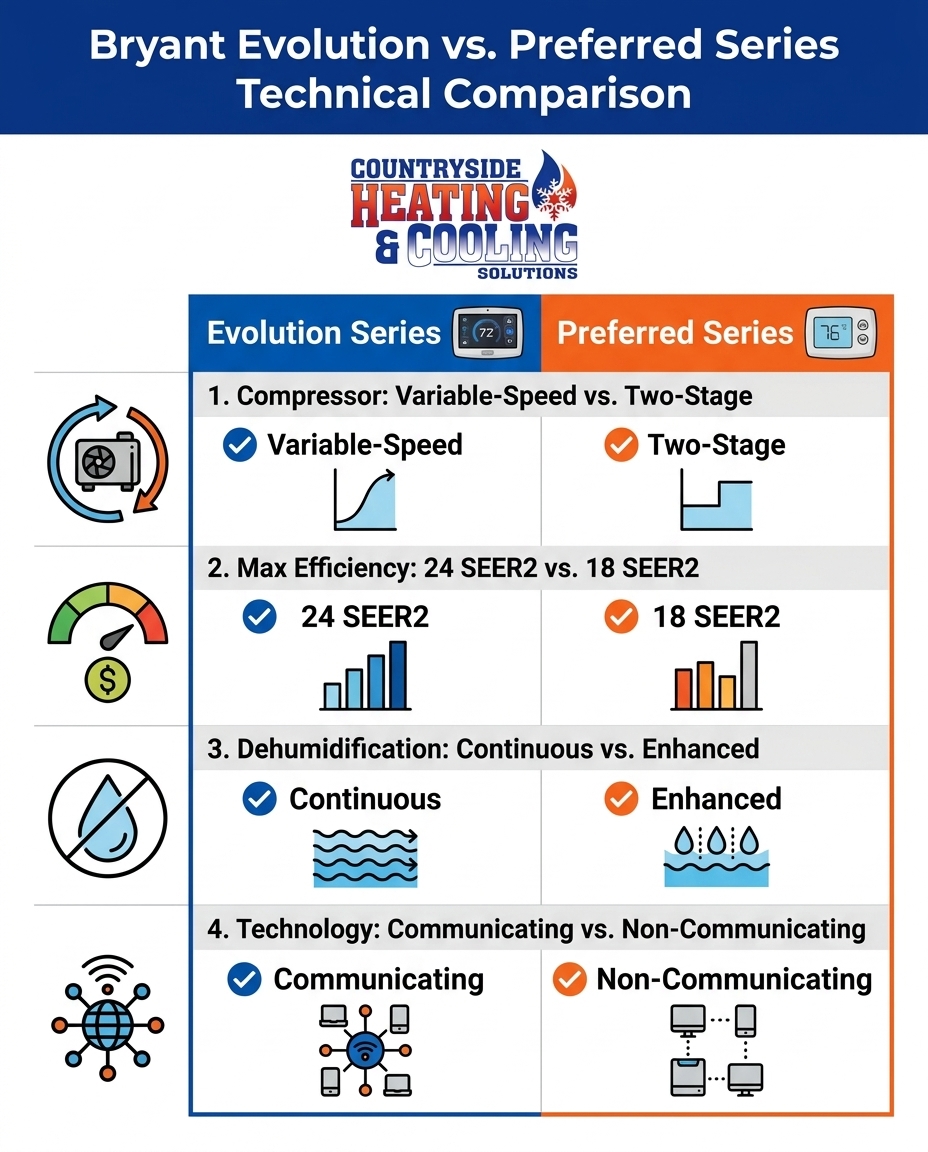
To make the decision clearer, it helps to look at the technical specifications side by side. While both lines carry Bryant's reputation for durability, their internal mechanics serve different levels of comfort demand. Here is how the Bryant Evolution and Preferred Series stack up against each other:
• Compressor Type — Bryant Evolution Series: Variable-speed rotary (adjusts in tiny increments) — Bryant Preferred Series: Two-stage scroll (high and low speeds)
• Dehumidification — Bryant Evolution Series: Maximum / Continuous moisture removal — Bryant Preferred Series: Enhanced / High moisture removal
• Efficiency Rating — Bryant Evolution Series: Up to 24 SEER2 — Bryant Preferred Series: Up to 17-18 SEER2
• Technology Platform — Bryant Evolution Series: Communicating (Evolution Connex data sharing) — Bryant Preferred Series: Non-communicating (Standard thermostat operation)
• Sound Levels — Bryant Evolution Series: Ultra-quiet continuous operation — Bryant Preferred Series: Standard quiet operation
As the table illustrates, the jump from Preferred to Evolution is largely a jump from excellent mechanical cooling to intelligent, data-driven climate control.
ROI in a Short Cooling Season: Is the Upgrade Worth It?
Evaluating the return on investment for an air conditioner in the upper Midwest requires a different mindset than evaluating one in the deep South. Because the equipment sits idle for over half the year, the decision must factor in the specific intensity of the active months. If you only look at pure energy savings, a 24 SEER2 system will certainly use less electricity than an 18 SEER2 system over a concentrated late May to September usage window, but the utility savings alone might take longer to offset the initial purchase price.
This is why you should shift the ROI conversation from pure energy savings to "comfort ROI." What is the value of sleeping comfortably through muggy late-summer August nights without waking up sweating? What is the value of a system that runs so quietly it never interrupts your family dinners on the patio? For many homeowners, the dramatic increase in daily comfort justifies the premium tier.
Additionally, qualifying high-efficiency Bryant systems may be eligible for general federal tax credits or local utility rebates, which can help offset the initial investment. (Always verify current programs with your utility provider or a tax professional, as guidelines frequently update). If you are considering an upgrade, exploring HVAC Financing Options can also make managing the upfront cost of premium technology much easier.
Finally, remember that proper sizing and installation matter just as much as the equipment tier. A perfectly installed Preferred system will always outperform a poorly installed Evolution system. The ductwork must be capable of handling the airflow, and the unit must be sized precisely to your home's square footage, insulation levels, and sun exposure.
Making the Right Choice for Your Home
Choosing between these two exceptional systems ultimately comes down to your personal priorities. If you want reliable, high-value cooling that represents a massive upgrade over older technology, the Preferred series is an outstanding choice. If humidity control, ultra-quiet operation, and precise, variable-speed comfort are your top priorities, the Evolution series is unparalleled.
As a local expert, Countryside Heating & Cooling Solutions focuses on matching system capabilities to actual weather patterns, prioritizing your real-world comfort over blind upselling. We know that every home in Maple Plain, MN handles heat differently. A two-story home with vaulted ceilings and huge west-facing windows has very different cooling needs than a heavily shaded ranch.
A typical pattern we see is that replacing a major system can feel daunting. One Maple Plain homeowner reached out to us during a summer heatwave when their AC failed completely. The replacement process felt overwhelming for a single homeowner trying to navigate the options alone. However, our technicians took the time to explain the differences between the equipment tiers, outlined exactly how the installation would proceed, and ensured the customer understood everything before moving forward. The new equipment was installed promptly, and the homeowner was thrilled with both the clear explanation and the thorough follow-up.
That is the level of care you should expect. Your technician should evaluate your specific ductwork, check your insulation, and help you make a confident, informed decision.
Frequently Asked Questions About Bryant AC Systems
What is the difference between Bryant Evolution and Preferred?
The short answer is that the Evolution series uses variable-speed, communicating technology, while the Preferred series relies on two-stage, non-communicating technology. The Evolution can adjust its cooling output in tiny increments down to 25% capacity, offering maximum humidity control. The Preferred series switches between a high and low speed, providing excellent reliability and value for homeowners who do not need ultra-premium features.
Does variable speed AC matter in Minnesota?
Yes, variable speed technology matters significantly during the intense humidity of late summer. While the cooling season is shorter, the dew points in August can make homes incredibly uncomfortable. A variable-speed system runs continuously at low power to extract that heavy moisture without overcooling the house, preventing the cold, clammy feeling common with standard units.
What is a communicating HVAC system?
A communicating HVAC system features components that constantly share digital data with each other to optimize performance. Instead of a thermostat simply sending an "on" or "off" signal, a communicating thermostat (like the Evolution Connex) monitors indoor humidity, outdoor temperatures, and system history to tell the compressor exactly what speed to run for perfect comfort.
How long do Bryant air conditioners last?
Most homeowners don't realize that with proper annual maintenance, a high-quality Bryant air conditioner typically lasts 15 to 20 years. The lifespan depends heavily on regular filter changes, keeping the outdoor coil clean, and ensuring the system is properly sized for the home. Regular professional tune-ups are the best way to maximize the life of the equipment.
Can I use my existing thermostat with a Bryant Evolution system?
If you want to unlock the full potential of the Evolution system, you must use the proprietary Bryant Evolution Connex control. Standard thermostats cannot process the digital communication required to manage the variable-speed compressor and advanced dehumidification features. Using a standard thermostat on an Evolution unit severely limits its capabilities.
Get Expert Guidance on Your Next AC Installation
Choosing the right air conditioner does not have to be overwhelming. Whether you lean toward the reliable efficiency of the Preferred series or the unmatched humidity control of the Evolution series, having a professional evaluate your home ensures you get exactly what you need. Do not wait until your current system fails completely on the hottest day of the year. If your AC is struggling to keep up with the muggy weather, now is the time to schedule a thorough assessment. We will walk you through your options, compare the systems tailored to your specific layout in Maple Plain, MN, and provide a clear path forward so you can enjoy a perfectly comfortable home.
