.webp)

The Truth About Heat Pumps in Below Zero Temperatures
Do heat pumps work in below zero temperatures? Yes — and the data backs it up. Modern cold-climate heat pumps are specifically engineered to keep homes warm even when outdoor temperatures plunge well below zero, making them a genuinely viable heating option for Minnesota winters.
Here is a quick answer to what homeowners most want to know:
| Temperature | Cold-Climate Heat Pump Performance |
|---|---|
| 47°F | Full rated capacity; COP of 3.5–4.2 |
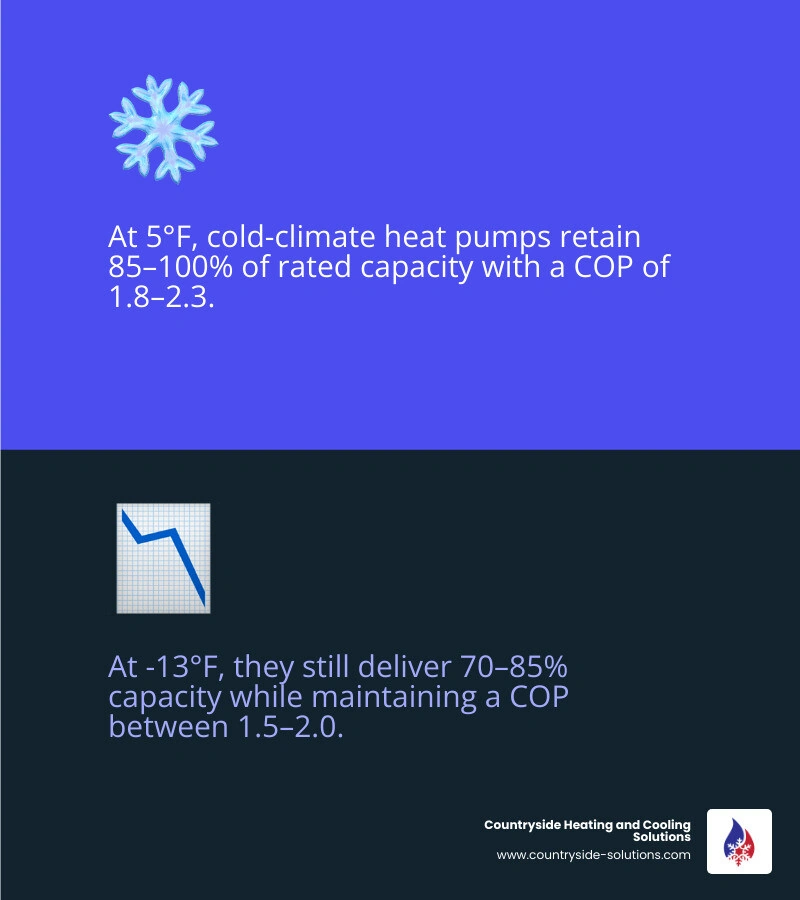
| 5°F | 85–100% of rated capacity; COP of 1.8–2.3 |
| -13°F | 70–85% of rated capacity; COP of 1.5–2.0 |
| -15°F | Meaningful heat output maintained |
| -25°F and below | Useful output confirmed in Alaska field testing |
If you have heard that heat pumps stop working once it gets cold enough, that concern made sense years ago — but it does not reflect what today's technology can do. Eight major manufacturers, including Bosch, Carrier, Daikin, and Trane, have successfully tested their cold-climate models at temperatures as low as -15°F. Field studies in Minnesota showed homeowners cutting heating energy use by 35% to 50%. And in places like Norway, Finland, and Sweden — countries that know a thing or two about brutal winters — heat pumps now heat roughly half of all homes.
For Minneapolis–Saint Paul homeowners wondering whether a heat pump can handle a real Minnesota winter, the answer is clear: with the right system, the right sizing, and the right installation, it can.
Do Heat Pumps Work in Below Zero Temperatures?
The short answer is yes. The better answer is yes, but only if we are talking about the right kind of equipment.
A standard older heat pump and a modern cold-climate heat pump are not the same thing. That distinction matters a lot in western Twin Cities communities like Maple Plain, Minnetonka, Wayzata, Orono, Medina, and surrounding areas where winter can get serious in a hurry.
Modern cold-climate systems are designed to keep producing heat in conditions that used to push older equipment past its comfort zone. Some are tested to keep operating at -15°F, and some field testing has shown useful output even lower than that. That does not mean every model performs equally well. It means homeowners need to look at verified low-temperature performance, not just marketing language.
If you are still in myth-busting mode, our guide to Learn the Facts About Heat Pumps is a good next read.
How Do Heat Pumps Work in Below Zero Temperatures to Keep Homes Warm?
Heat pumps do not create heat by burning fuel. They move heat from one place to another using refrigerant, coils, and a compressor.
That sounds suspicious when it is below zero outside. After all, if the air feels brutal, how can there still be heat in it?
Because "cold" air is not the same as "no" heat. Heat energy exists in outdoor air at any temperature above absolute zero. A heat pump uses refrigerant with a very low boiling point, allowing it to absorb available heat from outdoor air even when that air is far below freezing. The compressor then increases the temperature of that refrigerant, and the indoor coil releases the heat into your home.
Think of it like this: a heat pump is less of a furnace and more of a heat-moving machine. It is basically a very hardworking thermal delivery service.
A few reasons this works in sub-zero weather:
- Refrigerant can absorb heat at very low outdoor temperatures
- Variable-speed compressors adjust output as conditions change
- Inverter controls let the system ramp up or down instead of simply turning on and off
- Improved defrost controls help manage frost buildup on the outdoor coil
Research also points out a useful physics fact: even 0°F air still contains substantial heat energy. The system just has to be engineered well enough to collect it efficiently.
Debunking the Capacity Myth: Do Heat Pumps Work in Below Zero Temperatures Without Losing Output?
This is where many homeowners get tripped up. They hear "heat pumps lose efficiency in cold weather" and assume "therefore they cannot heat the house." Those are not the same thing.
Capacity is the amount of heat the unit can deliver. Load is how much heat your home loses. If the heat pump's available capacity matches or exceeds the home's heating load, the house stays comfortable.
That is why the real question is not "Do heat pumps work in below zero temperatures?" It is "Was the system selected and sized for this house and this climate?"
Modern cold-climate units hold their output much better than older or standard models:
- Many cold-climate systems maintain 85% to 100% of rated capacity at 5°F
- Many still hold 70% to 85% at -13°F
- Some continue delivering meaningful heat at -15°F and below
By contrast, standard heat pumps can see much steeper capacity drop-offs as temperatures fall.
This is the capacity myth in plain English: people assume all heat pumps lose too much output in extreme cold to be useful. In reality, properly selected cold-climate equipment can handle most or all heating needs for many homes, especially when paired with good insulation and air sealing.
And one more important note: bigger is not always better. Oversizing can reduce comfort and part-load performance. Proper load calculations matter. If you are wondering how indoor settings play into comfort and runtime, see What Temperature Should Heat Pump Be Set.
Cold-Climate Heat Pumps vs. Standard Heat Pumps
Cold-climate heat pumps are built differently from conventional systems. The improvements are not just minor tweaks. They are the reason modern systems can perform in Minnesota winters.
Key upgrades often include:
- Variable-speed inverter-driven compressors
- Enhanced vapor injection or similar low-ambient compression strategies
- Larger or better-optimized outdoor coils
- Smarter defrost controls
- Better cold-weather refrigerant management
Here is a simple comparison:
| Feature | Standard Heat Pump | Cold-Climate Heat Pump |
|---|---|---|
| Typical low-temp performance | Drops off quickly in deep cold | Built to maintain output in sub-zero weather |
| Capacity at 5°F | Often significantly reduced | Often 85-100% of rated capacity |
| Capacity at -13°F | May be limited | Often 70-85% of rated capacity |
| Compressor type | Single-stage or basic two-stage | Variable-speed inverter |
| Cold-weather technology | Basic | Advanced controls and low-ambient design |
| Best fit | Mild climates | Cold climates like the Twin Cities metro |
In plain terms, a cold-climate heat pump is designed for a Minnesota winter. A standard unit may not be.
This is one reason installation experience matters so much. A good contractor should be able to explain the unit's low-temperature capacity curve, not just its brochure headline.
Efficiency and Performance Metrics in Extreme Cold
When people ask whether heat pumps work below zero, they are often really asking a second question: "Will my electric bill explode?"
The best way to answer that is with COP, or coefficient of performance.
COP tells us how much heat a system delivers compared with the electricity it uses:
- COP of 1.0 = one unit of heat for one unit of electricity
- COP of 2.0 = two units of heat for one unit of electricity
- COP of 3.0 = three units of heat for one unit of electricity
Electric resistance heat, like baseboard heaters or electric strip heat, has a COP of exactly 1.0. A gas furnace is efficient in a different way, but it does not multiply electric input into several units of heat the way a heat pump can.
Modern cold-climate heat pumps often perform roughly like this:
- Around 47°F: COP of about 3.5 to 4.2
- Around 17°F: COP of about 2.2 to 2.8
- Around 5°F: COP of about 1.8 to 2.3
- Around -15°F: COP of about 1.3 to 1.8
So yes, efficiency drops as outdoor temperature falls. That is normal. The system has to work harder when the gap between indoor and outdoor conditions gets larger.
But here is the important part: a COP above 1.0 still means the heat pump is delivering more heat than the electricity it consumes. Even in severe cold, many modern systems remain more efficient than straight electric resistance heat. Field testing in Alaska even recorded COP around 2.0 at -25°C and 1.8 at -35°C, which is impressive cold-weather performance by any standard.
This also helps explain why modern heat pumps can cut heating energy use substantially in real homes. If you are exploring available incentives for upgrading equipment, read Federal Tax Credits for Heat Pump Upgrades.
Key Factors for Successful Sub-Zero Heat Pump Performance
A great heat pump can still underperform if the installation is poor. In our experience, success in cold weather depends on the whole system, not just the box outside.
The biggest factors are:
- Accurate load calculations
- Proper equipment sizing
- Home insulation and air sealing
- Duct system condition, if applicable
- Correct refrigerant charge and airflow setup
- Smart outdoor unit placement
- Installer experience with cold-climate applications
A home that leaks heat like a screen door on a submarine will challenge any heating system. That is why energy improvements and HVAC design should go hand in hand.
For homeowners planning an installation, these resources can help:
The Role of Backup and Auxiliary Heating
Backup heat is not a sign that a heat pump "failed." It is simply part of some system designs.
There are two common approaches:
- Electric auxiliary heat strips
- Dual-fuel systems that pair a heat pump with a furnace
A heat pump has a balance point, which is the outdoor temperature where its output matches the home's heat loss. Below that point, backup heat may be used to help maintain indoor comfort.
When is backup heat needed?
- During extreme cold snaps
- During defrost cycles
- If the system was intentionally designed with supplemental heat
- In homes with high heating loads or weaker insulation
- In dual-fuel setups where a furnace takes over below a chosen temperature
For many homes in our service area, backup heat is more about design strategy than daily necessity. A properly sized cold-climate heat pump may carry most of the winter load, while backup handles only the coldest stretches.
The practical takeaway is simple: backup heat should be planned, not improvised.
Selecting Certified Cold-Climate Systems
If you want a heat pump that is truly ready for Minnesota weather, do not rely on vague claims like "high efficiency" or "works in cold climates."
Instead, look for evidence such as:
- Inclusion on the NEEP cold-climate product list
- ENERGY STAR Cold Climate certification
- Verified capacity at 5°F and -13°F
- Strong HSPF2 ratings
- AHRI-rated low-ambient performance data
These details matter because certification standards help separate real cold-weather performers from equipment that only sounds tough in a sales sheet.
A few useful benchmarks from current research:
- ENERGY STAR Cold Climate systems must meet minimum low-temperature capacity and efficiency thresholds
- Verified cold-climate models are expected to retain at least 70% of 47°F capacity at 5°F
- Many strong performers do better than that and maintain 80% or more at 5°F
When reviewing quotes, ask for:
- The exact model number
- Rated heating capacity at 47°F, 17°F, 5°F, and if available -13°F
- HSPF2 rating
- Whether auxiliary heat is part of the design
- Whether the contractor performed a room-by-room load calculation
Frequently Asked Questions About Cold-Weather Heat Pumps
Do heat pumps work in places with extreme winters like Minnesota or Maine?
Yes. Real-world evidence is one of the strongest arguments in favor of modern cold-climate heat pumps.
The research shows:
- Minnesota field tests found heating energy reductions of 35% to 50%
- More than 115,000 heat pumps have been installed in Maine
- Efficiency Maine field data showed cold-climate models holding 80% to 100% of rated capacity at 5°F and 60% to 75% at -13°F
- Heat pumps heat roughly half the homes in Norway, Finland, and Sweden
Those are not mild-weather case studies. They are exactly the kind of places people bring up when they assume heat pumps cannot handle winter.
For homeowners in Minnetonka, Maple Grove, Chanhassen, Eden Prairie, Edina, Delano, Buffalo, and nearby communities, that is encouraging news: the technology is proven in cold regions when it is chosen and installed correctly.
If you want a local planning resource, visit our Heat Pump Installation Guide Minnetonka MN.
How do you maintain a heat pump during freezing winter months?
Winter maintenance is not complicated, but it does matter.
Here are the basics:
- Keep snow, drifting ice, and debris away from the outdoor unit
- Do not let the unit get buried after a storm
- Make sure there is room for airflow around the cabinet
- Check your filter regularly and replace it as needed
- Watch for unusual noises, short cycling, or weak airflow
- Schedule professional maintenance before peak winter demand
Homeowners are sometimes alarmed when they see steam or notice the system switch into defrost mode. Usually, that is normal. Defrost mode helps melt frost from the outdoor coil so the system can keep operating efficiently.
What should not happen is solid ice buildup that does not clear, blocked airflow, or chronic inability to maintain temperature. Those issues deserve professional attention.
For more winter care guidance, see:
What happens to a heat pump's efficiency when temperatures drop below zero?
Efficiency decreases, but that does not mean the system stops being useful.
As outdoor temperatures fall:
- The heat pump has less easily accessible heat to capture
- The compressor works harder
- Defrost cycles may become more frequent
- COP drops compared with milder weather
That is why a system may be spectacularly efficient on a 35°F day and merely very good on a -5°F day.
The important distinction is this: reduced efficiency is not the same thing as no efficiency. A cold-climate heat pump can still deliver useful, economical heat below zero, especially compared with electric resistance heat.
In real life, homeowners may notice:
- Longer runtimes
- Air from the vents feeling warm, but not furnace-hot
- Occasional auxiliary heat during extreme cold
- Higher energy use during the coldest weeks than during shoulder season
All of that can be normal. Heat pumps are designed for steady, even comfort rather than short blasts of super-heated air.
Conclusion
So, do heat pumps work in below zero temperatures? Absolutely - when the system is a true cold-climate model and the installation is done right.
For homeowners across Maple Plain and the western Minneapolis-Saint Paul metro, the biggest takeaways are simple:
- Modern cold-climate heat pumps can keep heating in sub-zero weather
- Many retain strong capacity at 5°F and continue providing meaningful output at -13°F to -15°F
- Efficiency drops in extreme cold, but many systems still outperform electric resistance heat
- Proper sizing, insulation, placement, and backup strategy all matter
- Verified certifications and low-temperature ratings are worth checking before you buy
At Countryside Heating and Cooling Solutions, we help homeowners make sense of the details so they can choose equipment that fits their home, comfort goals, and winter conditions. As a family-owned company serving the area since 1974, we bring decades of experience, NATE-certified technicians, and dependable service throughout the Twin Cities west metro.
If you are considering a heat pump for your home, the next best step is a professional evaluation. Schedule a Cold-Climate Heat Pump Consultation and let us help you find a system built for real Minnesota winter.
