.webp)

The Truth About How Heat Pumps Work in Cold Climates — and Why It Matters for Minnesota Homeowners
How does a heat pump work in cold climates is one of the most common questions we hear from Minneapolis–Saint Paul homeowners — and for good reason. When January temperatures plunge into the single digits (or worse, the negatives), you need to know your heating system won't let you down.
Here's the short answer:
How a Heat Pump Works in Cold Weather — At a Glance
- A heat pump does not generate heat by burning fuel. Instead, it moves heat from outdoor air into your home using refrigerant, a compressor, and coils.
- Even at 0°F, outdoor air still contains usable thermal energy — enough for a heat pump to extract and transfer indoors.
- Modern cold climate heat pumps are engineered to operate effectively down to -15°F, and some models reach -22°F.
- At 5°F, a certified cold climate unit maintains a Coefficient of Performance (COP) of at least 1.75 — meaning it delivers nearly twice the heat energy per unit of electricity compared to a basic resistance heater.
- Below a certain threshold (called the balance point), a backup heat source — such as electric heat strips or a gas furnace — may assist or take over.
- With proper sizing and installation, a cold climate heat pump can handle 100% of a Minnesota home's heating needs for the vast majority of the winter season.
What's changed in recent years is significant. A decade ago, heat pumps had a real reputation problem in cold regions — and honestly, some of it was deserved. Older standard models struggled below freezing and leaned heavily on inefficient backup heat. But today's cold climate heat pumps are a fundamentally different technology, and homeowners across snowy states — from Maine to Minnesota — are proving they work.
If you've ever watched your energy bill spike during a cold snap and wondered whether there's a smarter way to heat your home, this guide was written for you.
How Does a Heat Pump Work in Cold Climates?
At its core, a heat pump works like a refrigerator in reverse. A refrigerator removes heat from inside the box and pushes it into your kitchen. A heat pump removes heat from outdoor air and pushes it into your home.
That may sound impossible when it's freezing outside, but it isn't. Cold air still contains heat energy. A heat pump uses a refrigerant cycle to capture that energy and move it indoors.
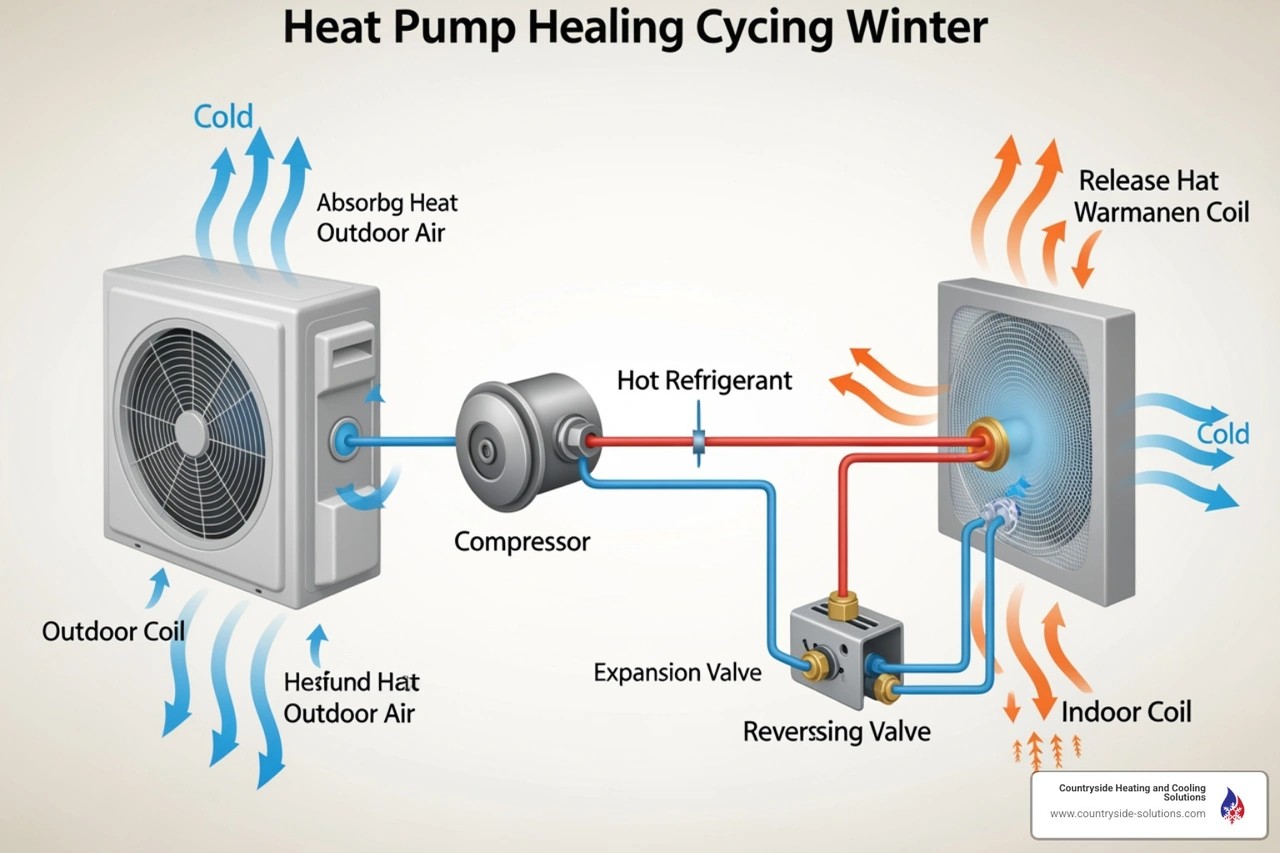
The main parts doing the work are:
- Outdoor coil
- Indoor coil
- Compressor
- Expansion valve
- Reversing valve
- Refrigerant
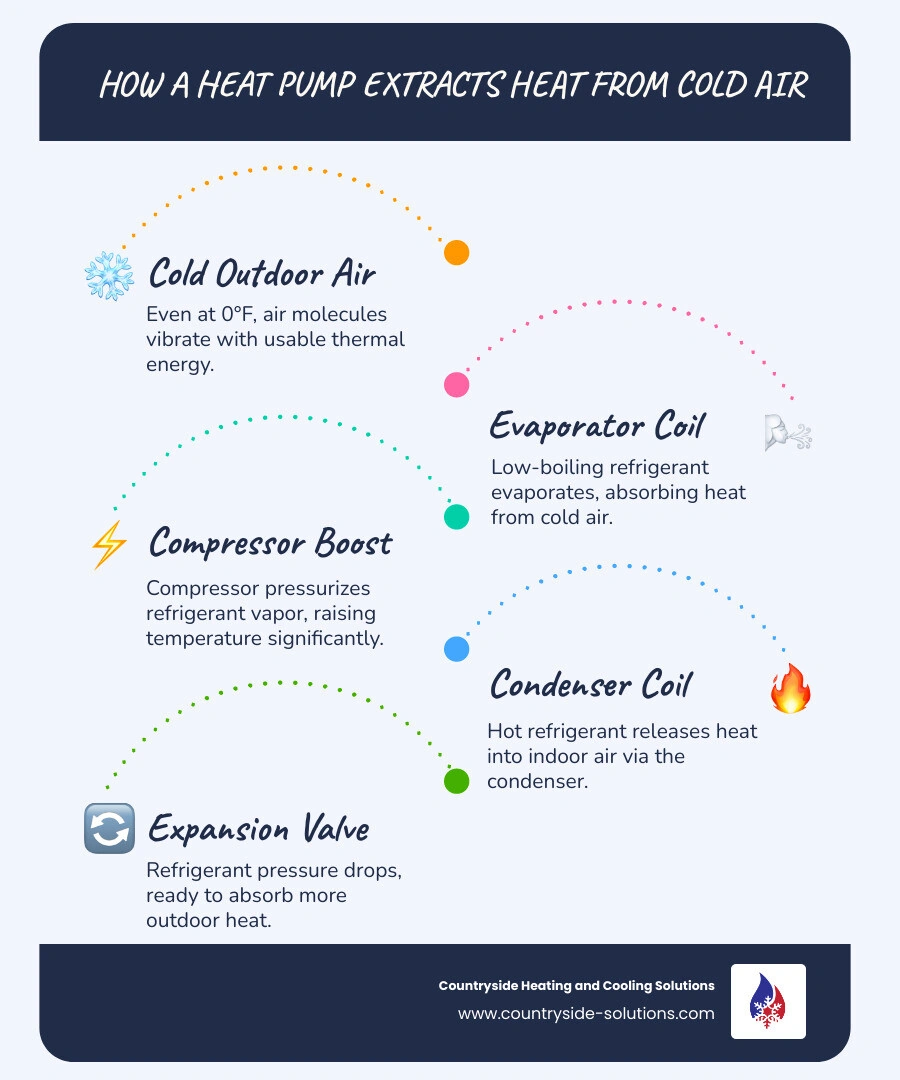
In heating mode, the outdoor coil absorbs heat from the air. The refrigerant inside the coil has a very low boiling point, so it can absorb heat even when outdoor temperatures are far below what we would call "warm." The compressor then raises the refrigerant pressure and temperature. Indoors, that heat is released through the indoor coil and delivered into your living space.
The reversing valve is what lets the same system cool your home in summer and heat it in winter. It changes the direction of refrigerant flow depending on the season.
How does a heat pump work in cold climates when the air feels freezing?
This is the part that feels counterintuitive. If the air is 5°F, or even below zero, how can there possibly be heat to collect?
Because "cold" does not mean "no heat." It only means less heat than what is indoors. As long as the outdoor air contains thermal energy and the refrigerant is colder still, heat can move into the refrigerant. That is the same basic principle that lets your refrigerator pull heat out of food.
So the answer to how does a heat pump work in cold climates is not magic. It is heat movement, pressure changes, and carefully engineered components designed to keep that cycle going in winter conditions.
How heat pumps extract heat from cold outdoor air
Here is the winter heating cycle in simple terms:
- The outdoor coil pulls in heat from outside air.
- The refrigerant evaporates as it absorbs that heat.
- The compressor squeezes the refrigerant, raising its temperature.
- The hot refrigerant moves to the indoor coil.
- The indoor coil releases heat into your home's air.
- The refrigerant cools, passes through the expansion valve, and starts over.
That cycle repeats continuously. Modern systems do not just switch fully on or off. Many adjust output up and down to match your home's heating needs more precisely.
Why heat pumps don’t “create” heat like furnaces
A furnace creates heat through combustion. Electric baseboards and electric resistance heat strips create heat by passing electricity through heating elements.
A heat pump is different. It transfers heat rather than generating it directly.
That is why heat pumps can be so efficient. Their performance is commonly measured by COP, or Coefficient of Performance. A COP of 1 means you get one unit of heat for one unit of electricity, which is basically what electric resistance heat does. A cold climate heat pump must achieve at least a COP of 1.75 at 5°F for ENERGY STAR cold climate qualification, and many operate at COPs of 2 to 3 in milder winter temperatures around 30°F to 40°F.
That efficiency advantage is the whole reason heat pumps have become such a serious heating option for Minnesota homes.
What Makes a Cold Climate Heat Pump Different From a Standard Model?
Not all heat pumps are built for Minnesota winters. A standard heat pump may perform well in milder weather, but cold climate heat pumps are specifically engineered to keep delivering heat when outdoor temperatures fall hard.
What sets them apart usually includes:
- Inverter-driven variable-speed compressors
- Electronic expansion valves
- Enhanced vapor injection or similar low-temperature boost technology
- Larger or better-optimized outdoor coils
- Smarter controls and sensors
- More effective frost and defrost management
- Verified cold-weather performance through programs like ENERGY STAR Cold Climate and NEEP listings
How does a heat pump work in cold climates better than older or standard systems?
Older heat pumps often had one basic speed: on or off. That worked, but not especially well in deep winter. They lost output quickly as the outdoor temperature dropped, which pushed the system to rely on backup heat sooner.
Modern cold climate models are better at retaining capacity in low temperatures. Research shows many can deliver about 70% to 100% of nominal capacity at 5°F, and DOE-tested cold climate models have successfully operated down to -15°F, with some reaching around -22°F.
In plain English: newer systems stay productive longer, run steadier, and hit their balance point later than older equipment.
Key technologies that keep heat pumps running in extreme cold
The biggest cold-weather improvements come from a few important technologies:
- Variable-speed inverter compressor: Lets the system ramp output up or down instead of blasting on and off. That improves comfort and helps maintain performance in changing weather.
- Enhanced vapor injection: Adds refrigerant vapor partway through the compression process to help the system hold capacity in subzero weather.
- Electronic expansion valve: Fine-tunes refrigerant flow much more precisely than older controls.
- Variable-speed fan motors: Improve airflow and heat exchange efficiency.
- Smart sensors and controls: Help manage discharge temperatures, compressor operation, and defrost timing.
- Cold-weather coil design: Improves heat absorption from low-temperature outdoor air.
Temperature range: when heat pumps work well and their lowest operating limits
A few benchmarks help make sense of winter performance:
- Around 30°F to 40°F: Many heat pumps operate very efficiently, often with COPs around 2 to 3.
- At 5°F: A certified cold climate heat pump must maintain a COP of at least 1.75 at maximum capacity.
- At -15°F: Many cold climate units can still provide useful and effective heating.
- At -22°F: Some models are designed to keep operating even at this temperature.
That does not mean every system provides full output at every low temperature. It means the system remains operational and useful within that range. What matters most for a Minnesota home is the match between the home's heating load and the equipment's actual low-temperature capacity.
Cold Weather Performance: Efficiency, Backup Heat, and What Homeowners Should Expect
A heat pump's winter performance depends on two big things:
- How much heat the home is losing
- How much heat the equipment can provide at that outdoor temperature
When the home loses heat faster than the heat pump can replace it, you have reached the balance point. Below that point, backup heat may be needed.
| Feature | Standard Heat Pump | Cold Climate Heat Pump |
|---|---|---|
| Best use case | Mild to moderate winters | Long freezing and subzero winters |
| Low-temperature capacity | Drops faster in deep cold | Better capacity retention |
| Typical backup reliance | Higher | Lower |
| 5°F performance target | Often weaker | COP at least 1.75 for certified models |
| Controls | Simpler staging | More advanced low-ambient controls |
| Minnesota fit | Limited for full-time heating | Much better suited |
Why standard heat pumps lose efficiency in extreme cold
Standard units lose efficiency in extreme cold for simple physical reasons:
- There is less available heat in the outdoor air
- The indoor-outdoor temperature difference is larger
- The system must work harder to move heat uphill, so to speak
- Capacity falls as outdoor temperatures drop
- Runtime increases, and auxiliary heat may turn on
Some sources estimate standard heat pumps can lose 30% to 50% of output below freezing. That does not mean they fail. It means they may not keep up on their own when temperatures plunge.
Do heat pumps need backup heat in cold climates?
Sometimes yes, sometimes not, and it depends on the system and the house.
Backup heat options include:
- Electric heat strips in ducted systems
- Dual-fuel setups that pair a heat pump with a gas furnace
- Emergency heat mode for special situations
Electric heat strips are common, but they use much more electricity than the heat pump itself. They are basically giant toasters inside your air handler. Useful? Absolutely. Cheap to run? Usually not our first choice.
Dual-fuel systems are popular in very cold areas because the heat pump handles most winter days efficiently, while the furnace only steps in during the harshest weather. In Minnesota, that can be a practical "best of both worlds" setup for some homes.
The key is thermostat staging and setup. A poorly configured system may trigger backup heat too often, while a properly configured one lets the heat pump do as much of the work as possible.
How performance is measured in cold weather
Here are the numbers we look at most often:
- COP: How much heat output you get for each unit of electricity used
- HSPF2: Seasonal heating efficiency rating under newer testing methods
- Capacity retention: How much heating output the system keeps at low temperatures compared to its rated output
- Low-ambient rating: The lowest outdoor temperature at which the system is designed to operate
DOE field data from cold-weather sites has shown heat pumps achieving COPs around 2.1 to 2.4 even at single-digit temperatures in some cases. That is still far better than electric resistance heat at COP 1.
Installation and Maintenance Tips That Matter Most in Winter
Even the best heat pump can disappoint if it is installed poorly. In cold climates, installation quality is not a small detail. It is the difference between "this system is amazing" and "why is my backup heat running all the time?"
For homeowners, the biggest priorities are correct sizing, strong airflow, good home insulation, and smart outdoor placement. We cover related planning details in Factors That Impact Heat Pump Installation and outdoor setup ideas in Best Locations to Install Heat Pump.
Sizing, insulation, and airflow: the foundation of winter performance
This is where many projects are won or lost.
A proper Manual J load calculation helps determine how much heat your house actually needs at Minnesota design temperatures. We do not recommend guessing by square footage alone. Two homes of the same size can have very different heating loads depending on insulation, windows, air leakage, and duct condition.
Important factors include:
- Insulation levels in walls and attic
- Air sealing around windows, doors, and penetrations
- Duct leakage and static pressure
- Return airflow
- Thermostat setup and staging
A well-weatherized home makes any heat pump perform better. If your house leaks heat like a screen door on a submarine, even excellent equipment will have to work harder.
Defrost cycles, ice buildup, and snow management
In cold, damp weather, frost can form on the outdoor coil. That is normal. To clear it, the system runs a defrost cycle. During defrost, the heat pump temporarily switches modes to warm the outdoor coil and melt frost.
A few things matter here:
- The unit needs room around it for airflow
- Snow should not block the coil or fan
- Melt water must drain away properly
- The outdoor unit should be elevated enough to stay above drifting snow and refreezing slush
If the unit looks frosty for short periods, that can be normal. If it is buried in snow or encased in solid ice, that is not.
For seasonal upkeep, our HVAC Maintenance Checklist for Extreme Cold Climates is a good place to start.
Common winter problems and simple maintenance steps
A few common issues can reduce cold-weather performance:
- Dirty air filters
- Blocked outdoor coil
- Low airflow
- Incorrect thermostat settings
- Short cycling
- Drainage problems
- Mini-split shutdown behavior that is actually related to sensors, modes, or protection controls
Homeowner-friendly maintenance steps include:
- Replace or clean filters regularly
- Keep snow, leaves, and debris away from the outdoor unit
- Check that supply and return vents are open
- Watch for unusual ice buildup
- Schedule annual professional maintenance
If your ductless system seems to stop and start in winter, it may not be failing. Some systems pause during defrost or protective operation. We explain more in Mini-Split Heat Pump Shutting Off. You can also review Learn the Facts About Heat Pumps for more practical basics.
Myths, Real-World Results, and Incentives for Cold Climate Heat Pumps
Heat pumps have one of the most stubborn reputations in home comfort. A lot of people still picture older units that struggled in winter. That history is real, but it is also outdated.
Myth: Heat pumps stop working below freezing
This is the big one, and it is false.
Modern cold climate heat pumps are specifically designed for freezing weather and subzero operation. Certified models are built to maintain meaningful heating output at 5°F, and many continue operating far below that. Research cited in recent years shows cold climate systems performing effectively down to -15°F, with some reaching about -22°F.
Below freezing is not the problem. The real questions are:
- Is it a true cold climate model?
- Was it sized correctly?
- Is the home reasonably insulated?
- Is backup heat configured properly?
What real-world studies and cold-region examples show
Real-world adoption tells a strong story.
- Heat pumps now heat roughly half the homes in snowy Nordic countries such as Norway, Finland, and Sweden.
- More than 115,000 heat pumps have been installed in Maine, one of the coldest U.S. states.
- Research has shown that 65 million American households could save on energy bills by switching to air-source heat pumps.
- DOE testing has confirmed that major manufacturers' cold climate models can perform at -15°F, and some prototypes have gone even lower.
- Field data has shown COPs in the low 2s at single-digit outdoor temperatures in some installations.
That does not mean every home should install the same system. It does mean the old claim that "heat pumps don't work in real winter" no longer holds up.
Certifications, rebates, and what to look for before you buy
Before buying, we recommend checking for:
- ENERGY STAR Cold Climate qualification
- NEEP listing for cold-climate performance data
- HSPF2 and low-temperature capacity information
- Proper match to your home's heating load
- Contractor experience with Minnesota installations
Homeowners should also review available incentives. Federal programs and utility rebates can change over time, so it helps to start with current information. Our guide to Federal Tax Credits for Heat Pump Upgrades explains one of the most important places to look, and our Heat Pump Comparison page can help you compare system types more clearly.
Frequently Asked Questions About How Does a Heat Pump Work in Cold Climates
Can a heat pump heat a whole house during a Minnesota winter?
Yes, in many homes it can. The answer depends on the home's heating load, insulation quality, ductwork or zoning setup, and the specific cold climate equipment selected. Some homes do very well with a standalone cold climate heat pump. Others are better served by a dual-fuel system or by adding ductless zones in hard-to-heat spaces.
What temperature is too cold for a heat pump to work?
There is no single universal cutoff. Many cold climate models are effective down to -15°F, and some operate around -22°F. But "still running" is not the same as "meeting the full heating load alone." The more useful question is where your home's balance point falls and whether backup heat is available for the coldest periods.
Is a cold climate heat pump right for older homes?
Often yes, but older homes need careful planning. A load calculation, insulation review, and airflow assessment matter a lot. In some older homes, envelope improvements make a huge difference. In others, ductless heat pump zones can solve comfort problems without major ductwork changes.
Conclusion
So, how does a heat pump work in cold climates? By doing something smarter than making heat from scratch. It captures heat that is already present in outdoor air, concentrates it through the refrigerant cycle, and delivers it inside with impressive efficiency, even during real Minnesota winter weather.
The catch is that winter performance depends on choosing the right kind of system and installing it correctly. Cold climate heat pumps are not just "regular heat pumps with better marketing." They use better controls, better compressors, and better low-temperature strategies to keep homes comfortable when older systems would struggle.
For homeowners in Maple Plain, Minnetonka, Wayzata, Eden Prairie, Waconia, and the western Twin Cities suburbs, the best next step is a home-specific evaluation. Proper sizing, insulation, airflow, and equipment selection matter just as much as the name on the box.
If you want help exploring the right setup for your home, learn more about heat pump services. At Countryside Heating and Cooling Solutions, our NATE-certified technicians provide expert service and guaranteed next-business-day support to help homeowners stay comfortable through every season.
