.webp)

Why Energy-Efficient Homes in Minneapolis–Saint Paul Need the Right Ventilation
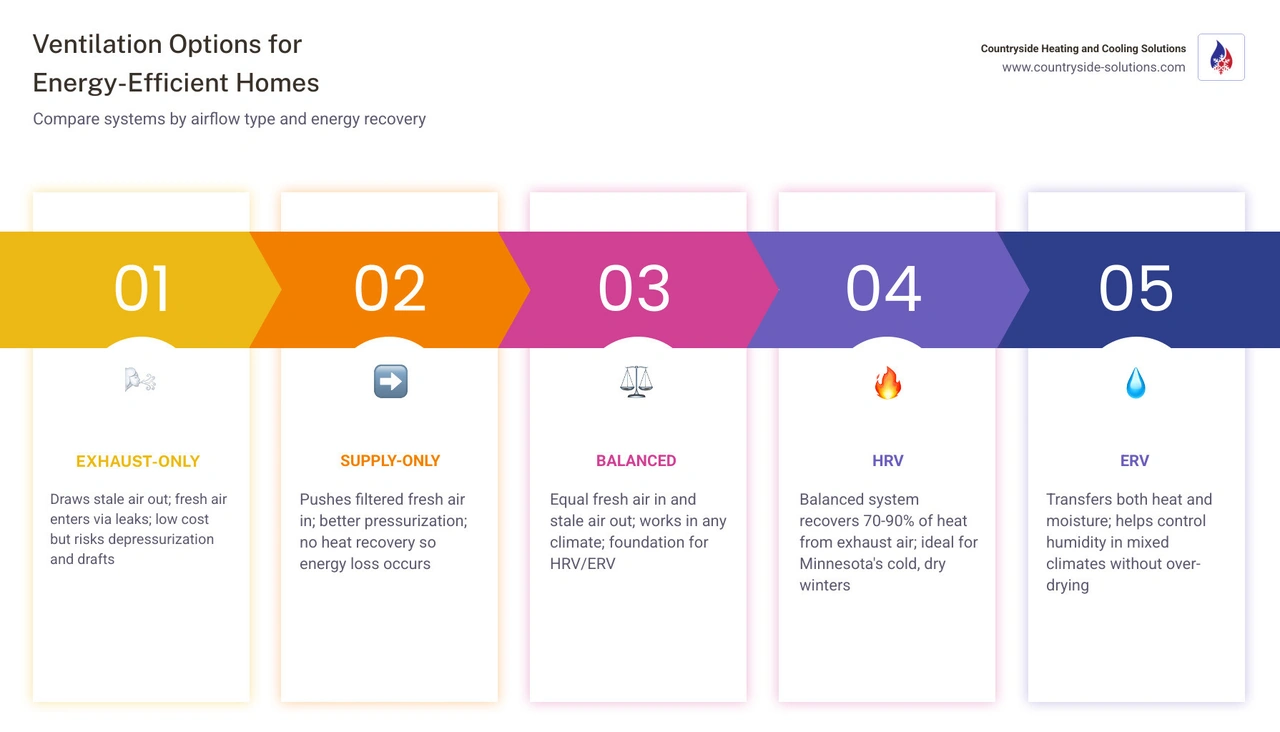
The main ventilation options for energy efficient homes are:
- Exhaust-only systems – Draw stale air out, letting fresh air seep in through gaps; simple and low-cost, but can depressurize the home
- Supply-only systems – Push fresh outdoor air in while stale air escapes; better for pressurizing the home, but no heat recovery
- Balanced ventilation – Brings in and exhausts equal amounts of air simultaneously; suitable for all climates
- Heat Recovery Ventilators (HRVs) – A balanced system that captures heat from outgoing air to pre-warm incoming fresh air; ideal for cold, dry climates like Minnesota
- Energy Recovery Ventilators (ERVs) – Like HRVs, but also transfer moisture; better for managing humidity in mixed or humid climates
- Demand-controlled/zonal ventilation – Uses CO2 and humidity sensors to ventilate only where and when needed, maximizing efficiency
Today's energy-efficient homes are built tighter than ever — and that's mostly a good thing. Less air leaking out means lower heating bills through brutal Minnesota winters. But there's a trade-off that too many homeowners don't hear about until it's causing problems: when a home is sealed tight, stale air, excess moisture, carbon dioxide, and indoor pollutants like VOCs have nowhere to go. Opening a window isn't a reliable fix when it's -10°F outside.
That's why mechanical ventilation isn't optional in a truly energy-efficient home — it's essential. The right system keeps your indoor air fresh and healthy without throwing away the energy you paid to heat or cool that air. HRVs and ERVs, for example, can recover 70% to 90% of the heat from air being exhausted — meaning you get fresh air without the energy penalty.
In this guide, we break down every major ventilation option available to Minneapolis–Saint Paul homeowners so you can make a smart, informed choice for your home and family.
Why Airtight Homes Require Dedicated Ventilation Systems
In the past, older houses in places like Minnetonka, Wayzata, and Eden Prairie were naturally drafty. They relied on "passive infiltration" (air leaking through gaps in windows, doors, and floorboards) to swap out stale indoor air for fresh outdoor air. While this kept the air moving, it also sent heating bills sky-high during our freezing winters.
Today, modern building standards focus on creating a highly airtight building envelope. If a home is sealed below 4 Air Changes per Hour (ACH) at 50 Pascals of pressure, it is tight enough that natural infiltration can no longer provide sufficient fresh air. Without dedicated mechanical ventilation, pollutants quickly accumulate to unhealthy levels.
Consider this: the average person breathes out roughly 1 kilogram (about 2.2 pounds) of carbon dioxide (CO2) every single day while inhaling around 10,000 liters of oxygen. Because we spend at least 90% of our lives indoors, the quality of that indoor air is paramount to our health. When CO2 levels rise in a sealed home, it leads to fatigue, headaches, and trouble concentrating.
Additionally, daily activities like showering, cooking, and doing laundry produce significant moisture. In an airtight home, this moisture has nowhere to escape, settling on cold window panes and inside wall cavities, which leads to mold, mildew, and structural rot. Daily life also releases Volatile Organic Compounds (VOCs) from furniture, carpets, and cleaning products.
Understanding the Importance of Proper Ventilation is the first step toward protecting both your family's health and your home's structural integrity. To learn more about how these dynamics impact your living space, read about The Need for an Air Exchanger in Your Home.
Comparing the Main Ventilation Options for Energy Efficient Homes
To maintain excellent indoor air quality in an airtight home, you need a whole-house mechanical ventilation system. These systems are designed to operate continuously or on a precise schedule to provide a controlled, reliable exchange of air.
There are three primary configurations of whole-house mechanical ventilation: exhaust-only, supply-only, and balanced systems. The table below outlines how these systems compare across key performance and operational metrics:
| System Type | Operating Principle | Climate Suitability | Heat/Energy Recovery? | Risk of Moisture Issues |
|---|---|---|---|---|
| Exhaust-Only | Depressurizes the home by pulling air out | Cold climates | No | High in hot, humid climates |
| Supply-Only | Pressurizes the home by pushing air in | Hot/humid or mixed climates | No | High in cold climates |
| Balanced | Equal supply and exhaust airflow | All climates | Optional (Standard in HRVs/ERVs) | Low |
Exhaust-Only and Supply-Only Systems
Exhaust-only systems rely on small, localized exhaust fans—frequently installed in bathrooms and kitchens—to continuously draw stale air out of the home. By pulling air out, the system creates a slight negative pressure inside the house (depressurization). This negative pressure forces fresh outdoor air to seep in through whatever tiny gaps remain in the building envelope or through passive wall vents.
While simple to install, exhaust-only systems have a major drawback: you cannot control where the incoming air enters. It might be drawn from a dusty attic, a damp crawlspace, or a garage containing car exhaust and chemical fumes. This can compromise your efforts to Improve Home Indoor Air Quality.
Supply-only systems work in reverse. They use a dedicated fan to force fresh outdoor air into the home, creating positive pressure (pressurization). This positive pressure pushes stale indoor air out through passive vents and small gaps in the building shell.
Because the air is drawn from a single, known outdoor intake, it can be filtered before it enters the living space. However, in cold climates like Minnesota, supply-only systems can push warm, moisture-laden indoor air into cold wall cavities, where it can condense and cause hidden mold problems.
Balanced Ventilation Options for Energy Efficient Homes
Balanced ventilation systems provide the most controlled and reliable approach to indoor air quality. These systems use two dedicated fans: one to exhaust stale indoor air and another to pull in an equal volume of fresh outdoor air. Because the incoming and outgoing airflows are perfectly matched, the home remains at a neutral pressure.
In a balanced setup, fresh air is typically delivered directly to the rooms where you spend the most time (like bedrooms and living rooms), while stale air is extracted from moisture- and odor-prone areas (such as bathrooms, kitchens, and laundry rooms). This continuous, balanced exchange ensures that every corner of your home receives a steady supply of clean air.
Discover How Fresh Air Exchange Improves Indoor Air Quality by keeping air moving without altering your home's pressure.
Heat Recovery (HRV) vs. Energy Recovery (ERV) Systems
While balanced ventilation is highly effective, simply dumping warm indoor air outside and pulling freezing winter air inside would force your heating system to work overtime. This is where Heat Recovery Ventilators (HRVs) and Energy Recovery Ventilators (ERVs) come in.
These systems feature a specialized heat exchange core that allows the two airstreams to pass close to one another without mixing.
- Sensible Heat Recovery (HRV): Captures only the heat (temperature) from the outgoing air and transfers it to the incoming fresh air.
- Total Energy Recovery (ERV): Transfers both heat (sensible energy) and moisture (latent energy) between the airstreams.
HRVs and ERVs are highly efficient, recovering 70% to 90% of the heat from the discharged air. From an energy standpoint, installing an HRV or ERV can reduce your heating and cooling system's energy consumption by 13.5% to 17.4% compared to standard mechanical ventilation without heat recovery. This makes them exceptionally cost-effective in climates with extreme winters or hot, humid summers.
To understand how these systems maintain a healthy, comfortable, and efficient indoor environment, explore the details of an Air-to-Air Exchanger Indoor Environment.
HRV and ERV Ventilation Options for Energy Efficient Homes in Cold Climates
For homeowners in the Minneapolis–Saint Paul metro area—from Maple Grove to Lake Minnetonka—the choice between an HRV and an ERV often comes down to winter humidity management.
During a freezing Minnesota winter, the outdoor air is naturally very dry. When that cold air is warmed up inside your home, its relative humidity drops significantly.
- An HRV will continuously exhaust indoor air and bring in dry outdoor air, which is highly effective if your home has excess moisture issues, such as heavy condensation on your windows. High-efficiency HRVs can recover up to 85% of outgoing heat, making them a popular choice for homes with high indoor moisture loads.
- An ERV transfers some of the moisture from the outgoing indoor air back into the incoming dry outdoor air. This helps prevent your indoor air from becoming uncomfortably dry, reducing static electricity, dry skin, and throat irritation. However, in extremely cold weather, ERVs require reliable frost protection controls to prevent the core from freezing up.
If you are dealing with winter dryness or moisture imbalances, consult with local experts on Indoor Air Quality - Minnetonka MN. In many cases, pairing an HRV or ERV with targeted moisture control solutions, such as Whole Home Humidifiers - Minnetonka MN, offers the best balance of comfort and efficiency.
Advanced Strategies: Demand-Controlled and Zonal Ventilation
As smart home technology continues to evolve in 2026, ventilation systems are becoming increasingly sophisticated. Rather than running at a constant speed 24/7, modern systems can adapt in real-time to your household's actual needs.
- Demand-Controlled Ventilation (DCV): Uses integrated sensors to monitor indoor air quality indicators like carbon dioxide (CO2) and relative humidity. When the system detects a spike in CO2 (such as when you host a dinner party) or humidity (such as during a shower), it automatically ramps up the fan speed. Once air quality returns to normal, the system dials back down, saving electricity and reducing wear on the equipment.
- Zonal Ventilation: Allows you to direct fresh air precisely where it is needed. Instead of ventilating the entire house equally, smart dampers and multi-room ventilation units can focus airflow on occupied bedrooms at night and living spaces during the day.
Integrating these advanced controls with your home comfort systems keeps your indoor climate perfectly balanced. For example, homes with variable moisture levels can benefit from pairing zonal ventilation with Whole House Dehumidification - Lake Minnetonka MN to maintain ideal humidity levels year-round.
Frequently Asked Questions about Home Ventilation
What is the difference between an HRV and an ERV?
The primary difference is moisture management. An HRV (Heat Recovery Ventilator) transfers only heat between the exhaust and supply airstreams, making it ideal for keeping indoor humidity low during cold winters. An ERV (Energy Recovery Ventilator) transfers both heat and moisture, helping to retain indoor humidity during dry winters and block outdoor humidity during hot, muggy summers.
How does ASHRAE 62.2 affect my home's ventilation requirements?
ASHRAE Standard 62.2 is the national standard for residential ventilation and indoor air quality. It establishes minimum ventilation rates based on your home's square footage and the number of bedrooms. Many local building codes and energy programs (like ENERGY STAR and EPA's Indoor airPLUS) require compliance with ASHRAE 62.2 to ensure homes receive adequate, continuous fresh air.
How often do whole-house ventilation systems require maintenance?
To keep your system running efficiently, you should clean or replace the air filters every 3 to 6 months. Every 1 to 2 years, the heat exchange core should be taken out and gently cleaned according to the manufacturer's instructions. Additionally, you should periodically inspect the outdoor intake and exhaust hoods to ensure they are free of leaves, nests, and debris.
Conclusion
Choosing the right ventilation system is one of the most important decisions you can make for your energy-efficient home. Whether you opt for a high-efficiency HRV to handle dry Minnesota winters or an advanced ERV to keep your indoor humidity perfectly balanced, professional installation is key to ensuring your system delivers its promised efficiency and performance.
At Countryside Heating & Cooling Solutions, our NATE-certified technicians have been helping homeowners throughout Maple Plain, Wayzata, Minnetonka, and the surrounding western suburbs stay comfortable and healthy since 1974. We can help you select, size, and install the perfect ventilation system tailored to your home's unique layout and your family's needs.
Ready to breathe easier and protect your home's efficiency? Explore the Countryside Heating & Cooling Solutions Air Quality Services or contact our friendly team today to schedule a professional consultation!
