.webp)

Why HVAC Replacement Is a Smart Investment for Minneapolis-Saint Paul Homeowners
Understanding why HVAC replacement is a smart investment can be the difference between a smooth home sale and a deal that unravels at inspection — or between shrinking utility bills and watching energy costs climb year after year. For homeowners in the Minneapolis-Saint Paul area, where winters are genuinely brutal and summers push cooling systems hard, your HVAC system isn't a background appliance. It's one of the most financially significant components of your home.
Here's a quick snapshot of why replacing an aging HVAC system tends to pay off:
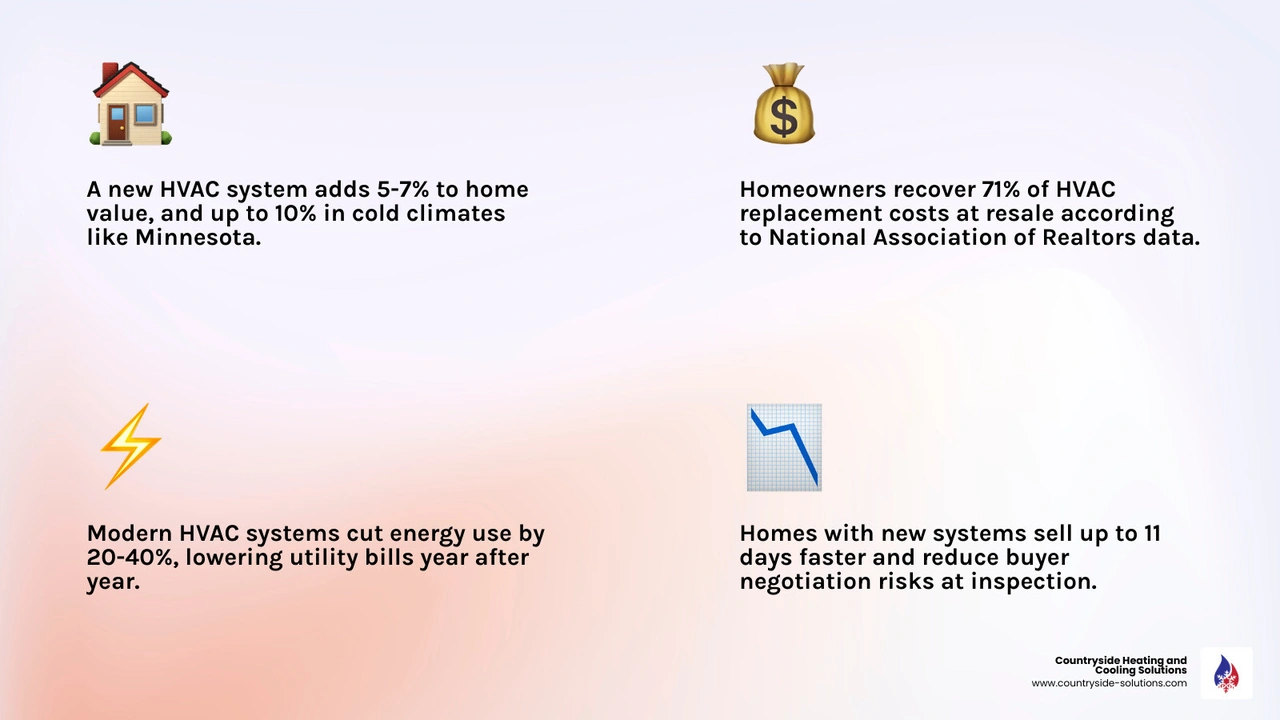
- Home value boost: A new HVAC system typically adds 5% to 7% to a home's value — and up to 10% in climates like Minnesota's where heating and cooling are critical
- Cost recovery at resale: Homeowners recoup around 71% of replacement costs, according to National Association of Realtors data
- Faster sales: Homes with new systems can sell up to 11 days faster than comparable homes with aging equipment
- Lower utility bills: Modern systems can cut energy use by 20% to 40% compared to older, inefficient units
- Buyer confidence: 72% of buyers prioritize energy-efficient features — a new system signals a well-maintained home
- Reduced inspection risk: New HVAC eliminates one of the most common negotiation pressure points buyers use to request credits or price reductions
- Tax incentives: Under the Inflation Reduction Act, homeowners can access federal tax credits of up to $2,000 for qualifying high-efficiency systems, lowering the net cost of replacement
Whether you're preparing to list your home or simply tired of watching your furnace eat through your budget while struggling to keep up, the financial case for replacement is hard to ignore. This guide breaks down the real ROI — so you can make a confident, informed decision.
Why hvac replacement is a smart investment vocab to learn:
Analyzing the ROI: Why HVAC Replacement Is a Smart Investment for Sellers

When selling a home in competitive Twin Cities markets like Edina, Minnetonka, or Eden Prairie, sellers often focus on cosmetic upgrades. They repaint walls, refinish hardwood floors, and stage the living room. While these visual touch-ups certainly help draw buyers in, they do nothing to address the structural and mechanical anxieties that keep buyers up at night.
In the real estate world, relief often beats excitement. A buyer might love a gourmet kitchen, but if they walk down to the basement and see a rusted, 18-year-old furnace shaking and groaning, their enthusiasm immediately evaporates. They see an impending financial headache.
This is exactly How a New HVAC System Increases Home Value. Rather than trying to negotiate a lower sales price or demanding massive credits, buyers look at a newly installed heating and cooling system as a form of financial insurance. It tells them they won’t have to deal with an emergency system failure during their first Twin Cities winter.
The hard numbers back this up:
- Appraisal Impact: Appraisers look closely at the age and condition of primary mechanical systems. A new, high-efficiency system provides strong support for a higher appraisal value, translating to a direct home value increase of 5% to 7% (and sometimes up to 10% in extreme climates like ours).
- Cost Recovery: According to data from the National Association of Realtors (NAR), homeowners typically recoup about 71% of the project costs directly through the home's resale price.
- Reduced Time on Market: Homes featuring updated, energy-efficient mechanical systems sell significantly faster—often 10% to 15% quicker, saving sellers up to 11 to 15 days on the market. In real estate, time is money; fewer days on market means fewer mortgage payments and less staging upkeep.
By making the upgrade before you list, you protect your asking price, build immediate buyer confidence, and eliminate the risk of late-stage negotiation drama.
When to Choose Replacement Over Ongoing Repairs
Deciding whether to keep patching up an old unit or to finally invest in a replacement is a classic homeowner dilemma. To take the emotion out of the decision, professional HVAC technicians and financial advisors rely on a few simple mathematical frameworks.
The first is the 50% Rule. If a single repair quote exceeds 50% of the cost of a brand-new system, the money is almost always better spent on a replacement. Sunk costs into terminal equipment rarely pay off.
The second framework is the $5,000 Rule. To apply this, multiply the age of your system (in years) by the cost of the recommended repair. If the resulting number is greater than 5,000, replacement is the mathematically smarter decision. For example:
- A 12-year-old air conditioner needs a repair. 12 years × repair cost = if that product exceeds 5,000, you should replace the unit.
- Conversely, a 6-year-old system with a minor issue will fall well below that threshold, making a repair the right move.
Another critical trigger for replacement is the R-22 refrigerant phase-out. If your cooling system was installed before 2010, it likely relies on R-22 (often called Freon). Because R-22 is entirely phased out due to environmental regulations, sourcing it for repairs has become incredibly scarce and prohibitively expensive. Investing in a major repair on an R-22 system is essentially throwing money away.
If you are trying to determine where your current system stands, it is helpful to Know the Signs When to Replace Your Old HVAC System so you can plan ahead rather than waiting for an emergency breakdown. If you are currently nursing a struggling air conditioner, take a moment to evaluate whether Is It Time to Repair or Replace My Air Conditioner before the next summer heatwave hits Maple Grove or Plymouth.
Understanding Why HVAC Replacement Is a Smart Investment for Aging Systems
Every mechanical system has a natural expiration date. On average, residential furnaces last between 15 and 20 years, while central air conditioners and heat pumps typically have a lifespan of 10 to 15 years.
As a system crosses these age thresholds, it undergoes a natural process of efficiency loss. Over time, internal components wear down, motors work harder to move the same amount of air, and scale builds up in heat exchangers. Even if an old furnace is still running, it might be operating at a fraction of its original efficiency rating, quietly driving up your monthly utility bills.
If your heating system is approaching its golden years, learning When to Consider Heater Replacement can save you from a middle-of-the-night emergency in January. For our neighbors in Wayzata, checking out a localized resource like our Furnace Replacement Guide Wayzata MN can provide valuable context on selecting a system engineered to handle harsh Minnesota winters.
Why HVAC Replacement Is a Smart Investment to Avoid the Repair Spiral
One of the most frustrating aspects of keeping an aging HVAC system on life support is what we call the "repair spiral." An HVAC system is an interconnected web of electrical and mechanical components. When one major part begins to fail, it places compounding stress on the rest of the system.
For example, a failing blower motor might draw too much electrical current, which eventually damages the control board. Or a struggling compressor might cause the system to short-cycle, accelerating wear on the fan motors and contactors. Before you know it, you are caught in a cycle of calling for service multiple times a year, paying for individual repairs that quickly add up to the cost of a brand-new, reliable system.
Worse yet, running an old system can introduce serious safety hazards. A cracked heat exchanger in an old furnace is a direct pathway for dangerous carbon monoxide to enter your home’s breathing air. If your system is showing signs of systemic failure, it is likely the Right Time for Residential AC Replacement or heating upgrade. For those living in the Lake Minnetonka area, our Air Conditioner Replacement Wayzata MN Guide offers practical advice on how to break the repair cycle and secure long-term peace of mind.
High-Efficiency Upgrades That Deliver the Best Returns
If you decide to move forward with a replacement, choosing the right technology will maximize your long-term financial returns. Today's HVAC market is vastly different than it was even a decade ago. Modern systems leverage smart technology, variable-speed motors, and advanced thermodynamic principles to deliver unprecedented comfort and efficiency.
Here are the high-value upgrades that deliver the strongest return on investment:
- Variable-Speed Heat Pumps: Heat pumps have surged in popularity and value. Modern cold-climate heat pumps can extract warmth from the outdoor air even in freezing temperatures, providing highly efficient heating in the winter and cooling in the summer. Because they move heat rather than generating it from fossil fuels, they can slash heating costs dramatically.
- High SEER2 and AFUE Ratings: Cooling efficiency is measured by SEER2 (Seasonal Energy Efficiency Ratio 2), while heating efficiency is measured by AFUE (Annual Fuel Utilization Efficiency). Upgrading from an old, low-SEER system to a modern high-efficiency unit can cut your monthly cooling bills by 20% to 40%.
- Smart Thermostats: Integrating a smart thermostat allows your system to learn your daily routines, automatically adjusting temperatures when you are away or asleep. This simple addition can save homeowners significant money annually on heating and cooling costs.
- ENERGY STAR Certification: Choosing systems with the ENERGY STAR label ensures you meet strict efficiency guidelines set by the EPA, making you eligible for valuable utility rebates and federal tax credits.
If you are looking to upgrade your cooling system, exploring options for an Energy Efficient Air Conditioner Replacement Near Eden Prairie is an excellent way to prepare your home for hot summers while keeping operational costs low.
To help visualize the difference, here is a comparison of standard vs. high-efficiency systems:
| Feature | Standard Efficiency System | High-Efficiency System (Variable-Speed) |
|---|---|---|
| Cooling Efficiency (SEER2) | Baseline minimum (typically 13.4 - 14.3) | High-efficiency (16 to 22+) |
| Heating Efficiency (AFUE) | Standard (80% AFUE) | High-efficiency condensing (95% to 98% AFUE) |
| Compressor Technology | Single-stage (On/Off) | Variable-speed (modulates to match exact demand) |
| Zoning Compatibility | Limited | Excellent (supports multi-zone temperature control) |
| Sound Levels | Standard operating noise | Ultra-quiet (whisper-quiet operation) |
| Monthly Utility Savings | Baseline | 20% to 40% reduction |
Frequently Asked Questions About HVAC Upgrades and Home Value
Does a new HVAC system prevent buyer concessions during home inspections?
Yes, absolutely. One of the most common ways a home sale gets derailed—or becomes much more expensive for the seller—is during the home inspection phase. When an inspector flags an HVAC system that is past its expected lifespan, has visible rust, or shows inconsistent temperature splits, the buyer’s agent will almost always use this as negotiation leverage.
They will often demand thousands of dollars in price concessions or insist that the seller pay for a replacement before closing. By proactively installing a new system before listing your home, you completely take this weapon out of the buyer's hands. It provides total peace of mind and keeps the transaction moving forward smoothly.
Should I replace my system or offer a buyer credit before selling?
While offering a buyer credit might seem like an easy way to avoid the hassle of an installation, pre-listing replacement is almost always the smarter financial strategy.
First, many buyers—especially first-time home buyers—are already stretching their budgets to cover the down payment and closing costs. They do not want to take on a major construction project immediately after moving in, even if they are given a credit.
Second, a home with a brand-new, working HVAC system can be marketed as "move-in ready," which attracts a much larger pool of buyers and leads to faster sales. Finally, a buyer credit is a direct dollar-for-dollar reduction in your net proceeds, whereas a pre-listing replacement allows you to market the home at a premium, helping you recoup a significant portion of the investment.
What documentation should I provide to buyers to maximize perceived value?
To get the absolute highest return on your investment, you should present a clean, organized documentation packet to prospective buyers and their appraiser. This packet should include:
- The original installation invoice: Showing the date of installation and the licensed contractor who performed the work.
- Warranty information: Highlight any transferable manufacturer warranties, which provide incredible peace of mind to the new owner.
- Permit documentation: Proof that the system was installed legally and up to local building codes.
- Maintenance records: If you have kept up with annual tune-ups, showing a consistent service history proves that you have cared for the entire property.
Conclusion
At the end of the day, making home improvements that protect your comfort, lower your monthly bills, and secure your property value is always a wise choice. Whether you are planning to stay in your home for decades or preparing to put it on the market in Waconia, Orono, or Minnetrista, a modern, reliable heating and cooling system is an investment that keeps paying you back.
When you are ready to explore your options, our team at Countryside Heating and Cooling Solutions is here to help. Our NATE-certified technicians have been serving Maple Plain and the greater Minneapolis-Saint Paul metro area since 1974. We are committed to providing quality workmanship, honest advice, and guaranteed next-business-day service to keep your family comfortable in every season.
Ready to make a smart investment in your home's comfort and value? Schedule your professional consultation with us today at https://www.countryside-solutions.com/hvac.
