.webp)

Why That Clammy August Air Forces a System Evaluation
As the late-summer humidity settles over the area, our technicians field dozens of calls about homes that feel like a swamp even after the air conditioner just shut off—which is exactly why understanding the real ROI of upgrading to a variable-speed blower motor matters more than just looking at your utility bill. You are experiencing a classic late-summer problem. The thermostat reads a perfectly cool 70 degrees, yet your skin feels sticky, the floors feel slightly damp, and the air is heavy. In our years of servicing Maple Plain homes, we've found this discomfort often traces directly back to the type of blower motor pushing air through your ductwork.
Traditional single-speed motors operate on a very simple premise: they blast cold air into your living space as quickly as possible until the thermostat registers the target temperature, and then they shut down entirely. While this brute-force method lowers the air temperature rapidly, it completely fails at the secondary (and arguably more important) job of your cooling equipment: removing moisture. The system simply does not run long enough to wring the humidity out of the air.
If you are evaluating your current heating system and cooling equipment, you are likely facing a central decision point. Our team recommends looking past generic utility savings to determine whether the enhanced comfort, superior humidity control, and energy reduction of variable-speed technology actually justify the upgrade over standard equipment. Making this decision requires understanding how this technology transforms the way your home feels, especially during the August back-to-school transition and muggy late-summer weather in Minnesota.
The Mechanics: ECM Variable-Speed vs. PSC Single-Speed Motors
To understand why these two technologies produce such drastically different results inside your home, you have to look at the mechanical differences driving the airflow. The HVAC industry relies on two primary types of motors to circulate air: Permanent Split Capacitor (PSC) motors and Electronically Commutated Motors (ECMs).
A PSC motor is the traditional, single-speed unit found in older or budget-friendly HVAC systems. It is essentially an on/off switch. When the thermostat calls for heating or cooling, a PSC motor powers up to 100% capacity immediately and pushes a fixed volume of air until the cycle ends. Conversely, an ECM is a variable-speed unit equipped with a built-in microprocessor. This allows the motor to adjust its airflow output precisely based on real-time demand, ramping up and down in tiny increments rather than simply turning on or off.
When we sit down with homeowners to compare furnace options, we always emphasize that understanding this distinction is critical. The difference is much like driving a car. A PSC motor is like driving with your foot pinned to the floorboard until you reach the speed limit, then slamming on the brakes. An ECM operates like adaptive cruise control, gently accelerating and decelerating to maintain a perfectly consistent speed regardless of the terrain.
• Operation Style — PSC Single-Speed Motor: 100% capacity or completely off. — ECM Variable-Speed Motor: Adjusts anywhere from 30% to 100% capacity.
• Airflow Delivery — PSC Single-Speed Motor: Sudden, forceful blasts of air. — ECM Variable-Speed Motor: Gradual, quiet, and continuous circulation.
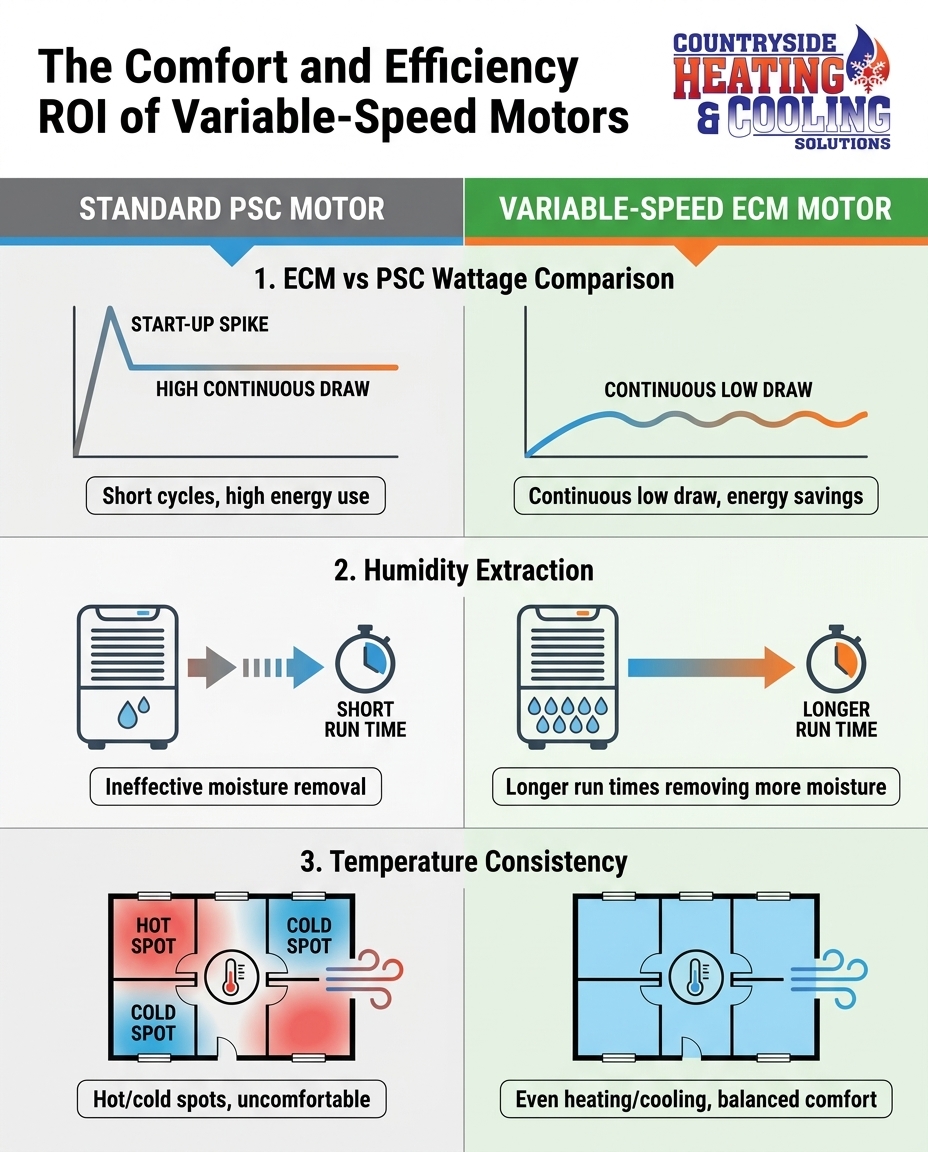
• Energy Consumption — PSC Single-Speed Motor: High electrical draw, massive start-up spikes. — ECM Variable-Speed Motor: Ultra-low continuous draw, no start-up spikes.
• Thermostat Integration — PSC Single-Speed Motor: Basic on/off communication. — ECM Variable-Speed Motor: Two-way communication for precise climate control.
The "All-or-Nothing" Flaw of Single-Speed Blowers
A pattern we see often with single-speed blowers running at full blast is the creation of noticeable hot and cold spots throughout the house. Because the system pushes a massive volume of air very quickly, the rooms closest to the equipment get freezing cold, satisfying the thermostat located in the hallway before the air ever reaches the bedrooms at the far end of the house. Furthermore, the physical wear and tear of constant hard starts and abrupt stops degrades the motor components faster, leading to more frequent mechanical breakdowns.
The Precision of Variable-Speed Airflow
By running at 40% to 60% capacity most of the time, an ECM maintains incredibly consistent temperatures from room to room. The air has time to mix properly, eliminating stagnant zones. Additionally, these advanced motors offer seamless transitions between heating, cooling, and fan-only modes. When the system detects that the temperature is drifting slightly, it does not need to kick on a massive, noisy cycle; it simply ramps up the blower a few hundred RPMs to gently nudge the home back to the target temperature.
The Comfort ROI: Mastering Dehumidification in Late Summer
To fully appreciate the value of this technology, you have to understand the basic physics of how air conditioners actually dehumidify a house. Your cooling system removes moisture by pulling warm, humid indoor air across cold evaporator coils. As the warm air hits the chilled metal, the moisture in the air condenses into water droplets, drips into a drain pan, and is channeled safely out of your home.
The critical factor in this process is contact time. When a blower motor runs at a lower speed for a longer duration, the air moves slowly across those cold coils. This extended contact time maximizes condensation, allowing the system to extract significantly more moisture from the air. When our team handles air conditioning upgrades, this is the exact metric we focus on to ensure your home feels crisp rather than swampy.
Contrast this with single-speed systems that short-cycle. A standard motor blasts air across the coils so fast that the moisture barely has time to condense. The thermostat registers a drop in temperature and shuts the system down after just ten minutes. The result is air that feels cold but damp. During the August late-summer muggy weather in Minnesota, when high dew points demand superior moisture extraction, this short-cycling behavior leaves homes feeling deeply uncomfortable.
The true comfort ROI is the ability to feel completely dry and comfortable with the thermostat set to 74 degrees, rather than shivering in a clammy, 70-degree room. Because dry air feels cooler on human skin than humid air, a variable-speed motor allows you to set your thermostat higher while actually improving your baseline comfort, fundamentally changing how you experience the late-summer transition in Maple Plain.
The Efficiency ROI: Eliminating the Start-Up Spike
When homeowners ask us about energy savings, they usually look for a specific dollar amount on their monthly statement. However, our technicians advise that the most accurate way to evaluate the efficiency ROI of a variable-speed motor is to look at electrical efficiency and wattage reduction. The secret to this efficiency lies in how the motor handles inertia.
Getting a heavy blower wheel to spin from a dead stop requires a massive surge of electricity. This is known as "inrush current." Every single time a standard PSC motor turns on, it pulls a huge spike of wattage to overcome that initial resistance. Because single-speed systems turn on and off dozens of times a day, your home is constantly absorbing these heavy electrical spikes.
Variable-speed ECMs operate on a completely different electrical principle. They use internal electronics to convert alternating current (AC) into direct current (DC), which is inherently more efficient. More importantly, they ramp up slowly.
• Eliminating the surge: By starting at a very low RPM and gradually increasing speed, an ECM avoids the massive electrical spikes that single-speed motors require.
• Continuous efficiency: It takes significantly less wattage to keep a wheel spinning at a low speed than it does to repeatedly jump-start a heavy wheel from zero.
• Lower continuous wattage consumption vs. single-speed start-up spikes: Running an ECM continuously at 30% capacity often uses less electricity than a 75-watt lightbulb, making continuous circulation highly efficient.
• Utility incentives: Qualifying utility incentives and generic federal tax credits frequently reward this specific reduction in peak wattage draw, as it reduces the overall strain on the local electrical grid during high-demand summer afternoons. (Always check with your utility provider or a tax professional for current eligibility.)
By reframing energy savings around how the motor actually consumes power, it becomes clear that the continuous, low-draw operation of an ECM is vastly superior to the start-and-stop energy spikes of traditional equipment.
Intangible Returns: Indoor Air Quality and Whisper-Quiet Operation
Beyond humidity control and wattage reduction, our clients consistently tell us that variable-speed technology delivers secondary benefits that heavily influence daily homeowner satisfaction. Chief among these is the dramatic improvement in indoor air quality.
Your HVAC filter can only clean the air when the air is actually moving through it. Because a single-speed motor only runs during active heating or cooling cycles, your air is only being filtered for a fraction of the day. Furthermore, the high-velocity blast of a single-speed motor can actually force smaller particles straight through the filter media, rendering it less effective.
The filtration advantage: A variable-speed motor can be set to run a continuous, low-speed fan cycle even when the compressor or furnace burner is off. This means your indoor air is constantly circulating through the filter 24 hours a day. The slower air velocity allows the filter media to capture significantly more dust, pet dander, and seasonal allergens without the particles being pushed through by high static pressure.
The noise reduction: Another major quality-of-life improvement is whisper-quiet operation. Everyone is familiar with the loud "clunk" and the rushing roar of air that announces a standard HVAC system turning on. Because an ECM ramps up gently, that disruptive noise is entirely eliminated. You will likely never hear the system turn on; you will simply notice that the house remains perfectly comfortable. These intangible returns—breathing cleaner air and enjoying a quieter home—are critical components of the overall upgrade investment.
Navigating the Upgrade: Making the Right Long-Term Choice
Deciding to upgrade to variable-speed technology rarely happens on a lazy Sunday afternoon. More often than not, it happens during an unexpected equipment failure when you are forced to make a rapid decision. One Maple Plain homeowner experienced this firsthand when their heating system failed over a weekend with temperatures dropping to 10 below zero. Our technician arrived within an hour to restore heat quickly, preventing further discomfort—but emergency moments like these often spark the conversation about what comes next when the current system is on its last legs.
When you are dealing with the stress of a breakdown, having a professional walk through the installation process and explain the technical details clearly is invaluable. You need to know whether you are dealing with the symptoms of a failing AC contactor vs. a bad capacitor, or if the entire blower assembly has reached the end of its lifespan.
Evaluating the whole system—not just the blower—ensures maximum efficiency and compatibility. A variable-speed motor cannot solve underlying issues like severely undersized ductwork or failing insulation. As local experts who understand the extreme seasonal shifts in our region, Countryside Heating & Cooling Solutions specializes in accurately calculating energy savings and utility ROI specific to Minnesota's climate demands. We look at the entire thermal envelope of your home.
Finally, a proper installation guarantees the variable-speed motor performs exactly as designed. The internal microprocessors must be calibrated correctly with the thermostat to ensure the motor knows exactly when to ramp up and when to dial back. Without meticulous installation, even the most advanced motor will default to basic operation, robbing you of the ROI you invested in.
Frequently Asked Questions About Variable-Speed Upgrades
Is a variable speed blower motor worth it?
Yes. In our experience, for most homeowners, the benefits heavily outweigh the initial cost. The true value comes from a massive increase in indoor comfort, specifically through better humidity control and the elimination of hot and cold spots. Additionally, the reduction in electrical start-up spikes lowers the long-term strain on your electrical system. It is an investment in both daily quality of life and long-term mechanical reliability.
What is the difference between single speed and variable speed blower motors?
The primary difference is how they deliver air. A single-speed motor only operates at 100% capacity, meaning it blasts air until the thermostat is satisfied and then shuts off completely. A variable-speed motor can adjust its output anywhere from a gentle continuous breeze to full capacity, matching the exact heating or cooling demand of the house in real-time. This precision prevents temperature swings and reduces wear and tear.
Does a variable speed furnace save energy?
Yes, it saves energy by operating much more efficiently than standard models. Instead of requiring a massive surge of electricity to jump-start the motor multiple times a day, a variable-speed unit ramps up slowly and often runs at a very low, continuous wattage. Running a motor at 30% capacity for longer periods consumes significantly less total electricity than repeatedly starting and stopping a motor at 100% capacity.
How does a variable-speed motor help with indoor humidity?
It helps by increasing the amount of time your indoor air spends in contact with the cold evaporator coil. Because the motor runs at a slower speed for a longer duration, the air moves gently across the coil, allowing maximum condensation to occur. This extended run time pulls far more moisture out of the air than a standard motor that blasts air quickly and shuts off before dehumidification can take place.
Can I upgrade just my blower motor or do I need a whole new system?
In most cases, you cannot simply swap a variable-speed motor into an older, single-speed furnace or air handler. The internal wiring, the control boards, and the communication protocols with the thermostat are fundamentally different. Upgrading to variable-speed technology typically requires replacing the entire furnace or air handler unit to ensure the components communicate properly and operate safely.
Maximize Your Home's Comfort with a Professional Assessment
The true ROI of a variable-speed motor is found in a clear, non-monetary framework: consistent temperatures, superior humidity extraction during muggy summers, and a significant reduction in peak energy consumption. It is about fundamentally changing how your home feels and operates. If you are tired of dealing with clammy air and noisy start-ups, the next step is to get a professional evaluation to see if this technology makes sense for your specific floor plan and ductwork. Reach out to our local team today to schedule an assessment and take control of your home's long-term comfort.
