.webp)

How Clean Ducts Reduce Mold Risk: A Scientific Approach
Understanding how clean ducts reduce mold risk requires looking at the biology of your home. Mold isn't just a "dirt" problem; it is a biological process that requires three ingredients: spores, a food source, and moisture. In the dark, secluded environment of your HVAC system, these three elements often meet.
Bioaerosol contaminants—microscopic organisms like mold spores, bacteria, and fungi—are always present in the air. When these spores settle into a layer of dust inside your ductwork, they find a rich buffet of organic nutrients. By physically removing this accumulation, we break the cycle of growth. Furthermore, proper airflow regulation ensures that air moves quickly enough through the system to prevent pockets of stagnant, humid air from forming.
If you are concerned about what might be lurking in your vents, starting with Indoor Air Quality Mound MN services can help identify the specific pollutants in your home. For those in the western suburbs, Household Air Quality Testing Excelsior MN provides a scientific baseline to determine if your ducts are contributing to poor air health.
Eliminating Organic Debris: How Clean Ducts Reduce Mold Risk
Think of the dust in your ducts as "mold fuel." This layer of debris is composed of skin cells, dust mites, pet dander, and pollen. These are all organic materials that mold uses as a food source.
When we perform a professional cleaning, we are stripping away this particulate matter. Without this layer of "soil," mold spores that enter the system have nowhere to land and thrive. This is especially important for households with pets or high foot traffic, where debris builds up faster. To keep the air entering your ducts as clean as possible, we often recommend the Best Home Air Filtration Long Lake MN to trap these particles before they ever settle in your ventilation.
Controlling Moisture Accumulation: How Clean Ducts Reduce Mold Risk
Moisture is the "on-switch" for mold growth. In our humid Minnesota summers, air conditioning coils produce significant amounts of condensation. If your ducts are dirty, that dust acts like a sponge, soaking up moisture and staying damp for days.
By keeping the system clean, we ensure that moisture drains away as intended rather than being trapped against organic debris. Maintaining indoor humidity levels between 30% and 50% is the gold standard for mold prevention. If your home feels "clammy" or your windows are constantly fogging up, you might benefit from Whole House Dehumidification Loretto MN, which addresses the root cause of mold risk by pulling excess water out of the air before it can condense inside your ducts.
Identifying the Warning Signs of HVAC Mold Contamination
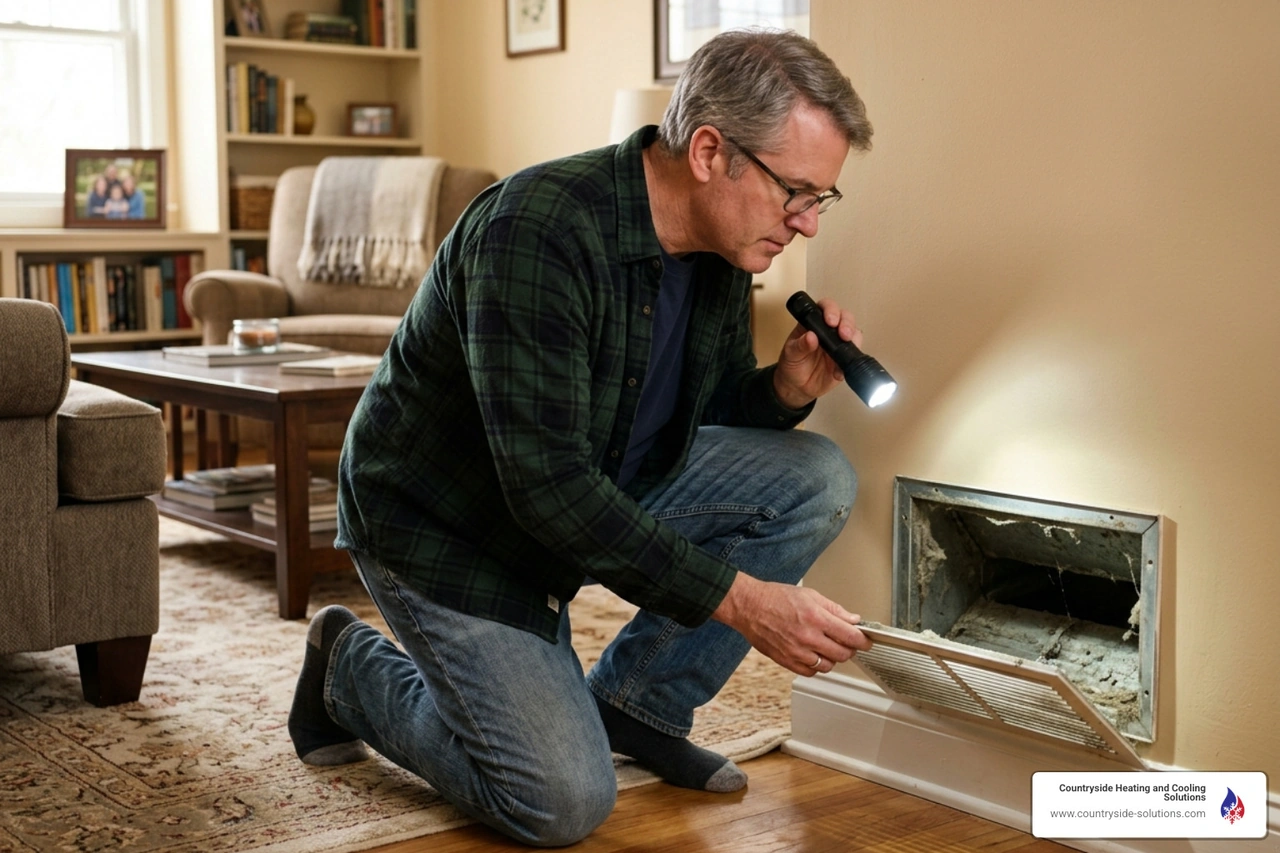
Mold is a sneaky tenant. It rarely sits out in the open where you can see it. However, your senses and your health often provide the first clues. One of the most common signs is a "musty" or "earthy" odor that becomes stronger specifically when the furnace or air conditioner kicks on. This is often called "Dirty Sock Syndrome," caused by bacteria and mold growing on moist coils or inside the ducts.
Other warning signs include:
- Visible Spotting: Black, green, or white fuzzy patches on vent covers or around the edges of registers.
- Allergy Flare-ups: If family members experience unexplained sneezing, coughing, or itchy eyes only when they are at home, the HVAC system may be aerosolizing mold spores.
- Stale or Damp Air: Air that feels heavy or smells like a wet basement.
If the air in your home feels "dead" or trapped, it might be time to look into The Need for an Air Exchanger in Your Home. These systems swap out stale indoor air for fresh, filtered outdoor air, preventing the buildup of spores and odors.
Moisture: The Root Cause of Duct Contamination
We often tell our neighbors in Maple Plain and Wayzata that duct cleaning is only half the battle; you must also fix the moisture source. Common culprits include:
- Clogged Drip Pans: If the condensate drain line is plugged, water backs up and creates a standing pool—a perfect mold nursery.
- Oversized AC Units: If your AC is too big for your house, it "short-cycles," meaning it turns off before it has a chance to properly dehumidify the air.
- Leaky Roofs or Pipes: Water dripping onto the exterior of a duct can cause the interior insulation to become soggy.
Ensuring your system is properly vented is critical. For homeowners in our local area, professional Ventilation Work Maple Plain MN ensures that moisture from bathrooms and kitchens is sent outside rather than lingering in your attic or crawlspace.
Understanding Duct Materials and Mold Vulnerability
Not all ducts are created equal when it comes to mold. The material of your ductwork significantly impacts how easily it can be cleaned and how likely it is to harbor growth.
| Duct Material | Mold Risk Level | Cleaning Potential | Notes |
|---|---|---|---|
| Sheet Metal | Low | Excellent | Smooth surfaces and zinc (galvanized) coating act as natural fungicides. |
| Fiberglass Lined | High | Difficult | Porous surfaces trap moisture and dust; mold can grow inside the fibers. |
| Flexible Duct | Moderate | Limited | Ridges trap debris; easily damaged by aggressive mechanical brushing. |
If you have fiberglass-lined ducts that have become wet and moldy, the North American Insulation Manufacturers Association (NAIMA) and the EPA generally recommend replacement rather than cleaning. Once mold penetrates the porous surface of the insulation, it is nearly impossible to remove completely.
Professional Remediation vs. DIY: Why Expert Help Matters
It is tempting to try and vacuum out your vents with a household shop-vac, but DIY duct cleaning can actually make a mold problem worse. Standard vacuums do not have the filtration power to trap microscopic spores; instead, they often just "stir the pot," sucking spores out of the dust and blowing them into your living room.
Professional cleaning by Countryside Heating and Cooling Solutions utilizes negative pressure. We seal the system and use high-powered, truck-mounted HEPA vacuums to ensure that every bit of dust and every mold spore is pulled out of the house, not pushed further in. We use mechanical brushing and air sweeps to agitate the debris, but the negative pressure ensures that nothing escapes into your breathing air during the process.
For an added layer of protection, many of our Lake Minnetonka neighbors choose Whole House Air Purification Lake Minnetonka MN. These systems, often using UV-C light or ionization, actively neutralize spores that might be floating in the air stream, providing a secondary defense after the ducts are cleaned.
The EPA Stance on Biocides and Ozone
You may see companies offering to "fog" your ducts with chemicals or use ozone generators to kill mold. We advise caution here. The EPA does not currently register any biocides for use on internally-insulated ductwork. Furthermore, ozone is a lung irritant that can damage materials like rubber and plastic inside your HVAC system.
The most effective way to handle mold is physical removal and moisture control. If a biocide is used on hard-surface metal ducts, it must be an EPA-registered product specifically labeled for HVAC use. Always ask for the Material Safety Data Sheet (MSDS) before allowing any chemicals to be sprayed into your air system. Importance of Proper Ventilation is always a safer, more sustainable path to clean air than relying on heavy chemical treatments.
Short-Term vs. Long-Term Effectiveness
Scientific studies show that professional duct cleaning is highly effective in the short term, reducing bioaerosol counts by approximately 85% within 48 hours. However, duct cleaning is not a "one and done" permanent fix if the environment doesn't change.
Between one and three months after a cleaning, particulate levels can begin to climb back toward pre-cleaning levels if the underlying humidity and dust entry points aren't addressed. This is why we focus on "whole-system" health. By Enhancing IAQ with Ventilators, you can maintain those low spore counts for years rather than months.
Long-Term Maintenance Strategies to Keep Mold Away
Once your ducts are clean, the goal is to keep them that way. Think of duct cleaning like a professional dental cleaning—it’s great, but you still need to brush and floss at home to prevent new problems.
- Upgrade Your Filtration: Use filters with a MERV rating between 8 and 13. These are efficient enough to trap mold spores without overworking your furnace motor.
- Stick to a Schedule: The EPA and most manufacturers recommend replacing filters every 1 to 3 months. If you have pets or live in a dusty area like a new construction zone in Maple Grove, check them monthly.
- Clean the Coils: Your AC evaporator coil is the primary source of moisture. Have it professionally cleaned annually to prevent "biofilm" buildup.
- Seal the Leaks: Leaky ducts in attics or crawlspaces can suck in humid, moldy air from those unfinished spaces.
If you are unsure how to handle the basics, our guide on How to Replace a Furnace AC or Heat Pump Filter is a great starting point. For a more comprehensive look at protecting your system, check out our HVAC Maintenance Tips for Minnesota Homeowners.
Frequently Asked Questions about Duct Cleaning and Mold
Can moldy fiberglass be cleaned?Generally, no. If the fiberglass lining inside a duct becomes visibly moldy or soaked with water, it should be removed and replaced. The porous nature of the material allows mold to grow deep where brushes and vacuums cannot reach.
How often should filters be changed to reduce mold risk?Every 1 to 3 months. In April 2026, with higher awareness of indoor pollutants, we suggest setting a recurring reminder on your phone. A clogged filter reduces airflow, which can lead to freezing coils and—you guessed it—more moisture and mold.
Does the EPA recommend routine duct cleaning?The EPA does not recommend routine cleaning for every home. Instead, they suggest cleaning "as needed"—specifically if there is visible mold, a vermin infestation, or if the ducts are clogged with excessive debris that is being released into the home.
Conclusion: Breathing Easier in the Twin Cities
At Countryside Heating and Cooling Solutions, we’ve been helping our neighbors in Maple Plain, Minnetonka, and across the Twin Cities metro breathe easier since 1974. We know that how clean ducts reduce mold risk is about more than just a vacuum; it’s about a commitment to your home’s overall health.
Our NATE-certified technicians don't just "blow and go." We perform a thorough inspection of your entire system, from the blower motor to the furthest register, ensuring that moisture sources are identified and debris is safely removed. As a family-owned business, we take pride in quality workmanship and guaranteed next-business-day service.
If you’re ready to Improve Home Indoor Air Quality or need to schedule a professional assessment, explore our full range of Air Quality Services today. Let's make sure the only thing circulating through your home this season is clean, fresh, healthy air.
