.webp)

Why Humidity Control Is Your Home's Best Defense Against Mold
Understanding how humidity control prevents mold in your home starts with one simple fact: mold cannot grow without moisture. Here is a quick breakdown of what you need to know:
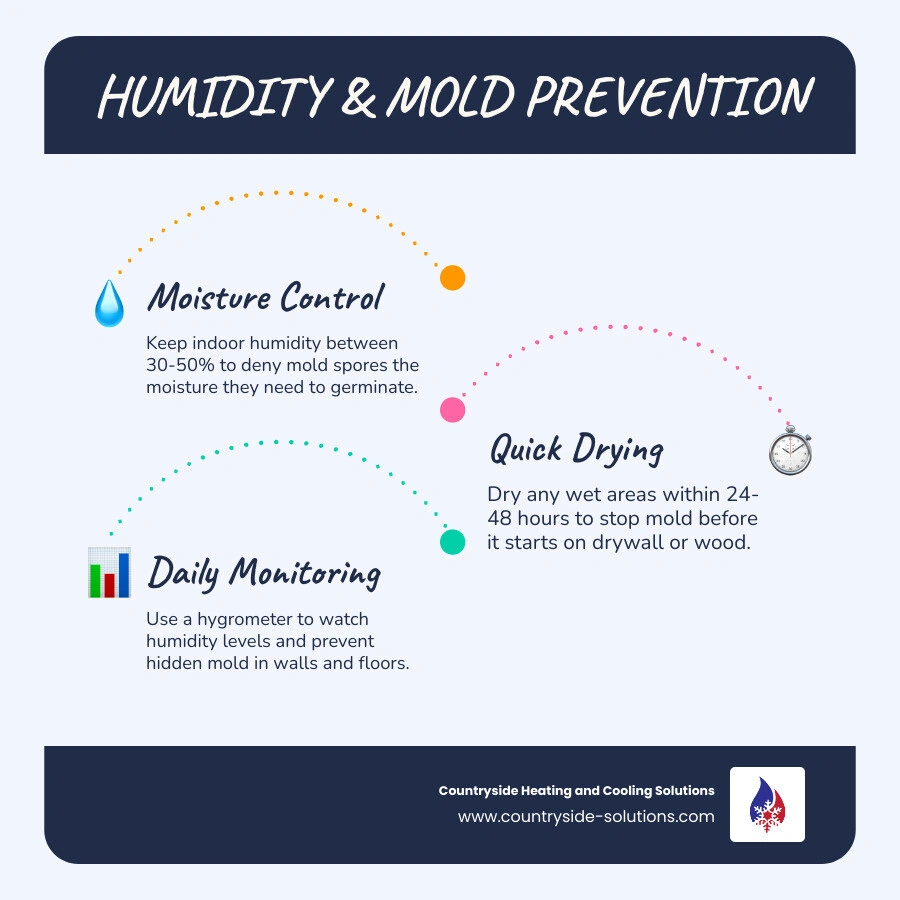
- Keep indoor humidity between 30% and 50% (EPA and ASHRAE recommendation)
- Dry wet or damp areas within 24-48 hours to stop mold before it starts
- Mold risk rises sharply above 60% relative humidity — at 70%+, mold can appear within 24 hours on drywall, wood, or carpet
- Mold spores are always present in your home — controlling moisture stops them from becoming a problem
- You cannot eliminate spores, but you can deny them the moisture they need to colonize
For Minnesota homeowners, this is especially important. The Twin Cities region brings humid summers and tightly sealed homes in winter — two conditions that can quietly push indoor humidity into the danger zone. Mold does not announce itself right away. It grows slowly, often hidden behind walls or under flooring, and by the time you notice a musty smell or see discoloration, it has already taken hold.
The good news? Preventing mold is far easier — and far less costly — than removing it. Controlling moisture in your home is the single most effective step you can take to protect both your family's health and your home's structure.
Understanding How Humidity Control Prevents Mold in Your Home
To truly master mold prevention, we have to look at the science of the "unseen." Mold spores are everywhere—drifting through open windows in Minnetonka or hitching a ride on your coat after a walk in Maple Plain. These spores are harmless until they find a landing spot that meets four specific criteria: a food source (organic matter), oxygen, a comfortable temperature, and—most importantly—moisture.
Since we can’t easily remove oxygen or organic building materials like wood and drywall, moisture is the only factor we can truly control. This is how humidity control prevents mold in your home: by making the environment inhospitable for spore germination.

The Science of Relative Humidity and Water Activity
In the HVAC world, we often talk about Relative Humidity (RH). This is the amount of water vapor present in the air compared to how much the air could hold at that specific temperature. When RH levels stay above 60% for a prolonged period, materials like drywall and carpet backing reach a "water activity" level of 0.75 or higher. At this point, mold doesn't just think about growing; it starts colonizing.
If the RH climbs to 70% or higher, mold can begin to appear within a single day. However, if we keep that RH below 60%, and ideally between 30% and 50%, mold typically remains dormant. It’s still there, but it’s essentially "asleep" and unable to cause damage or release harmful allergens. If you're noticing a lingering damp feeling in your home, it might be time to look into our Indoor Air Quality Services to get things back in balance.
The 24-48 hour rule for moisture
Time is of the essence when it comes to mold. Whether it’s a spilled gallon of milk, a leaky pipe under the sink, or a heavy Minnesota rainstorm that pushed a little water into the basement, you have a very narrow window to act.
Most mold species require 24 to 48 hours of consistent moisture to begin growing. If you can dry out wet or damp materials within this timeframe, you will prevent mold from taking root in most cases. This is why we emphasize quick action for residents needing Whole-House Dehumidification Rockford, MN. Don't let a small spill turn into a structural nightmare.
Why surface temperature matters for mold growth
You might have a hygrometer that says your room is at a safe 45% humidity, yet you still find mold in a corner or behind a couch. Why? This happens because of "microclimates" and cold-condensing surfaces.
When warm, moist indoor air hits a cold surface—like a poorly insulated exterior wall or a window pane during a chilly Minnesota spring—the air cools down rapidly. Since cold air cannot hold as much moisture as warm air, that moisture "drops out" as condensation. This creates a localized area of 100% humidity right on that surface.
Improving air circulation and insulation helps keep surface temperatures above the "dew point," which is the temperature at which condensation forms. If you notice your vents are contributing to a damp smell, check out our guide on 6 Reasons Why Your HVAC Smells Musty to see if condensation inside your ductwork is the culprit.
Identifying the Ideal Indoor Humidity Levels for Minnesota Seasons
In the Twin Cities, we don't just have weather; we have "drama." From the sweltering, sticky days of July to the bone-dry, sub-zero nights of January, our homes go through a lot. Understanding how humidity control prevents mold in your home requires adjusting your targets based on the season.
Mold Risk Level Table
| Relative Humidity (RH) | Mold Growth Risk | Action Recommended |
|---|---|---|
| Below 30% | Very Low | May cause dry skin/static; use a humidifier carefully. |
| 30% - 50% | Ideal | The "Sweet Spot" for health and mold prevention. |
| 50% - 60% | Moderate | Monitor closely; ensure good ventilation in bathrooms. |
| 60% - 70% | High | Mold can colonize within 48 hours. Use a dehumidifier. |
| Above 70% | Very High | Mold can appear within 24 hours. Immediate action needed. |
Maintaining 30-50% RH: How humidity control prevents mold in your home during summer
As we move through May 2026, the outdoor humidity is starting to climb. During a Minnesota summer, the air is thick with moisture. Your air conditioner does double duty: it cools the air and removes moisture. However, sometimes an AC unit alone isn't enough, especially in basements or larger homes in areas like Wayzata.
For many of our neighbors, Whole-House Dehumidification Wayzata, MN is the best solution. These systems work with your HVAC to pull gallons of water out of the air every day, ensuring that even when it’s 90% humidity outside, your living room stays at a crisp, mold-resistant 45%.
Winter moisture management: Preventing condensation in the Twin Cities
Winter brings the opposite problem. We often add moisture to our homes to prevent dry skin and static electricity. But be careful! If you crank your humidifier too high when it's -10°F outside, you'll see frost and water pooling on your windows. This standing water is an invitation for mold to grow on your window sills and wooden frames.
We recommend a winter target of 30-40% RH. If you see condensation on your windows, your humidity is too high for the outdoor temperature. For help finding that perfect balance, read our tips on Choosing the Right Humidifier.
Practical Steps to Reduce Excess Moisture and Prevent Mold
You don't always need high-tech equipment to make a big difference. Many of the ways how humidity control prevents mold in your home involve simple daily habits and minor home maintenance.
Daily Habits for a Drier Home
- Kitchen Vapors: Always use your range hood fan when boiling water or steaming veggies. Cover your pots to keep the moisture in the pan rather than in the air.
- Shower Steam: Run the bathroom exhaust fan during your shower and for at least 15-20 minutes afterward. If you don't have a fan, crack a window (if it's not too humid outside!).
- Laundry: Ensure your clothes dryer vents entirely to the outside, not into a crawl space or attic.
- Plants and Firewood: Houseplants release moisture through transpiration. If you have a "jungle" in your living room, you might be raising the RH. Similarly, don't store large amounts of firewood inside; it releases moisture as it seasons.
Using ventilation to stop mold before it starts
Ventilation is the process of replacing "stale," moist indoor air with "fresh," drier outdoor air (when weather permits). In modern, tightly sealed homes in places like Eden Prairie or Maple Grove, moisture can get trapped inside with nowhere to go.
This is where mechanical ventilation becomes a lifesaver. Installing an air exchanger can help balance your home’s pressure and moisture levels automatically. Learn more about The Need for an Air Exchanger in Your Home to see how it can refresh your indoor environment.
Identifying hidden moisture sources and high-humidity problem areas
Sometimes the moisture isn't coming from your shower—it's coming from the ground. In many Minnesota homes, basements and crawl spaces are the primary "mold zones."
- Check for Grading: Ensure the ground around your home slopes away from the foundation.
- Gutter Maintenance: Clean your gutters regularly so water doesn't pool near your basement walls.
- Vapor Barriers: In crawl spaces, a plastic vapor barrier over the dirt can stop moisture from rising into your floor joists.
If your basement always feels a bit "tacky" or smells like an old gym bag, you might benefit from Whole-House Dehumidification Chanhassen, MN. These units are much more powerful and efficient than the portable ones you might find at a big-box store.
Advanced Solutions: Dehumidifiers and HVAC Maintenance
When DIY steps aren't enough, it’s time to look at your home’s "lungs"—the HVAC system. A well-maintained system is the most powerful tool in your arsenal for how humidity control prevents mold in your home.
The Role of the AC Coil and Drip Pan
Inside your air conditioner is an evaporator coil. As warm air passes over it, moisture condenses on the cold metal and drips into a pan, where it’s drained away. If this coil is dirty or the drain line is clogged, you’ve got a recipe for mold growth right inside your ductwork. Our NATE-certified technicians specialize in keeping these components clean and functional, ensuring your system removes moisture effectively. Check out our Indoor Air Quality Services for a full system health check.
Why whole-house systems are the best way how humidity control prevents mold in your home
Portable dehumidifiers are fine for a single small room, but they have limitations. You have to empty the buckets constantly, they can be noisy, and they only treat the air in their immediate vicinity.
A whole-house dehumidifier is integrated directly into your ductwork. It monitors the humidity of the air returning from every room in the house and removes moisture before sending the air back out.
- Automatic Regulation: You set it and forget it.
- Energy Efficiency: These systems are designed to handle large volumes of air more efficiently than several small portables.
- Comprehensive Protection: It protects your hardwood floors, your furniture, and your drywall in every corner of the home, from the attic to the basement.
For residents in Medina, we often recommend Whole-House Dehumidification Medina, MN as a permanent solution to seasonal dampness.
Professional help for persistent moisture issues
If you’ve noticed visible mold covering an area larger than 10 square feet (about the size of a standard bath towel), it’s time to call in the professionals. Similarly, if you have experienced a major flood or a long-term hidden leak, structural drying is required to ensure moisture isn't trapped inside the walls.
Painting over mold does nothing. It will just grow through the paint. You must fix the moisture source and properly clean or replace the material. If you smell that tell-tale musty odor but can't see the source, it might be hidden in your vents. Read more about 6 Reasons Why Your HVAC Smells Musty to troubleshoot the problem.
Frequently Asked Questions About Mold and Humidity
What are the health risks of high indoor humidity?
High humidity doesn't just invite mold; it also encourages dust mites. Both are major triggers for allergies and asthma. Mold produces allergens, irritants, and in some cases, potentially toxic substances called mycotoxins. Exposure can lead to sneezing, runny noses, red eyes, and skin rashes. For those with compromised immune systems or chronic lung diseases, mold can even lead to more serious infections like hypersensitivity pneumonitis.
Can mold grow if I don't see standing water?
Absolutely. This is a common misconception! Mold doesn't need a "puddle" to grow. If your air is consistently above 70% relative humidity, the microscopic layer of moisture on your walls, clothes, and books is enough for spores to germinate. This is why using a hygrometer (a digital humidity meter) is so important—it tells you there’s a problem before you can see it.
Is a portable dehumidifier enough to prevent mold?
It depends on the size of the problem. If you have a small, damp closet, a portable unit might work. However, for a typical Minnesota basement or a multi-story home, a portable unit usually lacks the "reach" to lower the humidity everywhere. Plus, if the unit stops running because the bucket is full, the humidity will spike again, giving mold a chance to grow. A whole-home system offers much more consistent protection.
Conclusion
At Countryside Heating and Cooling Solutions, we’ve been helping our neighbors in Maple Plain, Minnetonka, and across the Twin Cities stay comfortable since 1974. As a family-owned business, we know that your home is your sanctuary, and keeping it mold-free is essential for your peace of mind.
Mastering how humidity control prevents mold in your home isn't just about buying a piece of equipment; it's about creating a balanced environment where your family can breathe easy. Whether you need a NATE-certified technician to inspect your AC coils or you're ready to upgrade to a whole-home moisture control system, we are here to help.
Don't wait for a musty smell to tell you there's a problem. Be proactive about your home's health. Explore our Indoor Air Quality Services today and let us help you find the perfect moisture balance for your Minnesota home. From Buffalo to Wayzata and everywhere in between, we’re your partners in home comfort and safety.
