.webp)

Why Understanding How Modern Heat Pumps Handle Extreme Cold Matters for Twin Cities Homeowners
How modern heat pumps handle extreme cold comes down to a combination of advanced compression technology, specialized refrigerants, and intelligent system design — and the short answer is: they work remarkably well, even in Minneapolis winters.
Quick answer for homeowners:
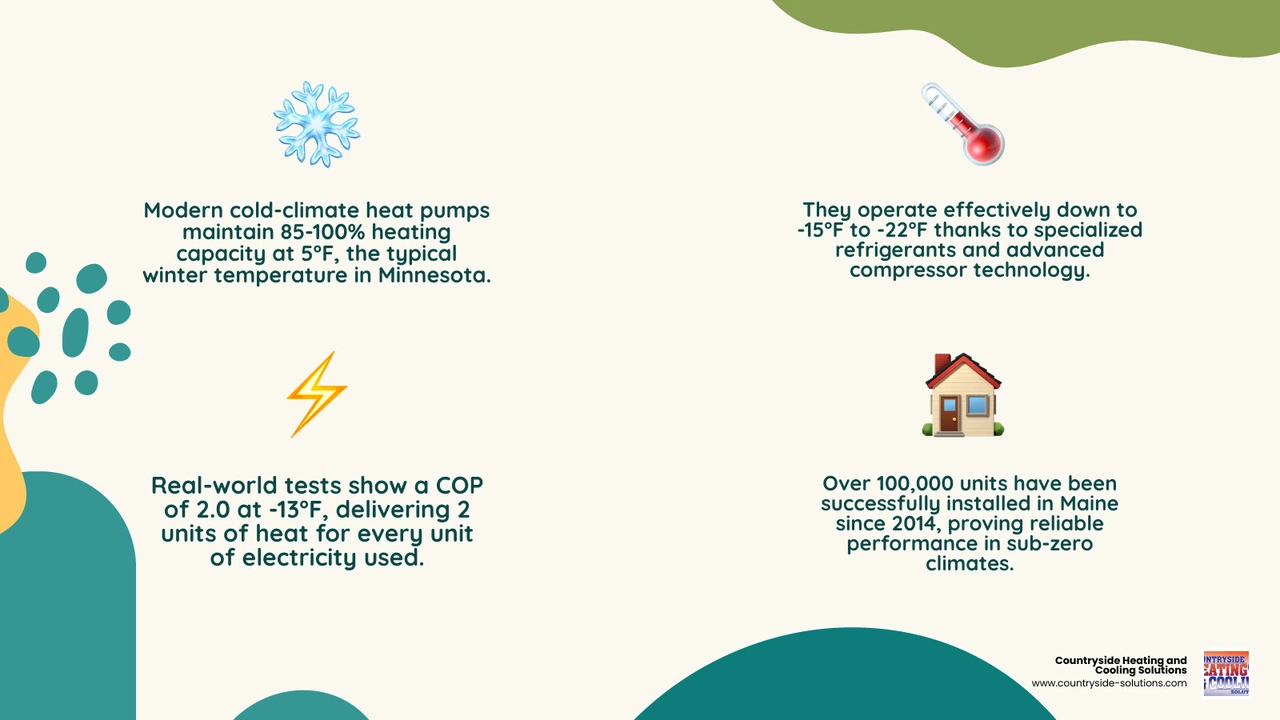
- Modern cold-climate heat pumps operate effectively down to -15°F to -22°F
- They maintain 85-100% heating capacity at 5°F — temperatures common in Minnesota
- Key technologies include variable-speed inverter compressors and vapor injection (EVI)
- Real-world field testing recorded a COP of 2.0 at -13°F — meaning 2 units of heat per unit of electricity used
- Eight major manufacturers have successfully tested cold-climate units in sub-zero conditions
- Over 100,000 units have been installed and proven in Maine since 2014, a climate comparable to Minnesota
If you've ever heard that heat pumps don't work up north, that reputation belongs to older equipment. Today's cold-climate heat pumps are a different technology entirely.
For many Twin Cities homeowners, winter is the make-or-break season for any heating system. When temperatures in Minnetonka, Maple Plain, or Minnetrista plunge below zero, the stakes are real — comfort, safety, and energy bills all hang in the balance. The good news is that modern cold-climate heat pumps are specifically engineered for exactly this kind of challenge. One Minneapolis-area homeowner even documented their system maintaining warmth during a cold snap that hit -29°F. That kind of performance would have been unthinkable from a heat pump just 20 years ago.
Learn the Facts About Heat Pumps
This guide breaks down exactly how these systems work in extreme cold, what technologies make it possible, and what Twin Cities homeowners should know before choosing one.
How Modern Heat Pumps Handle Extreme Cold
To understand how modern heat pumps handle extreme cold, we have to bust a very common myth: the idea that cold air has no heat in it.
To us humans walking around Lake Minnetonka in January, 0°F feels absolutely freezing. But from a physics perspective, heat energy is relative. Absolute zero—the point at which there is absolutely zero heat energy—is -459.67°F (-273.15°C). This means that even when the outdoor air is a bone-chilling 0°F, it still contains about 85% of the thermal energy that it does at 70°F.
A heat pump’s job is not to create heat through combustion (like a gas furnace does), but rather to capture this existing environmental heat and move it indoors.
The Physics of How Modern Heat Pumps Handle Extreme Cold
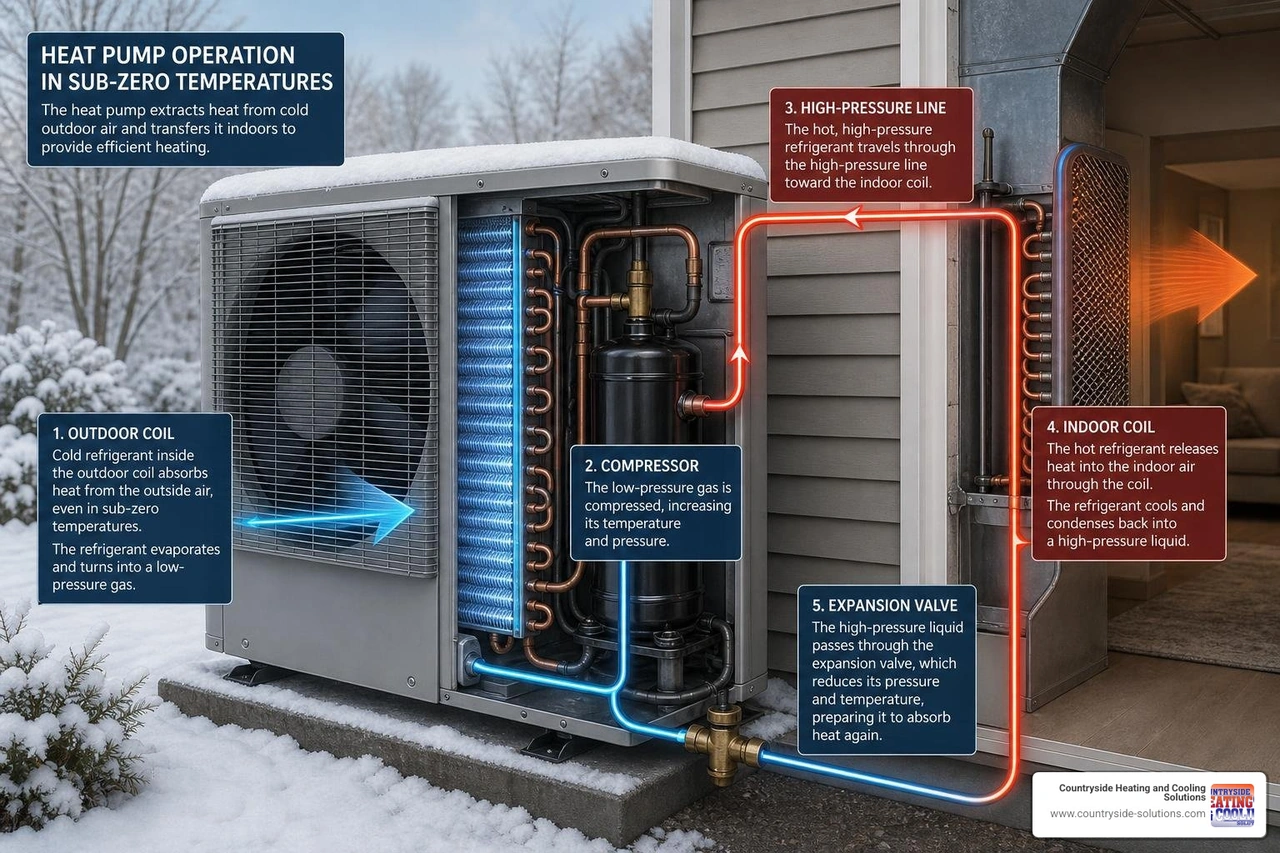
How does a machine grab heat from freezing air? It all comes down to the relationship between pressure, temperature, and the boiling point of refrigerants.
The refrigerants used in modern cold-climate heat pumps are formulated to have incredibly low boiling points—often as low as -40°F to -50°F. When this super-chilled liquid refrigerant is circulated through the outdoor coil, it is actually much colder than the freezing outdoor air. Because heat naturally flows from a warmer area to a colder area, the "warm" 5°F or -15°F outdoor air transfers its heat into the even colder refrigerant.
As the refrigerant absorbs this heat, it boils and turns into a low-pressure gas. The system then pumps this gas into the indoor compressor, where it is highly compressed. Compressing a gas packs its molecules tightly together, which causes its temperature to skyrocket. This super-heated gas is then sent to your indoor coil, where a fan blows air across it, distributing warm, comfortable air throughout your home.
This thermodynamic magic works efficiently even when temperatures drop to -15°F or lower. Knowing What Temperature Should Heat Pump Be Set can help you maximize this physical process for peak efficiency during our coldest months.
Key Technologies That Enable Low-Ambient Heating
Older, standard heat pumps were essentially "single-stage" systems. They were either 100% on or 100% off. When the outdoor temperature dropped below 35°F, they quickly lost their ability to extract heat and had to rely entirely on expensive backup electric resistance heat.
Modern cold-climate heat pumps (often called CCHPs) are engineered with a suite of advanced technologies that change the game entirely:
- Variable-Speed Inverter Compressors: Unlike old single-stage compressors that run like a light switch, inverter-driven compressors operate more like a dimmer switch. They can modulate their speed in tiny increments, running anywhere from 10% to 100% capacity. In extreme cold, they speed up to extract maximum heat; in milder weather, they slow down to conserve energy.
- Enhanced Vapor Injection (EVI): This is the true "secret weapon" of sub-zero performance. Vapor injection technology takes a portion of the refrigerant, flashes it into a cool vapor, and injects it directly into the compressor mid-cycle. This lowers the compressor's operating temperature, allowing it to compress the remaining refrigerant to much higher pressures (and temperatures) without overheating. This keeps the system running strong down to -15°F and beyond.
- Electronic Expansion Valves (EEVs): While older systems used mechanical valves that struggled to adapt to changing temperatures, modern systems use electronic valves. These adjust the flow of refrigerant with extreme precision based on real-time sensor data, ensuring the heat pump operates at peak efficiency regardless of how crazy the Minnesota weather gets.
- Oversized Outdoor Coils: Cold-climate models feature physically larger outdoor coils with advanced fin designs. This increases the surface area available to absorb heat, allowing the system to capture more warmth from the surrounding air even in a deep freeze.
Cold-Climate vs. Standard Heat Pumps: Performance and Efficiency
When comparing standard heat pumps to dedicated cold-climate models, the differences in capacity retention and efficiency are stark. Standard units are designed primarily for southern climates where heating is a secondary concern. Cold-climate models, on the other hand, are built to survive and thrive in northern winters.
Below is a direct comparison of how these two types of equipment perform when the temperature drops:
| Performance Metric | Standard Heat Pump | Cold-Climate Heat Pump (CCHP) |
|---|---|---|
| Minimum Operating Temp | 25°F to 30°F | -15°F to -22°F |
| Capacity Retention at 5°F | Drops to ~40% to 50% of rated capacity | Maintains 85% to 100% of rated capacity |
| Capacity Retention at -13°F | Near zero (system shuts down) | Maintains 70% to 85% of rated capacity |
| Average COP at 5°F | 1.0 (equivalent to electric resistance) | 1.75 to 2.2 (up to 2x more efficient) |
| Compressor Technology | Single or Two-Stage | Variable-Speed Inverter |
| Vapor Injection (EVI) | No | Yes (in premium models) |
For a deeper dive into how these systems stack up against other heating options, check out our comprehensive Heat Pump Comparison page.
Real-World Testing of How Modern Heat Pumps Handle Extreme Cold
We don't have to rely purely on laboratory data to know that modern heat pumps work in harsh winters. Extensive field testing in cold climates has provided concrete numbers on how these systems perform in the wild.
- The COP Factor: The Coefficient of Performance (COP) measures a system's efficiency. A COP of 3.0 means that for every 1 unit of electricity the system consumes, it delivers 3 units of heat into your home. Traditional electric baseboard heaters have a COP of exactly 1.0. Field testing shows that modern cold-climate heat pumps maintain a COP of 2.0 to 2.5 at 15°F and still deliver a COP of 1.5 to 2.0 at -13°F. Even at these extreme temperatures, they are still significantly more efficient than standard electric heat.
- Minnesota Field Assessments: Studies conducted in the Upper Midwest have shown that cold-climate heat pumps successfully kept homes warm through prolonged sub-zero stretches, outperforming traditional electric resistance heating even during cold snaps below -12°F.
- Global Proof: In countries like Norway, Sweden, and Finland—where winter temperatures regularly plunge below -22°F—heat pumps are incredibly popular. In fact, Norway has more than 60 heat pumps per 100 households, proving that the technology is more than capable of handling serious winter weather.
Sizing, Installation, and Winter Maintenance Best Practices
Even the most advanced cold-climate heat pump will struggle if it isn't sized and installed correctly. Because heat pumps behave differently than standard gas furnaces, they require a specialized approach to installation.
- The Critical Manual J Calculation: Many traditional contractors size heating systems using simple "rules of thumb" based on square footage. For a variable-speed heat pump, this is a recipe for disaster. We perform a detailed room-by-room Manual J load calculation to determine your home's exact heating and cooling needs.
- The Danger of Oversizing: With gas furnaces, slightly oversizing the unit doesn't cause major issues. With variable-speed heat pumps, however, oversizing is actively harmful. An oversized inverter compressor will constantly "short-cycle" (turn on and off rapidly) instead of running in long, efficient, low-speed cycles. This short-cycling increases wear and tear, hurts dehumidification in the summer, and can drop your seasonal efficiency by 10% to 20%.
- Proper Outdoor Elevation: In places like Wayzata, Minnetonka, and Maple Grove, winter snow accumulation is a given. Outdoor heat pump units must be mounted on heavy-duty stands that elevate them 12 to 18 inches above the ground. This keeps the unit clear of snow drifts and allows meltwater to drain freely away during defrost cycles.
- Strategic Placement: The outdoor unit should be placed away from roof valleys where snow or ice could shed directly onto it. It should also be shielded from prevailing winter winds, which can interfere with the defrost process.
If you're planning an upgrade, read our local guides: Heat Pump Installation Guide Minnetonka MN and Heat Pump Installation Wayzata MN Guide.
Managing Defrost Cycles and Winter Maintenance
Because the outdoor coil of a heat pump gets incredibly cold, moisture in the outdoor air will naturally freeze on the coil's surface. This frost buildup acts as an insulator, reducing the system's ability to absorb heat. To handle this, modern heat pumps are equipped with automatic defrost cycles.
- Adaptive Defrost Algorithms: Older systems used simple, caveman-style timers that initiated a defrost cycle every 30, 60, or 90 minutes regardless of whether frost was actually present. Modern cold-climate systems use intelligent adaptive defrost. By measuring coil temperature, outdoor humidity, compressor RPM, and runtime patterns, they only run a defrost cycle when absolutely necessary.
- How Defrost Works: During a defrost cycle, the heat pump temporarily reverses its operation, sending warm refrigerant back to the outdoor coil to melt the ice. This process only takes a few minutes.
- What You Might Experience: During a defrost cycle, you might hear a brief change in compressor sound, see steam rising from the outdoor unit, or notice a slight whooshing noise. These are completely normal behaviors, but if you ever hear anything concerning, our guide on Heat Pump Making Strange Noises can help you troubleshoot.
To ensure your system is ready for the heavy lifting of a Minnesota winter, scheduling annual professional maintenance is highly recommended. Learn more in our Heat Pump Maintenance Wayzata MN Guide.
Backup Heating and Economic Considerations in Cold Climates
While modern cold-climate heat pumps can handle the vast majority of our winter weather, the extreme lows of a Twin Cities polar vortex mean that backup heating is still an important part of the conversation.
There are two primary ways to configure backup heat with a CCHP:
- Electric Resistance Heat Strips: These are heating coils installed directly inside your indoor air handler. They act like a giant hair dryer, providing 100% efficient heat when the outdoor temperature drops below the heat pump's operational limit. While cheap to install, electric resistance is expensive to run.
- Dual-Fuel (Hybrid) Systems: This is often the most practical and economical setup for Twin Cities homes. A dual-fuel system pairs an electric cold-climate heat pump with a high-efficiency gas furnace. The heat pump handles all the heating duties down to a specific "balance point" (usually between 10°F and 30°F, depending on utility rates). When it gets colder than that, the system automatically switches over to the gas furnace. This gives you the best of both worlds: ultra-efficient electric heating for most of the winter, and the intense, reliable heat of gas combustion for the deepest freezes.
Switching to a heat pump also opens up excellent financial incentives. Between local utility rebates and federal programs, you can significantly offset your upfront investment. Read more about these opportunities in our guide on Federal Tax Credits for Heat Pump Upgrades.
Deciding If Your Home Needs a Backup Heating System
Determining whether you need backup heat—and what kind—depends heavily on your home's insulation, existing ductwork, and your personal comfort preferences.
- The Balance Point: Every home has a thermal "balance point"—the outdoor temperature at which the heating load of the home exactly matches the maximum heating capacity of the heat pump. Below this temperature, the heat pump needs auxiliary help to maintain your indoor setpoint.
- Ductwork and Insulation: If your home is older and drafty, or if your ductwork is uninsulated, your heat loss will be higher, meaning you'll reach your balance point sooner. Upgrading your home's insulation and air sealing before installing a heat pump is one of the best ways to maximize your system's performance.
If your system ever struggles during an unexpected cold snap, we are here to help. Check out our Heat Pump Repair Wayzata MN Guide and keep our 24 Hour Heat Pump Repair Wayzata MN Guide handy for emergency winter service.
Frequently Asked Questions About Low-Ambient Heating
Do heat pumps work in sub-zero temperatures?
Yes! Modern cold-climate heat pumps are specifically designed and tested to operate effectively in sub-zero temperatures. High-performance models can continue extracting heat from the air down to -15°F or even -22°F. While their efficiency (COP) decreases as the temperature drops, they still remain more efficient than traditional electric resistance heating.
What certifications should I look for in a cold-climate heat pump?
When shopping for a system, look for models that are certified by the Northeast Energy Efficiency Partnerships (NEEP). The NEEP cold-climate air-source heat pump database is the gold standard for verifying true low-ambient performance. You should also look for the ENERGY STAR Cold Climate designation and check the system's AHRI (Air-Conditioning, Heating, and Refrigeration Institute) low-ambient ratings to confirm its capacity at 5°F and below.
How long do cold-climate heat pumps last?
A high-quality cold-climate heat pump typically has a lifespan of 15 to 20 years for the outdoor compressor and 20 to 25 years for the indoor air handler. Because these systems run for longer, more consistent cycles compared to traditional on/off furnaces, they experience less start-stop wear and tear. Regular professional maintenance and keeping the outdoor unit clear of snow and debris are key to maximizing their lifespan.
Conclusion
Modern cold-climate heat pumps are no longer a technology reserved only for mild southern climates. Thanks to advanced engineering like variable-speed inverter compressors, vapor injection, and intelligent defrost systems, they are now a highly viable, energy-efficient, and reliable heating solution for homes throughout the Twin Cities metro area.
At Countryside Heating and Cooling Solutions, we’ve been keeping our neighbors warm and comfortable since 1974. Our team of NATE-certified technicians has the training, experience, and local expertise to design, install, and maintain the perfect heat pump system for your home. Whether you live in Maple Plain, Minnetonka, Wayzata, or anywhere in the surrounding western suburbs, we are committed to providing quality workmanship and guaranteed next-business-day service.
Ready to see how a modern heat pump can transform your winter comfort and lower your energy bills? Contact us today to schedule a consultation with our comfort specialists, and explore our heat-pump services to get started!
