.webp)

Why Hot, Humid Summers Cost Minnesota Homeowners So Much to Cool
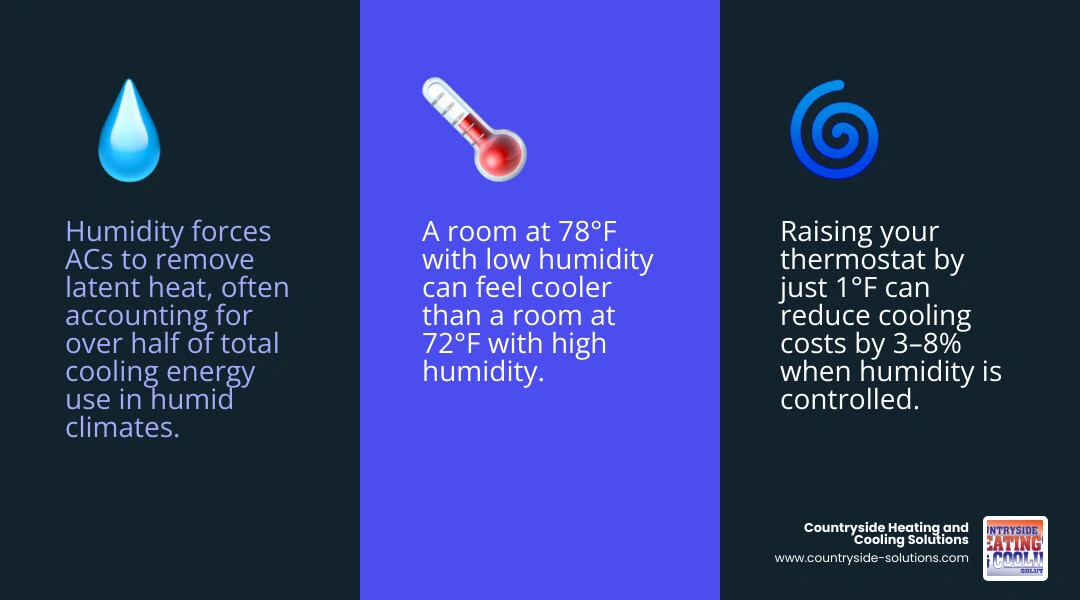
Reducing cooling costs during hot, humid weather starts with understanding why humidity makes your AC work so much harder than the temperature alone would suggest. In the Minneapolis–Saint Paul area, summer air doesn't just feel hot — it feels heavy. That extra moisture in the air forces your cooling system to tackle two problems at once: lowering the temperature (sensible heat) and pulling water vapor out of the air (latent heat). That dual workload is a major reason why cooling can account for anywhere from 40% to 60% of a home's total annual energy costs in humid climates.
Here's a quick breakdown of the most effective ways to reduce your cooling costs this summer:
- Set your thermostat to 78°F when home — every degree lower adds roughly 3–8% to your cooling bill
- Use ceiling fans to feel comfortable at higher thermostat settings without extra cost
- Control indoor humidity with exhaust fans, proper ventilation, or a dehumidifier
- Seal air leaks around windows, doors, and ductwork to stop humid outdoor air from sneaking in
- Change your AC filter monthly during peak cooling season to maintain efficiency
- Close blinds on south- and west-facing windows during peak sun hours — reflective blinds can cut heat gain by up to 45%
- Schedule annual professional AC maintenance to keep your system running at peak efficiency
- Consider upgrading to a higher-SEER2 system or adding whole-home dehumidification if your current setup is struggling
The key insight most homeowners miss: a room at 78°F with low humidity can actually feel more comfortable than a room at 72°F with high humidity. Managing moisture isn't just about comfort — it directly reduces how hard your AC has to run, and that shows up on your energy bill.
Smart Habits for Reducing Cooling Costs during Hot Humid Weather

When the sweltering heat of a Minnesota July rolls around, many homeowners in Chanhassen, Minnetonka, and Wayzata immediately run to their thermostats to crank down the temperature. However, creating a comfortable indoor environment without sending your electric bill into the stratosphere is entirely possible through smart, daily habits.
To start, let’s talk about window management. Did you know that roughly 40% of unwanted heat enters your home through your windows? During the sunniest parts of the day, your windows act like giant radiators. By closing your curtains, blinds, or shades—especially on south- and west-facing windows—you can dramatically block solar heat gain. Highly reflective blinds can reduce heat gain by around 45% when they are completely closed and lowered on a sunny window. If you want to take it a step further, installing properly designed exterior awnings can reduce solar heat gain by up to 65% on southern windows and 77% on eastern windows.
Another simple habit is optimizing your ceiling fans. It is important to remember that fans cool people, not rooms. They create a wind-chill effect by evaporating moisture from your skin, making the air feel about 4°F cooler than it actually is. Because of this, you can comfortably set your thermostat higher without sacrificing comfort. However, because fans don't actually lower the air temperature, leaving them running in empty rooms is just wasting electricity. Always turn them off when you leave the room!
By combining these simple behavioral shifts, you can significantly ease the strain on your air conditioner. For a deeper look at these foundational adjustments, check out our guide on 8 Ways to Save on Air Conditioning Costs.
Thermostat Strategies for Reducing Cooling Costs during Hot Humid Weather
Your thermostat is the command center of your home comfort, and how you program it makes a massive difference on your monthly utility statement. The U.S. Department of Energy estimates that most households can save around 3% on cooling bills for every single degree the thermostat is moved up.
If you are still adjusting your thermostat manually throughout the day, it’s time to let technology do the heavy lifting. Programmable and smart thermostats allow you to establish automated schedules that align with your family's routine.
To maximize your savings, consider these recommended temperature targets:
- 78°F when you are at home and awake.
- 82°F overnight while you are sleeping (paired with a ceiling fan over your bed for airflow).
- 85°F when you are away from the home for more than a few hours.
A common mistake is turning the AC completely off when leaving for work, thinking it saves energy. In a highly humid climate like ours in the western Twin Cities suburbs, turning the system completely off allows heat and heavy moisture to saturate your drywall, carpets, and furniture. When you return and switch the AC back on, the system has to work in "marathon mode" for hours to remove that massive latent load. Instead, use a moderate setback temperature of 82°F to 85°F. This keeps the humidity under control while preventing the compressor from running unnecessarily.
For more details on setting up an economical cooling schedule, read our expert tips on 5 Ways to Reduce Your Cooling Costs This Summer.
Passive Ventilation and Fan Best Practices
To make the most of your fans, you must ensure they are working with the seasons. In the summer, your ceiling fans should rotate counterclockwise at medium to high speed. This direction pushes a cool column of air straight down, creating the breeze you need to feel comfortable.
In addition to ceiling fans, some homeowners use whole-house fans or practice "night flushing." This technique involves opening windows during cool, dry evenings to purge the warm indoor air, then sealing the house tight first thing in the morning. While this building-science technique works beautifully in arid climates, you must use caution in Minnesota. If the overnight outdoor humidity is incredibly high, opening your windows will actually invite gallons of water vapor inside, which your AC will have to work twice as hard to remove the next day. Only use natural ventilation when the outdoor dew point is comfortably low.
Managing the Latent Load: Humidity Control Strategies
When we talk about "cooling," we aren't just talking about lowering the temperature on a thermometer. In places like Mound, Excelsior, and Loretto, humidity is the real enemy. High humidity levels (above 60%) prevent your sweat from evaporating, leaving you feeling sticky, hot, and miserable even if your thermostat says it is 72°F. Furthermore, excess indoor moisture promotes mold growth, musty odors, and can even warp wood flooring.
To combat this, your home's ventilation systems must be used strategically. Always run your bathroom exhaust fans during showers and for at least 20 minutes afterward to vent that hot, humid steam directly outside. Similarly, run your kitchen range hood while boiling water or cooking. Ensure these exhaust fans actually vent to the outdoors rather than simply recirculating air back into the kitchen or attic.
For comprehensive moisture control, many homeowners look into dedicated dehumidification. Below is a comparison of your two primary options:
| Feature | Portable Dehumidifiers | Whole-Home Dehumidifiers |
|---|---|---|
| Coverage Area | Single room or small basement | Entire home via existing ductwork |
| Energy Efficiency | Low (runs on standard 110V, often runs constantly) | High (optimized to work alongside your central HVAC) |
| Maintenance | High (must manually empty water buckets daily) | Low (drains automatically into your home’s plumbing) |
| Noise Level | Moderate to high inside the living space | Virtually silent (installed in the utility room) |
| Lifespan | 3 to 5 years | 10 to 15 years |
Dehumidifiers as a Secret Weapon for Reducing Cooling Costs during Hot Humid Weather
If you want to truly slash your cooling bills, a whole-home dehumidifier is your secret weapon. Because standard air conditioners are designed primarily to lower the temperature, they only dehumidify as a byproduct of the cooling cycle. On mild but incredibly humid days, your AC may "short-cycle"—meaning it cools the room quickly and shuts off before it has a chance to pull moisture out of the air. This leaves you with a cold, damp, and uncomfortable home.
By installing a whole-home dehumidifier integrated into your return ductwork, you offload the moisture-removal process from your AC. The dehumidifier targets the latent load using far less electricity than your central air conditioner's heavy compressor.
With the humidity safely maintained between 30% and 50%, your sweat evaporates naturally, making 78°F feel like a breezy 74°F. This allows you to raise your thermostat setpoint significantly, reducing your AC's runtime and extending its overall lifespan. In fact, studies show that pairing a whole-home dehumidifier with central AC can cut space-conditioning energy use by over 8% annually.
Room-by-Room Moisture and Heat Reduction
Beyond mechanical systems, you can curb indoor heat and moisture generation room by room:
- The Kitchen: Avoid using your oven or stovetop during the hottest parts of the day. Large cooking appliances release massive amounts of dry and wet heat into your living spaces. Instead, fire up the outdoor grill, use a toaster oven, or utilize the microwave (which cooks faster and emits up to 90% less heat than a traditional oven).
- The Laundry Room: Postpone running your clothes dryer until the evening. Dryers pull air from inside your home and vent it outside, which forces warm, humid outdoor air to infiltrate your home through tiny cracks and gaps. Always make sure to wash full loads to maximize efficiency.
- The Bathroom: Take shorter, tepid showers rather than steaming hot baths. Tepid water keeps you cool without releasing excessive moisture into the air.
- The Living Areas: If you have a green thumb, keep an eye on your indoor plants. Plants release moisture into the air through transpiration. During peak humid weeks, consider moving moisture-loving plants to a porch or patio.
High-ROI Maintenance and Home Sealing Upgrades
Many homeowners look for major equipment upgrades when trying to cut costs, but the highest return on investment (ROI) often comes from simple, preventative maintenance and sealing.
The single most important DIY task is checking and replacing your air filter. During the peak summer cooling season in Medina or Plymouth, your AC runs for hours on end. A dirty, clogged filter restricts airflow, forcing the blower motor to work harder and consume significantly more electricity. Replacing a dirty filter with a clean one can reduce your system's energy consumption by 5% to 15%. For the best balance of filtration and system airflow, we recommend using a filter rated between MERV 8 and MERV 11, and checking it every 30 days.
Additionally, keep your outdoor condenser unit clear of grass clippings, cottonwood seeds, and overhanging brush. The outdoor unit needs at least two feet of clear space around it to properly release the heat it gathered from inside your home.
To keep your system running safely, efficiently, and to prevent sudden mid-summer breakdowns, check out our checklists on AC Maintenance Tips to Increase the Performance of Your Unit and Summer HVAC Maintenance Tips.
Sealing the Building Envelope and Ductwork
All the cold air your AC produces won't do much good if it is leaking right out of your home. Sealing air leaks prevents humid outdoor air from infiltrating your living spaces.
Start by inspecting your windows and doors. If you can see daylight around your door frames or feel a draft, apply fresh caulk or replace worn weatherstripping.
Next, look up. About one-third of unwanted heat builds up through your roof. Ensure your attic is properly sealed and insulated to keep that heat from radiating down into your bedrooms. A ventilated attic is about 30°F cooler than an unventilated one, which dramatically reduces the heat load on your ceiling. If you want to boost your attic's defense, consider adding a radiant barrier, which can reduce heat gains through your ceiling by about 25%.
Finally, don't ignore your ductwork. In the average home, leaky ducts waste 20% to 30% of the conditioned air before it ever reaches your vents. Sealing those duct joints with specialized mastic or foil tape keeps the cool air where it belongs. For more home envelope tips, read our 6 Best Summer Maintenance Tips for Your Air Conditioner.
When to Call an HVAC Professional
While checking filters and cleaning debris around your outdoor unit are great DIY tasks, some cooling issues require professional expertise.
You should call a licensed professional if you notice:
- Short-Cycling: Your AC turns on and off rapidly every few minutes. This strains the compressor and fails to dehumidify your home.
- Ice on the Coils: Frozen indoor or outdoor coils usually point to restricted airflow or a refrigerant leak.
- Warm Air: If the air blowing from your registers feels lukewarm, your system may have electrical issues or low refrigerant.
- Uneven Cooling: Rooms on upper floors are sweltering while the basement is freezing.
- Unusual Noises: Loud squealing, banging, or whistling sounds coming from your indoor or outdoor units.
Having a certified technician address these issues promptly will keep your system running efficiently and protect your wallet from major compressor failures down the road. Learn more about how expert care keeps your utility bills low by reading Professional AC Service Reduce Energy Bills.
Upgrading to High-Efficiency Cooling Systems
If your air conditioner is more than 10 to 15 years old, it may be time to consider an upgrade. Older systems operate at much lower efficiency levels, and as they age, mechanical wear causes them to consume even more electricity.
Modern air conditioners are rated by SEER2 (Seasonal Energy Efficiency Ratio 2). The higher the SEER2 rating, the more efficiently the system converts electricity into cooling. Upgrading from an old 10 SEER unit to a modern high-efficiency SEER2 system can cut your cooling costs by 20% to 40%.
When shopping for a new system, look for variable-capacity (or variable-speed) compressors. Unlike traditional single-stage systems that run at either 100% capacity or 0%, variable-speed systems adjust their output precisely to match your home's cooling demand. They can run at lower speeds for longer periods, which allows them to constantly and quietly extract moisture from the air, providing unmatched comfort in humid weather.
To learn more about finding the perfect system for your home's layout, read our guide on What Size AC Do You Need and explore options for Energy Efficient Air Conditioner Replacement Near Eden Prairie.
Financial Incentives and Rebates in 2026
Upgrading to a high-efficiency system is a smart long-term investment, and federal and local programs in 2026 make it more accessible than ever. Under the Energy Efficient Home Improvement Credit (Section 25C of the Inflation Reduction Act), homeowners can qualify for federal tax credits of up to 30% of the cost of qualifying high-efficiency cooling upgrades, including advanced heat pumps.
Additionally, local utility providers in the Minneapolis–Saint Paul area (such as Xcel Energy and CenterPoint Energy) offer generous rebates for installing Energy Star-certified central air conditioners, ductless mini-splits, and smart thermostats.
To see if making the switch makes financial sense for your home, explore our breakdown: Is a Higher Efficiency Rating Worth the Extra Cost and discover What Is the Most Energy Efficient Type of Air Conditioner.
Frequently Asked Questions About Summer Cooling
Is it cheaper to leave the AC on all day or turn it off when away?
It is more cost-effective to leave your air conditioning on but at a higher "setback" temperature (such as 82°F to 85°F) while you are away. Turning the system completely off allows heat and humidity to saturate your home's structure and furnishings. When you return, your AC will have to run continuously for hours to remove that heavy moisture load, putting immense strain on the compressor and consuming more energy than if you had maintained a moderate setback temperature.
Does a dehumidifier actually lower cooling bills?
Yes! While a dehumidifier uses electricity to run, it extracts moisture much more efficiently than a standard air conditioner. By lowering the indoor relative humidity to between 30% and 50%, your body’s natural evaporative cooling works much better. This allows you to comfortably raise your thermostat setpoint by 4°F or more, resulting in a net reduction in your overall energy consumption.
Does closing vents in unused rooms save money?
No, this is a common myth that can actually damage your system. Modern HVAC systems are designed to distribute air based on specific pressure balances. Closing vents increases the static pressure within your ductwork, which can cause air leaks, reduce system airflow, and put extra strain on your blower motor. Over time, this can lead to frozen coils, a cracked heat exchanger, or premature compressor failure. Keep all registers open and clear of furniture for optimal efficiency.
Conclusion
Reducing your cooling costs during hot, humid weather doesn't mean you have to suffer through a sticky, uncomfortable summer. By adopting smart thermostat habits, managing indoor moisture, keeping up with basic maintenance, and sealing up your home's envelope, you can keep your home comfortable while keeping your utility bills under control.
When you need professional help to keep your cooling system running at peak performance, Countryside Heating and Cooling Solutions is here for you. Based in Maple Plain, MN, we proudly serve the entire Minneapolis-Saint Paul metro area, including Minnetonka, Medina, Eden Prairie, and the surrounding western suburbs. As a family-owned business since 1974, we back our work with NATE-certified technicians and a commitment to quality.
Schedule professional air conditioning services today to ensure your home stays cool, dry, and energy-efficient all summer long!
