.webp)

The Late-Summer Cooling Dilemma for Minnetonka's Century-Old Properties
The late-summer heat is pushing your window air conditioners to their absolute limit, yet the sticky, oppressive humidity of August still lingers in every room. Retrofitting central air in historic Minnetonka homes without destroying plaster is the ultimate goal for property owners who want modern comfort but refuse to sacrifice their home's original architectural beauty. You already know the unique frustration this season brings: enduring intense heat and noise, or risking permanent damage to the heritage walls that give your property its character.
In our years of providing comprehensive air conditioning solutions across Maple Plain and Minnetonka, our team at Countryside Heating & Cooling Solutions has seen firsthand how Minnesota's late-summer climate transitions from simply being hot to highly humid, making reliable whole-house dehumidification a strict necessity. Window units struggle to remove this heavy moisture, often leaving historic homes feeling damp and smelling musty. The decision point for most homeowners comes down to a difficult choice: suffer through another sweltering late summer with inadequate, noisy window units, or find a minimally invasive retrofit that bypasses the need for destructive traditional ductwork.
Here is the thing our technicians always tell our customers: you do not have to choose between a comfortable home and a beautiful one. Modern HVAC technology has evolved specifically to solve the architectural challenges of older properties. By exploring high-velocity and ductless alternatives, you can achieve whisper-quiet, whole-home cooling while leaving your original moldings, woodwork, and plaster walls completely intact.
The Architectural Reality of Early 1900s Construction
When our team inspects historic Minnetonka early 20th-century homes, we always marvel at the incredible craftsmanship, but we also know they were designed long before modern cooling standards existed. In our experience, the vast majority of these properties relied entirely on radiant boiler heating. Because radiators heat a space using hot water or steam rather than forced air, these houses were constructed without any existing ductwork infrastructure. The wall cavities are often shallow, obstructed by solid wood blocking, and sealed behind some of the most delicate materials used in residential construction.
The Anatomy of Lath and Plaster
We frequently explain to homeowners that to understand why standard HVAC retrofits are notoriously difficult, you have to look at the pre-1950s construction standard. Lath and plaster walls are essentially layered works of art. Builders nailed thin strips of wood (the lath) horizontally across the wall studs. They then applied multiple heavy coats of wet plaster over the wood. The base coat squeezed through the gaps in the lath, drooping down the back to form "keys" that hardened and locked the entire wall together.
• The structural risk: The plaster keys become incredibly brittle after a century.
• The vibration hazard: Cutting into these walls with modern power tools causes intense vibrations that snap the keys off the lath.
• The spiderweb effect: Once the keys break, structural cracking spreads rapidly across the wall, often extending far beyond the original incision point.
This fragility is exactly why cutting large holes into historic walls to accommodate modern vents often results in extensive, costly drywall and plaster repair.
Why Traditional Ductwork Fails Historic Aesthetics
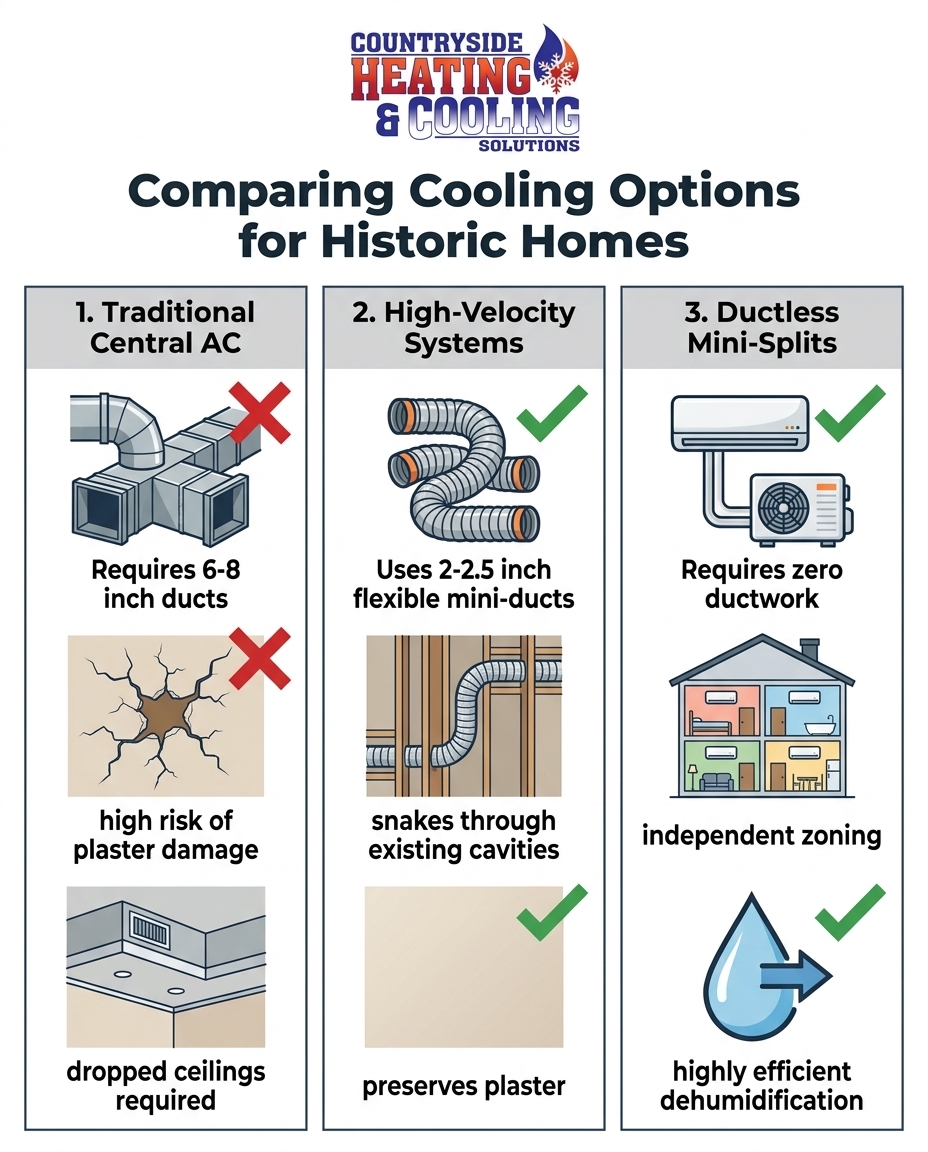
Standard central air requires bulky sheet metal ducts that typically measure 6 to 8 inches in diameter. These massive trunks simply cannot fit inside the narrow, 3.5-inch stud bays of a 1920s wall cavity. When we see the aftermath of other contractors attempting to force traditional systems into heritage homes, the aesthetic compromises are severe.
Homeowners are often forced to accept dropped ceilings, bulky drywall soffits built into the corners of rooms, and the complete loss of valuable closet space just to hide the metal trunks. In rooms with original crown molding or intricate ceiling medallions, boxing in traditional ductwork destroys the historic sightlines that make the property special.
High-Velocity Systems: Invisible Cooling for Heritage Homes
For purists who want central air without the visual clutter, our team highly recommends high-velocity mini-duct systems as the premier, damage-free alternative to traditional forced-air cooling. Instead of relying on massive metal trunks, high-velocity systems utilize narrow, flexible tubing that is typically only 2 to 2.5 inches in diameter.
These systems operate differently than standard air conditioners. While traditional systems dump cold air into a room and wait for it to settle, high-velocity cooling uses an "aspiration" method. The air is delivered at a higher pressure through small, discrete vents. This creates a gentle vortex that continuously mixes the room's air, providing even temperatures from floor to ceiling without creating the cold drafts often felt in older homes.
Routing Mini-Ducts Without Demolition
The true genius of a high-velocity system lies in its flexibility. Because the mini-ducts are small and bendable, they can be snaked through existing wall cavities, routed between floor joists, and navigated around structural obstacles without requiring major demolition.
1. Strategic placement: The main air handler is typically tucked away in an unconditioned space, such as an attic or a basement.
2. Invisible routing: The flexible 2-inch tubing is fed down through interior walls or up through the floorboards, bypassing the delicate lath and plaster entirely.
3. Discreet finishing: The vents themselves are barely larger than a standard recessed light fixture. They can be painted or stained to match original wood floors, plaster ceilings, or heritage trim, allowing them to blend seamlessly into the room's character.
If your home's layout presents unique challenges, another excellent option we frequently install for preserving architectural integrity is a ductless mini split installation in Minnetonka, which bypasses the need for internal routing entirely.
Targeted Dehumidification with Ductless Technology
While high-velocity systems are ideal for whole-home integration, ductless mini-splits offer another powerful, minimally invasive option. As the name implies, ductless cooling systems operate entirely without ductwork. They consist of an outdoor compressor connected to one or more indoor air-handling units mounted directly on the wall, floor, or ceiling.
The installation requires only a small, 3-inch hole drilled through the exterior wall to connect the refrigerant lines, power cables, and condensate drain. This singular, precise incision completely eliminates the risk of interior plaster damage.
Because the back-to-school transition in August brings oppressive humidity to the Twin Cities metro, the moisture-removal capabilities of ductless systems are just as important as their raw cooling power. Modern mini-splits feature advanced dehumidification modes (often called "dry mode") that extract moisture from the air without overcooling the space. This is critical for battling late-summer indoor moisture that can warp historic woodwork and encourage mold growth.
Furthermore, ductless technology introduces true zoning capabilities. Historic homes often have notoriously hot upper-level bedrooms. With a multi-zone ductless system, homeowners can cool specific problem areas independently, focusing the energy exactly where it is needed without wasting power on unoccupied guest rooms.
• Noise Level — Seasonal Window Units: Loud, disruptive compressor cycling — Ductless Mini-Splits: Whisper-quiet indoor operation
• Security — Seasonal Window Units: Leaves ground-floor windows vulnerable — Ductless Mini-Splits: Fully secure; windows remain locked
• Dehumidification — Seasonal Window Units: Poor; often struggles in August heat — Ductless Mini-Splits: Excellent; dedicated dry modes available
• Aesthetics — Seasonal Window Units: Blocks natural light and historic window frames — Ductless Mini-Splits: Sleek wall, floor, or ceiling-mounted cassettes
Navigating a Minimally Invasive Installation Process
Upgrading a heritage property is a significant undertaking, and it is entirely normal to feel apprehensive about contractors working around your delicate 100-year-old materials. We recently worked with a local homeowner who found the prospect of replacing their failing summer AC equipment completely overwhelming. The process of upgrading a delicate property can feel daunting for a single homeowner, but our dedicated team explained every step of the installation clearly, performed the work with precision, and followed up to ensure the new equipment was running perfectly.
At Countryside Heating & Cooling Solutions, we often say we act as architectural preservationists just as much as HVAC technicians. We prioritize damage-free installations because we understand that the legacy of your home is irreplaceable. When providing AC installation services in Minnetonka, our process always begins with a rigorous structural assessment and a formal Manual J load calculation to determine the exact cooling requirements for your specific layout.
The Importance of Pre-Installation Planning
In our experience, thorough planning is the only way to prevent accidental damage to legacy wiring, original plumbing, or fragile lath and plaster. Before a single tool is used, our technicians map out every duct run or line set path through attics, basements, and closets to keep the installation as hidden as possible.
• Structural mapping: Identifying solid blocking and fire stops inside walls before attempting to route flexible tubing.
• Electrical assessment: Ensuring the home's antique electrical panel can safely handle the load of a modern inverter-driven compressor.
• Clear communication: Discussing every vent location and line-set cover with the homeowner to ensure there are no aesthetic surprises.
Working with contractors who communicate every detail of the process ensures that complex installations are managed step-by-step, removing the stress of dealing with heritage architecture.
Modern Energy Efficiency Meets Historic Preservation
Replacing leaky, inefficient window units with sealed, high-efficiency systems does more than just improve your comfort; it dramatically lowers monthly energy consumption. Understanding how the Minnesota climate affects your HVAC system is key to maximizing these efficiency gains. Traditional air conditioners operate on a single-stage system—they blast at 100% capacity until the thermostat clicks off, then shut down completely.
Modern high-velocity heat pumps and ductless mini-splits utilize inverter-driven compressors. Instead of turning on and off constantly, an inverter compressor adjusts its speed in tiny increments to maintain a perfectly consistent temperature. It acts like the cruise control on your car, using only the exact amount of energy needed to overcome the late-summer heat. This continuous, low-speed operation is also the secret to their superior humidity control.
Because these systems are so energy efficient, upgrading to qualifying heat pump and mini-split technology may make homeowners eligible for federal tax credits or local utility incentive programs. We always advise our customers to verify current programs with their utility provider or a tax professional. By investing in a minimally invasive retrofit, you achieve 21st-century comfort, lower your carbon footprint, and protect your home's 20th-century charm.
Frequently Asked Questions About Historic Home Cooling
Can you put central air in a house with plaster walls?
Yes, our team frequently installs central air in houses with plaster walls by utilizing a high-velocity mini-duct system. Instead of cutting large holes for traditional metal trunks, technicians snake flexible 2-inch tubing behind the walls and between joists. This preserves the fragile lath and plaster while delivering whole-home cooling.
How do you cool an old house without ductwork?
In our experience, the two most effective ways to cool an old house without existing ductwork are high-velocity systems and ductless mini-splits. High-velocity systems add small, flexible ducts that fit into existing cavities, while ductless mini-splits bypass ductwork entirely by mounting individual air handlers directly in the rooms that need cooling.
What is the best air conditioning for an old house with radiators?
Because houses with radiators lack the ductwork used by forced-air furnaces, ductless mini-splits are often considered the best option for targeted cooling and dehumidification. For homeowners who want a completely invisible solution, high-velocity systems are the premier choice, as their small vents blend seamlessly into historic ceilings and floors.
How large are the vents for a high-velocity HVAC system?
The vents for a high-velocity system are remarkably small, typically measuring only 2 to 5 inches in total outer diameter depending on the trim plate. They look very similar to small recessed lighting fixtures and can be painted or finished in wood grain to match the original architecture of the room.
Will installing a mini-split damage my historic home's exterior?
Installing a mini-split requires only a small, 3-inch hole drilled through the exterior wall to connect the indoor and outdoor units. Professional installers use slim, paintable line-set covers to hide the exterior cables and refrigerant lines, ensuring the installation remains tidy and respects the home's historic facade.
Protect Your Home's Legacy and Your Summer Comfort
You do not have to accept the noise, security risks, and poor performance of window units just because you live in a heritage property. Retrofitting central air in historic Minnetonka homes without destroying plaster is entirely achievable with the right technology and a careful, preservation-focused approach. Whether you choose the invisible integration of a high-velocity mini-duct system or the targeted dehumidification of a ductless mini-split, you can conquer the late summer heat without sacrificing the architectural details you love.
Before the late-summer heat peaks again, take the time to explore your options. Consult with our local experts at Countryside Heating & Cooling Solutions who truly understand the delicate nature of historic Minnetonka homes, and schedule an assessment to find the perfect balance between preserving your home's legacy and securing your family's comfort.
