.webp)

Is Your AC Struggling? Here's When to Call a Professional
Knowing when to call a professional for AC problems can save you from a small inconvenience turning into a costly breakdown — especially during a hot Twin Cities summer when your system works hardest. Most homeowners aren't sure where the line is between a quick DIY fix and a problem that needs a licensed technician. The good news is that line is clearer than you might think.
Call a professional for AC problems when you notice any of the following:
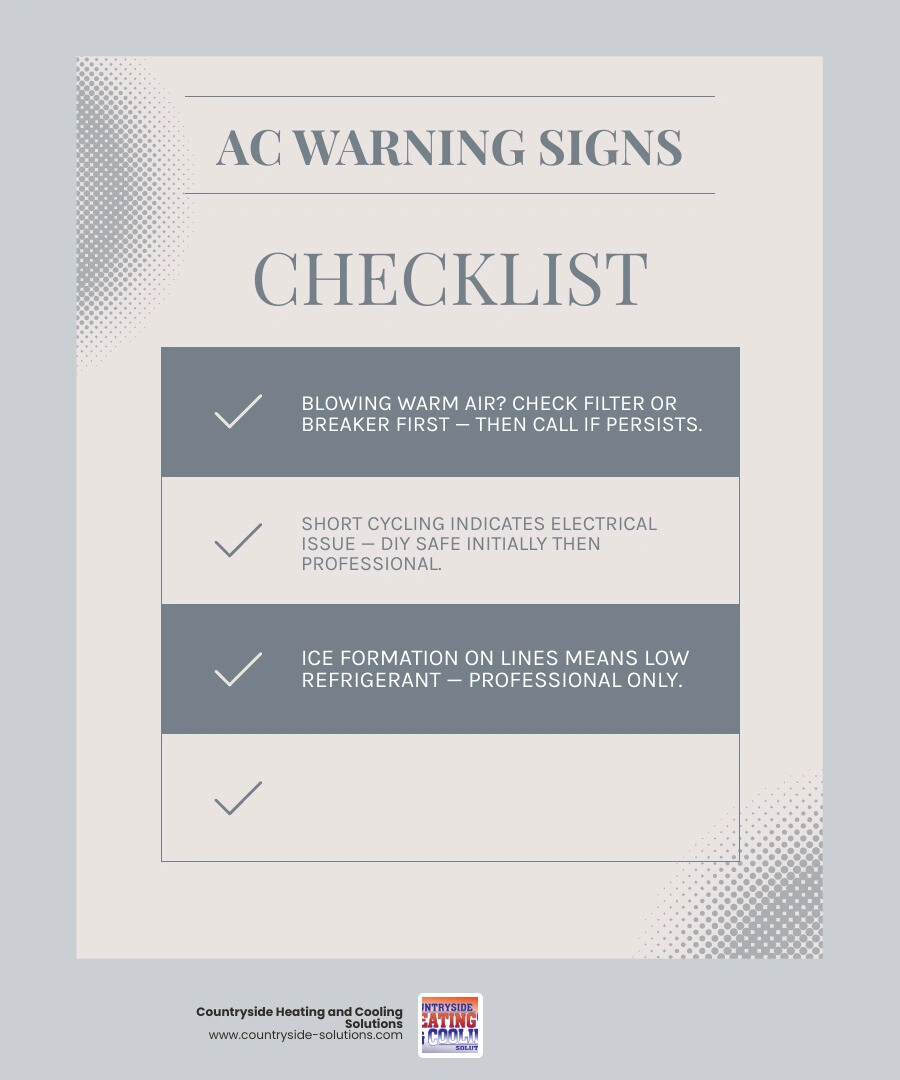
- The system is blowing warm or room-temperature air
- You hear unusual noises — banging, hissing, grinding, or squealing
- The AC turns on and off repeatedly in short bursts (short cycling)
- You see ice forming on the unit or refrigerant lines
- Water is leaking inside your home near the indoor unit
- There is a burning smell or any electrical odor coming from vents
- Your energy bills have spiked without a change in usage
- The system won't turn on at all after basic checks
For less urgent situations — like a clogged filter or a tripped breaker — homeowners can often handle the check themselves before picking up the phone. But when the symptoms above appear, waiting rarely makes things better.
In the sections below, we walk through exactly what you can safely check on your own, which warning signs require immediate professional attention, and how a trained HVAC technician at Countryside Heating and Cooling Solutions approaches a service call to get your system running right.
Safe Checks Homeowners Can Do Before Calling
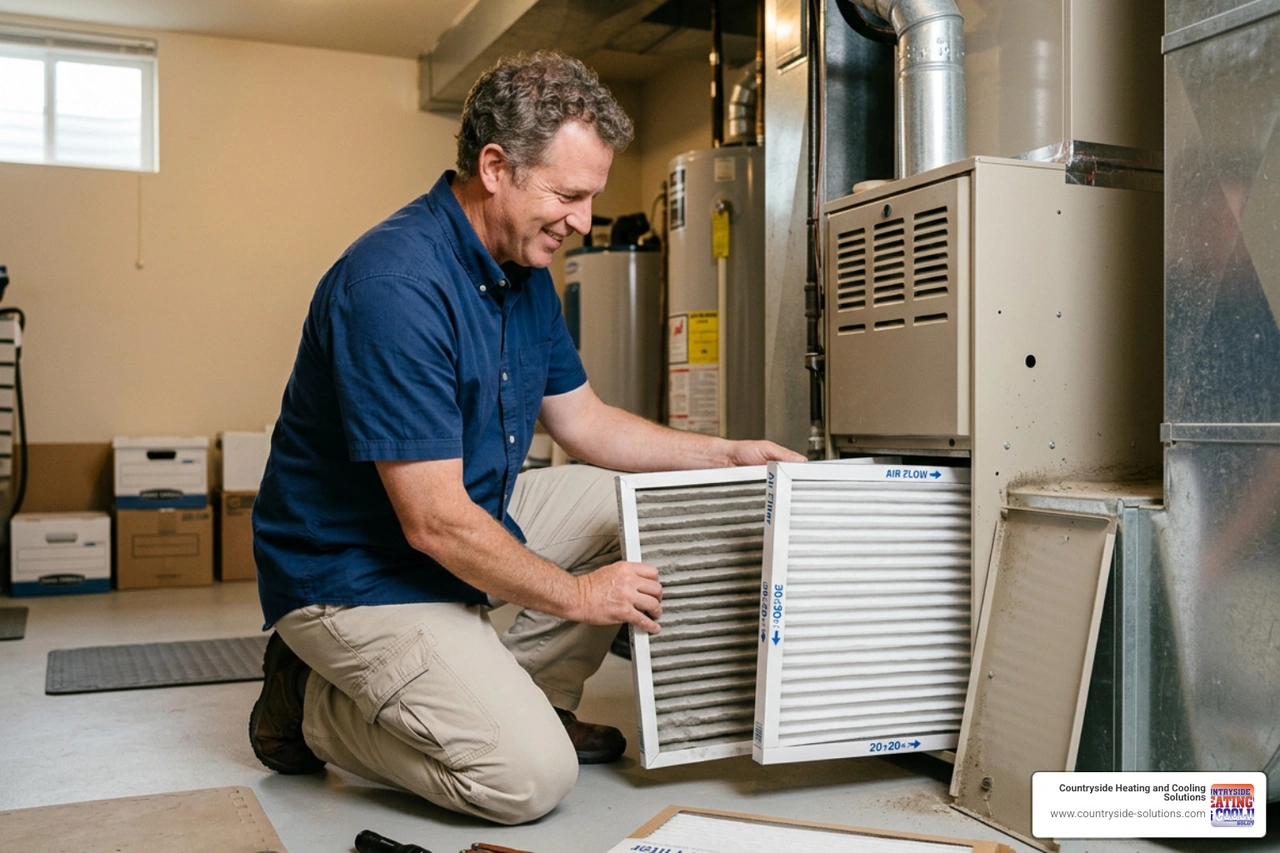
Before you pick up the phone to schedule an emergency service call, there are several basic, safe checks you can perform. It is not uncommon for a seemingly major cooling failure to be caused by a simple, overlooked setting or a minor maintenance issue that you can resolve in a few minutes.
Here are the safe troubleshooting steps we recommend taking first:
- Verify Your Thermostat Settings: It sounds simple, but check that your thermostat is set to "Cool" and the fan is set to "Auto" rather than "On" (which runs the fan continuously even when the system is not actively cooling). If the screen is blank, replace the batteries.
- Inspect and Replace the Air Filter: A heavily clogged air filter restricts airflow, which can cause your evaporator coils to freeze over or trigger the system to shut down entirely to prevent overheating. We recommend changing your filter every 30 to 90 days. Keeping a clean filter in place resolves a surprising number of airflow issues without requiring a service call.
- Check Your Circuit Breakers: Go to your home's main electrical panel and check the breaker labeled for your air conditioner. If it has tripped to the "Off" position, flip it fully off and then back on. Safety Note: If the breaker trips again immediately, do not attempt to reset it a second time. This indicates a serious electrical fault, and you must call a professional.
- Clear the Outdoor Condenser Unit: Your outdoor unit needs room to breathe to release the heat removed from your home. Ensure there is at least two feet of clear space around the unit. Clear away tall grass, weeds, fallen leaves, and brush. You can gently spray the exterior fins with a garden hose to wash away accumulated dirt and cottonwood fuzz, but never use a pressure washer, which will bend the delicate aluminum fins.
If you have performed these steps and your system still refuses to cool your home properly, it is time to look closer at the symptoms. You can learn more about identifying these early issues in our guide on Signs Your Home Needs AC Repair.
When to Call a Professional for AC Problems
While basic checks are perfect for routine maintenance, professional troubleshooting is a highly technical process. Modern air conditioners are complex systems that integrate advanced refrigeration chemistry, high-voltage electrical circuitry, and precise airflow mechanics.
The table below outlines how basic homeowner checks compare to the comprehensive diagnostic steps our technicians perform during a service call:
| Homeowner Check | Professional Diagnostic Step | Why the Professional Step Matters |
|---|---|---|
| Thermostat Check | Calibration & Signal Testing | Ensures the thermostat communicates accurately with the control board. |
| Filter Inspection | Static Pressure Testing | Measures actual airflow resistance to detect hidden ductwork restrictions. |
| Breaker Reset | Electrical Contactor & Amperage Load Testing | Identifies failing capacitors, shorted wiring, or a motor drawing excessive current. |
| Visual Coil Inspection | Superheat & Subcooling Refrigerant Analysis | Uses manifold gauges to determine exact refrigerant levels and expansion valve performance. |
| Clearing Drain Line | Condensate Pump & Drain Line Flush | Uses specialized vacuums and antimicrobial treatments to clear deep clogs and prevent mold. |
Attempting to diagnose these deeper mechanical and chemical operations without specialized training and tools can lead to misdiagnosis, further system damage, or personal injury.
Red Flags: When to Call a Professional for AC Problems Immediately
Some air conditioning issues are more than just minor inconveniences; they are direct warnings that your system is undergoing severe stress or facing imminent failure. Recognizing these red flags early can prevent a straightforward component replacement from turning into a complete system breakdown.
Warm Air and Weak Airflow
If your vents are blowing warm or room-temperature air, or if you can barely feel air moving through your home, your system is working overtime without delivering comfort. This is often caused by a failing compressor, a frozen evaporator coil, or a severely restricted blower motor. Running an air conditioner in this state places immense strain on the compressor, which can lead to permanent damage.
Short Cycling
Short cycling occurs when your air conditioner turns on, runs for a few brief minutes, and then abruptly shuts down, repeating this cycle continuously. This process prevents your home from dehumidifying properly and subjects the electrical and mechanical components to rapid wear and tear. Short cycling can be caused by anything from an oversized unit to a failing sensor or compressor. If your system is experiencing this, or if you are asking Why Won't My Air Conditioner Turn Off, it is critical to shut the system down and call for service.
Fan Malfunctions
If your outdoor condenser fan or indoor blower fan refuses to spin, the heat exchange process grinds to a halt. To understand why this happens and what components are at risk, read our detailed breakdown on The Fan In Your AC Isn't Working Let's See Why.
Safety Risks: When to Call a Professional for AC Problems Involving Electrical or Refrigerant Lines
There are two areas of your air conditioning system where DIY attempts are not only ill-advised but can also be highly dangerous: the electrical systems and the refrigerant loop.
The Dangers of High-Voltage Electrical Components
Your air conditioner runs on high-voltage electricity. The system utilizes start and run capacitors that store a lethal electrical charge even after the power to the unit has been turned off.
A common failure point in these systems is the electrical contactor, which acts as a switch to turn your compressor and fan on and off. If you are experiencing electrical issues, you can read about What Happens If The Air Contactor Goes Bad to understand the symptoms, but actual replacement must be left to a licensed professional.
If you hear a persistent hum or vibration, or if your system is actively making an AC Making Buzzing Sound, this points to an electrical failure that requires immediate professional testing to avoid electrical fires or compressor damage.
Refrigerant Handling and Environmental Regulations
Refrigerant is the chemical medium that absorbs and releases heat to cool your home. It is a sealed system; your air conditioner does not "consume" or "burn" refrigerant. If your system is low on refrigerant, it means you have a leak.
- EPA Regulations: Under Section 608 of the Clean Air Act, it is illegal for anyone who is not an EPA-certified technician to purchase, handle, or charge refrigerant into an HVAC system.
- System Damage: Simply adding more refrigerant without locating and repairing the leak will not solve the problem. Operating a system with incorrect refrigerant levels causes the compressor to run hot, leading to premature failure.
- Water Leaks: Low refrigerant levels also alter pressure balances, causing the indoor evaporator coil to drop below freezing. This leads to ice buildup, which eventually melts and overflows your drain pan. If you notice pooling water, check out our guide on How To Fix Your AC Leaking Problems to understand how refrigerant issues and condensate blockages are linked.
Repair vs. Replacement: The Long-Term Decision
When faced with a major mechanical failure, every homeowner must eventually ask: is it wiser to repair the existing system or invest in a new, energy-efficient air conditioner?
As systems approach the end of their typical 10 to 15-year lifespan, frequent repairs can become a poor financial investment. To help make this decision easier, we recommend using a strategic decision framework:
- The Age-Adjusted Formula (The $5,000 Rule): Multiply the age of your air conditioner by the repair quote. If the result exceeds $5,000, replacement is generally the more cost-effective long-term choice. For example, a 12-year-old system needing a complex repair easily crosses this threshold, whereas a 5-year-old system with a minor component failure is an obvious candidate for repair.
- The 50% Rule: If the cost of a single repair exceeds 50% of the value of a brand-new system, we highly recommend replacement.
- Refrigerant Type: If your older system still operates on R-22 refrigerant (which was phased out due to environmental regulations), any leak repair will be incredibly costly due to the scarcity of the chemical. Upgrading to a modern system operating on current, environmentally friendly refrigerants is almost always the best path forward.
- Energy Efficiency Gains: Modern systems feature significantly higher SEER2 (Seasonal Energy Efficiency Ratio) ratings. Upgrading an old, low-efficiency system can reduce your monthly cooling energy consumption by 20% to 40%.
For a deeper dive into evaluating your system's condition and making the right choice for your home, read our guide: Is It Time to Repair or Replace My Air Conditioner.
Frequently Asked Questions About AC Troubleshooting
Is it okay to wait a day or two before calling for service?
In the mild weather of spring or autumn, waiting a day or two for a non-emergency repair is perfectly fine. However, during the peak of a humid Minnesota summer, delaying service can be risky.
High indoor humidity levels can quickly lead to mold growth if your air conditioner isn't running to dehumidify the air. Furthermore, running a struggling system with low refrigerant or a failing motor can turn a minor repair into a total compressor blowout. If you live in the western suburbs and need reliable, prompt support, we offer certified AC Repair Chanhassen MN to resolve issues before they escalate.
Should I turn my AC off before calling for service?
Yes. If your air conditioner is blowing warm air, making loud mechanical noises, short cycling, or showing signs of ice buildup, turn it off immediately at the thermostat.
If the evaporator coils are frozen, keeping the system running will only build more ice, making it impossible for a technician to diagnose or repair the unit upon arrival (it can take hours for a solid block of ice to melt). Turning the system off protects the compressor from overheating and prevents water damage from melting ice. If you are in the Lake Minnetonka area and notice these freezing or leaking issues, turn off your unit and contact our team for AC Repair Wayzata MN right away.
What steps does a professional HVAC technician take during a service call?
When a Countryside Heating and Cooling Solutions technician arrives at your home, they follow a systematic diagnostic process:
- Visual and Safety Inspection: We check for signs of wear, physical damage, and proper electrical connections.
- Electrical Testing: Using a multimeter, we test the capacitors, contactors, fan motors, and compressor for proper voltage and amp draw.
- Refrigerant Pressure Analysis: We measure the pressure and temperature of the refrigerant to ensure the system is charged precisely to manufacturer specifications.
- Airflow and Temperature Split Measurement: We measure the temperature difference between the return air and supply air to verify that heat exchange is occurring efficiently.
- Condensate System Check: We inspect the drain pan and flush the condensate line to ensure water drains safely out of your home.
Conclusion
An air conditioning failure during the heat of summer doesn't have to be a stressful experience. By understanding when to call a professional for AC problems, you can take quick action to protect your home, keep your family comfortable, and avoid the risks of DIY electrical or refrigerant work.
At Countryside Heating and Cooling Solutions, we have been keeping Twin Cities families comfortable since 1974. Our family-owned business relies on licensed, NATE-certified technicians who possess the tools and training to diagnose and repair any AC make or model correctly the first time. We are committed to prompt, honest service, which is why we guarantee next-business-day service to get your home's cooling restored as quickly as possible.
Don't let a minor cooling issue turn into a major breakdown. If your air conditioner is showing any of the warning signs we've discussed, contact us today to schedule a professional inspection on our Countryside Heating & Cooling Solutions Air Conditioning Services page. Let us restore your home's comfort and your peace of mind.
