.webp)

Why Minnesota Homeowners Need to Think About Ventilation and Mold Prevention for Cold Climate Homes
Ventilation and mold prevention for cold climate homes is one of the most overlooked challenges facing Minneapolis–Saint Paul area homeowners every winter. When temperatures drop and windows stay shut for months, moisture builds up inside tightly sealed homes — and that trapped humidity can trigger mold growth on walls, ceilings, and inside building assemblies before you ever see a single spot.
Here is a quick overview of the most effective strategies:
- Control indoor humidity — Keep relative humidity between 30% and 50% in winter (closer to 25–35% during extreme cold snaps)
- Install an HRV or ERV — Heat and energy recovery ventilators continuously exchange stale, humid indoor air for fresh outdoor air without wasting heat
- Use exhaust fans consistently — Run bathroom and kitchen fans during and after cooking or showering to remove moisture at the source
- Seal and insulate properly — Air barriers, vapor retarders, and thermal breaks prevent hidden condensation inside wall and ceiling assemblies
- Monitor with a hygrometer — A simple digital humidity monitor gives you real-time feedback so you can act before mold gets a foothold
- Address foundation moisture — Basements and crawl spaces can account for a significant share of a home's total moisture load
- Call a professional when needed — Persistent musty odors, visible spotting, or health symptoms that worsen indoors warrant a professional mold or air quality assessment
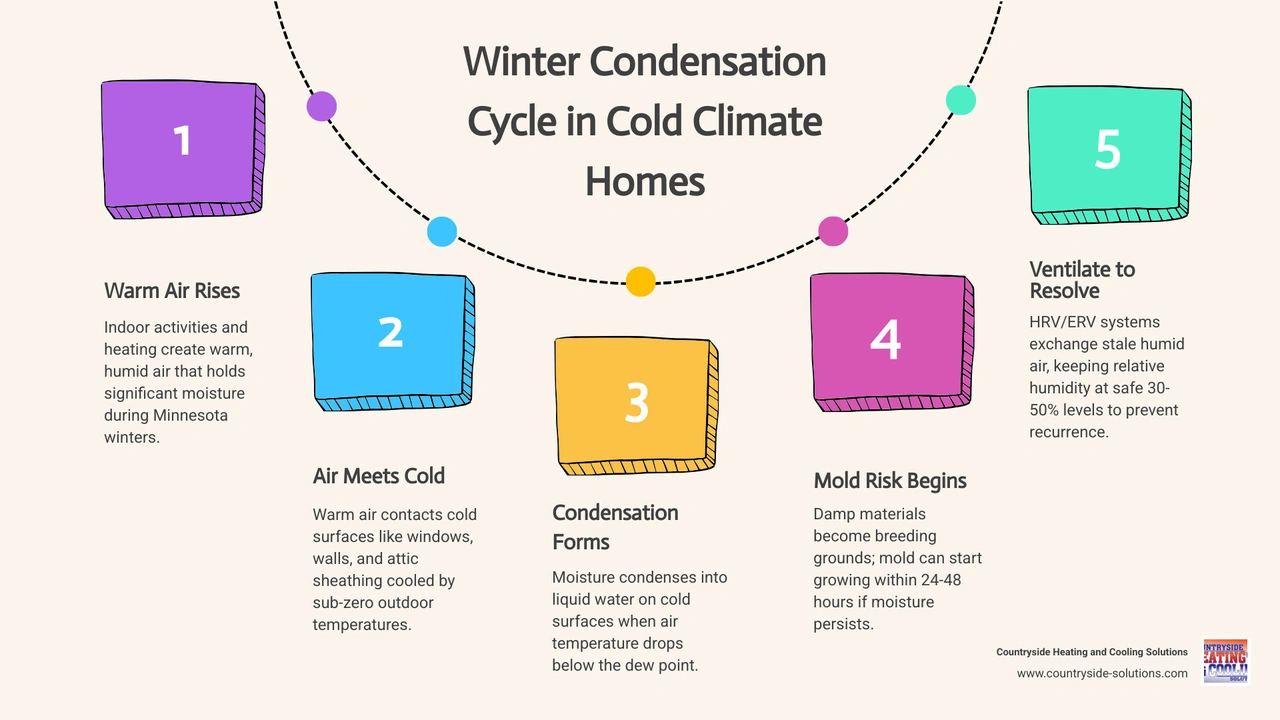
Most people assume mold is a warm-weather problem. It isn't. In cold climates like Minnesota, the real danger comes from the physics of winter itself: warm, humid indoor air meets cold surfaces — windows, exterior walls, attic sheathing — and condenses into liquid water. Mold can begin growing on wet building materials in as little as 24 to 48 hours. In a home that's tightly sealed against sub-zero temperatures, that moisture has nowhere to go unless you actively manage it.
The good news is that with the right ventilation strategy and a few smart construction and maintenance practices, you can keep your home dry, healthy, and mold-free all winter long.
Understanding Winter Condensation and Mold in Minnesota Homes
To stop mold in its tracks, we have to look at the invisible science happening inside our homes every winter. When we heat our homes in places like Maple Plain, Minnetonka, or Wayzata, we create a massive temperature differential between the cozy interior and the freezing Minnesota outdoors. This temperature difference sets the stage for condensation, the primary driver of winter mold.
Condensation occurs when the temperature of a surface—such as a window pane, a wall stud, or the underside of roof sheathing—drops below the dew point of the indoor air. The dew point is the temperature at which air becomes fully saturated with water vapor and can no longer hold it in gaseous form. When warm, humid indoor air comes into contact with these cold surfaces, it sheds its excess moisture as liquid water.
If this moisture isn't managed quickly, it creates a perfect breeding ground for mold spores, which are always present in the air waiting for water to land on. Learning to spot the early warning indicators of this cycle is crucial. For a deeper look at what to watch out for, check out our guide on Signs Your Home Needs Better Ventilation.
Why Cold Weather Triggers Indoor Moisture Problems
In the summer, moisture problems are often driven by outdoor humidity pushing its way inside. In a Minnesota winter, the dynamic flips entirely. The outdoor air is actually incredibly dry because cold air cannot hold much moisture. However, our indoor activities—cooking, showering, breathing, doing laundry, and even watering houseplants—generate a massive amount of water vapor.
A single ten-minute shower can release about half a liter of moisture into the air. In older, draftier homes, this moisture naturally escaped through cracks in the building envelope. But modern, energy-efficient homes in the Twin Cities are built tightly to prevent drafts and lower heating bills. While this is fantastic for your energy budget, it traps that daily moisture indoors.
When this warm, humid air migrates toward cold exterior walls or pools against cold double-pane windows, it cools down rapidly. The air right next to the cold surface drops below its dew point, and suddenly you have water pooling on your window sills or damp spots forming in the cold corners of your closets.
Recommended Indoor Humidity Levels for Minnesota Winters
Managing winter moisture requires a careful balancing act. If your indoor air is too dry (below 20% relative humidity), you will experience dry skin, static electricity, and irritated sinuses. But if it is too humid, you invite condensation and structural mold.
To keep your home safe, we recommend using a digital hygrometer to monitor your indoor relative humidity (RH). Because the risk of condensation increases as the outdoor temperature drops, your indoor humidity target must adjust dynamically throughout the winter. When it is 30°F outside, your home can safely handle 40% RH. But when a January cold snap pushes outdoor temperatures below zero in Minnetrista or Medina, you must lower your indoor humidity to prevent frost and condensation from forming on your windows and inside wall cavities.
| Outdoor Temperature (°F) | Recommended Indoor Relative Humidity (RH) |
|---|---|
| Above 30°F | 35% to 45% |
| 10°F to 30°F | 30% to 35% |
| 0°F to 10°F | 25% to 30% |
| Below 0°F | 20% to 25% |
The Science of Ventilation and Mold Prevention for Cold Climate Homes
The fundamental rule of modern building science is: "build tight, ventilate right." We want our home's outer shell (the building envelope) to be as airtight as possible to save energy and protect the structure. But because we live in a sealed box, we must use controlled mechanical ventilation to maintain healthy indoor air quality and prevent mold.
Without a dedicated ventilation strategy, indoor pollutants, carbon dioxide, and water vapor build up to unhealthy levels. To understand how proper airflow keeps your living spaces safe and comfortable, read about how to Improve Home Indoor Air Quality.
How Air Exchangers Provide Ventilation and Mold Prevention for Cold Climate Homes
An air exchanger is the heart of a healthy cold-climate home. These systems work by continuously pulling fresh, dry air from the outdoors while simultaneously exhausting stale, humid air from the kitchen, bathrooms, and living spaces.
As these two air streams pass through the exchanger, they don't mix, but they do exchange heat. The outgoing warm indoor air preheats the incoming freezing outdoor air. This process recovers up to 70% to 80% of the heat energy that would otherwise be lost, ensuring you get fresh air without feeling a freezing draft or causing your furnace to work overtime.
By constantly replacing damp indoor air with dry outdoor air, an air exchanger naturally lowers indoor relative humidity to safe winter levels, eliminating the moisture that mold needs to grow. If your home currently lacks this technology, you can learn more about why it is a game-changer in our article on The Need for an Air Exchanger in Your Home.
The Role of Supplemental Dehumidification in Winter
In a typical Minnesota winter, running a balanced ventilation system like an air exchanger is more than enough to keep your indoor humidity in the safe zone. Because outdoor winter air is so dry, constantly bringing a small amount of it indoors naturally lowers your overall humidity.
However, there are times when supplemental dehumidification is necessary, particularly in below-grade spaces. Basements in areas like Lake Minnetonka, Excelsior, or Mound can remain damp even in the winter. Concrete foundations can hold thousands of gallons of construction moisture or wick water from the surrounding soil.
Additionally, during the transitional "shoulder seasons" of spring and autumn, outdoor temperatures are mild but humidity is high, meaning your air exchanger won't dry out the house as effectively. In these scenarios, a dedicated dehumidifier is an invaluable tool to keep basement moisture under control. To explore how a whole-home system can protect your entire property, read about Whole House Dehumidification.
Effective Ventilation and Construction Practices to Prevent Hidden Mold
While surface mold on a window sill is annoying, hidden mold inside your walls, attic, or floor assemblies is a far greater threat to both your health and your home's structural integrity. Preventing hidden mold requires a combination of smart construction practices and targeted ventilation.
When warm, humid indoor air leaks into a wall cavity, it travels outward toward the cold exterior sheathing. If it hits a surface that is below the dew point, it condenses, saturating the insulation and wood framing. Because this area is dark, warm, and wet, mold can colonize the wall cavity completely undetected.
Spot Ventilation: Kitchen and Bathroom Exhaust Best Practices
The first line of defense in ventilation and mold prevention for cold climate homes is spot ventilation—removing moisture right where it is created. Bathrooms and kitchens are major moisture factories, and they require high-quality, dedicated exhaust fans.
To make spot ventilation effective in cold climates, follow these best practices:
- Run fans long enough: Don't turn the bathroom fan off the second you step out of the shower. Run it for at least 20 to 30 minutes afterward to fully exhaust the residual steam. Installing a simple wall timer switch makes this effortless.
- Verify discharge locations: Ensure all exhaust fans vent directly to the outdoors through smooth, insulated metal ducting. Never vent a bath fan or range hood into an attic, crawl space, or under an eave, as this simply transfers the moisture problem to another cold, unconditioned part of your home.
- Keep fans clean: Dust and grease buildup can restrict airflow by more than 50%. Clean your fan grilles and blades annually to maintain peak performance.
- Kitchen range hoods: Always run your range hood when boiling water or cooking on a gas stovetop (which produces water vapor as a byproduct of combustion).
For a complete breakdown of why these systems are so critical to your home's structural health, refer to our post on the Importance of Proper Ventilation.
Whole-House Solutions: HRVs vs. ERVs
When choosing a whole-house air exchanger for a cold climate like Minnesota, you will run across two main options: Heat Recovery Ventilators (HRVs) and Energy Recovery Ventilators (ERVs).
An HRV transfers only heat from the exhaust air stream to the fresh air stream. It is highly effective at drying out humid homes during freezing weather because it brings in dry air and expels damp air.
An ERV transfers both heat and moisture (latent heat). In the winter, it keeps some of the indoor humidity from escaping, which is ideal if your home tends to get uncomfortably dry. However, in tightly built homes with high occupancy, an ERV can sometimes retain too much moisture, leading to condensation issues.
For most northern homes, an HRV is the gold standard for winter moisture control, though a properly sized ERV can work beautifully in the right application. To find out which system fits your specific home layout, you can read about our Air to Air Exchanger Services or explore our insights on Enhancing IAQ with Ventilators.
Air Sealing, Insulation, and Vapor Retarders
To prevent hidden condensation within your walls and ceilings, your home needs a continuous air barrier and a properly rated vapor retarder.
An air barrier stops the physical movement of air through gaps, cracks, and penetrations (like electrical outlets and light fixtures). Because air leakage carries up to 100 times more moisture into a wall cavity than vapor diffusion, maintaining a continuous, sealed air barrier is your absolute best protection against hidden mold.
A vapor retarder is a material that limits the rate at which water vapor diffuses through building materials at a molecular level. In cold climates, the primary vapor retarder must always be placed on the warm, interior side of the insulation. This prevents warm indoor humidity from migrating outward into the cold wall cavity.
Modern building science often utilizes "smart" vapor retarders. These advanced materials change their permeability based on ambient humidity—remaining tight in the winter to block moisture from entering the wall, but opening up in the summer to allow the wall assembly to dry inward if moisture somehow gets trapped.
Managing Moisture at the Foundation and Walls
Foundation walls are highly vulnerable to moisture because they are in direct contact with damp soil. To prevent basement mold, builders use a combination of exterior waterproofing, capillary breaks (which prevent water from wicking upward from the concrete footings into the wood framing), and continuous exterior insulation.
Insulating a foundation or exterior wall on the outside is incredibly effective. By placing rigid foam insulation on the exterior of your sheathing or concrete foundation, you keep the structural materials warm. Because the sheathing and framing stay close to room temperature, they remain well above the dew point of the indoor air, virtually eliminating the risk of condensation and mold growth inside the wall cavity.
Warning Signs of Hidden Mold and High Humidity
How do you know if your winter moisture control is failing? Keep a close eye out for these common warning signs:
- Persistent window condensation: If your windows are constantly fogged up or dripping water at the bottom of the glass, your indoor humidity is too high.
- Musty odors: A damp, earthy smell is a surefire sign of mold growth, even if you can't see it.
- Peeling paint or curling wallpaper: Moisture trapped behind drywall will cause finishes to lift and bubble.
- Warped baseboards or flooring: Wood trim and hardwood floors will cup or swell when exposed to chronic high humidity.
- Unexplained respiratory symptoms: If family members experience increased sneezing, coughing, or sinus congestion that only seems to happen when they are inside the house during winter, hidden mold may be the culprit.
Frequently Asked Questions About Winter Mold and Ventilation
How does ventilation and mold prevention for cold climate homes differ from warm climates?
In warm climates, mold prevention is all about keeping hot, humid outdoor air from infiltrating your air-conditioned home. The vapor drive moves from the outside inward, meaning vapor barriers are placed on the exterior side of the wall assembly, and air conditioning systems are used to actively pull moisture out of the air.
In cold climates like Minnesota, the dynamic is completely reversed. The vapor drive moves from the warm interior toward the freezing exterior. We must keep our indoor humidity low through controlled ventilation, protect our walls with an interior vapor retarder, and ensure our wall assemblies have "drying potential" toward the outside so any incidental moisture can safely escape.
When should I call a professional for mold remediation?
According to the EPA, if the visible mold stain covers an area of less than 10 square feet (roughly a 3-foot by 3-foot patch), you can generally handle the cleanup yourself. Scrub the mold off hard surfaces using water and a mild detergent, and dry the area completely. Always wear personal protective equipment, including an N-95 respirator, long gloves, and unventilated goggles.
However, you should call a professional if:
- The mold covers an area larger than 10 square feet.
- You suspect mold is growing inside your heating and cooling ducts.
- The water damage was caused by sewage or contaminated water.
- You have pre-existing health conditions, such as asthma or a compromised immune system, that make you highly sensitive to mold exposure.
- The mold is growing inside structural wall cavities or crawl spaces where access is difficult.
Can dirty air ducts contribute to winter mold growth?
Yes, dirty air ducts can absolutely increase your risk of winter mold. Over time, dust, pet dander, and organic debris accumulate inside your ductwork. If your home experiences periods of high indoor humidity, this dust can absorb moisture, creating a perfect food source for mold spores inside your dark HVAC system.
Once mold takes hold in your ducts, every time your furnace kicks on, it can distribute spores throughout your entire home. Keeping your ductwork clean and maintaining your system's air filters is a vital part of a comprehensive home health strategy. To see how this fits into your overall home maintenance plan, read about How Clean Ducts Reduce Mold Risk.
Conclusion
Protecting your home from the damp, destructive effects of winter mold doesn't have to be a guessing game. By understanding the physics of cold-weather condensation and implementing a smart, balanced ventilation strategy, you can enjoy a warm, energy-efficient, and incredibly healthy home all winter long.
At Countryside Heating & Cooling Solutions, we have been helping our neighbors throughout Maple Plain, Minnetonka, Minnetrista, and the surrounding western Twin Cities suburbs stay comfortable and safe since 1974. Our licensed, NATE-certified technicians specialize in designing and installing custom indoor air quality systems tailored to the unique challenges of our harsh Minnesota winters.
Whether you need to install a high-efficiency HRV to keep your air fresh and dry, or you want to upgrade your home's overall filtration, we are here to help with guaranteed next-business-day service. To learn more about keeping your indoor air pristine, check out our options for Whole House Air Filtration, or reach out to us today to Schedule an Indoor Air Quality Consultation and take the first step toward a healthier, mold-free home.
